1. How to Read
“The word ‘derive’ scares those who believe politics must respect a set of
rules and that law must be the center of social life, those who think that
words have only one meaning, and that to understand one another in life it’s
necessary to use words according to their established meanings. This is all
wrong. When we speak, we don’t respect the meanings of words but invent
them….To understand is to follow the slides in the relations between signs and
referents…”1
The
above quote comes from Franco Berardi Bifo, an Italian Marxist scholar who
defined contemporary capitalism as “semio-capitalism” (capitalism of signs and
semiotic goods). This concept seems particularly apt today, when so much social
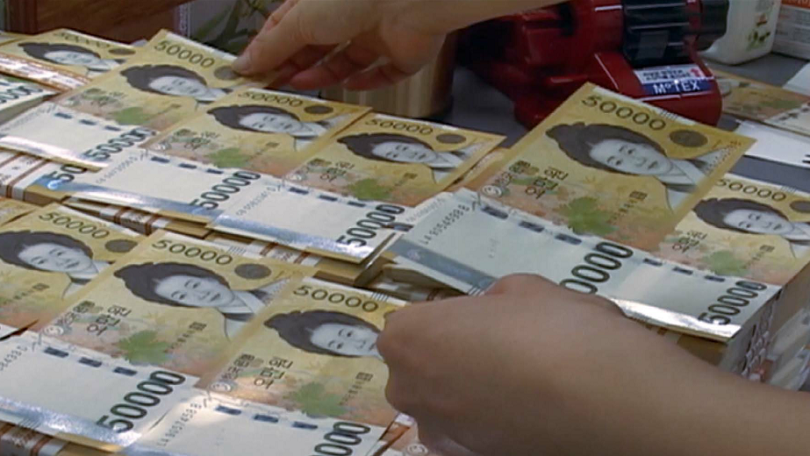
production and consumption involves financial derivatives or emotional labor,
while service industries frequently deal in subtle differences of signs. Such
practices are completely different from the industrial capitalism of the modern
age, which revolved around the production of material goods. In addition, Bifo
incisively points out that semio-capitalism has inverted the former autonomy of
signs, which were once used autonomously to invent forms of a new relationship,
but are now used to justify or even generate lies, swindles and scams. Bifo
used the word “derive” (to drift) to exemplify this inversion. For a while,
under the influence of postmodernism, “derive” had a positive connotation. But
under semio-capitalism, economic power routinely takes advantage of linguistics’
tendency to allow slippage between signs and referents in order to arbitrarily
manipulate the rules of politics and justice. Thus, “derive” has become
contaminated, and the contamination is spreading through the system like a
poison revealing the false politics and utter greed of economic power, which
operates above the law. As Bifo points out, the new interpretations of “derive”
are dislocated from the linguistic ideal of the invention of free, rich new
meanings. With the contemporary capitalist system, the deliberate invention of
meaning cannot compete with the rapid corruption of meaning or the mass
production of meaninglessness.
Bifo’s
critique of contemporary society, which cuts across politics, economics, and
humanities, can help to explicate the art of Yang Ah Ham in many ways, albeit
indirectly. These ideas provide an intellectual background and a useful
humanities and social sciences perspective for examining various aspects of
Ham’s art, especially Nonsense Factory, the project she has been
constantly developing since 2010, and which will be discussed in the final
section of this article. Furthermore, Bifo’s critique can also serve as the
foundation for interpreting Ham’s prevalent artistic themes in conjunction with
issues related to the transitory nature of social life, such as the freedom or
instability of relationality and the confusion of meanings or contamination of
values. Therefore, before starting the next section, I ask readers to take a
moment to again contemplate the ambivalent meaning of Bifo’s quotation.
2. Transition
Yang Ah Ham began her artistic career in the late 1990s, at a time when Korean
art, and indeed the entire Korean society, was swept up in the globalization
wave and thus moving towards greater diversity and plurality. She has since
become one of Korea’s most renowned artists, both domestically and
internationally, focusing primarily on video and installation works. Now, this
description may sound familiar, even cliched, to anyone who has read
contemporary art criticism. Exhibition catalogues, brochures, and bios
habitually tout the “international” status of the featured artists, usually as
a way of compressing information. Such phrases convey the impression that
artists deserve our attention simply because they have worked in various
places. But my brief summary of Ham’s career applies more directly to the
specific content of her art, rather than just the reception or scope of her
work. Although it may sound clichéd, Ham literally spent these years like a
nomad, living here and there, both “domestically and internationally.” This
lifestyle has been creatively crystallized in her works, which allow us to
simultaneously view opposing concepts, such as the interior and exterior of a
society, or the life of an individual and that of the masses. Of course, her
art is actually the cause of her “life in transit,” taking her back and forth
between antipodal aspects of life, such as familiar and unfamiliar spaces,
private and public spheres, and the visibility and invisibility of a society.
Ham
continuously observes contemporary social life, and her observations,
experiences, and contemplations inspire her to produce images of reality that
she then incorporates into her video and installation works. Her art
consistently focuses on the social reality where my life, your life, and our
lives are objectively revealed. With every work, her subjective contemplation
and her physical act of creation turn a spotlight on reality, critically
interpret it, and enact it into a different reality through the language of
video and installation media. But this “different reality” is not to imply that
her works depict a complete fiction or some innocent world of imagination.
Instead, her works aim to change our view and perception of the reality that we
typically ingest directly and unequivocally. Through her advanced artistic
capacity, she reconstructs this unequivocal reality by removing the
superficiality. For example, most of us are now well accustomed to life in the
era of globalization, and we automatically engage in daily activities such as
incessantly moving through virtual spaces via digital media, traveling across
vast distances of physical space via transportation vehicles, and toting our
belongings in suitcases through repeated departures and arrivals. Ham gathers
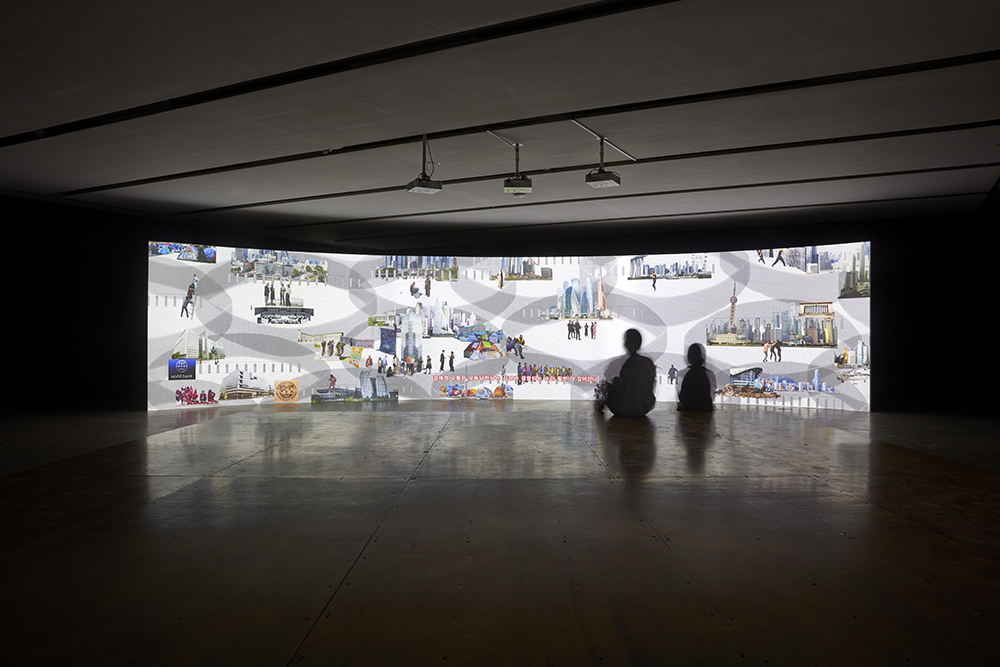
fragmented images of such activities in her video work Land, Home,
City (2006). By re-arranging real images into a “different reality,” she
evokes the essential aspects of contemporary life, which is marked by continual
flux, both online and offline.
The
primary impetus in Ham’s personal life and her art is the idea of “transition,”
which might refer to domestic and foreign spaces, a place to settle and a place
to pass through, different versions of reality, and the objective world and the
world as constructed according to an artist’s intention and execution. In all
of these dualities, the situation or movement of “transition” emerges. If we
are forced to remain fixated in one place and live one reality, and if we
cannot imagine any reality different from the one we know, then it is
impossible to conceive of “transition” as a “change into a different condition
or situation.” This helps to explain why globalism was so widely and rapidly
embraced in the 1990s, to the extent that it too became “globalized.” By
approving and promoting the cultures and values of diverse people, globalism
offered a way to overcome the homogeneity and obstruction of Western
imperialism and totalitarianism. As people everywhere eagerly embraced the
value of reciprocal exchanges and movements, globalism spread exponentially,
and contemporary artists played a key role in this trend. In actual terms,
artists contributed to globalization by participating in international
exhibitions and residency programs, but they further stimulated globalism and
transformed it into a social and political topic by producing
pseudo-ethnographic works that actively intervened in regional politics and
society.
Ham’s
artwork from the early to mid-2000s exemplifies these aspects of
globalism. Illusion of Memory (2005) is a single-channel video based
on her research of small and medium-sized cities in China, which she conducted
while doing a residency program there. In Transit Life (2005), Ham
captures a nightscape of a ferry shuttling between Mokpo and Jeju Island,
representing our constant spatial movements, but also eliciting the unique
instability of the contemporary era. Dream in…Life (2004)
and Tourism in Communism (2005) revolve around similar tourist
carriages found in three different places (New York City, Chicago and Mt.
Geumgang). Although tourist carriages are an antiquated cultural form, they are
commonly appropriated by global tourism as an effective signifier. In these two
works, she forces the viewer to consider the differences between reality and
their dream of reality, as well as the political and capitalist ideology at
work in reality. These works represent Ham’s artistic responses to globalism,2 and
together they form a landscape of global-local transitions that she privately
captured in her “nomadic mode of life.”3 At the same time, they
provide opportunities to reconsider the meaning of the contemporaneous concept
of globalism.
3. Meaning and Non-meaning
For the last ten years or so, Yang Ah Ham’s artistic intentions and practices
have moved beyond simple visual collages that traverse oppositional aspects of
reality or hover between various social spaces and living landscapes. All of
the abovementioned video-installation works eschew a definitive, unitary
meaning in favor of neutrality and ambiguity that allow each viewer to form
their own interpretation. The scenes of these videos seem to be composed
according to the intermittent movements of various incidents, rather than the
expected narrative structure of an introduction, development, turn, and
conclusion. Furthermore, instead of directly proposing a message or moral, they
produce meaning through the multi-layered quality of the images, which
encourages the free derivation of meanings. We can infer that, at least at that
time, Ham’s works were more akin to an “image−mirror” that reflects reality, which
possibly extends its meaning in the process, rather than an “image−text” that criticizes reality or
provides further insights on society.
This
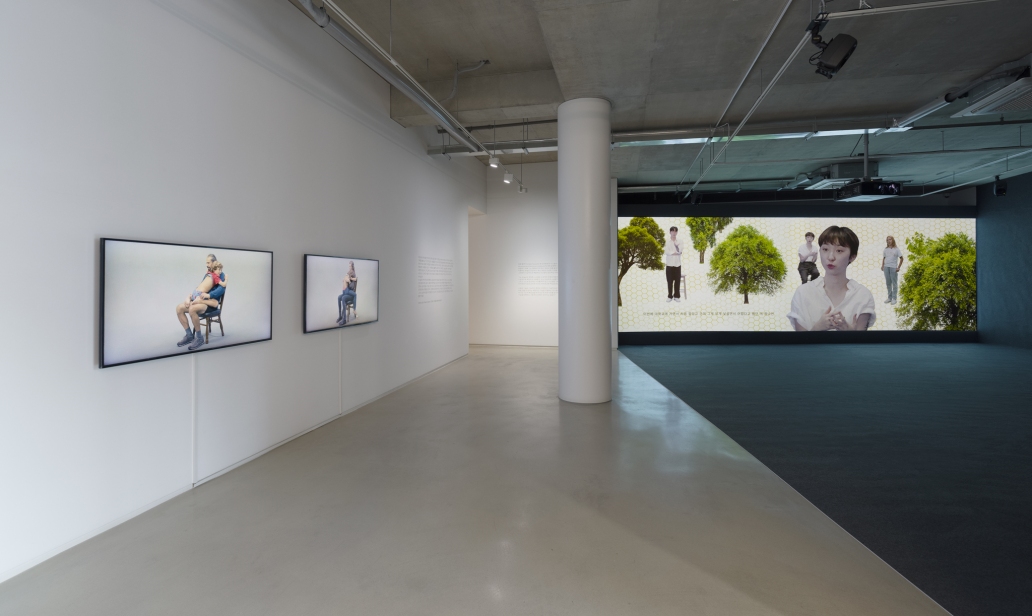
trend is exemplified by Adjective Life − Out of Frame, a
video-installation work based on performance that Ham introduced in Amsterdam
in 2007, which has since been featured at many major special exhibitions in
Korea and abroad. This work isolates the moments of our senses, perceptions,
desires, and appreciations, exploring how we relate to the things and people in
the world around us, physically or psychologically, directly or indirectly.
First, Ham sculpted a chocolate bust of a European curator who is well known in
the international art field, and then she hired five dancers to interact with
the chocolate bust on video. Rather than directing the dancers with specific
instructions or choreography, Ham gave them complete liberty to do anything
they wanted with the sculpture based on their own impulses. The resulting video
is a documentation of the flow of human will or desire, as the performers
indulge their impromptu whims to caress, lick, bite and embrace the bust,
simultaneously formulating both a physical relationship with the statue and a
symbolic relationship with the curator. We observe a wide range of interactions
between the performers and the sculpture, from subtle glances to sensuous
movements of hands or a tongue enraptured by the tender texture and sweet taste
of the chocolate. An interesting contrast emerges between the seemingly solid
chocolate and the living bodies that touch the head in a very primal and sexual
way. Furthermore, the behavior of the five dancers evolves throughout the video,
as they first circle around the unfamiliar statue somewhat apprehensively,
before gradually becoming more open and intimate with their gestures and
interactions.
Through this series of actions exhibits, we witness the
progression of feelings that a subject feels toward an object, demonstrating
that familiarity is not an abstract concept, but a parade of very detailed and
subtle senses. The viewers come to feel that they can unknowingly interfere
with and share in a range of different perceptions: the delicate interplay of
acts as people become entangled with one another; the progression between
feelings that are discerned by very minute differences; the exchange of keen
sensations. As such, the video provides a cross-section of the dynamics that go
into forming “social intimacy.” Adjective Life − Out of Frame visualizes how
our instinctual desires unfold and change in certain ways within the open space
of society or a community of coexistent people. For the audience, this work
serves as a communal stage where their own perceptions are interwoven with a
wide variety of sensations, including curiosity, eroticism, longing,
possessiveness, love, and hatred. All of these feelings and many more are
embodied by the dancers’ physical and emotional expressions with the chocolate
sculpture, the signifier of a person with some secular power. On this communal
stage, the audience’s perceptions add more layers to the complex system of
sensations that formulate our relationship with the world, such that the work
and the audience become entangled in another of the infinite relational
networks that constitute life.
The
title of the work is also worthy of interest, as Ham innovatively uses the word
“adjective” as an adjective to modify “life.” But the phrase also works like a
predicate, declaring that “life is an adjective.” Ham seems to view life from
the perspective of an adjective, rather than a noun, verb, or adverb, which
means that her art does not attempt to recreate or develop life as it is, but
instead acts to indirectly mediate and generate meaning, like an adjective. In
a positive context, this might be considered her way to “derive meanings.” Very
few people, if any, consider life to be a closed or complete system, but Ham’s
view of life as an adjective is still quite unique. As modifiers that can only
function by being attached to nouns, adjectives have a relatively unstable
linguistic status, since they can be replaced or nullified by other rhetoric.
As such, adjectives carry some implication of negation. But through her theme
of “adjective life,” Ham attempts to show that the essence of our lives (if there
is any) cannot be comprehensively surmised by a noun, verb, or adverb form.
Unlike nouns, verbs, and adverbs, Ham believes that adjectives are most
suitable to life, because adjectives can express the nature and condition of
life and, above all, existence. This perspective can be traced back to her own
somewhat transient lifestyle, and the unique values of that life that cannot be
deferred. Her oeuvre has emerged from her will to elevate that life into a work
of art.
Adjective
Life −
Out of Frame continued to evolve in 2010, when Ham created an entirely new
Korean version of the work. Audiences who encountered this updated version
experienced a completely different set of perceptions from those who saw the
original, again highlighting the “adjective” nature of our lives. Adjectives
are much more than innocent modifiers; they are capable of forming whole
expressions that are ineluctably deduced from the experiences and recognitions
that we accumulate, both socially and culturally. Indeed, certain social and
cultural conditions make it almost impossible to devise an adjective life. For
the 2010 work, Ham recruited ten Korean performers, who responded to the
chocolate head in a much different way than the performers in the 2007
Amsterdam performance. As opposed to the original performers, the Koreans’
interactions with the statue were rather peculiar, even a bit crude. At first,
they simply hang around the statue, making some curt, indifferent gestures.
Over time, however, they start to derisively snicker at the chocolate head, and
treat it explicitly as food to be eaten. Eventually, they stomp on the statue
to break it apart, as if seeking to vent their wrath against it. Viewers might
be reminded of an actor trying to maximize a certain emotion, but the more
subtle ways that the young Korean performers react and relate to the object
equally express their desires. Both form and content are crucial to determining
how we shape our lives, and in the case of the Korean performers, the unrefined
“verb” that spontaneously emerges is the content of the violent and rough
cultural background that serves as their form. Hence, their verb takes on
various rampant forms, as they “do” things without first probing the situation
with subtle perception; they “end” the relationship by “destroying” the Other
due to their inability to endure the delicate strain of their relations with
the Other; and they “exaggerate” their carefree attitude about the incident,
even though their actions are still swayed by their basic instincts. Thus,
interestingly, the 2010 version of Adjective Life − Out of Frame depicts a verb
life, or a life composed of actions that are somewhat absurd and nonsensical.
Thus, we must modify our earlier assessment that Ham’s art defined life as an
adjective by adding the following prerequisite: “not all lives are like an
adjective because of the structures of social consciousness and psychological
environments.” The 2010 Adjective Life − Out of Frame reveals the
possibility of a nonsense life, defined by the utter absence of meaning and
impossibility of self-awareness.
4. Derive ≠ Relation
If we are able to communicate about even the most subtle aspects of
sensibility, then we can achieve true freedom and beauty. Similarly, if the
meaning of a word is liberated to fully embody all the diverse possibilities of
perception, then we can achieve true empathy and communication between
ourselves and the Other. On the contrary, if the meaning is sterile or
stillborn without any variegation, due to our dull consciousness or violent
actions, then we willingly submit to the bridle that restrains us and forces us
to keep living in the same manner and mental state.
However,
there is a third possibility wherein rhetoric is corrupted, such that meaning
is supposedly liberated under the false guise of freedom. This leads to
embellished wordplay that inevitably devolves into lies and gibberish that
insinuate themselves into the legal, political, and economic discourse of a
society until the moral and ethical ideals have been completely subverted.
Bifo’s meditation on “derive” connotes such a case. Today, meaning has drifted
away amidst a flood of confusing new jargon: subprime mortgage, Free Trade
Agreement, derivatives, floating assets, Creative Economy. “Because of the
intrinsic inflationary (metaphoric) nature of language,”4 meaning
has drifted into a strange new realm where it can somehow be used to justify
the astronomical salaries of financial capitalists, to rationalize the unequal
trade conditions that multi-national companies thrive upon, and to enthrone the
chimerical concept of capital, based on numbers with no genuine assets behind
them, as the only value for us to revere. Is this negative development merely
an isolated case, among the almost infinite possibilities? Most people would
say no, because this rhetoric has been so loudly and consistently drummed into
our ears throughout the global network of the 2000s. Rather than an exception,
this phenomenon represents the cruel yet undeniable order of the reality that
we currently observe, and which we feel compelled to tacitly accept, either
voluntarily or involuntarily. In this reality, the “derive” of a meaning is
realized restrictively, in a way that is qualitatively different from the
freedom of relationship.
In
the past, we overcame oppression, uniformity, rigidity, obedience, closure, and
unilateralization with concepts like freedom, pluralism, fluidity, creation,
transition, and interaction, but today, the true value of these concepts has
been lost. Where has it gone? Simply put, those words are now adrift in a
purgatory between meaning and nonmeaning, such that their inherent value is
getting increasingly contaminated. Through Nonsense Factory, which took
her more than four years to produce, Ham offers a compelling artistic
consideration of this confusion of contemporaneous meaning, with particular
focus on how our values have become polluted to the point where we can no
longer hope to grasp their identity.
5. Nonsense, Factory
Adjective Life − Out of Frame represents a turning point in Ham’s career,
dividing the work that came before it from the work that came after it. In
terms of form and style, her work after Adjective Life − Out of Frame incorporates
various genres and media—video, painting, sculpture, performance, text and
audio—combined into a single work or project. While she did make video
installations prior to Adjective Life − Out of Frame, the earlier works
are primarily limited to the single-channel video format, while her works after
2007 utilized video in more complex, pluralistic ways. Notably, these formal
changes can be seen as reflections of the deeper cognitive and internal changes
that Ham was experiencing, as she matured as an artist and began to examine
contemporary life and society from a more critical perspective. As such, her
work always conveys a slight sense of aesthetic ambiguity, refusing to simply
settle into a neutral zone of a meaning. Her intentions for the work
are always very legible and communicable, allowing viewers to perceive and
judge it in a more detailed way. After Adjective Life − Out of Frame, Ham shifted her
priorities away from merely trying to cultivate artistic appreciation. That is,
rather than working within the typical relationship between artist and viewer,
wherein one of the two parties is always absent, she began exploring ways to
enact a much richer, more intimate relationship between artist and viewer. The
allegorical social critique of Nonsense Factory serves as a common
ground, allowing Ham to probe both the structure of our lives and their
internal dynamic function.
Nonsense
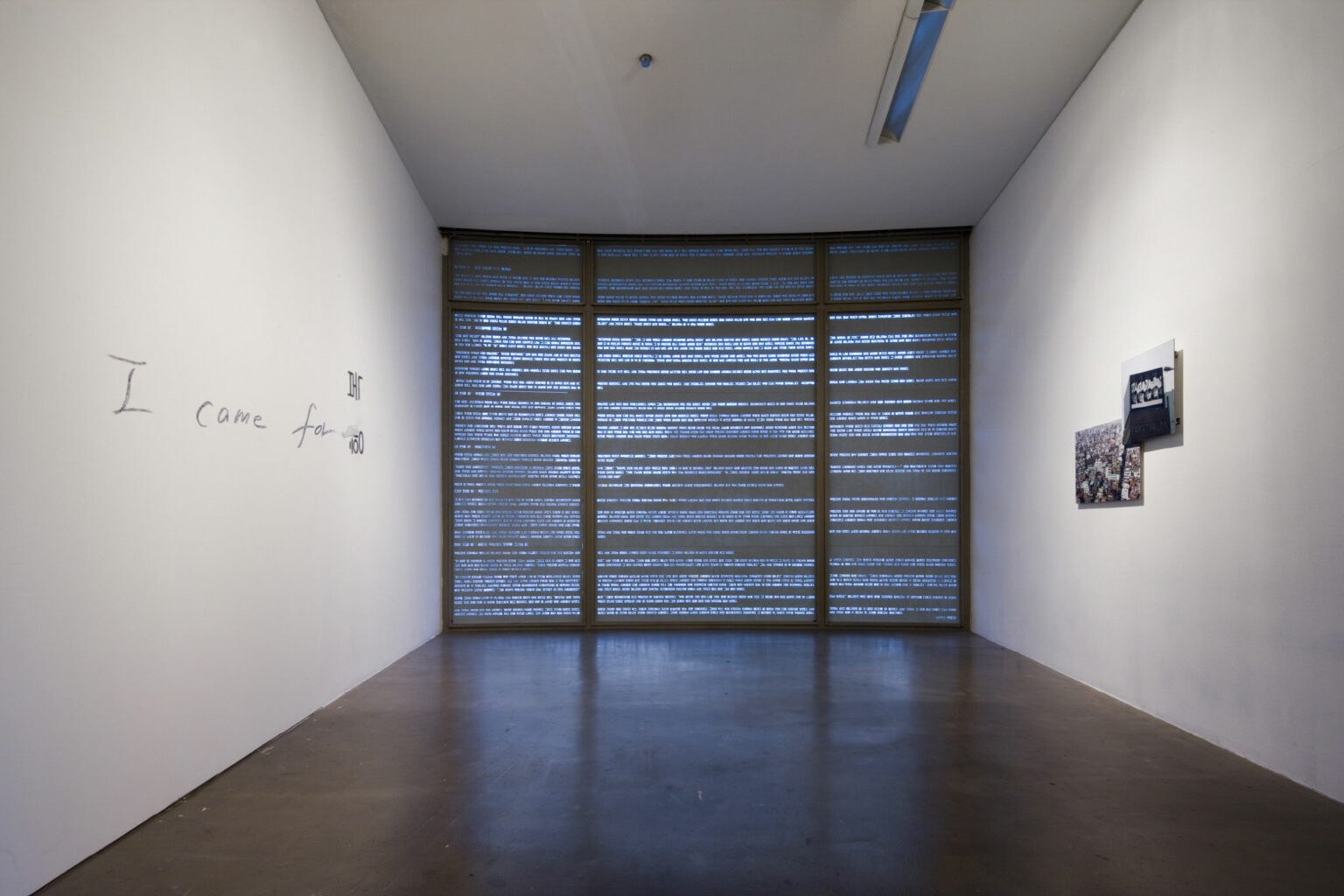
Factory started out as an allegorical short story that Ham wrote. For her
2010 solo exhibition at Artsonje Center, she printed the story in a large font
on contact paper, and stuck it to the glass front of the second floor of the
exhibition. Thus, rather than representing one of the visual elements of the
exhibition, it functioned more like a description that the viewer had the
option of reading. She also printed the story on regular paper so that viewers
could pick up a copy and read it. So what did she expect the audience to gain
from this story? In the current plans for the 2013 version of the project, she
explicitly identifies the “nonsense factory” with society. Hence, it is fair to
say that the meaning of Nonsense Factory is the meaninglessness of
contemporary society.
Nonsense
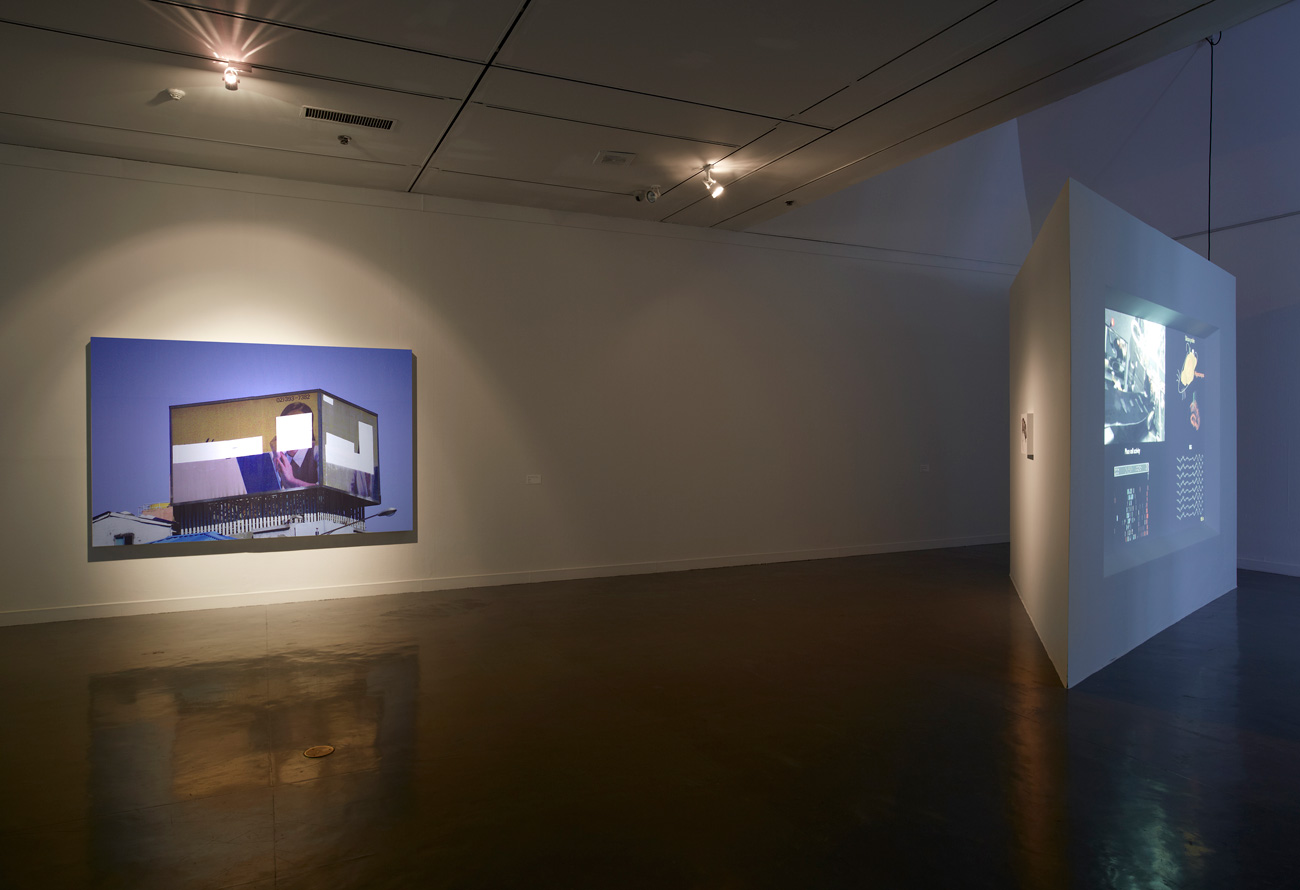
Factory depicts a factory set in a fictional location, adopting the
novelistic device of “coverage by a reporter for a company newsletter.” The
factory has six rooms: “Central Image Box Control Room;” “Welfare Policy Making
Room;” “Coupon Room;” “Artists’ Room;” “Factory Basement;” and “Blue Print Room
for Future Factory.” Those names—especially “control room” and “welfare
policy”—certainly ring true, as if they were culled directly from
reality. Nonsense Factory comes to resemble a microcosm of our
society, and those names are a big reason why. But beyond the titles, the rooms
themselves are eerily familiar to us, evoking various elements and functions of
our society.
The
first room, “Central Image Box Control Room,” is both structurally and
functionally reminiscent of the ubiquitous surveillance and control of
contemporary society, where every detail of our lives is constantly recorded,
managed, and regulated under the omnipotent umbrella of cutting-edge digital
technology. Over the last decade, one of the prime topics for debate around the
world has been the increasing amount of surveillance and data-tracking enabled
by digital and video technology. In the years leading up to Ham’s creation
of Nonsense Factory, discussions on the dangers of such social controls
were becoming increasingly fervent, with more and more people referencing “Big
Brother” from George Orwell’s 1984 (published in 1949). Today, in 2013, as Ham
presents an even more highly developed version of Nonsense Factory, the ominous
predictions made by social critics have become a frightening reality that goes
beyond even Orwell’s fiction. In June 2013, Edward Snowden, a computer engineer
and a former employee of the Central Intelligence Agency (CIA), revealed
to The Guardian that the United States National Security Agency (NSA)
had been using computer technology to monitor and collect a wealth of
information from around the world. Specifically, the NSA used a computer
surveillance program called PRISM to monitor Internet users, including American
citizens, while also hacking into other countries’ computer networks to steal
confidential information. These types of activities are happening constantly
around the world, even though the majority of the population is blissfully
unaware of it. In Nonsense Factory, Ham uses the allegorical device of “Central
Image Box Control Room” to expose how the people of the world remain oblivious
to the state of surveillance.
In
the second room, “Welfare Policy Making Room,” a young factory employee is
buried by an overwhelming workload, such that he cannot take time to even lift
his head and catch his breath. The worker’s exhausting plight is contrasted by
the displayed slogan “Happiness for Everyone!,” recalling a pencil drawing that
Ham made and displayed in the entrance of Artsonje Center for her solo
exhibition in 2010, which was entitled I Came for Happiness/Submission.
Here, “I” might refer to the artist, but it could also be anyone who reads the
sentence. The overwhelmed employee might be a portrait of “I,” or it might be
the portrait of all of us who senselessly (non-sense) “surrender” to the empty
promise of “happiness” ideologically propagated by power. It might be a
portrait of Snowden before he became aware of the grave absurdity of his
society, and realized that he had to blow the whistle against his own country’s
illegal surveillance of people under the guise of world peace and security.5
In
the third room, “Coupon Room,” Ham satirizes the monetary economy of
capitalism, an analogy that is even more evident in the short story upon which
the piece is based. In physical terms, the coupons are simply pieces of paper,
but in reality, they are precious materials that make everything else seem
irrelevant. In her story, the managers and workers of the Nonsense
Factory use the coupons to accumulate wealth and gamble, while taking
advantage of the people’s psychological need for the coupons to lead them
around by the nose. The most significant room in Nonsense Factory is
the fourth room, “Artists’ Room,” which is occupied by a master artist who acts
very inhumane towards his assistants and anyone he feels is inessential to his
work. However, the artist spuriously tells the reporter of the company
newsletter that the most important attitude for an artist is the “understanding
of others.” Of course, hearing such a response from someone who treats people
so carelessly symbolizes the absurd snobbishness of some people, particularly
within the art world. But from a more macroscopic perspective, Ham’s explicit
reference to art based on the “understanding of others” illustrates a deeper
contradiction within the themes of artists. She is criticizing the structure of
public discourse, and its rhetorical deceptions, for reducing huge and complex
issues into themes for popular culture or talking points for political
elections. The “Artists’ Room” reflects the duplicity of artists and others who
latch onto trendy themes (e.g. “human rights,” “consideration,” “relationship,”
“communication,” “healing”) and appropriate them for their own use. This
duplicity that superficially addresses genuine social problems only serve to
confuse and conceal the real causes and effects of those issues, inevitably
paving the way for more economic inequality, manipulation, violence, imbalance,
non-communication and fragmentary relationships.
Thus
far, using a fictional factory as a stage, Ham has tried to reveal the
underlying structure and hidden attributes of contemporary life, as well as the
systematic relationship between people and society. But where is she going with
this endeavor? Perhaps she simply wants the audience to share her awareness of
the problem, and therefore recognize the serious forms of oppression and
restriction that are concealed by acclamatory names such as “Free Trade” and
“Creative Economy.” If the lives of the people are dictated by the will of the
system and the capital of those in power, then that is not freedom; it is
fascism. And it will remain fascism, despite the disguise of specious issues
such as flexibility, pluralism, horizontal exchange, networks of human and
material resources, as well as the supposedly rich meanings that are invented
and attached to such issues.
Nonsense
Factory concludes with the sixth room, “Blue Print Room for Future
Factory” where a “promising architect” is tucked away, covertly re-designing
the structure of the factory in order to create a “system to maximize
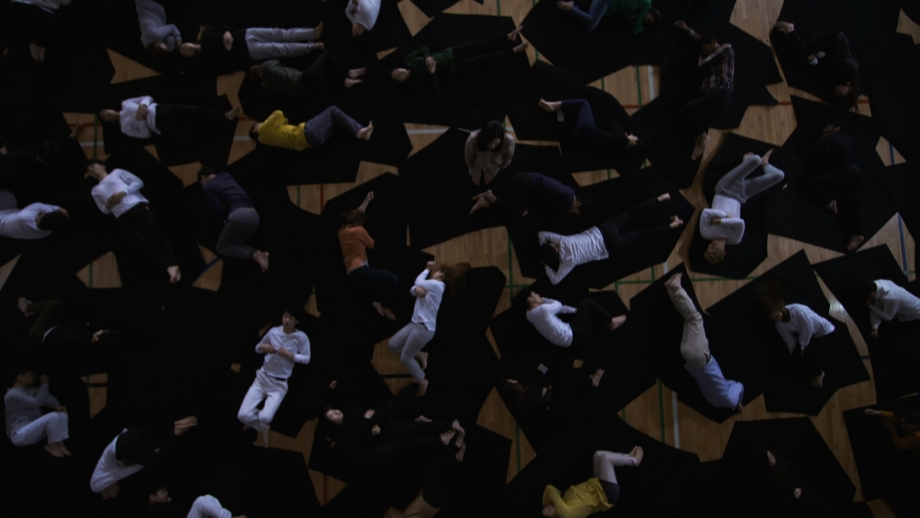
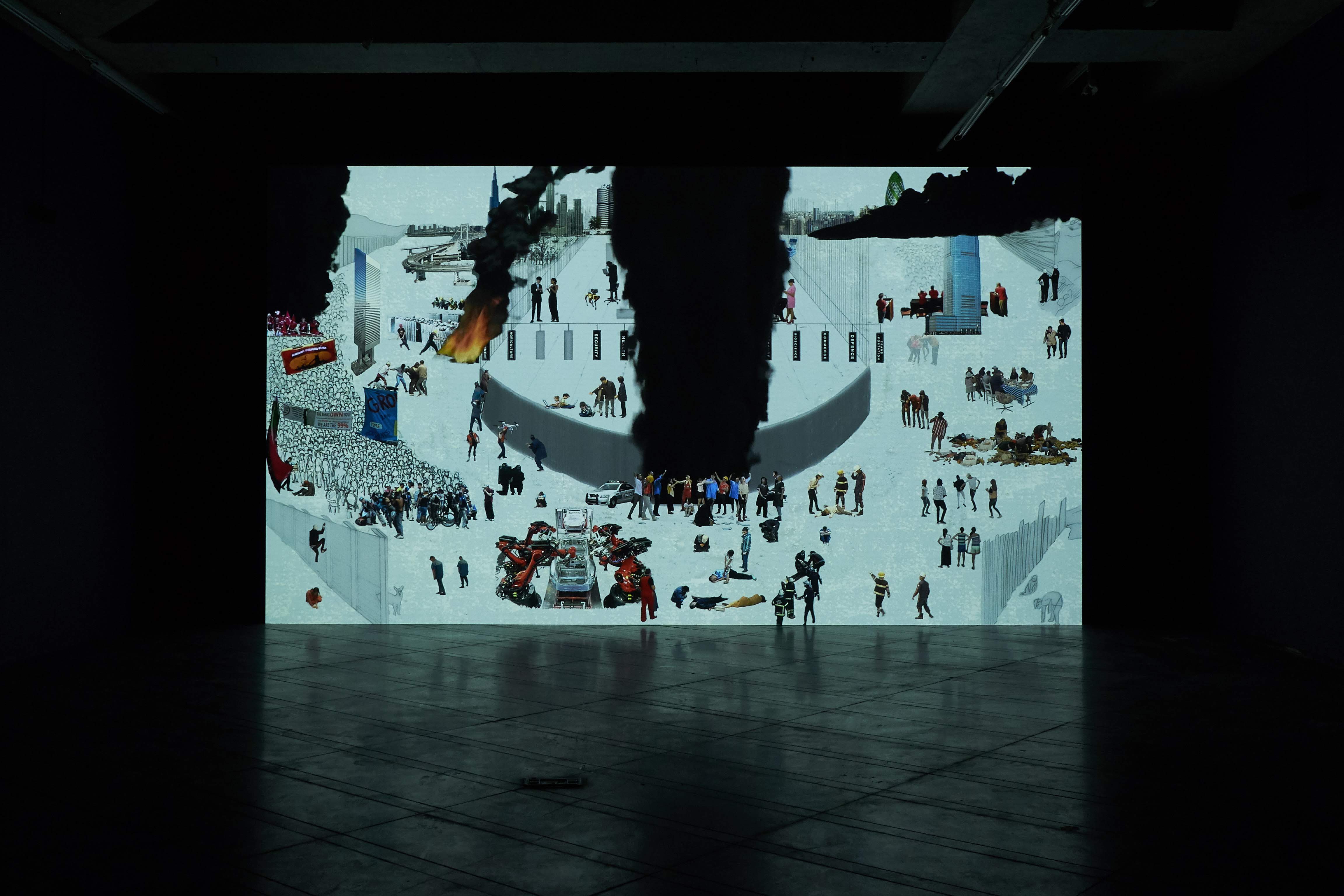
productivity.” When Ham developed Nonsense Factory into a full-scale
installation work in 2013, the first space was called “Factory Basement,” where
a group of anonymous people bumped into one another and energetically mingled
on a big platform shaped like a halfmoon or a ship. Due to the shape of the
platform, the motion of the people caused it to rock back and forth like a
cradle or seesaw. “Factory Basement” and “Blue Print Room for Future Factory”
seem to mark the beginning and end of the Nonsense Factory, allowing us to
tacitly recognize the two-faced nature of the society, as Ham intended. For
here we have an intensive system that purports to maximize productivity
connected to a structure of constant disturbance. The clandestine nature of
planning and policy-making is contrasted with the openness and visibility of
dynamic actions. I do not believe that Ham intended Nonsense
Factory to be a direct analogy of our actual society, but more of an
initial response or a warning sign. It seems unlikely that viewers who see the
moving platform and video of people mingling will suddenly start to imagine
freedom and a more intimate social relationship. But more importantly, visitors
to the Nonsense Factory might take time to reconsider our strange contemporary
times, when the lives of people around the world are dominated by instability,
and exchange and communication have become a global obsession.
1.
Franco Berardi Bifo, Gasry Genosko & Nicholas Thoburn (eds.), Arianna Bove,
Melinda Coope (trans.), After the Future (Edinburgh: AK Press, 2011),
105.
2.
For more detailed discussion of these works, see Kang Sumi, Wonderful
Reality of Korean Art (Seoul: Hyunsilbook, 2009), 164 -175.
3.
Reader’s Note: hereafter, direct quotations without reference come from Ham’s
own notes.
4.
Bifo, Ibid., 100.
5.
Snowden’s interview at The Guardian:
http://www.guardian.co.uk/world/2013/jun/09/nsa-whistleblower-edward-snowden-why