I have a memory of crying so bitterly before a family photograph
taken prior to my younger brother was born. While growing up, I was always
possessed by the question of why I had been so sad before a harmonious looking
family photograph. Once, I thought that it was due to a complex specific to a
second daughter who tried to find the ideal of a family in a family in which
the younger brother monopolized my parent’s attention. And also, right after my
father had died in my elementary school days, I had a self-reproach presuming
that my cry might have been a premonition of his death.
Of course, after growing up, I realized that ‘the death of a
photograph’ preceded the real death of my father and every photograph pre-experienced
death the moment it was born. Now I know that the sadness I felt about that
photograph was associated with the above mentioned reasons, such as social
psychology, enchantment, and the basis of photography aesthetics. But not all
my curiosities have been answered. In most of the cases, the size of senses
felt in a photograph far exceeds the sum of all the explanations about it.
Indeed, numerous particles of signs constructing a photograph ceaselessly
refuse to be anchored and repeatedly yell, “realign yourself!”
The reason why Heinkuhn Oh’s portraits look unfamiliar to us is
because his works begin where my original experience of the photograph deviates
from them. For a casual glance, he just seems to aim at azummas we usually
encounter on the street. They are social beings specific to Korea who are
composed of the combinations of the specific age, sex and class. Though they
just began to draw attention of a few researchers of cultural studies, they
still tend to carry a negative nuance. Especially for me who just passed my
mid-thirty, the moment I am called an azumma, I feel a little bit hurt. When
that appellation is affirmed to be grounded upon an objective choice without
any malicious intention, that hurt lasts longer. In other words, an azumma is a
category of an appellation that calls for evasion or dissimilation from it
rather than assimilation or sympathy toward it. This tendency is all the more
striking considering the ambiguous feeling attached to the appellation of
mother.
On the other hand, when I find an azumma among Oh’s azumma
portraits who looks exactly like the mother of one of my friends, I realize
that the azumma is an appellation used to call a relative or an acquaintance.
‘Aunt’ as an appellation for a close friend of a mother, or ‘mother’ as an
appellation for a mother of a close friend, in other words, a fake aunt and a
fake mother, surely reside in the spectrum of the azumma. We have agreed to use
the appellation of aunt or mother even when it referred to a relation which was
not a blood relative in order to shed a negative connotation of the appellation
of azumma. The shrewdness of Oh’s photographs lies in his decision to look at
all these azummas who must be surely someone’s mothers as azummas, not as
mothers. Through an azumma picture, not that of a mother, and through an
acquaintance, not a family member, Oh comments on a ‘fake photograph’.
Furthermore, he decides to say anew about the photograph.
The photograph in our daily lives, in itself, is synonymous with a
family member or the memory of a family member. Especially for us, who
experienced the disintegration of a large family and its displacement to a
nuclear family in the process of modernization mottled with rapid demolition
and shaky reconstruction, nothing can take the place of a photograph as an
effective substitute of memory. Ranging from a multiple picture frame in a
country home to a lavishly bound wedding picture album which is a necessary
item of a wedding, the photograph does not only enhance the sense of belonging
but also functions as a support of everyday life. And also, ranging from an old
black and white photograph on top of a signboard looking for a lost family
member to family portrait displayed at a commercial photography studio, the
photograph enhances the sense of community and offers an ideal
type for it. It is also difficult to deny that the strong experience of a
family photograph defined the way in which the photograph in general is
received.
In that sense, the saying, “what is left is only the photograph”
is our honest confession about photography. In Korean context, the photograph
is the record of an everyday life and at the same time, reversely, a kind of
cement that fixes our reaction toward the entire world. Perhaps in no other
region in this world is the bondage between the photograph itself and the world
facing it so bragged. Sticker pictures occupying the back cover of kid’s
notebook are nothing but the proof of this bondage.
At this juncture, once again, Oh’s pictures come to us as
something unfamiliar. In his azumma pictures, the kinds of sentiments we
thoroughly practiced through family photographs such as the sadness of
perceiving ‘the moment of death,’ the nostalgia for the time of the past and
natural compassion and sympathy toward the life of a specific person are
excluded. More exactly speaking, such sentiments have already been withdrawn.
Though the trace of such sentiments still remains, Oh is masquerading himself with
the distance toward them and intended coldness. After all, Oh’s azumma pictures
reflect his attitude of calling a fake aunt or a fake mother. Indeed, while we
call her in a very familiar manner, we still keep a certain distance toward her
so that it does not matter very much even if we could not recognize her on the
street in the future. Because of this internalized distance, the azummas
‘represented’ by Oh are wearing very familiar, deja vu faces. Yet overall,
these faces take on a strange, grotesque and even surrealist mood. This
internalized distance might especially differentiate Oh’s azumma pictures from
portraits by other Korean photographers.
However, the fascination of Oh’s photographs does not only lie in
his picking of hitherto unnoticed being in our society that was not brought
forth as an object of photography and offering it in his own style. Above all,
he does not differentiate between the matter of what to take picture and how to
take picture. When we find out that his pictures are not about the azumma but
about her signs, these matters will be spontaneously dissolved.
A closer look at his pictures tells us that Oh is an avid
collector of all the components that enable us to call a woman an azumma, such
as accessories, pattern and texture of her clothes, hair style and makeup. It
is also revealed that Oh is a keen physiognomist who can let us guess an
azumma’s character, family relationship and occupation by classifying wrinkles
and looks of her face. He even resembles a fortune teller with a high hitting
ratio who can work off her grudge and somewhat predict her future. Of course,
there is no confirming whether the azumma Oh ‘took’ picture really belongs to
the social category he classified or not, whether ‘the insurance saleswoman
type’ really is working in that field or not. His works are persuasive insofar
as he decides to look at the azumma in such a way and she actually looks so. In
this context, his works aiming at fake aunts and fake mothers are surely fake
photographs.
On the other hand, Oh’s typology in which the general and the
individual, the specific and the universal intersect in turn are related to the
dialectics of difference and identity well versed in photography. For instance,
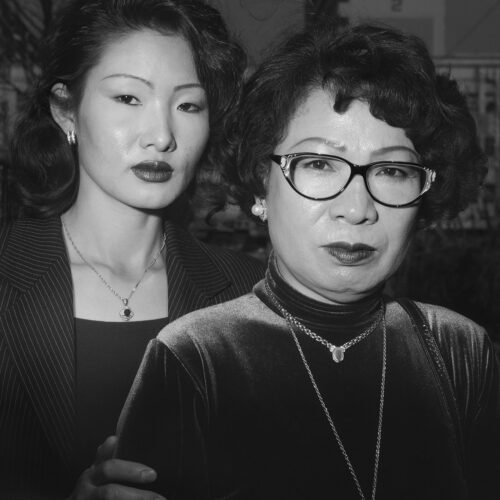
one of Oh’s works Two azummas 1 ) is positioned exactly at a
point opposite to Diane Arbus’s Twins. While Arbus’s picture is trying to
revive the voice of difference hidden inside the category of identity by
putting a scar to biological symmetry of the twins(footnote 1),Oh’s azummas,
who are not related with each other yet look like sisters, let us discover ‘a
social genotype’ that lies across the difference. Jittery eyes, wrinkles around
the mouth and glittering makeup that these azummas share who are in an
asymmetrical relationship with each other in terms of the age, body and their
characters are clues to the career of their common lives. If we put an
azumma wearing glasses and an azumma wearing glasses with
thick black frame and then put another pair of azumma
pictures next to them, these clues will be increasingly strengthened.
The association of these images exposes the ideology of typology
that nullifies the particular personality and at the same time instantly
condenses some common social experience beyond the competence of an individual.
Unlike azumma pictures, ajussi (the generic term for man) pictures have a
higher risk of failure because they are more likely to be read as an expression
of personality rather than as an interpretation of stereotypes. The category of
agassi (the generic term for young lady) is difficult to establish because the
trace on a human body left by social time and a shared experience decipherable
from it have not yet been formed in her.
Unlike with agassis, with azummas, the tension of confronting this
world, especially the aesthetic tension, is totally loosened. “The tangled hair
in permanent wave, loose skirt and dragged slippers” are the signs refering to
the loss of this tension. Oh reconstructs those azummas who lost their
aesthetic tension into aesthetic objects. Especially, while eliminating the
individual context in which each azumma is located, Oh brings them forth in
full rig.
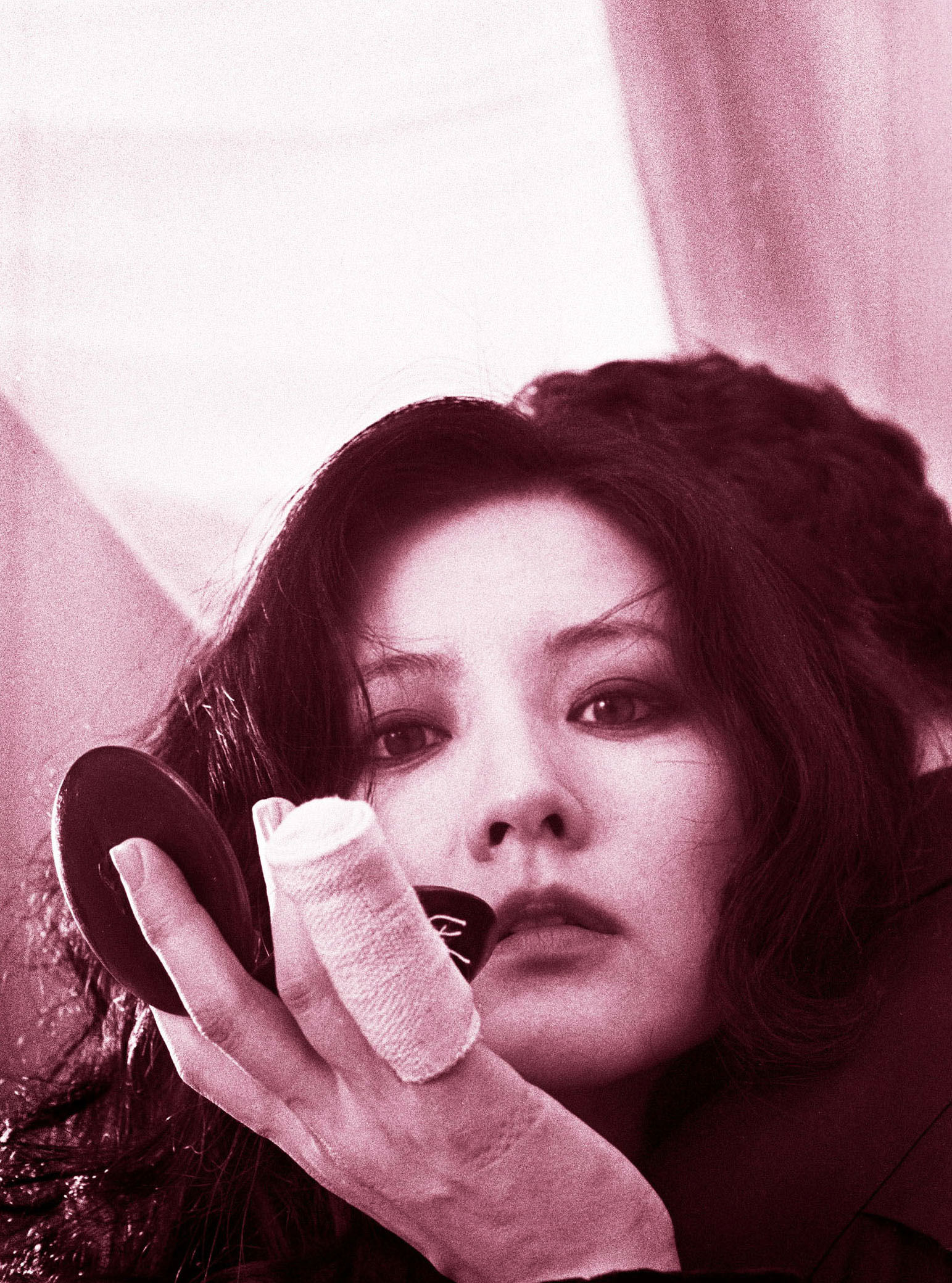
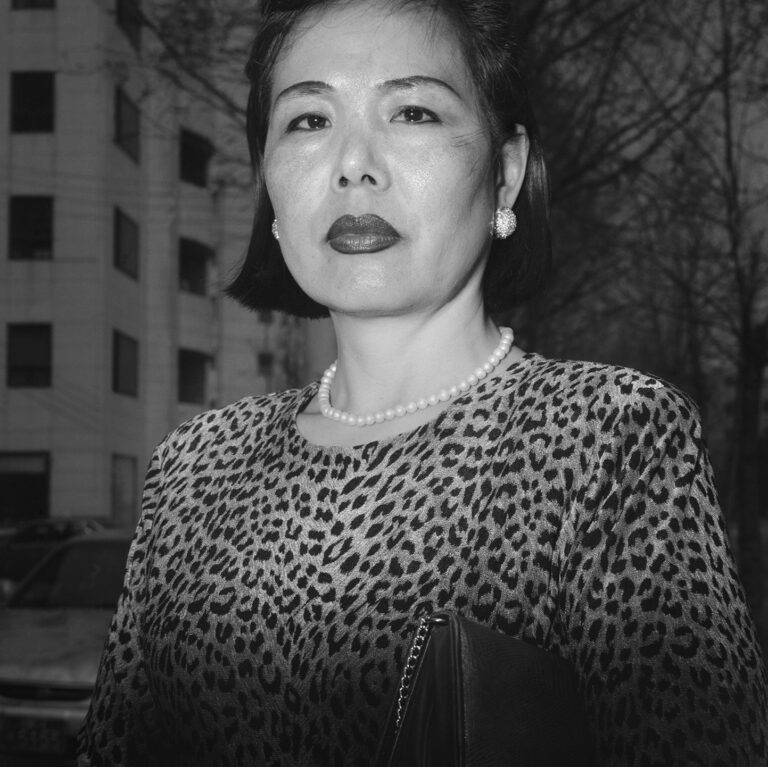
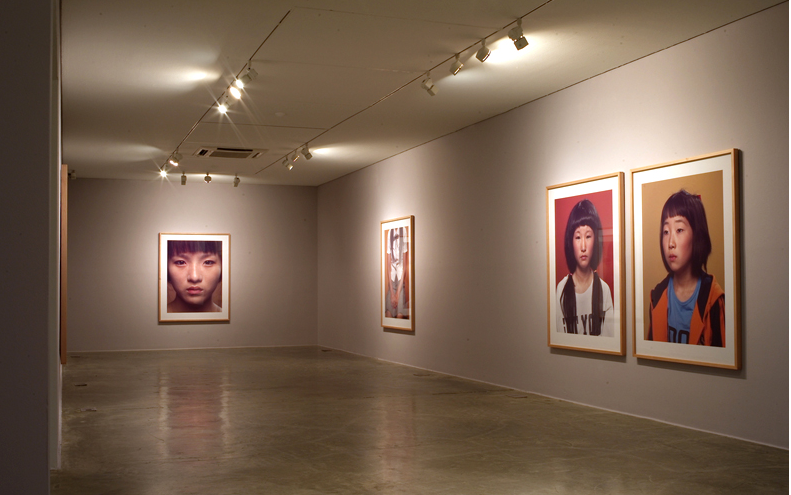
In most of his works, as the background and lower half of the
image are blackened and a strong flash of light is cast on the face, an
unnatural dividision of an image occurs. So, the overall scene is flat,
partially fragmented and also ambiguously overlapped. This space demands us to
grasp it in an ‘analytic’ perspective rather than in a ‘synthetic’
perspective.(footnote 2) azumma’s half-body portrait abruptly rising above the
background in fade-out above all reveals the lonely and desolate sense of being.
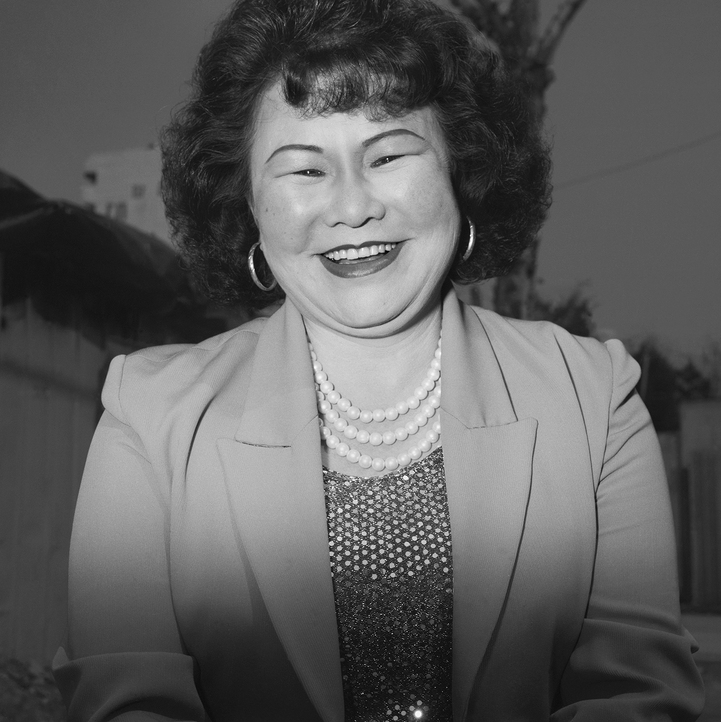
On the other hand, the glitter of fake jewelry scattered here and there all
over the scene expresses azumma’s naivety. The nap left on a jacket, pattern
and texture of a dated blouse, just like wrinkles around the neck that could not be camouflaged by makeup, remind us of the power of
dailiy life.
But as my eyes come across azumma’s eyes floating over the image,
I feel momentarily stunned. I don’t know how the photographer could ‘disarm’
azummas, but they are exposing their whole being without any exaggeration. We
can never feel the tension of confronting a camera or firm will to resist the
captation of one’s identity by the lens. They are also posed in a manner
completely distanced from the effort and awkwardness of young brides being
taken picture for wedding ceremony, or from the struggle to efface even such
awkwardness. Without any regret about their young days, jealousy toward other
young ones, or shame at their own face getting older, these azummas are boldly
getting rid of their own self-consciousness.
As I am in confusion regarding how to interpret azumma pictures,
along with the collapse of social aversion to azummas, the composition of the
image gives me a clue. The flat composition of the image that does not suggest
any three dimensional volume corresponds exactly to the depthlessness of
self-consciousness, the darkened outer rim looks like another frame within the
frame. These pictures look like a meta-discourse to azummas, ot still image of
a film.
Susan Sontag remarked that the relationship between the
photographed world and the real one was as inaccurate as that between a firm
still and a film. The photograph is defined by important details captured in a
moment and fixed for good, whereas the life is not.(Footnote 3) In a different
context, Oh’s photographs are similar to film stills. They are film stills of
actresses appearing in an imaginary movie produced only inside the imagination
of the photographer. These actresses are of course far from ‘stars’ who end up
overacting from too much self- consciousness or are always stressed by elements
other than their own performance. They are, rather, extras, amateurs or persons
with real jobs. Without distinguishing their role in the drama from reality, azumma
actresses in Oh’s ‘still images’ perform in a realistic manner and leak out the
reality of life.
Finally, it has become apparent that Oh’s azumma pictures are not
‘azumma’ pictures but azumma ‘pictures’. So, when confronting his pictures, I
am caught by a zestful energy that is not experienced when looking at a family
photograph. In many cases, a family photograph is, rather than a family
‘photograph’, a ‘family’ photograph that puts one under a psychical burden. To
the contrary, Oh’s azumma pictures free us from this sentiment of kinship
experienced in the real world. Nevertheless, no one can say for sure to where
the power of cultural identification that we have practiced through these fake
photographs of fake aunts and fake mothers will lead us.
Footnotes
1. “Biology, Destiny, Photography: Difference According to Diane
Arbus”, Carol Amstrong, October 66/fall 1933
2. “Photography’s Discursive Space”, The Originality of the Avant-
Garde and OtherModernist Myths, Rosalind Krauss, MIT press, 1986, p. 135
3. On Photography, Susan Sontag, 1986, P 105