In
a certain essay confessing his identity as an artist, Bae Young-whan once made
a half-joking, half-serious pledge “to live half as an artist and half as an
incompetent.” This may well have been because, to borrow his own words again,
he chose to live according to the “nonsensical promise” that “we should all
live kindly and truly sensibly, each going our own way.” The “common sense” of
our time is likely that of a cynic—knowing full well the belief accepted as
common sense, yet holding the shrewd conviction that following it only leads to
loss. Thus, the “sensible life” Bae speaks of may in fact be a jeer directed at
cynicism: a willingness to live a nonsensical life while still maintaining
faith in common sense. Identifying himself, as an artist, with the figure who
utters such jeers is a way of exposing and mocking the refined, elitist artist.
Yet this gesture cannot simply be supported as an act of critique. One of the
prevalent trends in contemporary Korean art since the 1990s has been the attack
and critique of the artist’s authority and identity.
But
perhaps the image of the cynic—one who can fully uphold a belief in common
sense while living nonsensically without any guilt or discomfort—overlaps with
that of the artist. At the very least, many artists today seem to conspicuously
deny their identity as artists, even go so far as to identify themselves with
non-artist identities, in order to make their artistic identity stand out all
the more. This is strikingly similar to the logic adopted by commodities in the
new capitalist society. In this system, commodities habitually feign critique
of the product identities of the “mass production era” or “producer-centered
economy.” In today’s capitalism, commodities present themselves as
non-commodities—concerned for health, caring for the environment, valuing
individuality and freedom. Thus, a commodity no longer flaunts itself as an
economic object. Purchasing it feels like choosing a particular lifestyle or
enjoying an aesthetic pleasure. And yet, by rejecting their
identity—criticizing the past world of commodities that blindly pursued profit
at the cost of environmental destruction and the suffocation of individuality
and freedom—commodities only enforce their commodity identity all the more
tenaciously.
Post-Minjoong Art and the Artist’s Identity
(omitted section)
The Dream of Perfect Love
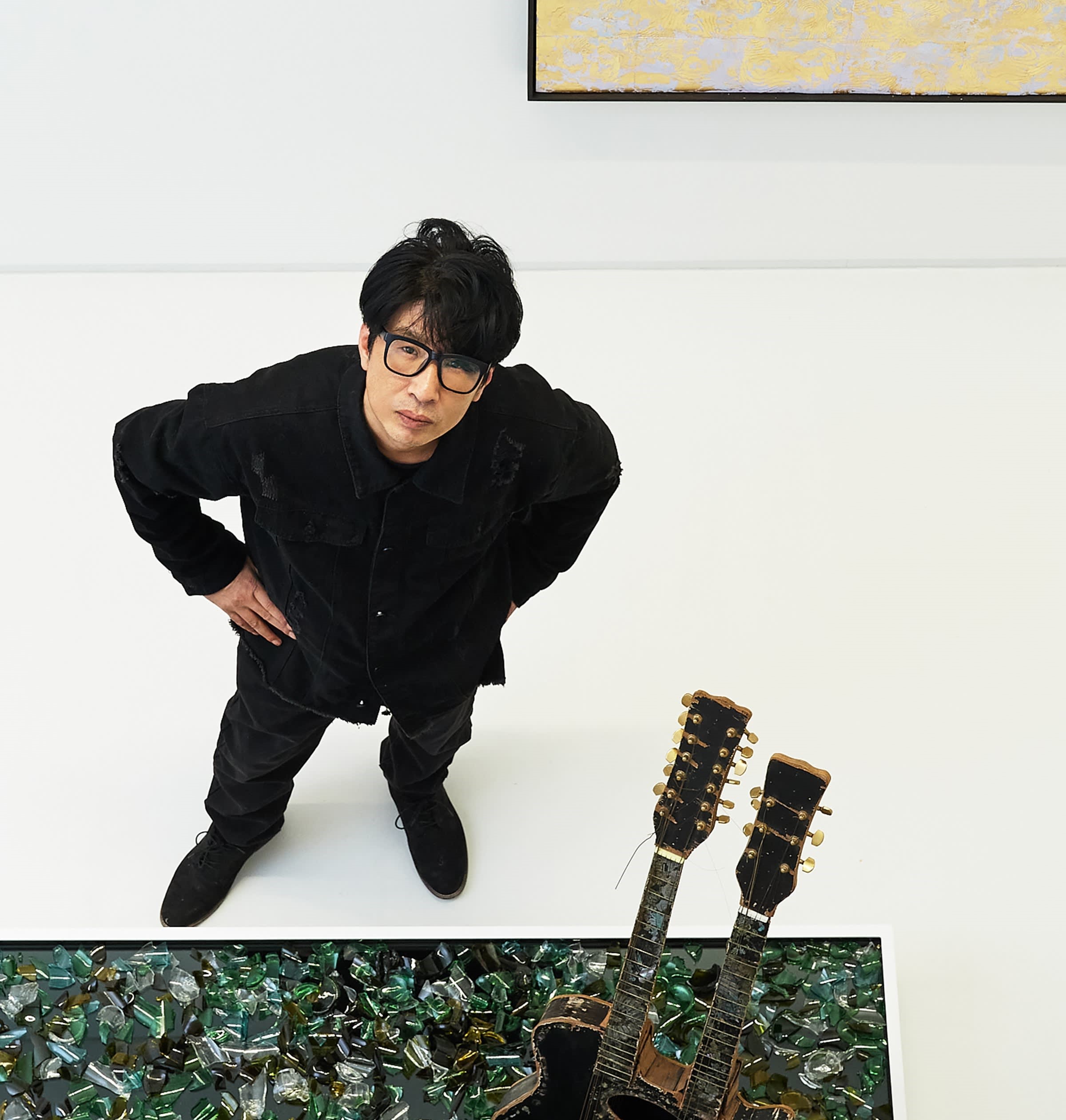
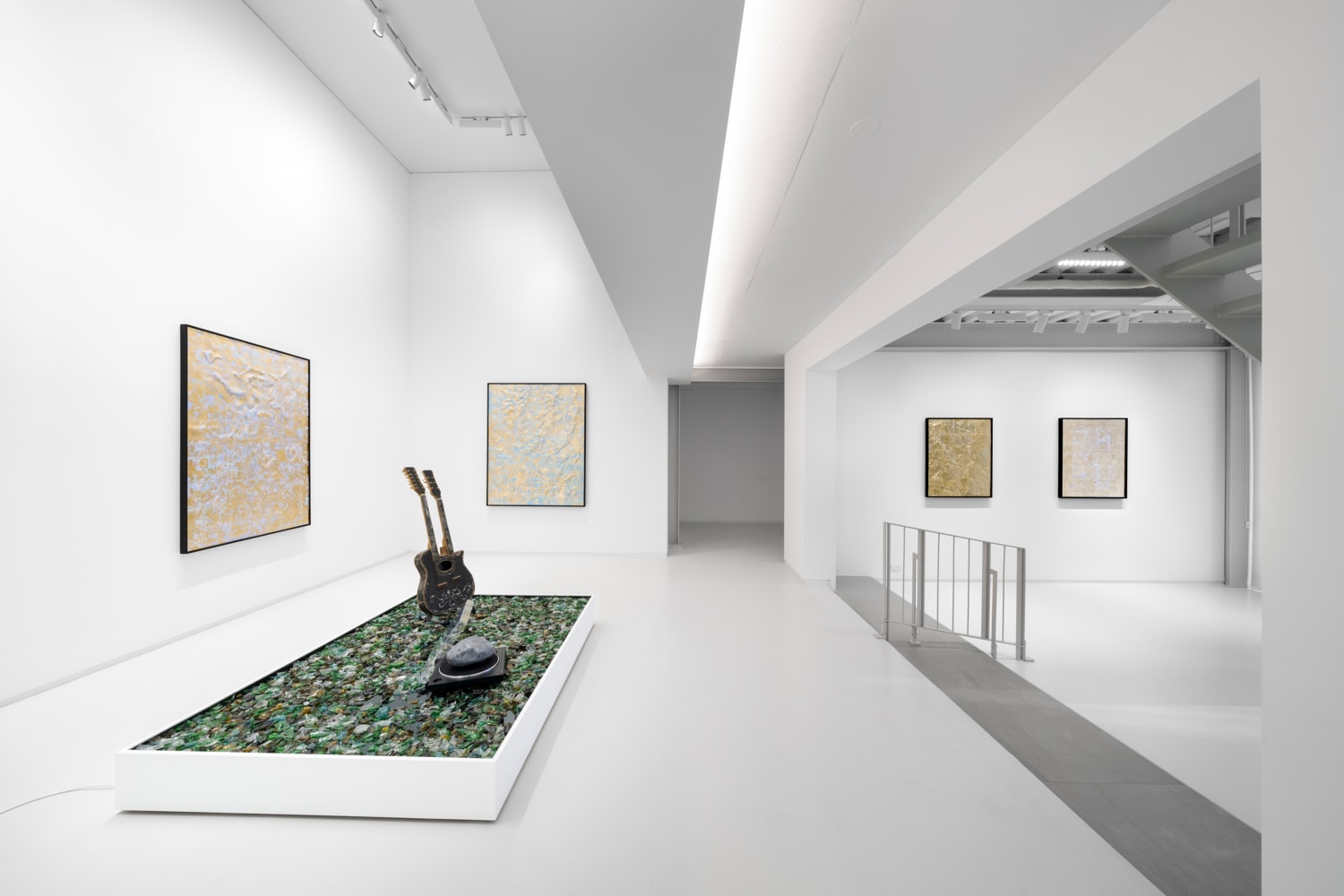
In The Way of Man, Bae Young-whan presents an
installation that is almost ascetically simple. The entirety of the exhibition
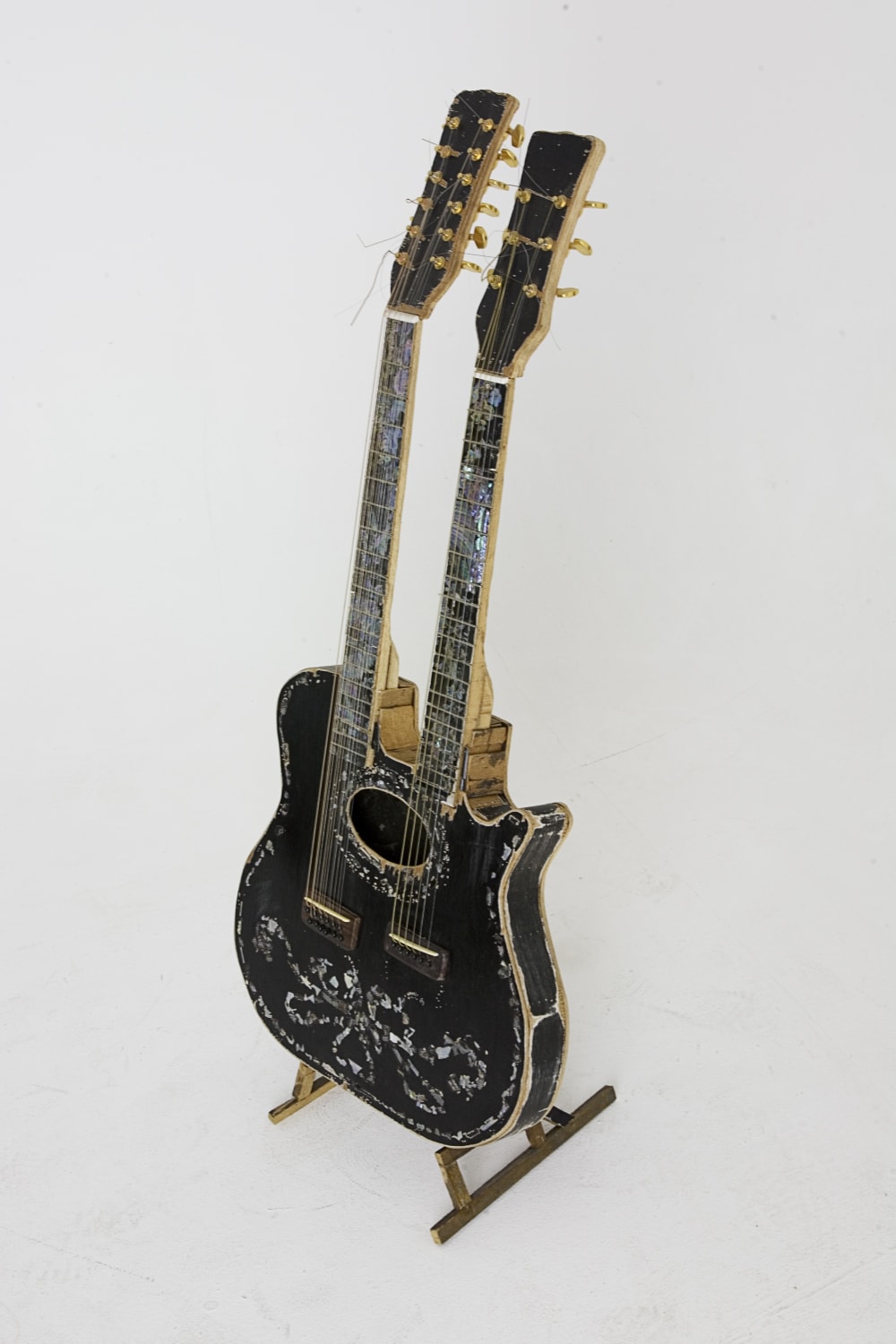
consists of guitars painstakingly—perhaps even pathetically—restored(?) by the
artist’s hand, and photographs that indicate the origin of the materials used
to make the guitars, as well as their narrative provenance as a medium. Among
the works on display, the only one with a title is a twin guitar called Perfect
Love, accompanied by a photograph of the mother-of-pearl vanity from
which its decorative materials were sourced and a photograph of the guitar
taken in a sunlit thicket. Yet the emotional resonance here is far stronger and
richer than in his immediately preceding Popular Song project.
Popular
Song was a series in which he directly transcribed the lyrics of
bygone popular songs using various objects as his medium. Whether pills or
shards of broken bottles, these materials not only reproduced the realities
mentioned in the lyrics (love, death, solitude, etc.) but also evoked the lives
of those implicated in that process of representation. It was deeply
melancholic, yet at the same time brought peripheral, shabby existences
abruptly to the surface.
However, The
Way of Man, while following the narrative framework of representing
such peripheral lives, also seeks a break from his earlier work. At first
glance, the shift from pairing observations of marginal details with specific
popular songs to telling the straightforward story of a sincere, modest
man—despite any pretension or affectation—might appear as a narrowing-down. Yet
this outward contraction could also be seen as a reflective expansion of his
work. If his focus were merely sentimental attachment to peripheral lives,
there would be little to move us in his work. “Human documentaries” far more
masterful at sentimental empathy are available, and they are far more moving.
If
the ethics of compassion and charity now dominate our era’s ethical-political
coordinates—replacing the ethics of anger and resistance, and representing the
people as victims or the oppressed—then the only difference we could find in
his work would be its institutional format as art exhibited in a gallery.
But The
Way of Man refuses such a position. The “way of man” he presents
keeps its distance from the convenient rhetoric of allegory or parody that is
in vogue. The title he chose—“The Way of Man”—and the sole work title, “Perfect
Love,” are, from the perspective of contemporary discourse that emphasizes
context, specificity, and difference, either utterly vulgar or blindly
idealistic. This is because they put forward the universal figure of “man” and
the rhetoric of “perfect” love. We might call this an impulse toward the
archetype. Of course, “the way of man” and his “perfect love” here are not an
elegiac nostalgia for the shabby love of the lumpenproletariat. They are a
pained, even scandalous, question aimed at the loss of society itself.
Thus,
while The Way of Man can be read as the story of
some nameless working-class man’s love, it can also be read as the artist’s
synecdoche for an “impossible society.” In other words, the act of collecting
and exhibiting “perfect love” and the specific story that testifies to it is
not merely a genre scene of mores, but an expression of the desire to represent
a universal subject that bears the fundamental impossibility of society. This
is why there is a clear reason to see Bae Young-whan as an artist within the
genealogy of Minjoong art who nonetheless strives to break through its limits.
He is one of the rare artists in Korea’s progressive art scene who remains
faithful to representing the universal subject without compromising with the
politics of identity. If the young progressive artists of post-Minjoong art
have ultimately degenerated into a post-political politics, he continues to
uphold the most important aesthetic politics of Minjoong art. This is, of
course, precisely what makes his work special—and beautiful.
—
Written at the request of ‘Monthly Art’ and under pressure from my
friend Bae Young-whan. Since this is an unpublished piece, the section
discussing the relationship between Minjoong art and the archetype, as well as
a critique of the politics of difference typical of post-Minjoong art, has been
omitted—hence the awkwardness in the flow. My loyalty to my friends sometimes
clouds my judgment and leads me to invent reasons to support their work. But
this time, the work was truly fine and moving.