My
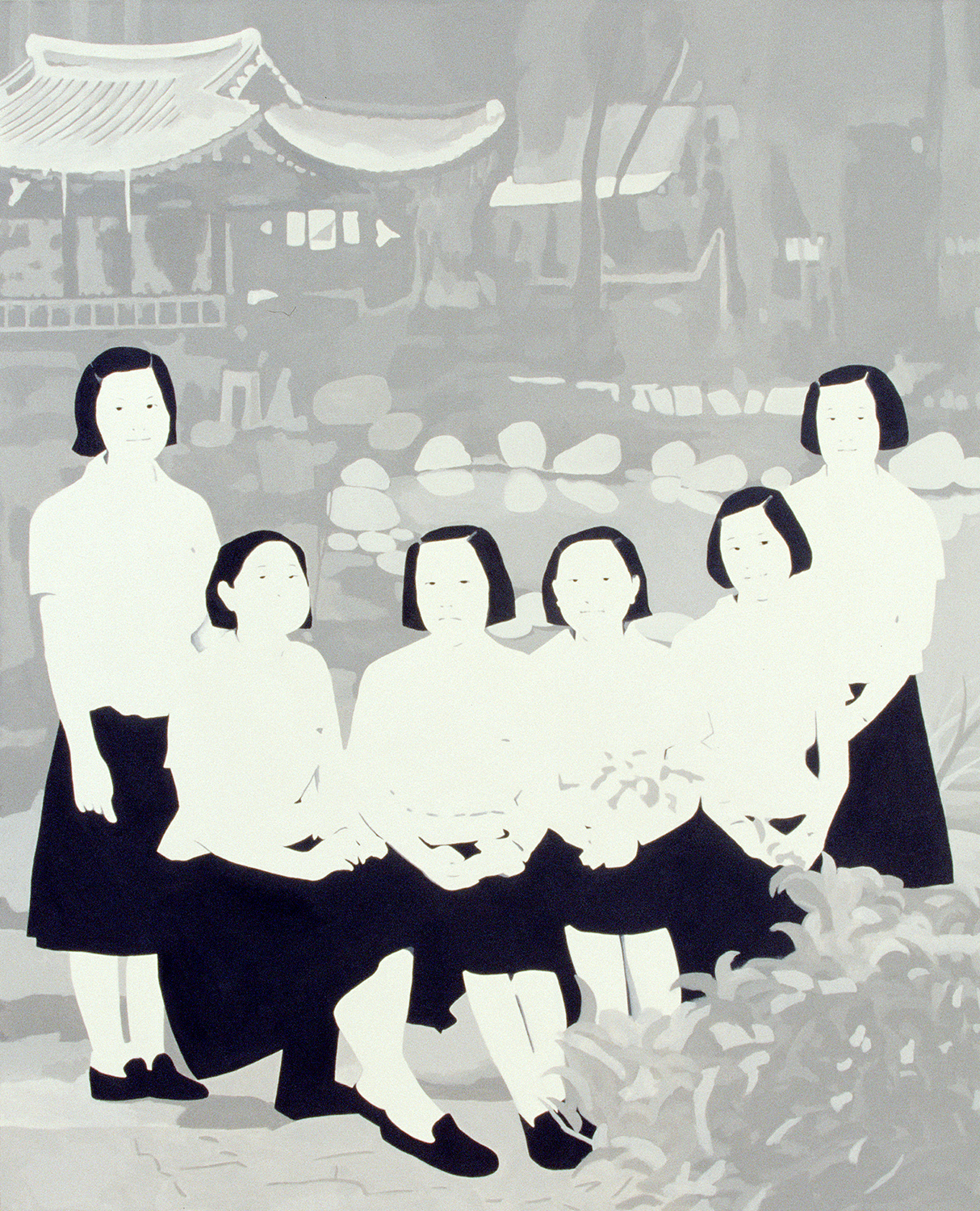
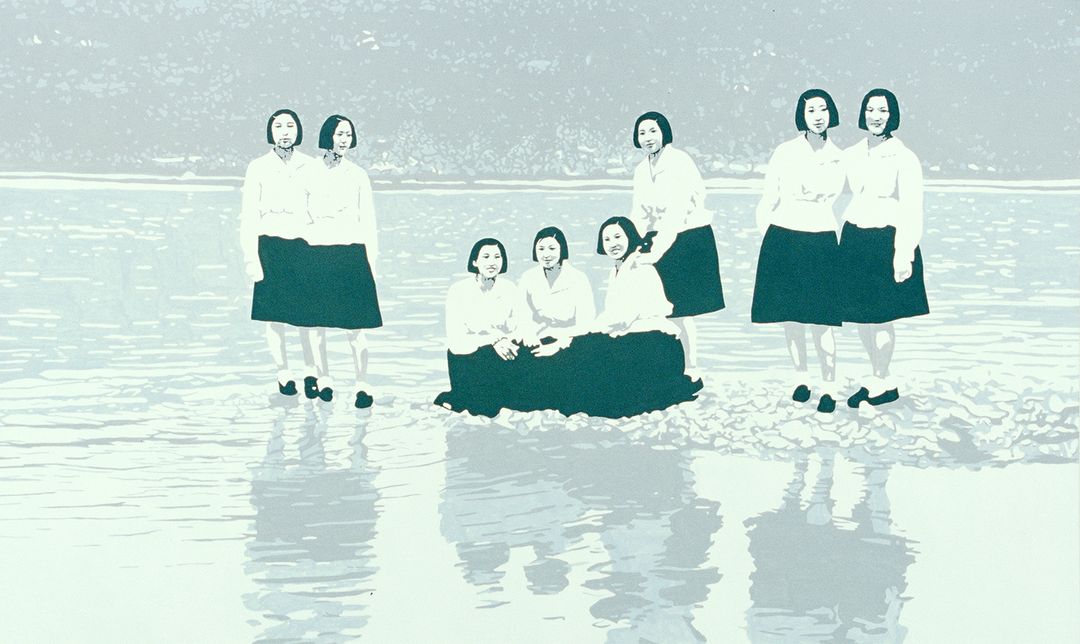
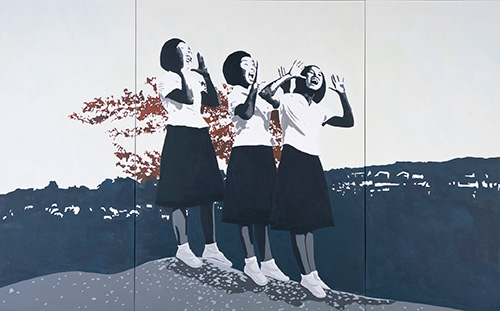
first encounter with Sunny Kim’s ‘Girls in Uniform’ series was from her 2001
Gallery Sagan exhibition. At the time, her work, which mostly originated from
documentary sources suggestive of standardized types, was transformed to
deliver an artificial formality akin to graphic images. There was a certain intentional
barrier that evoked a sense of absence and a feeling of cold detachment, and
the fact that one could not find any youthful energy nor movement in the
uniformed smiling girls made the paintings different. The psychological
blocking and absence shaped by the consciously-removed ambiance paradoxically
created a unique aura. Her solo exhibition at the Ilmin Museum of Art continued
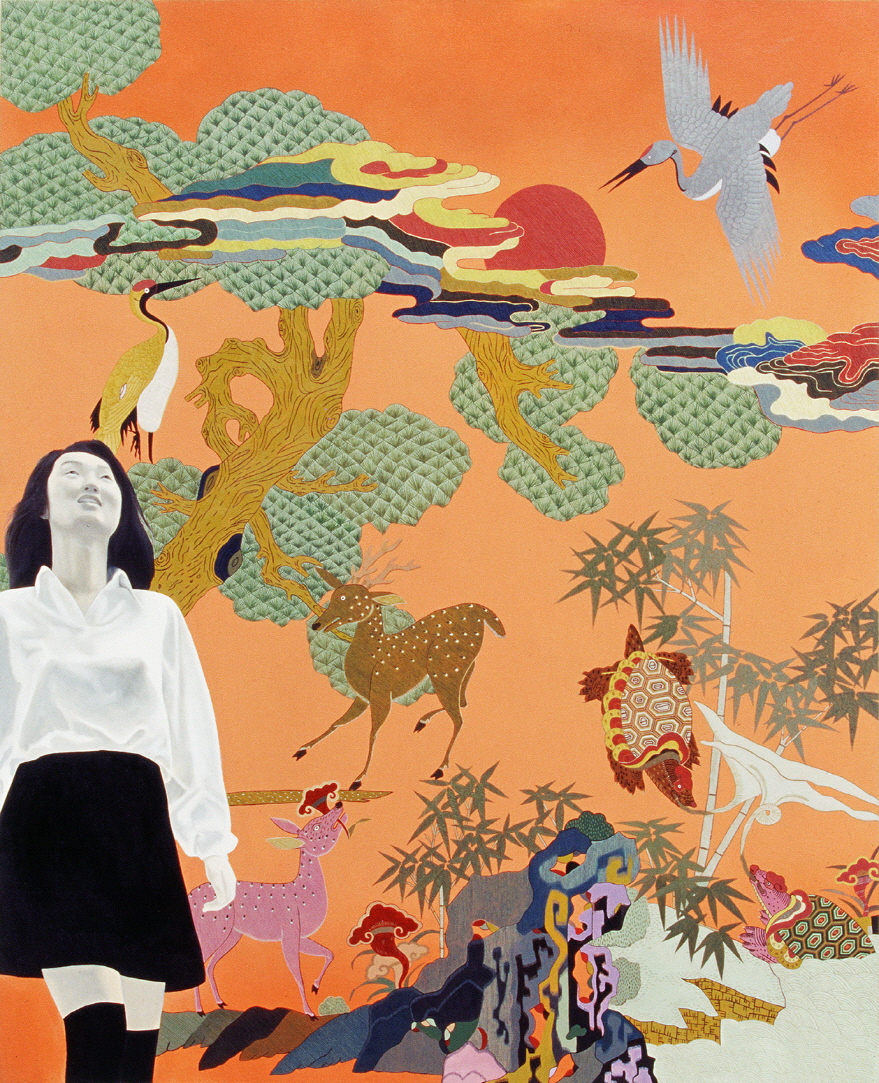
along the same path. Ornate and intricately painted traditional embroidery
motifs were also used to signify the lack of life and movement. The school
girls’ youthful energy is locked within the distance of time, even more distant
than old photographs one may find in a museum. The perfectly elaborated and
flawless finish of the paintings rendered them more unreal, and this intentional
effect of removal operated as a psychological device. It is interesting to note
that Kim explains such manipulation to be her attempt toward a “perfect image.”
When discussing Kim’s work, one cannot overlook the fact that she is a 1.5
generation Korean- American. As she admits, the abrupt break and change
following her move, and the attitudes formed therein, have been important
foundations for her work. The “Girls in Uniform” series shown at the Gallery
Sagan exhibition may have first created the impression that her interest was in
socio-cultural conditions such as the systematic suppressions found in Korean
society, perhaps due to the clearly systematic clichés embodied within the
motif of uniforms. However, her works using the theme of traditional embroidery
exhibited at the Ilmin Museum showed that the artist’s interest was not in
socio-political themes such as the systematic suppression of the individual,
but, rather, in the concept of standard “rules” under certain conditions.
“Rules” can have a suppressive and negative connotation, but, can also be a
very consciously creative act of controlling and organizing a subject in a
specific manner. In Kim’s work, these rules become a mechanism for consciously
manipulating the images in her paintings toward her targeted “perfect image.”
This aspiration toward the “perfect image” is an important motivation driving
Kim’s work. For Kim, who left Korea when students were still required to wear
uniforms, the appearance of a high school girl in uniform is always a prototype
of this “perfect image.” This is likely due to the neatness of the uniform, the
beauty regulated by rules, and the social position accurately and reasonably
thus imparted on the wearer. In an environment where rules were suddenly lost,
and in a situation where balance had to be independently found, uniforms could
have been for Kim an effective ideal of a youth where safe order was
guaranteed. In this vein, the uniforms in Kim’s work are not a means for
suppressing female students, but rather can be seen as a means for establishing
a fixed and clear identity.
Uniforms and embroidery have served as vehicles through which to recreate
memories, but those which Kim could never possess, since they were never
realized in and abruptly disappeared from her own life. Kim’s work, which seeks
to revive such objects which were omitted or absent, may be perceived as an
irrational nostalgia for memories which never existed in the first place. Thus,
her works are fundamentally based on the impossible attempt to hold what cannot
be held on to. The images in her paintings are also ultimately only substitutes
for what cannot be real, and are fabricated visions. Despite being constructed,
they still concern a reality which is continuously sought for balance within
the artist’s unconscious, and somehow connects and links within the artist’s
internal world. Even if these images never actually existed, they have a
psychologically compensating function in Kim’s work and acquire a complete
reality within her paintings. This is also why Kim speaks of a “perfect image”
rather than “perfection.” Kim’s paintings can be seen as works which
“perfectly” recreate the fragments of her lost memories, within the rules of
the painting surface which she can control as the artist. This is a conceptual
world which can never meet reality, a pure painted utopia. The weightless space
and ethereal nature represented in her recent works originated from the above.
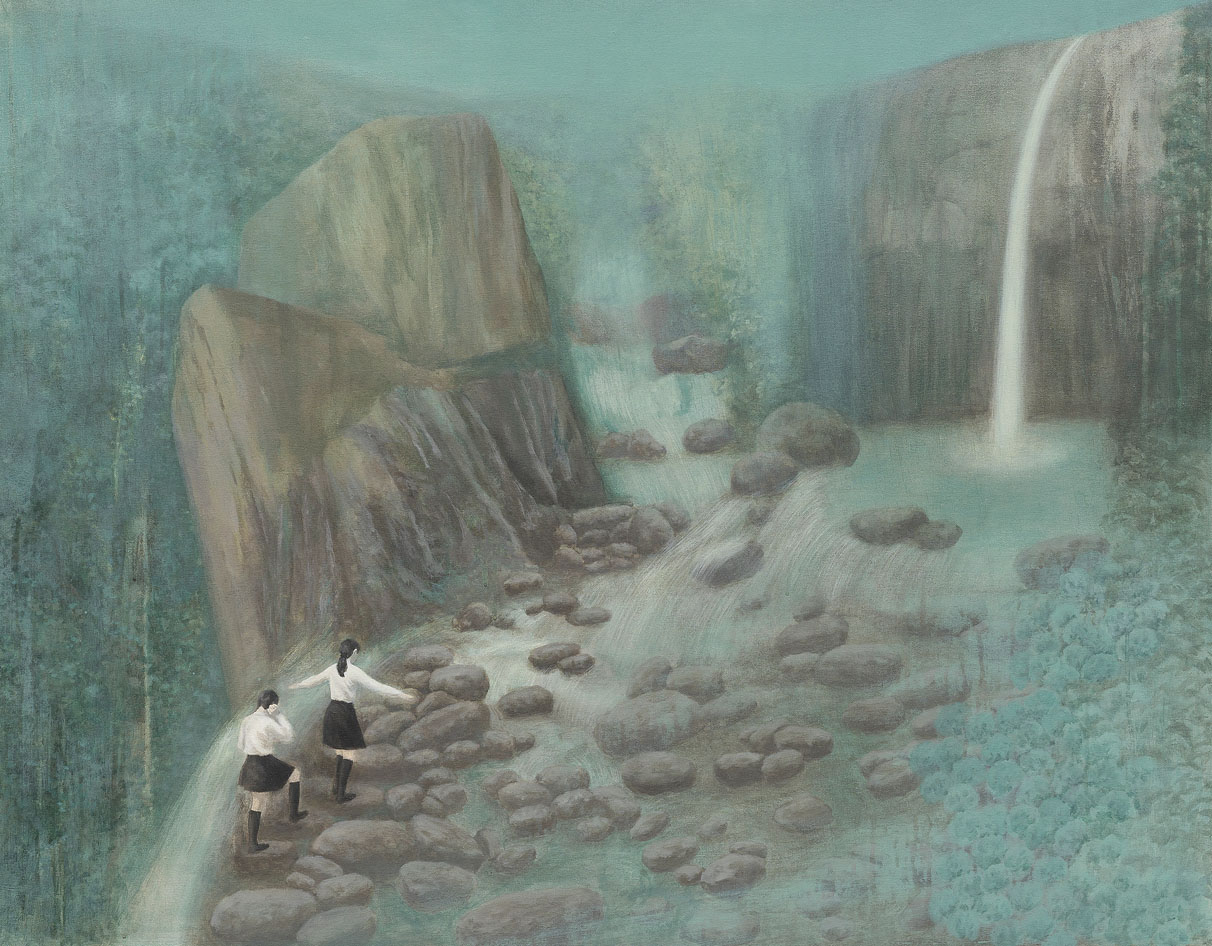
Recently, an important transformation has been occurring in Kim’s work. The works
in her Gallery Hyundai 16 Bungee show evolved from her ‘Girls in Uniform’
series, but mainly use objective sources such as movies, magazines and
newspapers, rather than personal photographs. The biggest change is that the
element of movement has been incorporated in her work. If her previous works
conveyed a stiff feeling through permanently fixed poses of uniformed girls or
embroidery patterns, the figures in her recent works – taken from movies or
magazines – appear to have a cautious vitality contained within a certain time
and space.
While this movement is still very subtle, and it remains uncertain
whether the figures are stationary or moving, what is clear is that they have a
greater spatial reality than the memorial-like arrangements of her previous
works. Uniformed figures still appear in Kim’s images. Unrelated to the
narrative of the original source, they play roles within the time and space
depicted by her paintings. They exist, but their actions or locations are
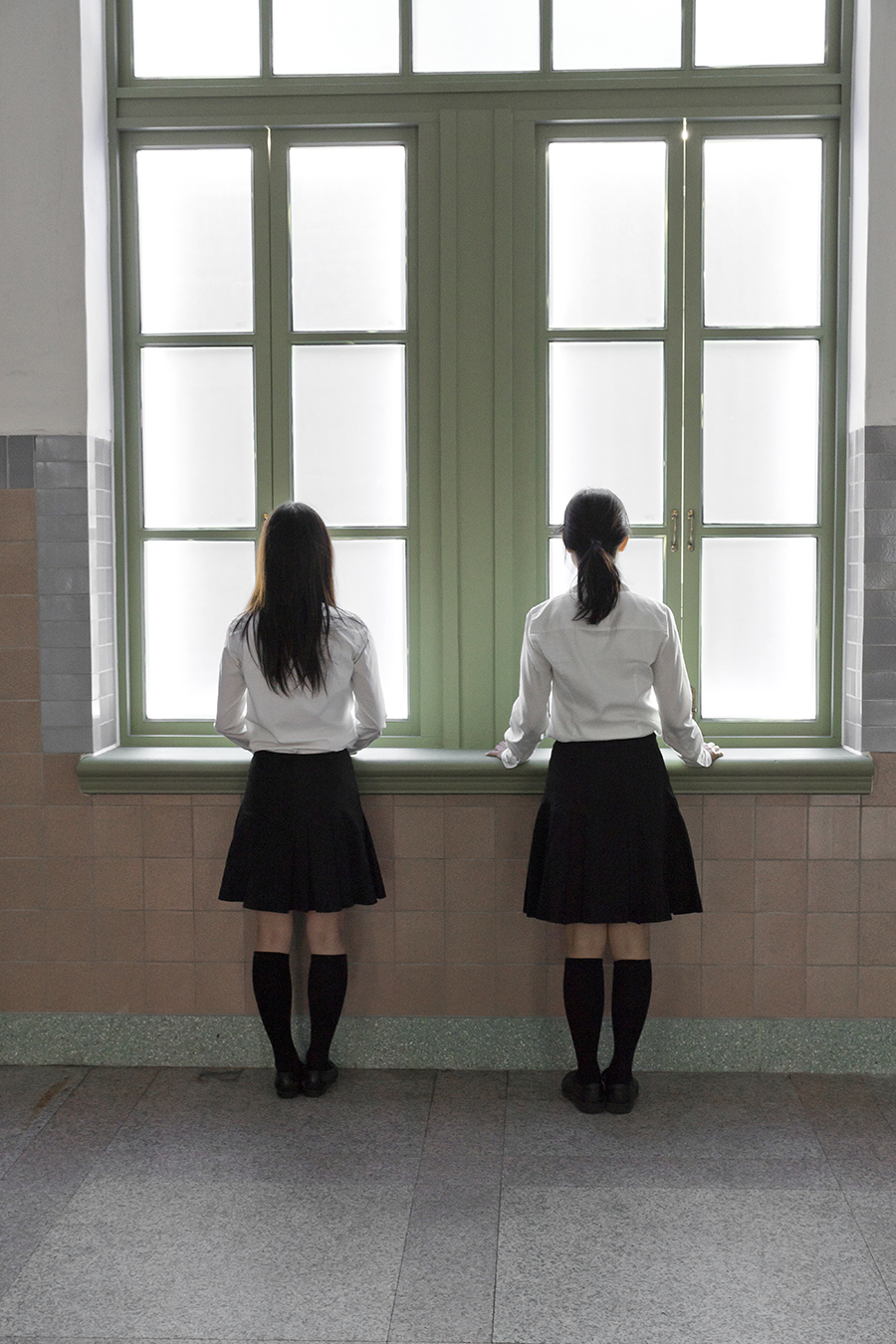
unclear – with no obvious clues of their situation. Their faces are not drawn,
and they mostly appear from the back or as partial views. Viewing Kim’s new
paintings, I was reminded of the Japanese movie “Wonderful Life”, which is
composed of the desired last memories of various deceased characters
immediately before they move on after their death, and create in the viewer an
illusory sensation, of not being sure if the characters are alive or dead or
where they are. I felt a similar sensation of a blurred middle ground from
Kim’s work.
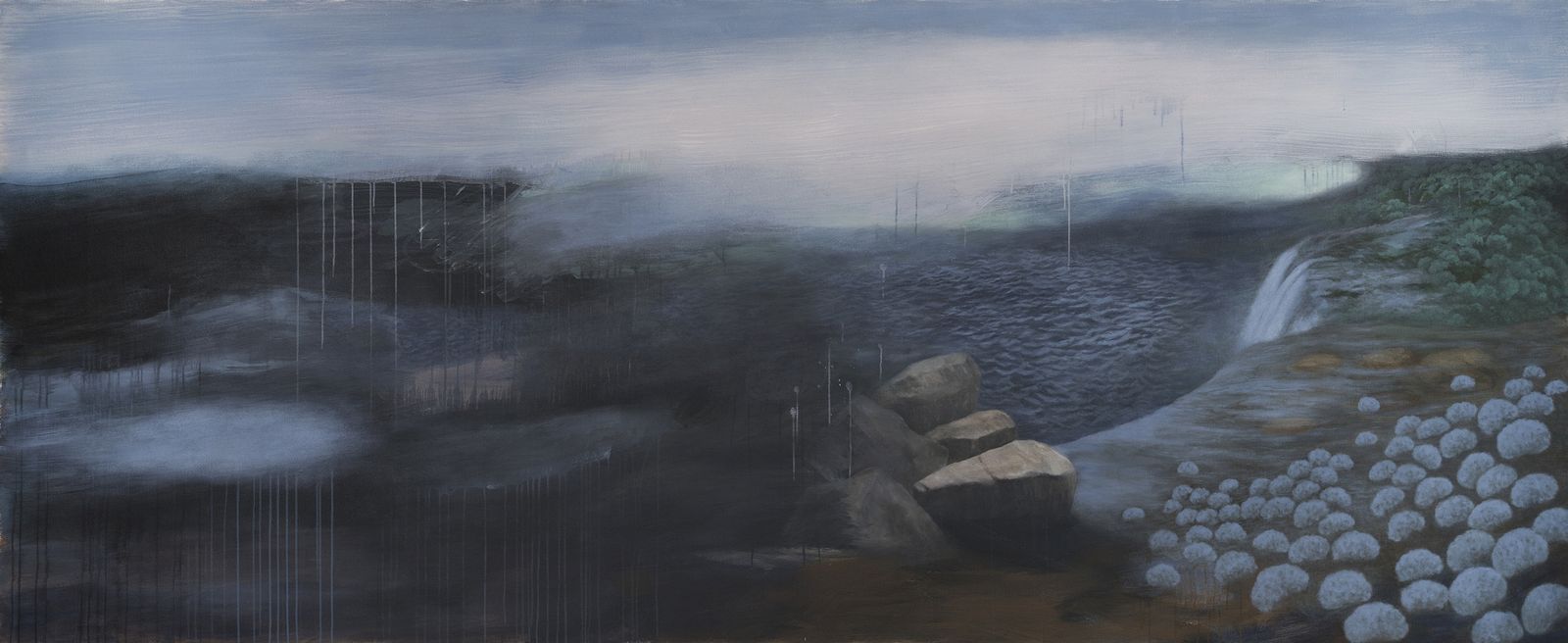
For instance, the uniformed students in Sunset are looking
at the landscape in front of them, but they also look somehow melancholy or
perhaps even singing together, or nervous about their future. Such as images
projected on a screen, they look likely to disappear without a trace once the
projector is turned off. The entire space of the painting seems airborne
through a transparent layered effect, and their existence looks as light as an
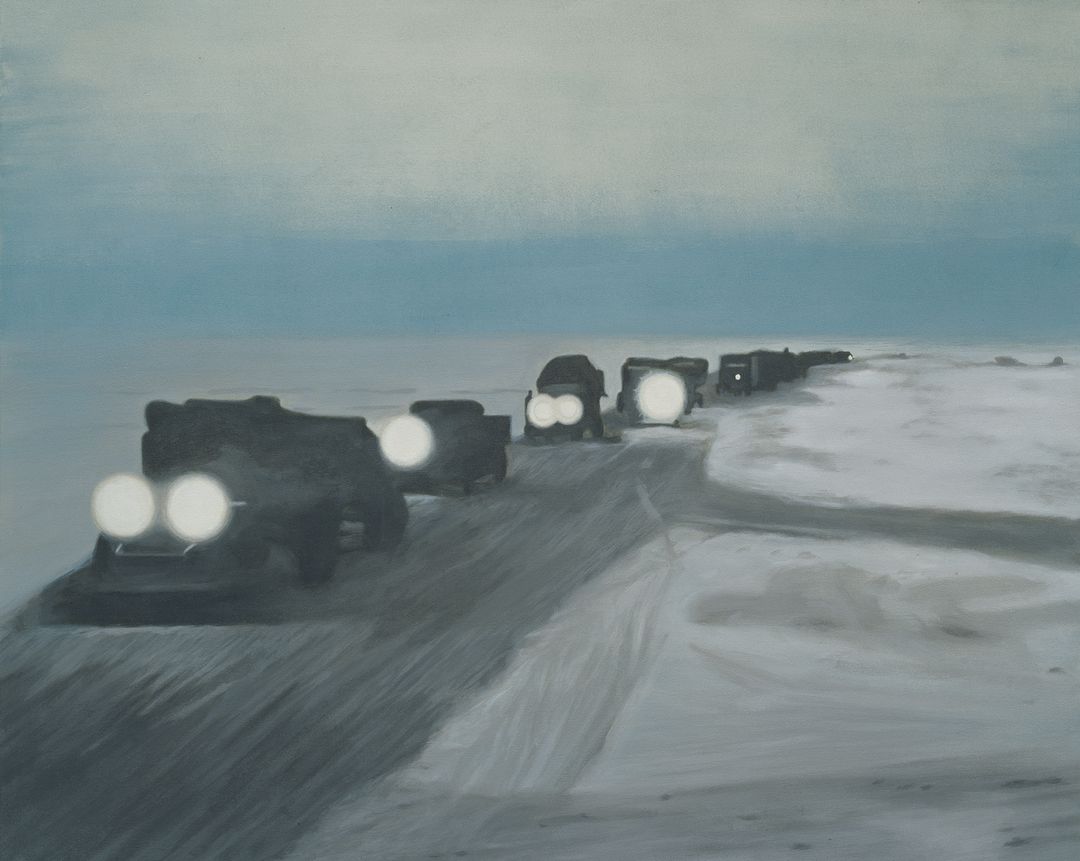
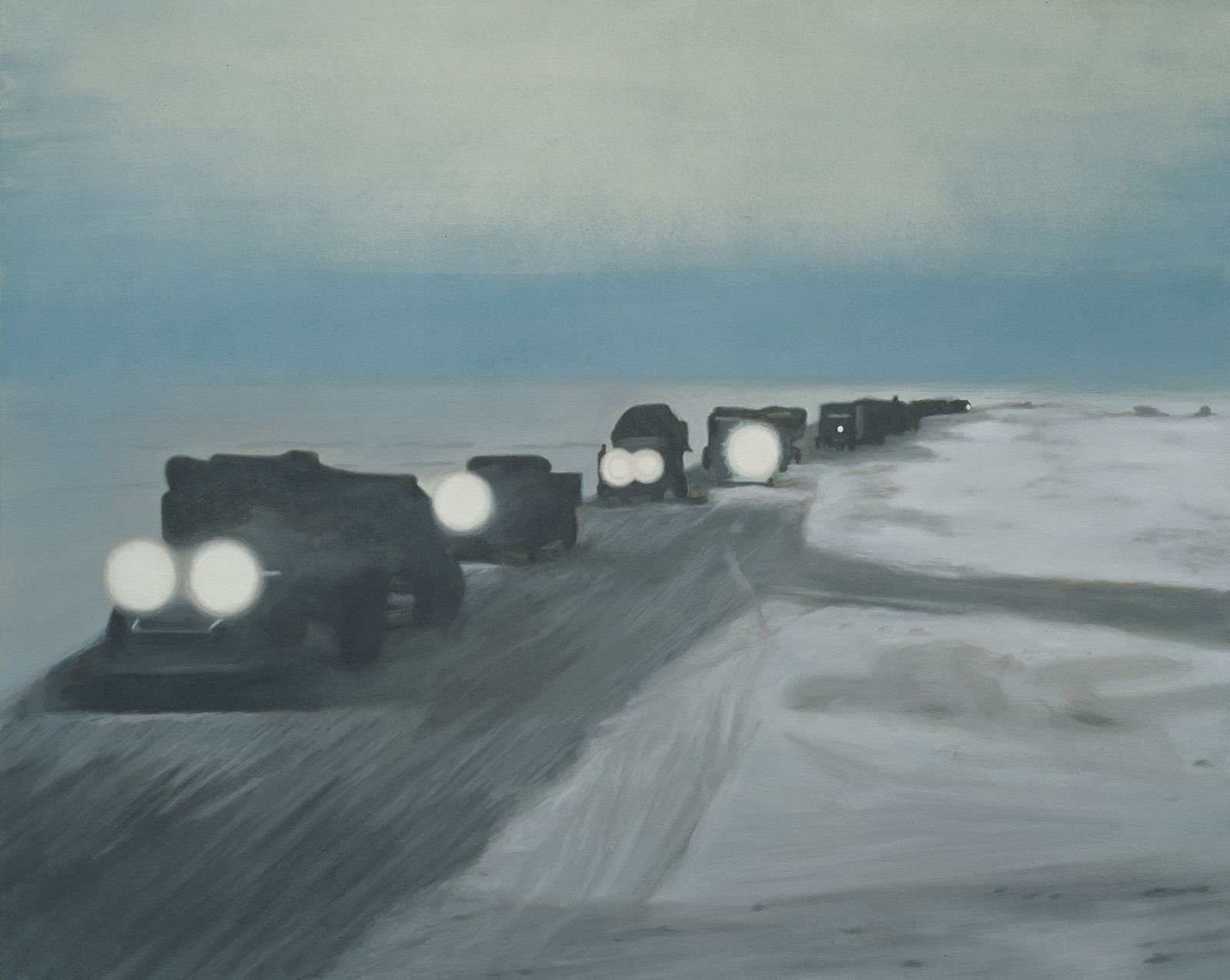
apparition. Works like Drive or Balloon
are transformed newspaper images. In Drive, the procession
of military trucks traversing through the faint light with their headlamps on
looks unsettled and endangered, as if suddenly forced into a secret move toward
an unknown destination.
The parachute in Balloon appears to
be moving very slowly within a space where time has stopped, with no clear
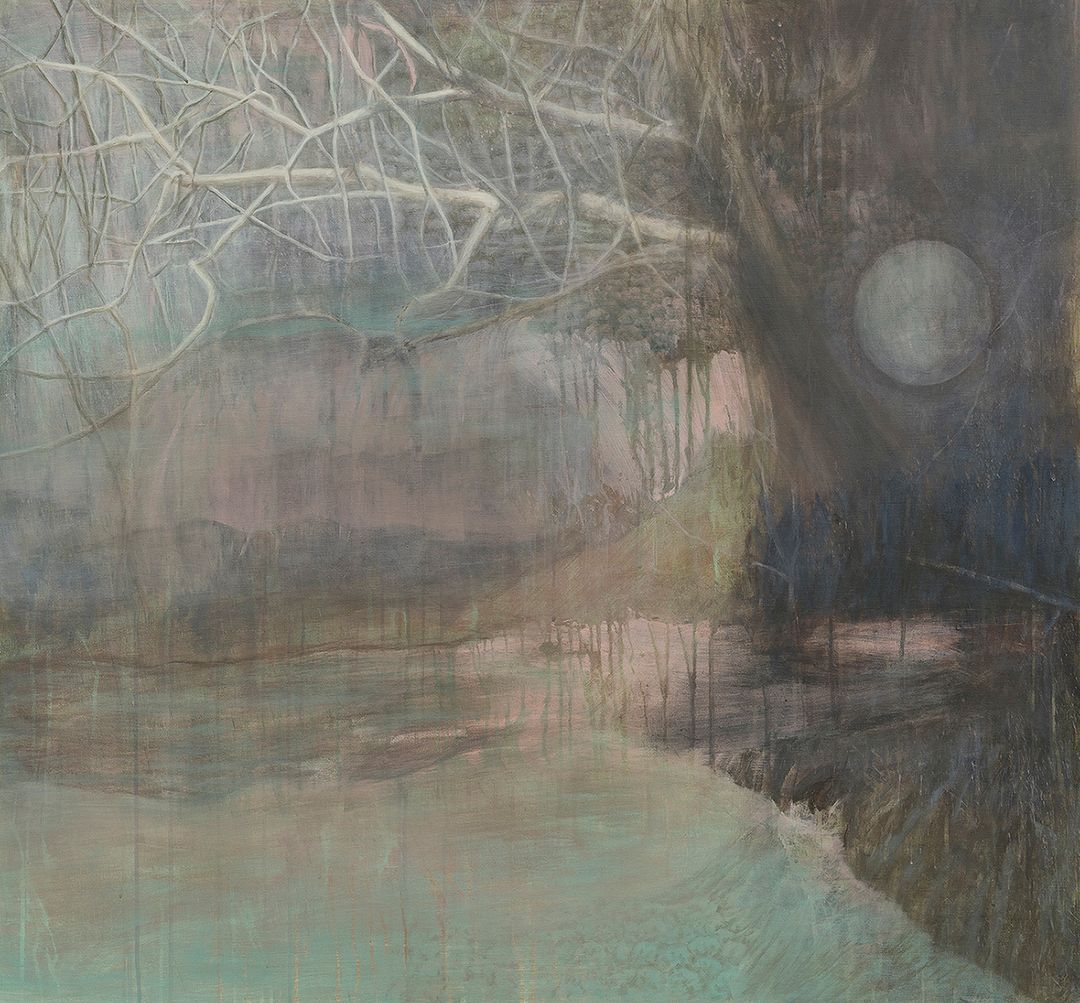
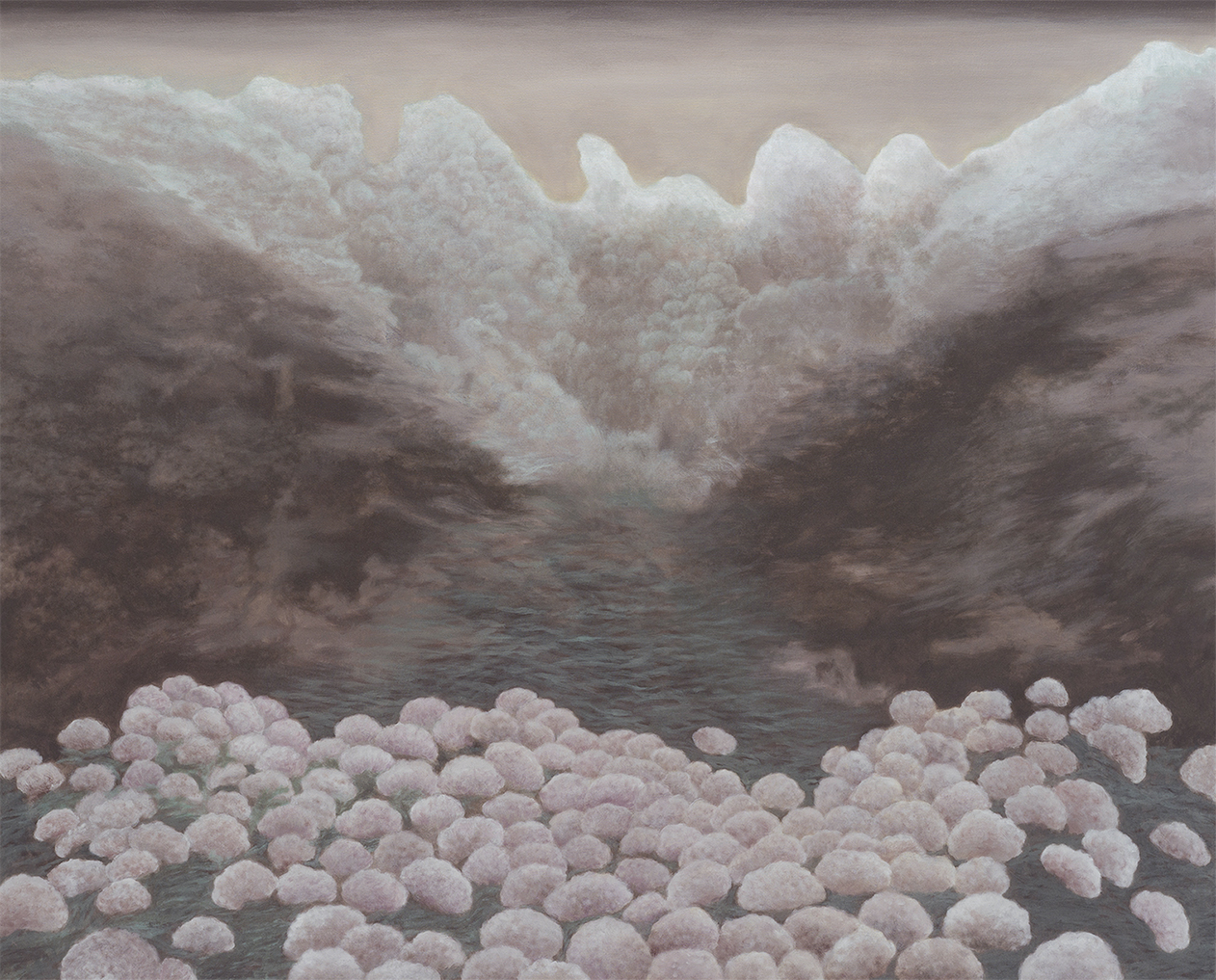
destination. From the building in Spring, which seems
somehow awkward, such as a sudden apparition appearing from nowhere within some
quiet mountains, one is reminded of the psychological experience of mysterious
objects which suddenly appear in a strange shape after being buried in everyday
life. Despite never being seen, they provide a feeling of déjà-vu or faint
recollection. This is likely due to the curious nostalgia created in the viewer
by the emotions imparted in the artificial memories created by Kim. This
emotional effect is a new characteristic of Kim’s recent work. If her past
works had a strong intended sense of a closed space, her recent works seem to
have a slightly open window for discourse where psychological experience can be
shared.
Kim explains that the uniformed girls and her other images are self-portraits
in some sense. Much like a film director, she takes characters and backgrounds
from various sources, removes their original context, and transforms them into
the protagonist and background existing only for her paintings. This
compilation method of creating her own storyline by editing various sources
fits well with her own multicultural interests. This attitude, which must have
been formed from staking out her own space within the disparate Korean and
American cultural frameworks, is still an important part of Kim’s working
process. To her, the original source is irrelevant, and the only significance
lies in how they ultimately contribute to her “perfect image.” By moving
between such sources, Kim is pursuing the psychological space she has lost but
wishes to recover. Even if impossible, her work, which seeks to connect broken
links like a mobius strip, creates a certain empathy. The vague feeling of
déjà-vu generated by Kim’s work may be due to our sense of nostalgia for things
lost. However, this lost world does not intrude into reality, remains forever
on the other side, but still returns faithfully to us as visions.
Kim has recently started a new portrait series of uniformed women well beyond
their teenage years. She is painting these women in idealized poses, in the
manner of icons, such as saints, and she states that they are idealized images
of uniformed teenage years which never existed, while also representing a
mourning for years already passed. This portrait series is Kim’s first attempt
using actual models, rather than indirect sources such as photographs and movie
stills. In placing her models in uniforms and specific poses, Kim is still
acting as the director, and her focus on the desired image rather than the
subject matter seems a clear link with her previous work. However, painting
live figures will involve the expression of a different reality, clearly
distinct from her past efforts. I am anxious to see how these portraits fuse
memory and reality to evolve into yet another “self-portrait.”