1
What does art mean to Minouk Lim? Or more precisely, what is the artist doing
in the name of art? These questions arise out of the nature of the relationship
between her works and the realm of what we commonly call art: the former often
seems to go off on a tangent or sometimes far off from the latter. The artist
has intervened in the social and political reality of ‘here and now’ and
everyday life within the context of the so-called political art. In particular,
she pays particular attention to the evils and disasters brought by financial
capitalism, consumerism, new town development, bureaucracy, and individualism
which have been formed and developed under global neoliberalism, taking themes
and motifs related to them from both mass media and subculture.
Nevertheless,
unlike the older generation of political artists who used art as a
revolutionary tool for social change and the materialization of ideology, Lim
not only pursues the aestheticization of political art through artistic
imagination and creativity power but also internalizes criticism and attack on
the contradictions of modern culture, social discords, a sense of historical
loss, lost memories, and human alienation with the continuing spirit of
skepticism and self-reflection.
Above all things, she approaches the most
controversial issues such as race, gender, body, representation, identity,
subjectivity, the Other, and multi-culture with an altruistic concern and eye.
Her exclamation of grief, “what should I do to live in your life?” — 2 is, in this
sense, an expression of her hope for the mutual benefit- and
relationship-oriented solidarity with others and the embracement of
disenfranchised people. If Lim ever has something that can be called the will
to depoliticization, it is motivated by her poetic sentiment to give artistic
form to the critical attitude toward politics and society and her feeling of
healing which aspires to bridge the social separation and isolation.
In
some respect, this will to depoliticization also parallels a dual or ambivalent
aesthetics which destroys or stands on the boundary between art and politics,
public and personal histories, society and individual, subject and object,
intelligence and sensitivity, and highbrow and lowbrow. It is a practical
ambivalence which definitely refuses to fall into a mere conceptual play or the
trap of ambiguity, but rather, is charged with the willingness for openness and
change, based on the Other-oriented point of view and concrete clarity. It is a
kind of weapon with which the artist challenges the unitariness, wholeness and
singleness of modernism and strikes a blow against the paternal discourse which
created the myth of success on the basis of developmentalism.
Apart
from these anti-modernist and anti-paternal implications, her ambivalent
aesthetics is also marked by non-visible tactility and non-fixed liquidity in
style. Within the framework of feminist criticism, tactility and liquidity are
feminine qualities which are opposed to visuality and fixedness and by direct
extension, to modernist masculinity. As if to reinforce the French Neo-feminist
argument that writing in mother’s milk, or white ink (Hélène Cixous) or an
erotic style that is tactile, fluid, and “already two―but not divisible into
one(s)” (Luce Irigaray) has an explosive power to overshadow or overthrow the
masculine mode— 3, it is in this fluid/tactile style that Lim finds the
creative inspiration to dissolve social and human conflicts. Soft and active
liquid, rather than hard and inactive solid, and tactile contact, rather than
scopic distance, are the reservoir to preserve the recuperative energy to
replenish the warmth of human life.
The
fluid/tactile style is non-systemic and non-visible like the pre-grammatical
language of the Imaginary. This pristine mode, which is not contaminated by the
paternal language, breaks out of the yoke of the rules and principles of the
symbolic. Lim’s signature formal strategies such as ‘jumping’ utterances and
the rhetoric of omission and leap are the most appropriate for constructing the
style. Here, in that her ambivalent aesthetics, fluid/tactile style,
non-systemic language, the rhetoric of omission and leap, etc. are at the
antipodes of modernism, masculinity and the Symbolic, it seems to be not only
possible but also necessary to understand her art in terms of gender politics.
However, this possibility and necessity is immediately blockaded by the nature
of ambivalent aesthetics which denies a single unitary one or univocality. What
lies at the center of her art, which continually strives to remain on border,
is the act of oscillating between two extremes such as femininity and
transcendental femininity, gendered and de-gendered, constantly frustrating
determinism.
2
Ambivalence, fluidity and tactility are also the properties of the medium of
video. Video images retain non-fixed fluidity caused by the flow of electronic
particles as well as a mosaic texture which involves both two- and three-
dimensions due to the intervention of time. Besides, her editing techniques of
omission and jumping create a non-systemic and non-visual video language. In
this sense, it is no coincident that she has used video as her main medium
since 2005.
Her
video works are documentaries. But these are not about the natural world or
specific events, but records of staged performances. They are sometimes
‘narrative documentaries’ with narrative structures and other times ‘poetic
documentaries’ brimming with poetic sentiment. As is suggested by the
adjectives such as ‘narrative’ or ‘poetic,’ her documentaries leave a deep and
ingenuous impression, while always dealing with a series of pairs of
contradictories: subject and object, public and private matters, history and
autobiography, and reality and fabrication.
The
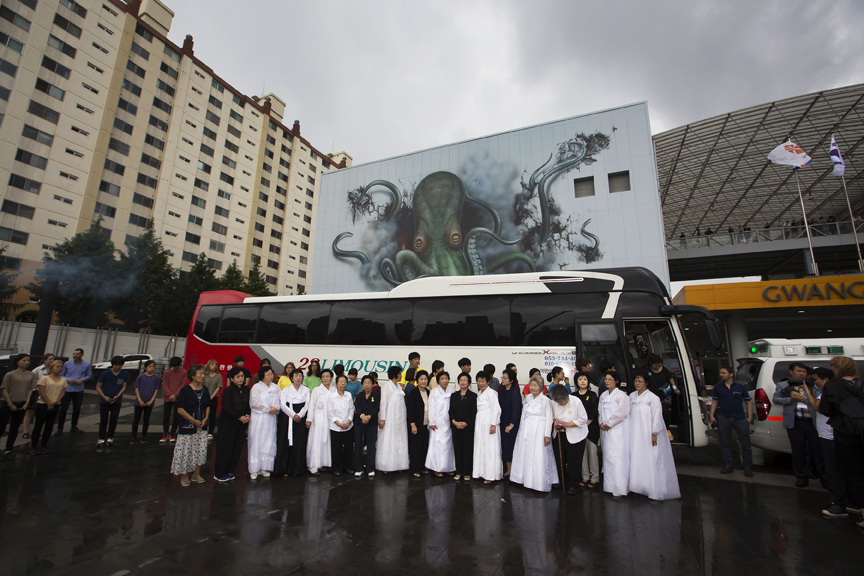
artist’s style is most vividly shown in The Weight of Hands (2010),
a documentary film which follows the conventions of the road-movie format. As
if carrying out an exorcising ritual on soon disappearing landscapes of
oblivion, destroyed and forbidden places, or spaces which are, as the artist
puts it, “already too late,” a person, beating a drum, makes a pilgrimage to
the closed ferry terminal at the foot of the cliff of Mt. Jeoldu, Seoul, the
vacant area of constructed-but-unsold housing units in Paju, and the Ipo Weir,
Yeoju, located on the basin of the Han River and laid bare by developmentalism,
etc. This pilgrimage is joined by a group of people who get off a tour bus and
begin to march in the dark. They all wear raincoats. The stream of movement
continues even in the bus: a woman who, holding a microphone, sobbingly sings a
song of farewell, is being lifted and carried by hand by the passengers. Lying
down like a dead body, or alluding to a funeral procession, she mournfully
flows through their hands like a river, like rainwater, or like tears.
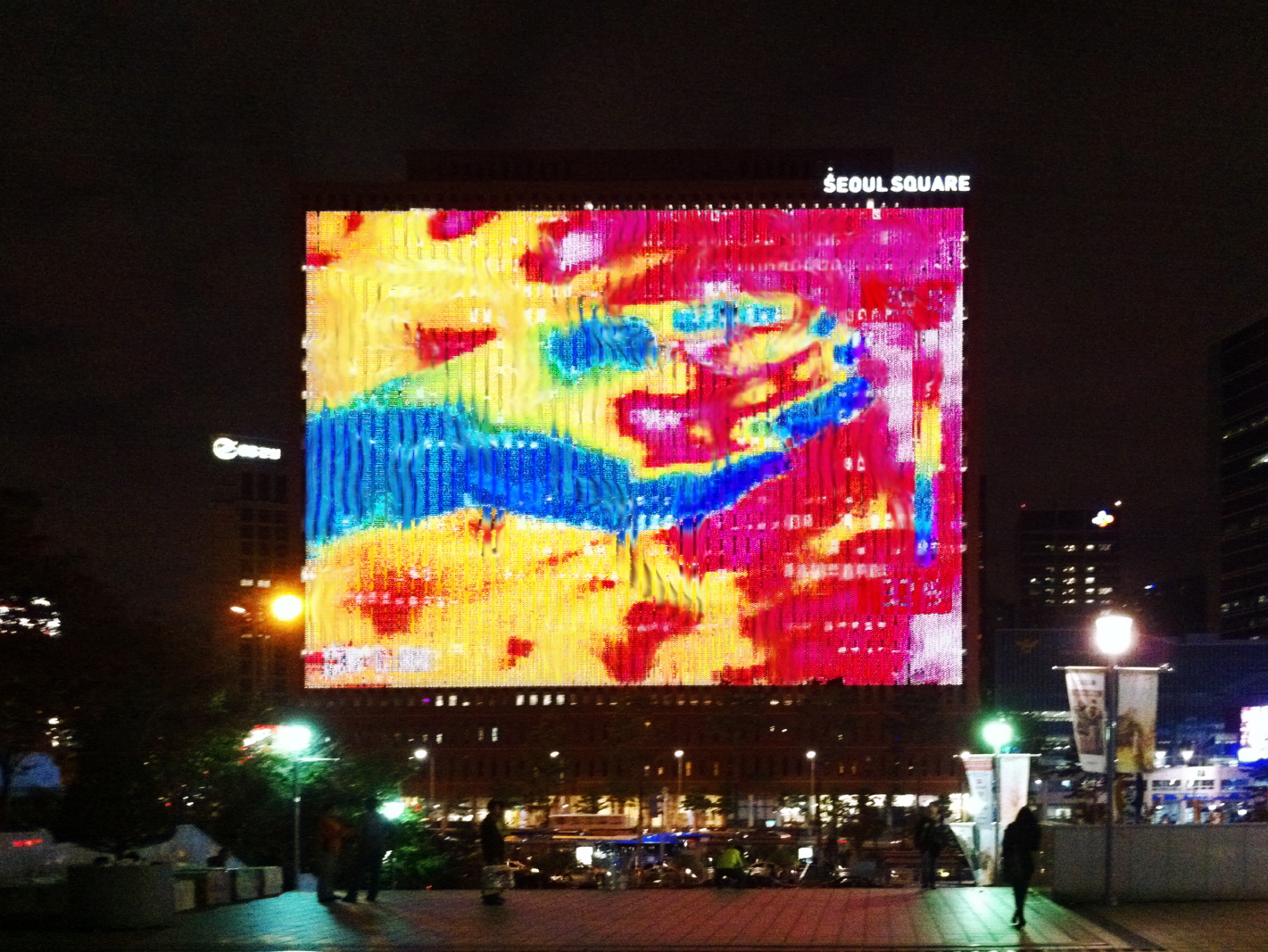
The
images like nightly rain, a running tour bus, pilgrimages of a drummer and
tourists, and the lateral drift of a singing woman have liquid qualities,
symbolic of the process and energy of movement, current and mobility.
Furthermore, the artist imbues these damp liquid-like images with warmth and
heat by using an infrared thermal camera. As soon as heat or temperature
captures an object, its image goes into the ‘warming’ or ‘heating’ mode,
quickly losing the sense of substantiality and being converted to illusionary,
immaterial one. These melting, distorted forms and their translucent
colors―reminiscent of watercolors― not only contribute to enhancing the
fluidity effect but also evoke the tactile sense, inviting viewers to touch
them.
While
video images by definition have a mosaic texture, Lim’s use of thermography
maximizes their tactility by transferring realistic forms into abstract colors
and textures. Thus, the title, the “weight of hands,” could be interpreted to
mean the heaviness perceived not by eyes but by hands. As the artist suggests a
new terminology of “sight touching” for “sightseeing”— 4, she aims to recover
the spectacular scenes, which were all built upon deadly destruction, through
contacting and touching. So, instead of the hand of construction, she
introduces another one, that is, the hand of ethics whose weight in no way
measurable. If the gigantic excavators frequently appearing in her videos
represent the hand of destruction for construction, the hands of the passengers
who hold up the weak and feeble woman and try to ease her grief are those of
salvation and healing. The striking distance between these two hands which
could be respectively regarded as paternal and maternal explains the sensory
difference between sight and touch and the perceptive difference between visual
and tactile sightseeings.
—
1 The title is borrowed from Jacque Derrida’s “Living On/Border Lines”
(translated by James Hulbert, in Deconstructionism and Criticism, edited by
Harold Bloom et al., New York: Seabury Press, 1979, pp. 75-176).
— 2 Works, www.minouklim.com
— 3 Chris Weeden, Feminist Practice and Poststructuralist Theory, Oxford: Basil
Blackwell, 1987, pp. 65-68; Luce Irigaray, This Sex Which is Not One (1977),
translated by Catherine Porter with Carolyn Burke, Cornell University Press,
Ithaca and New York, 1985, p. 78.
— 4 “Here, the term ‘Sightseeing’ is replaced by ‘Sight Touching’ and the video
record of the performance becomes a medium to perceive temperature and
weight.”(Works, www.minouklim.com)
3
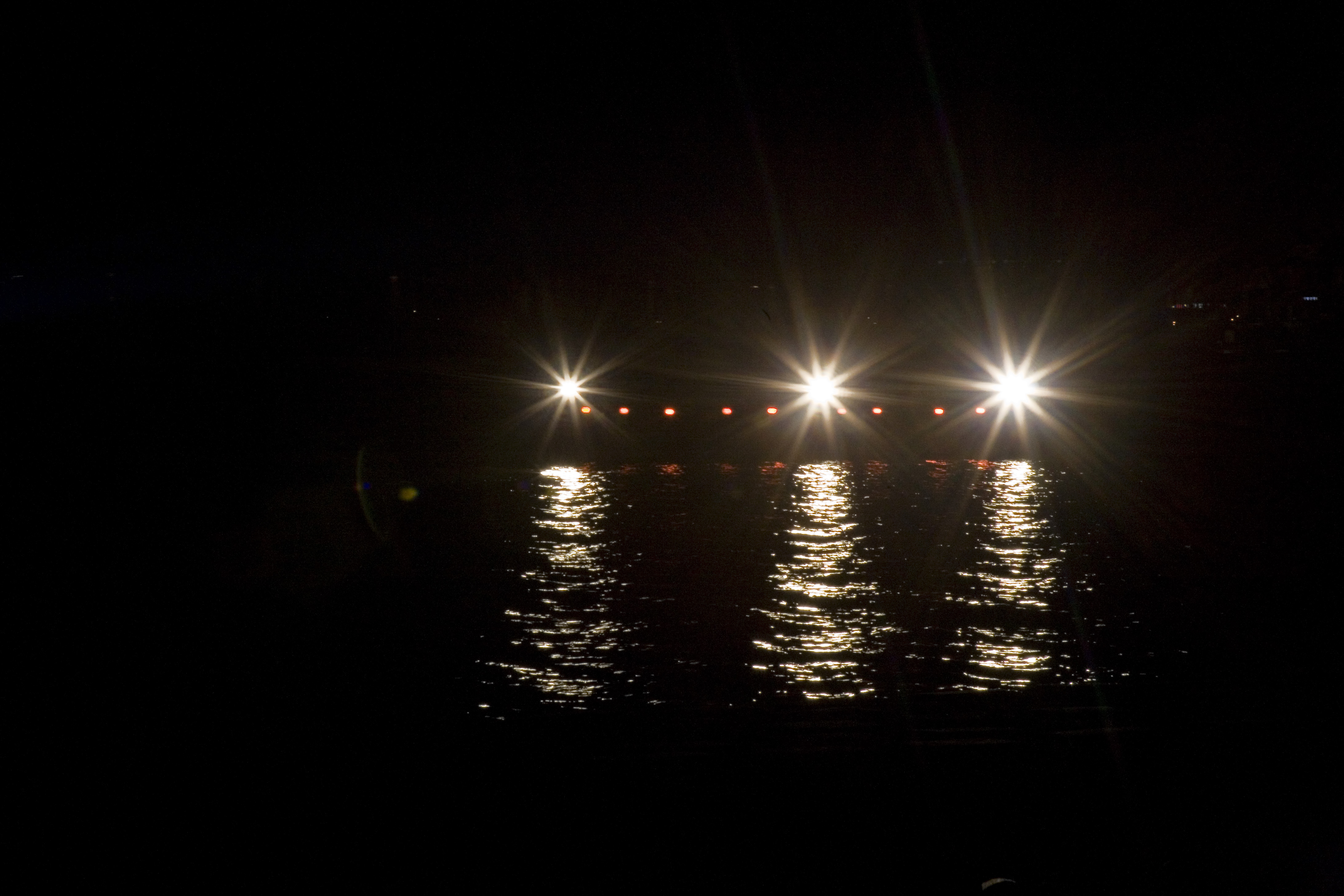
In S.O.S.– Adoptive Dissensus (2009), a documentary video of
a participatory performance given on a cruise ship along the Han River, Lim
explores the transition from visual sightseeing to tactile one. Here,
passengers on the ship are invited as the audience of the three episodes which
are being played on the riverbank. Like a story-within-a story, the film
comprises three inner narratives within a frame of cruise tour, with which it
unfolds a multilateral outer story, “S.O.S.” The artist poses questions to the
viewers by adopting three episodes regarding on the following issues: the
temporal and spatial disagreement with the ever accelerating world, the
dissensions occurring within the developmentalist desire, and the memories of
and resistances against “what we have already seen and what we have already
lost.” The audience becomes a momentary community who shares the situations and
memories of the three episodes and thereby “experiences a Möbius loop where the
role of object and subject is reversed.” — 5
The
first episode is a united demonstration of young people who rise against
developmentalism and call for “nameless places,” the second is a dramatic
farewell ceremony of two lovers who are reclaiming their refuge for love, and
the third is a lonely monologue of an unconverted long-term prisoner. All of
them send S.O.S. messages with a mirror, or by making a gesture, or through a
walkie-talkie, but the ship’s searchlight does not answer them, only to scan
the facade of the city. Though a real S.O.S. rescue did not take place
actually, the artist’s questioning about the “Han River Renaissance” leaves a
long-lasting impression both to the passengers on the cruise and to the viewers
in the exhibition room.
Here
again, as might be expected from the fact that it was a waterborne performance,
aquatic images and the motif of movement remain prevalent. All the passengers,
let alone the ship itself, join in movement and the light of the searchlight
and the synchronous sound heighten the excitement and tension of the cruise. If
the sensations of liquid and movement are evoked by tactile images in The
Weight of Hands, it is an omnidirectional, multisensory environment
that creates the same sensations in S.O.S. Adoptive Dissensus.
The artist becomes both a writer and director of this environmental total
theater, actors and audience being the Han River, the lifeline of Seoul, the
cruise ship, the captain and passengers on board, and the performers of the
three episodes on the three sites on the riverbank. This kind of a large-scale
collective performance which occurs real-time in a specific place for two days
inevitably emphasizes the sense of community and cooperation rather than an
individual’s vision, as well as involves the elements of life marked by its
accidents and events. Ultimately, by advocating life art and popular aesthetics
and attempting to unify the irreconcilable discordances such as art and life,
or art and the public, the artist proposes another Möbius loop in another
level.
As
was shown in the two above-mentioned works, rainwater and river water are the
symbolic subjects and motifs to embody the artist’s fluid/tactile style.
Furthermore, water has also an important meaning as an artistic material. This
liquid medium to dissolve heterogeneous substances into one inspired her to
find a new mixing technique of ‘marbling,’ i.e. a formal hybrid of unexpected
patterns and textures created by arbitrary blending of water and pigments. As a
visual expression of the liquid non-fixedness and as a product of the momentary
contact which brings disharmony into harmony, marbling serves as a key
technique in her unique style.
On
a rainy day, Lim had an extreme marbling performance in which she poured paints
on the car roof and then drove speedily so that they could melt in rainwater.
Or she built an imaginary miniature New Hometown by sticking
bundles of useless pens and pencils into a marbling canvas which she had made
by dissolving paints in water in a pool. The driving performance on a rainy day
and the site-specific installation in a pool were open to public as the formats
of documentary photography and ink-jet prints as part of To No Longer
Tell the End of the Rainy Season (2008). Here, she bitterly denounces
superfluity and excess, unlimited desire for growth, and the ideology of rapid
development, all of which are suggested by the rainy season or a flood on the
one hand, and on the other, earnestly prays for the communication, connection,
and harmonization between the self and others through the marbling technique of
mixing heterogeneities.
Considering
the fact that marbling allows the joining between art and external
nature/natural phenomena, latex, Lim’s another favored medium, can be used to
the same purpose. She pours liquid latex onto the roof of buildings or the
ground and exposed it to sunlight, wind, snow and rain for several months,
until it is hardened. This too is a fluid/tactile work to produce specific
textures by solidifying liquid. So both marbling and latex work are the
indexical trace of natural phenomena as a product of physical contacts. In
index art forms such as photography and video in which the image is identical
with its subject, physical marks are presented instead of imitative
representations. Therefore, Lim’s narrative/poetic documentary films which
recorded redevelopment districts, the “already-too-late” spaces requiring
memory, their trails of destruction and the process of reconstruction with her
unique fluid/tactile sensibility rather than with her eyes, are an extension of
her marbling and latex works based on the same sentiment and imagination.
—
5 Minouk Lim, S.O.S – Adoptive Dissensus — Bartleby in Myself (2009),
exhibition catalog of Hermès Foundation Missulsang 2009, p. 154.
4
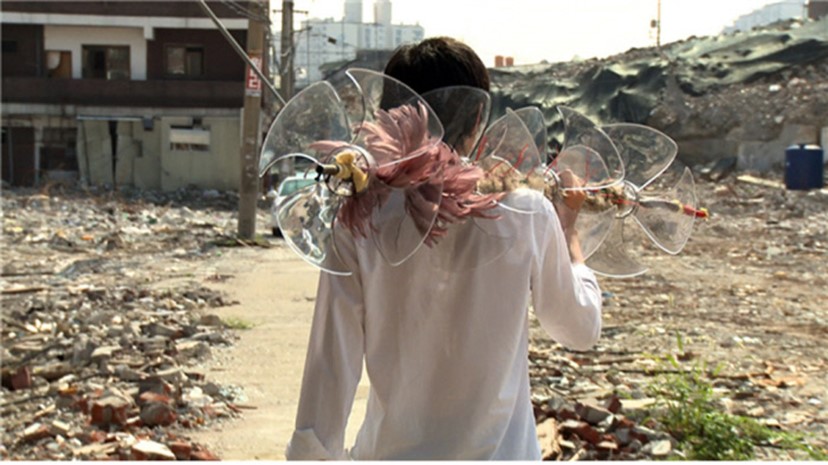
Portable Keeper (2009) and New Town Ghost
(2005) are documentary videos of the performances given in the redevelopment
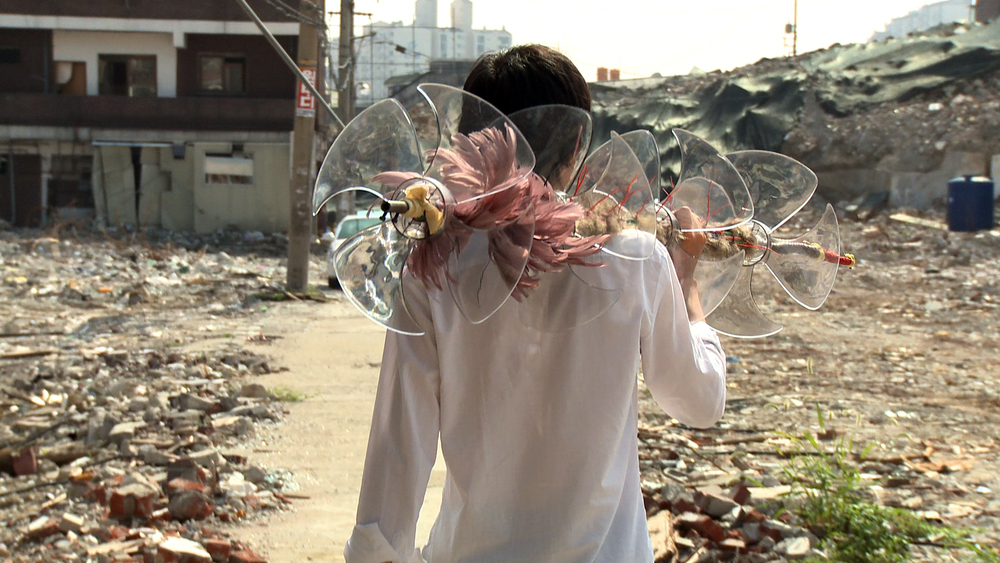
district in Yeongdeungpo, Seoul. In Portable Keeper, a
young man carrying on the shoulder a bar-like strange object made of tying
together useless writing utensils, bird’s feathers, faux fur, and fan wings
strays aimlessly through the market site and urban areas which became ruined or
changed to construction fields under the influence of The New Town project. The
thing on his shoulder reminds you of a weapon or an incantatory object but he
just looks enervated and exhausted, far from being a warrior or a shaman. The
object with which you can do nothing and which is useless and functionless and
its keeper seem to represent the sigh of grief over and the resignation to the
irrecoverably “too-late space.”
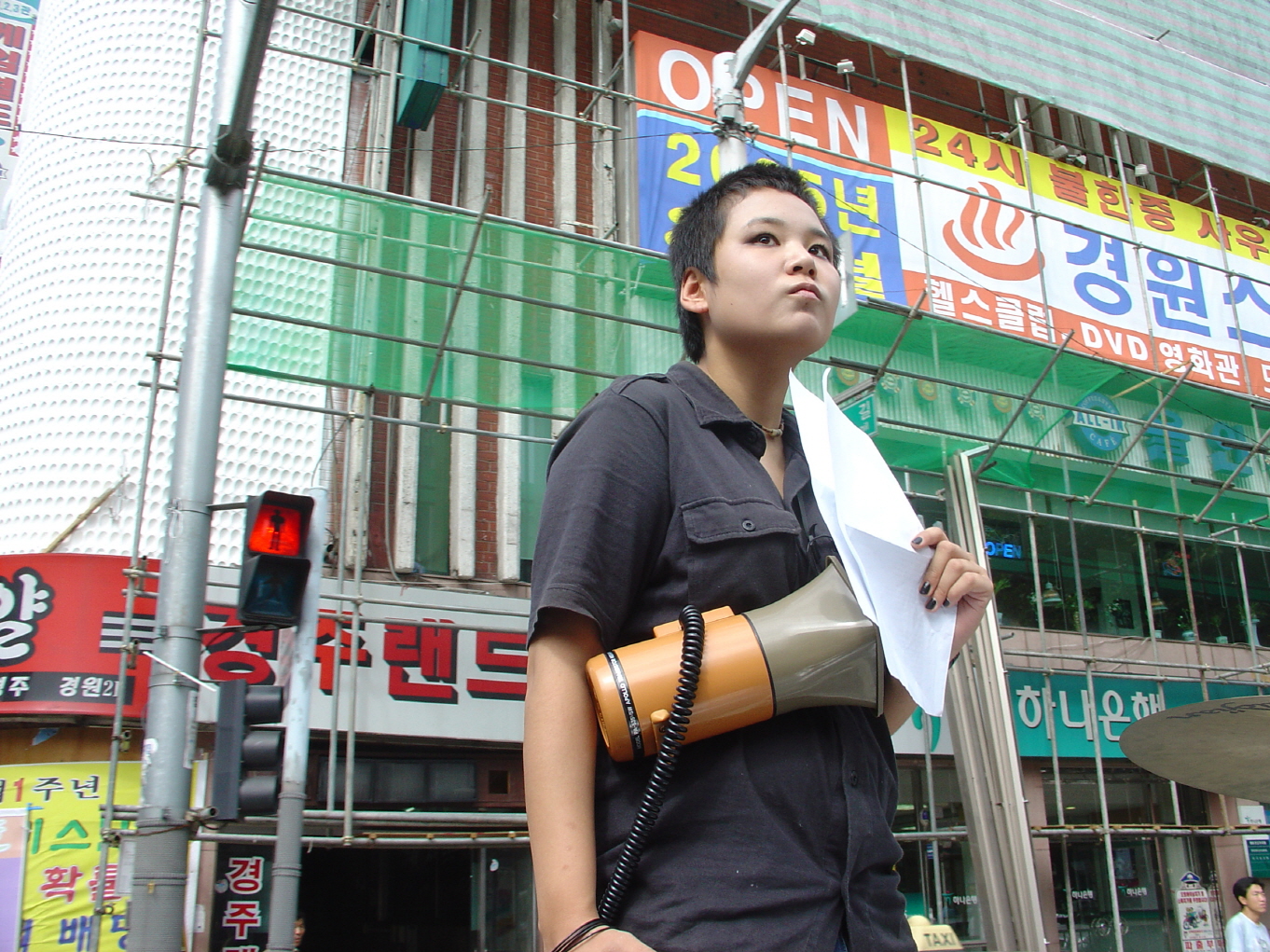
In
New Town Ghost, a street band composed of a rapper and a
drummer sing the resistance against and surrender to developmentalism in the
back of an open truck, their moving stage, traveling around the bustling
Yeongdeungpo Market. The female rapper in short cut hair recites aloud the
artist’s sarcastic texts about construction, prosperity, and the progress
ideology, announcing the advent of the sheer ghost of uncompassionate
developmentalism. The performance which is suggestive of an MV of an indie band
or a boisterous election campaign was done, moving around the neighboring area
of the artist’s home and office. In contrast to the ruined scenery which will
be selected as the setting for Portable Keeper after four
years, the area is still shown as the space of everyday life, crowded with
signs, stores and passersby.
Through
these two site-specific videos which include the recollections of her own and
her neighbors, the artist deals with the process of redevelopment of
Yeongdeungpo changing from the city’s old center of manufacturing to the
present new town and the complex feelings of its inhabitants’ hopes, regrets,
resistance and accommodations. If the clamorous rapper anticipates the specter
of development, the silent portable keeper intends to hand down the lost memory
as the last witness of the old town.
As
is illustrated by the way in which both of the two films closely interweave the
history of Korean redevelopment with the artist’s own story, Lim’s works
largely start from her personal and everyday experiences. Similarly, Game
of 20 Questions: the Sound of Monsoon Goblin Crossing a Shallow Stream,
a documentary of “The 4th Migrants’ Arirang 2008” shoot and edited by her, does
not avoid autobiographical reference. As if to confirm the feminist slogan “the
personal is political,” the artist investigates the truth and falseness of the
discourse on multiculturalism, in particular, the racial problems inherent in
the designation “Kosian” from the viewpoint of the minority family with a
French-Korean daughter, turning an altruistic eye toward and facing up to the
emergence of multicultural family as a new social phenomenon and a new
community in Korea today in the global age.
Wrong
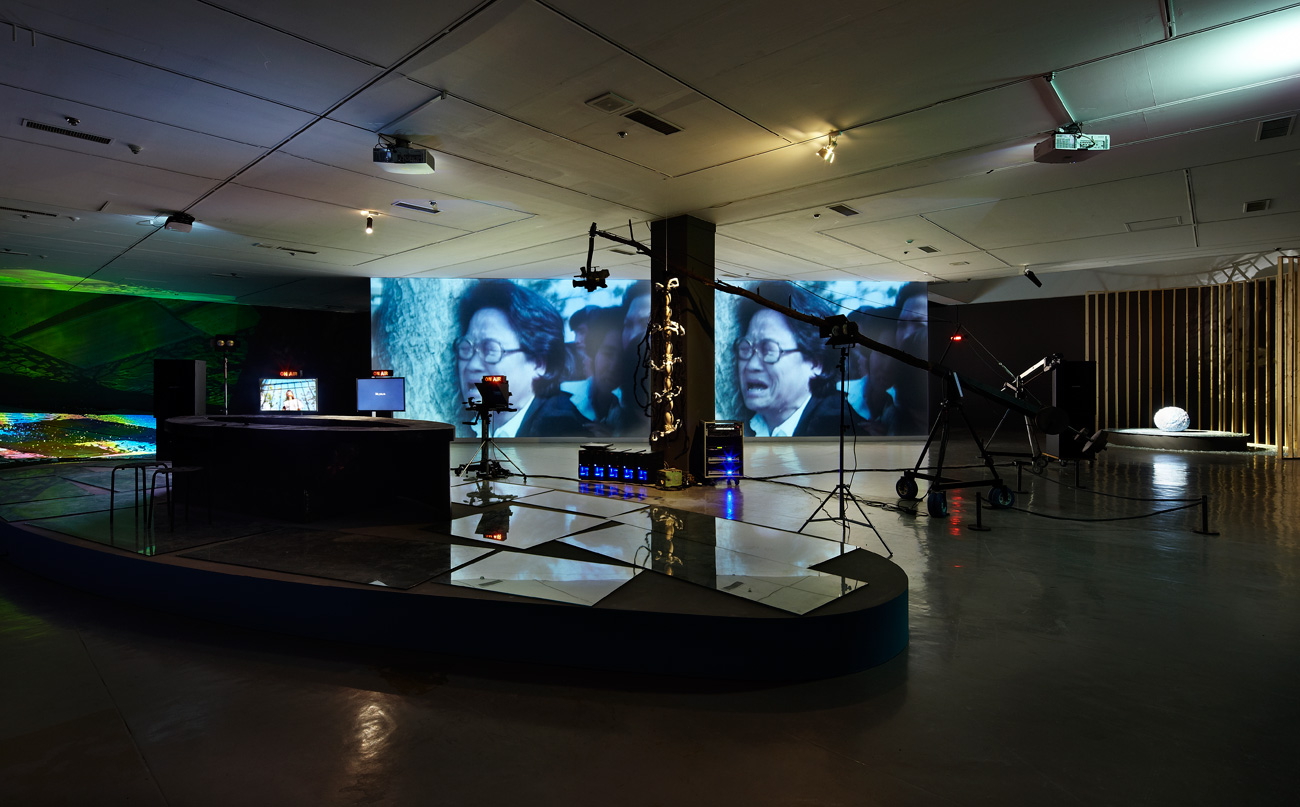
Question (2006), the 2 channel video work, presents the familiar
urban images like construction fields, demonstrations, and expressways,
accompanied by the ‘voice-over’ narration of a taxi driver who is emphatically
praising the rapid economic development occurred under the Park Jung-hee
regime. These scenes are interrupted frequently by scenes showing the artist’s
daughter –who appeared also in Game of 20 Questions – asking
questions in Korean to her grandfather. By using voice-over technique to create
the incongruity between image and sound, Lim tells you that the right answer to
a wrong question lies “not in the correspondence between image and sound but in
what is left behind in their distance.” — 6 In other words, the solution can be
given only by the attitude of mutual benefit which acknowledges difference, not
by binary oppositions such as left/right, new/old, east/west, which eventually
come down to agreement and identification. This is the very role of imagination
which is different from ideology and simultaneously, the power of art which
varies from politics.
—
6 Works, www.minouklim.com
5
In her Hermès Foundation Missulsang exhibition in 2007, 《Too Early or Too Late Atelier》, Lim aims to
show how imagination and art overcome ideology and politics and accept
diversity and difference. If a series of installation works including a latex
carpet made by casting the ground, a quilted car cover hanging from the
ceiling, and a transformed refrigerator are personal responses to the modern
urban life and everyday experiences, the video work titled The First
Impression of the Second Edition underscores the potentiality of the
present progressive tense which can be a new start at any time through a
bookbinder working in Choongmuro who concludes everything by saying “my name is
~ing.” The meaning of ‘too early or too late atelier’ might lie in opening
“polymorphous and complicated worlds in the distorted relation with the past
and to find another possibility of practice in them.” — 7
Original
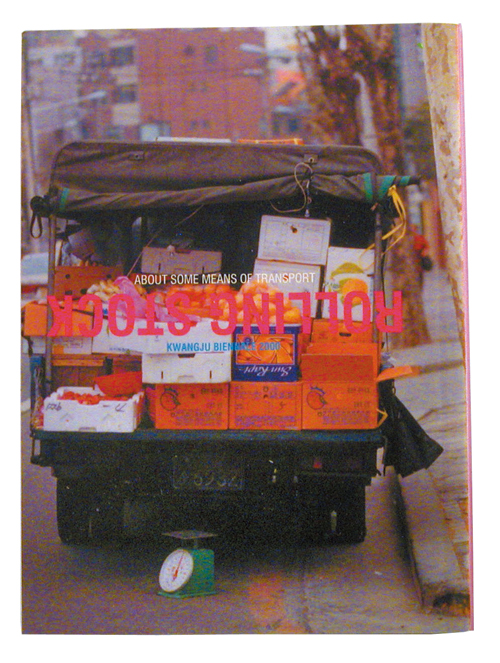
Live Club – Women’s Only Space presented in 2006 Gwangju Biennale
brings up a self-regulating alternative to globalism as a paternal structure
and the institutionalized biennale. At the entrance of this women’s only space
are screened the female images circulated in male entertainment establishments
and in the inside where both economic and porn magazines are supplied, female
audience are encouraged to take copies of their body parts as a participatory
activity. In the process in which the secret stories about what is going inside
are conveyed to male audience only through female participants’ explanation,
the female sex is mystified and information is distorted or omitted. By
creating a gender-specific space, Lim subverts the hierarchy of the traditional
art institution, exhibition culture, audience’s attitude, and the order of
communication. If this piece is conceived to “find another possibility of
practice” for the “distorted” biennale, it might be appropriate to rename it
“too late or too early Gwangju Biennale.”
The
exhibition 《Jump Cut》 held in Artsonje Center, 2008, shows not the tragedy of time
difference, which is ‘too early or too late,’ but another kind of movement
found in improvisation, accidental encounters and temporary relations.— 8 Here,
the movement relates to marbling using water, rain, flow, and natural
phenomena, that is, the casual action caused by momentary contacts between or
among heterogeneous elements. The artist moved the old-type Hyundai Grandeur,
the car she drove herself in a rainy day for her marbling performance, into the
exhibition space and converted it to a fountain called The Miracle of the Han
River. By liquefying and nullifying the miracle and a Grandeur, the Korean
symbol of prosperity, authority, riches and honors, into the monument of water,
she satirizes the distorted too-early-or-too-late Han River Renaissance.
The
eponymous work of the exhibition was Andrei Tarkovsky
‘Offret-Sacrificatio’―Jump Cut (2008), a film which attracted much
attention from the audience. Instead of taking the documentary format, this
eight-minute-long single channel video is a concise edition, or to use a
technical term, a jump-cut version of the feature film, The Sacrifice
by Russian director Andrei Tarkovsky. Because of its rapid scene changes, the
original storyline was impaired but the viewers were made to use their association
and imagination freely and actively. The artist gave back the edited, cut, or
omitted parts, which had been sacrificed in the process of making the new
version, as the audience’s share. However, this mode of interactive
appreciation which requires the recipients’ participation is also what she
demands from her own work created in a non-visible and non-systemic language
like jump-cut, that is, the rhetoric of omission and leap. By sacrificing the
film by the master director of the century using the jump-cut technique, she
attempts to recall the victims of the growing pains of the too-early-or-to-late
modernization to the audience and make them think over the true meaning of the
sacrifice for the salvation of the world and the development of the human race.
— 7 Works, www.minouklim.com
— 8 Works, www.minouklim.com
6
Her jump-cut version made the original film, which is well-known for being
difficult to understand, much more difficult. Perhaps it might be that the
artist intentionally chose the jump-cut technique to make it speak for her
difficult art and its validity. Lim’s videos marked by ambivalent aesthetics, a
fluid/tactile style, and a non-systemic/non-visual language have much in common
with the films by cine-artist Tarkovsky who denied realism, popular tastes, and
commercialism in pursuit of art cinema, but nevertheless, still persisted in
intertextual film-making for the audience. Besides, Lim’s critical concerns
about politics, society, culture, gender and ethics and practical activism are
also in line with the thoughts of the cine-artist who opposed authority from
critical and democratic viewpoints and talked about the future hope which would
be made possible by the memories of the past, nostalgia, and sacrifice with
constant self-examination and enduring humanity.
Lim’s
critical attitude and activism were evident in her early career. After
graduating from École Nationale Supérieure des Beaux-Arts, Paris, in 1995, she
worked as a member of a radical artists’ group “general genius” which she
organized with seven artists including Frédéric Michon in 1997, and then, had a
lot of exhibitions from 1998 when she returned home to 2001 when went back to
Paris. In defiance of the museum culture or exhibition conventions, most of her
works in this period were enterprising and alternative projects which replaced
object-oriented exhibition with process-oriented field work, making exhibitions
themselves the works of art. Social Meat (1999) presented in
the group exhibition “Tendencies of the New Generation” at ARKO Art Center
caused a great sensation and earned her ‘enfant terrible,’ for it realized the
provocative idea of opening the museum store as an exhibition room or changing
the exhibition hall to a rabbit warren.
After
coming back to Seoul again in 2004, Lim formed Pidgin Collective as a
descendant of Pidgin Girok (or Pidgin Record), an artists’ group in which she
had worked with Frédéric Michon since 2000, pursuing alternative activism in a
more earnest way. As she articulated the goal of Pidgin Collective as “not to
be limited to the single domain of the art world, but to create new situations
to disturb situations inside society,”— 9 or as term ‘pidgin’ suggests, the
collective prefers cooperation and community, having executed a lot of
non-systemic, temporary, process-centered and open-end projects. This is why
the group has paid more attention to everydayness and subculture than artistic
purity and attempted to draw out communicative, participatory, and interactive
creativity from them. The series of Scrap Project, performed in cooperation
with the Haja Center, a Korean alternative school, from 2004 to 2006, provided
an active archive with which to create a new art movement group involving in
the political and social reality and to develop a new model for youth culture.
The
art world of Lim who criticizes about the political and social contradictions
in contemporary Korean society in broad terms and more narrowly, new town
development, and sometimes the art institution, trying to present recuperative
alternatives to them, takes root in the aesthetic foundation which is made by
tempering and refining her keenly critical mind toward political issues and
interventional activism with artistic creativity, humanistic reflection and
literary sensibility. Standing at the frontier zone between politics and
aesthetics, armed with intelligent suspicion, ethical hesitation and the
sensibility of jump-cut-like omission, the artist constantly withholds any form
of political creed and assertive utterance which is all too subject to be declarative
and educative.
As if being the double of Bartleby, the eponymous main character
in Bartleby, the Scrivener by Herman Melville, like a
Bartleby here and now who tries to “read the invisible from what they see and
see something from the invisible,” Lim belongs to “those who hesitate and keep
looking back questioning themselves rather than giving a confident answer of
yes or no” and converts her resistance and negation to the rhetoric of
“momentary tremors, hesitations, empty talks and murmurs.”— 10 And this is
exactly where both the portrait of Lim, the artist living on border, and her
art found on ambivalent, borderless aesthetic are now placed.
—
9 Youngwook Lee, “Fine art, Too Late or Too Early,” Jump Cut, exhibition
catalog, Artsonje Center, 2008. p, 89.
— 10 Minouk Lim, “S.O.S. – Adoptive Dissensus―Bartleby in Myself.”