A New Genre : Robot Art
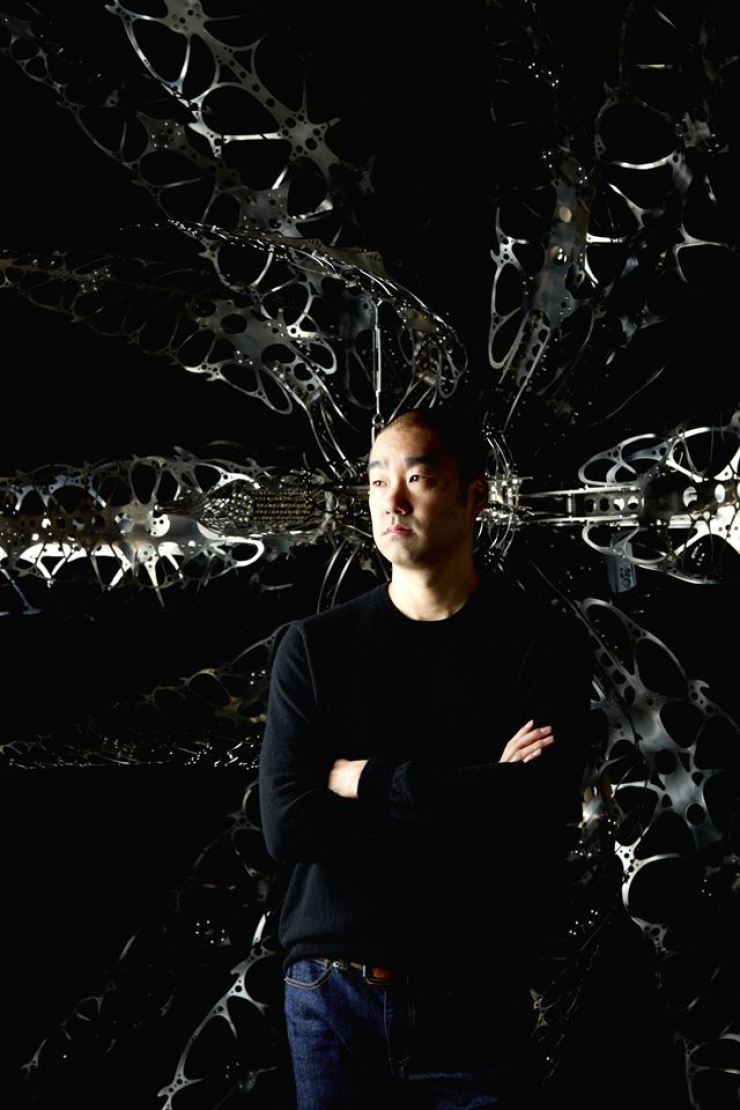
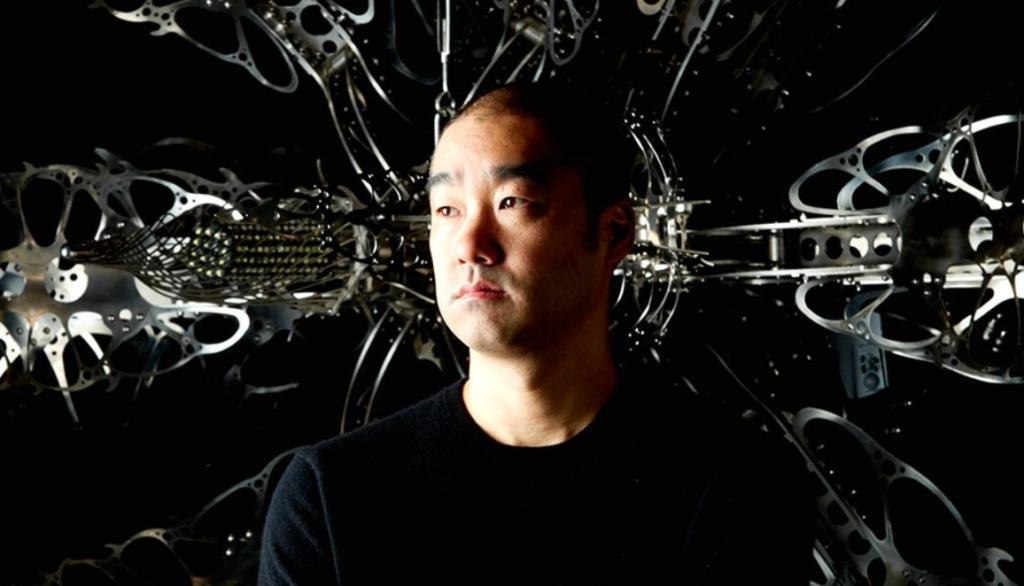
Choe's
work is a kind of progressive kinetic art, the perfect melding of artistic
imagination with technique. Advancements in technology and science has always
been a major force in taking art to the next level. The discovery of
perspective, the camera obscura, the development of new materials through
advancements in chemistry, Einstein's relativity theory, Nam June Paik's video
art, recent strides in media art -- these examples show how art has moved in
tandem with cutting-edge technology not only as in the domain of the
psychological and philosophical but also in physical terms, as material and
subject matter. Computer technology in particular has afforded artists
seemingly infinite freedom. Most of those who use it are software-oriented, but
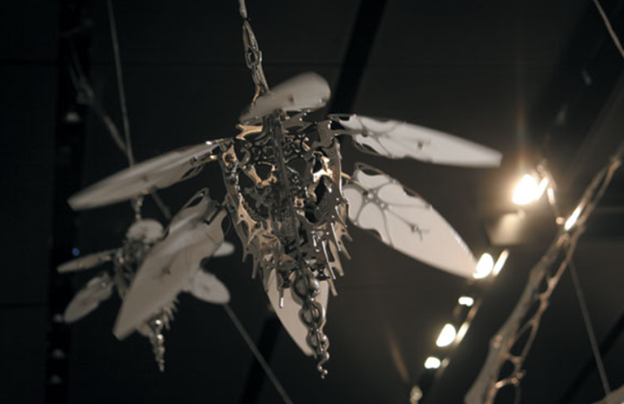
Choe's work stakes out a new genre, one that might well be called "robot
art."It is a kind of advanced kinetic art.
His
works sacrifice nothing of the grandeur or independence of classical sculpture.
They are free-standing "things" with fully developed storylines and
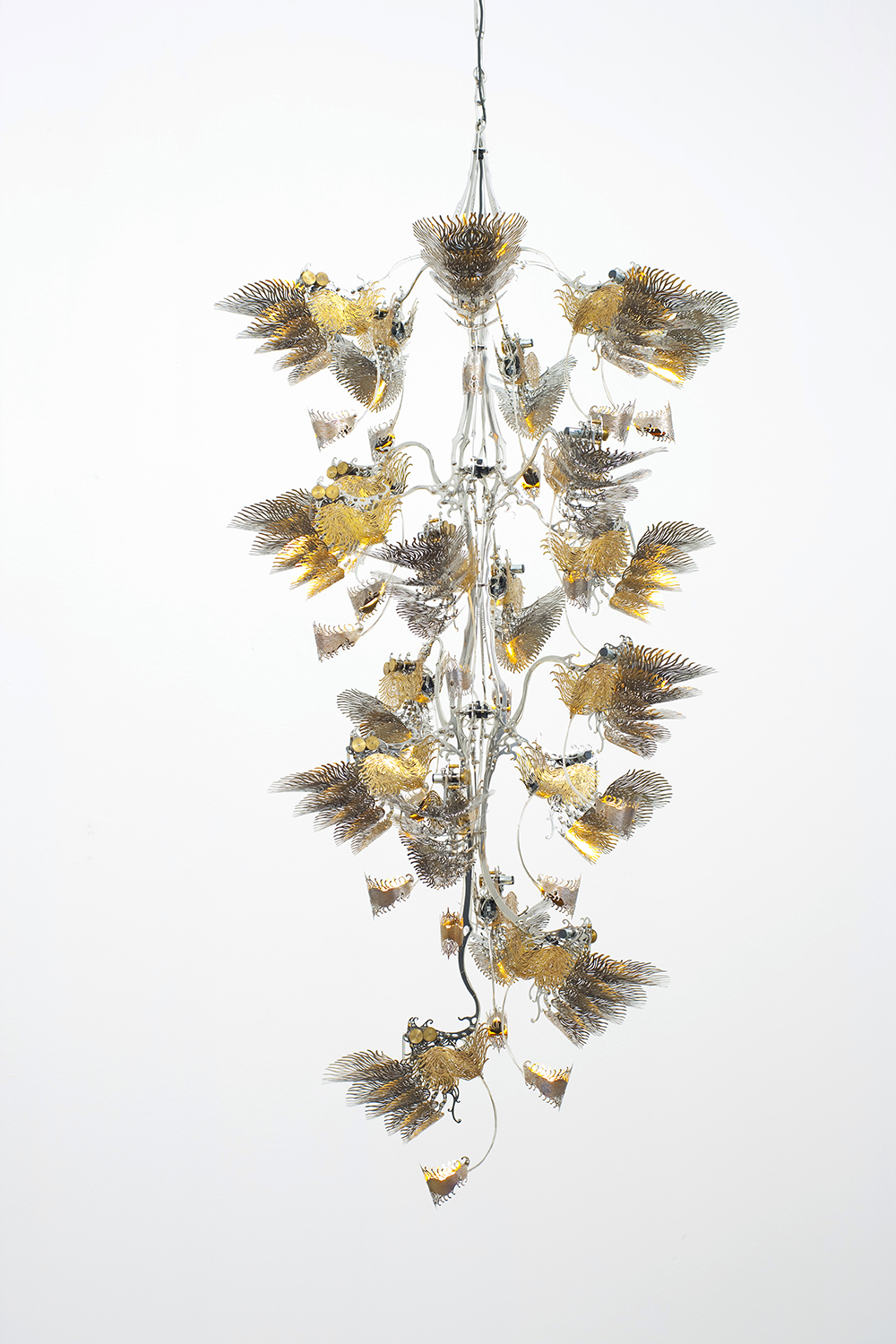
sci fi origins. To begin with, they are characterized by morphological
sophistication and beauty. Even the most simple-seeming of them is made up of
two thousand different parts, all crafted in the most meticulous detail to
embody a beautiful mechanical aesthetic. Fantasies from inside the mind become
things with a full-bodied presence, concrete sculptural objects of aesthetic
appreciation -- in short, they become another reality. In their slow, flexible
movements, they are comparable to the work of Rebecca Horn. Her mechanical
sculptures are hand-crafted machines whose operation is really very simple. The
artistry in those works, which are operated through simple mechanical control
units, and in the more advanced works of Choe U-Ram comes from the way that
lyricism thoroughly governs and mirrors technical skill. Artistic robot
sculptures come about when lyricism and technique meet in a golden ratio.
"The
mechanical organisms first arose from the boundless swelling of human
greed," Choe says. "I wanted the work to contain my own critique of
civilization, of human beings' insatiable desire." The course of
scientific development overlaps precisely with the flow of capital. No
technological advancement exists that does not generate gains. But the
technology Choe U-Ram develops is intended not to turn a profit, but to embody
an artistic idea. The slow pace of Choe's art runs counter to the fast pace of
the competition spurred on by capitalism. He is not a developer of technology,
but an artist presenting us with new ideas. Choe describes the sculpture as
"someone who expresses his feelings through shapes that do not exist in
people's heads." Today, he enjoys the status of the century's most exalted
artist and creator -- and of creator of an ecosystem.
Taming Science Through Art
Choe
U-Ram's mechanical creatures are slow and flexible in their movements. Their
motion is ill-suited to survival; any animal moving at that pace is certain to
be snapped up by a predator. Certainly, it hurts one's chances of surviving in
the jungle of capitalism, where the principles of survival of the fittest and
the strong dominating the weak operate explicitly. But no predators, no
conflict, are to be found in the ecosystem that Choe has constructed. Many
works of science fiction show a kind of proxy warfare, echoing real-world
conflicts in jaw-dropping displays of carnage and destruction. There is no war
in Choe's world.
But the creatures in it, by reflecting our world, are faithful
to the mission of art: using metaphor and imagery to express what cannot
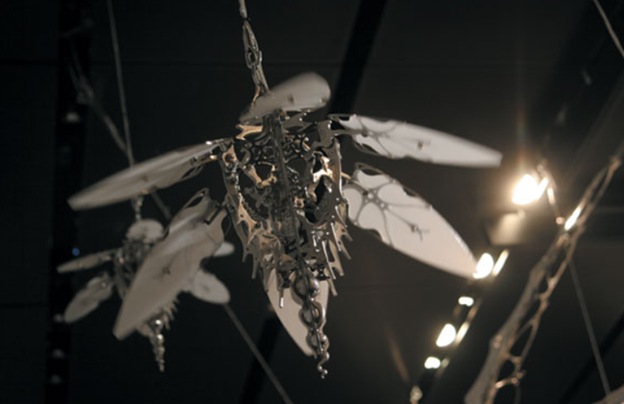
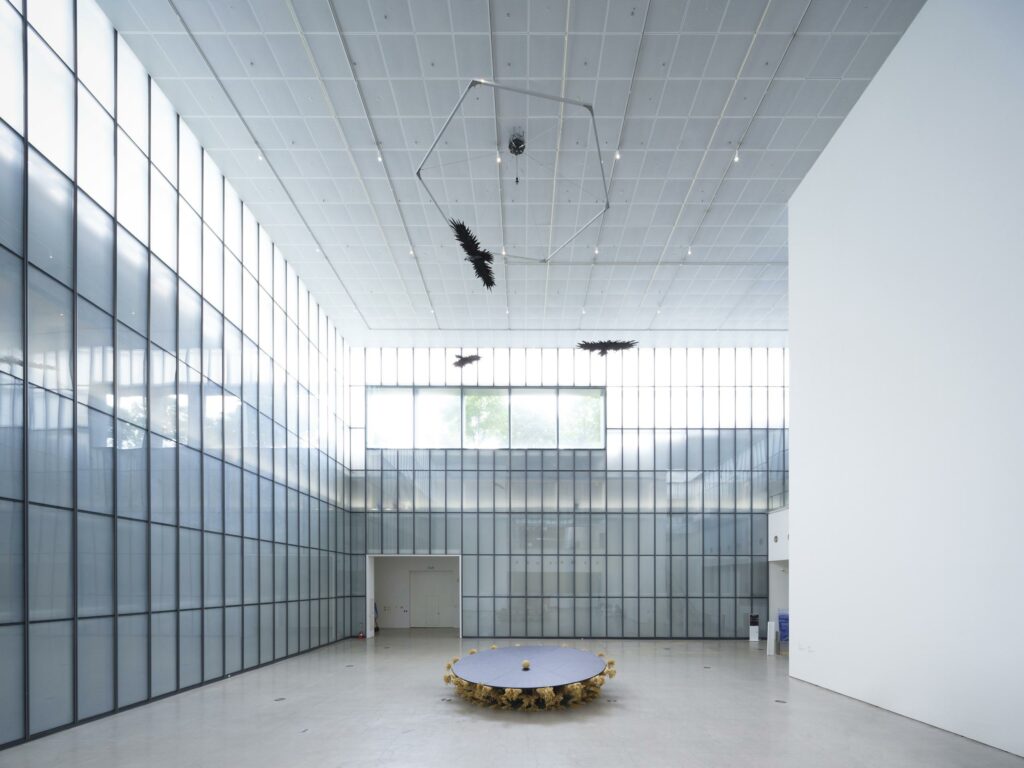
readily be understood. Opertus Lunula Umbra, which was shown
at the 2008 Liverpool Biennial, is a behemoth of a piece, weighing in at 750
kilograms and stretching to fully 5.70 meters in length. Shaped like the
crescent of a new moon, it swam through the venue with leisurely movements of
its oarlike ribs. "On brightly moonlit nights, I would sit up watching the
sea on the docks of Liverpool and it was as though some organism was rising up
over the surface of the water," Choe says. "With this work, I was
recreating those sunken boats and machines in the waters off Liverpool."
The name of the piece means "hidden moon shadow." By giving
classical, lyrical names to his cold, mechanical beings, Choe is trying to build
a new myth where myth has been lost to civilization.
His
recent works are based in a new narrative. Arbor Deus (Tree of God)
has a mythic structure, explaining the world we live in with a critique of our
fanaticism and greed for mechanical civilization. But this mythic world is
forever in danger of being marred by human apathy and overheated desire.
Indeed, the story of the endangered Custos Cavum is fraught with tragedy. This
creature's job is to make sure the two worlds, linked by small holes, do not
become completely closed to each other. The reason they are in danger is
because memories of another world are gradually disappearing from people's
minds. And the one who brings a light of hope in this crisis is none other than
the artist: Choe U-Ram himself. "Last night," he writes, "some
Unicuses began growing out of the last remaining Custos Cavum bone in my little
yard." As long as we have artists, and as long as artists can imagine a
deeper reality within reality, the world will correct its way out of crisis.