Abstract
feelings often become material. Love becomes a glittering ring; gratitude
appears as a gift box tied with a ribbon; hatred takes the form of a torn
letter. In human society, emotions rarely remain in an immaterial state; they
convert into material forms that appear before our eyes. Intriguingly, emotions
are layered. Beneath love, gratitude, and hatred, there is always desire.
Inside the ring and the gift box, there lies the desire for a favorable reply;
inside hatred, the desire for the other’s misfortune lurks. Human society may,
in fact, be a field in which desire constantly seethes—simply invisible. Choe
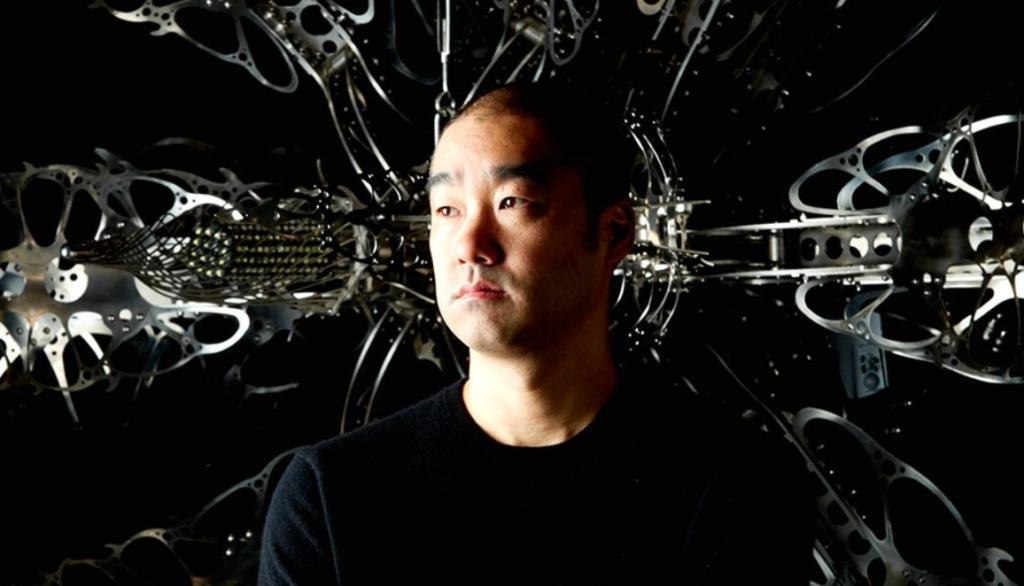
U-Ram, who creates mechanical life-forms, says his work tells “a story of
desire that, living in the interstices of human society, becomes independent
and turns into a life-form.”
Machines as the manifestation of human desire
The American philosopher of technology Lewis Mumford defined the phenomenon of
an entire society operating like a single machine according to the aims of
power and capital as the “megamachine.” This includes not only material and
technological systems but also the invisible structures created by humans. The
city is a representative example of a megamachine. Physically, urban
infrastructure and technology constitute a massive mechanical system; at the
same time, the invisible structures formed by human roles, relationships, and
organizations make the city function like a megamachine.
Born
and raised in the city, Choe discovered organic aspects in the transformations
cities undergo along with technological development. “I lived in Daechi-dong in
Seoul, and there was a new building going up outside my window. It felt like a
living thing growing taller. I realized we live in a ‘jungle of machines.’”²
“As an adult, watching cars speeding by one day, I felt as if a herd of wild
water buffalo were running. And when I lived in Gangnam during a development
boom, seeing a newly built structure rise higher with each passing day felt
like witnessing a growing organism. These experiences inspired me to combine
machine and life-form in my work.”³
Concentrated expressions of human social
traits, cities are volcanic vents of desire. Desire permeates everywhere,
turning into apartment towers, cars, and billboards that rise to touch the sky,
fill the roads, and blaze with ceaseless advertisements. In such scenes, Choe
sensed invisible life-forms. Perhaps this is why he constructs a new mechanical
ecosystem within the megamachine of the city and unfolds an imaginary world
where machines live like organisms. For example, Ultima Mudfox (2002)
is an imaginary life-form discovered at a subway construction site; Echo
Navigo (2004) is a being that feeds on the radio waves of voices
from mobile phones; and the Urbanus series (2006)
are life-forms that subsist by absorbing energy atop tall urban buildings. The
city is the ground from which the notion of organic machines springs for the
artist.
From
early on, Choe stated, “Machines exist in nature as a type of life-form.
Machines take human desire as their fundamental energy and have continued to
evolve to this day.”⁴ Seeing machines not as inanimate objects but as living
organisms, he combined them with the primal, abstract emotion of desire and
constructed a narrative of relations between machines and life. He named these
“anima machines.” The artist does not agree with labeling his work “kinetic
art,” because what matters is not merely the movement of machines but the
relationship between humans and machines and the ontology of machines.
Originally devised as tools to overcome human biological deficiencies and
limits, machines in turn drive the desire for progress and improvement,
altering human conditions and life. Machines are merely tools humans have made,
yet they also control humans and stir an even greater desire for advancement.
Machines are the manifestation of human desire. Choe’s anima machines can be
seen as living entities in which human desire infused into machines has
materialized.
A chronicle of desire–machine–life-form
From the moment Choe began presenting anima machines that combine machine and
life-form in 1998, his work drew art-world attention. It was singular at the
time and hailed as a new artistic experiment in both form and method. His solo
show 《City Energy》 at the Mori
Art Museum in Tokyo in 2006 and participation in the Liverpool Biennial in 2008
cemented his international reputation. Then 《MMCA
Hyundai Motor Series 2022: Choe U-Ram – Little Ark》 at
MMCA Seoul (2022–2023) solidified his standing in the Korean art scene.
The
three intertwined elements of “desire–machine–life-form” have run consistently
through his practice from the beginning to the present, though their relative
emphasis has shifted over time, generating varied formal iterations. His
practice can be broadly divided into four phases: an “early experimental
period” (1998–2001); a “leap of anima machines” (2002–2011); a “period of
expanded materials and forms” (2012–2021); and, from 2022 onward, a “period of
assemblies of machine-lives.”
From
1998 to 2001, during the early experimental period—including the first solo
show 《Civilization Host》
(1998) and the second 《170 Box Robots》 (2001)—a techno-dystopian aspect stands out, seemingly arising from
an intent to consciously manifest human desire in mechanical form.
From
2002 to 2011, the “leap of anima machines,” both the artist and his anima
machines became known domestically and internationally. Shedding the
techno-dystopian tint, machines appear as humanity’s companions. This phase
focuses on “machine-life,” lending realism to the works by presenting diverse
biological information as if these entities truly exist in the contemporary
world. Anima machines begin to appear as discrete forms evocative of flora and
fauna: for example, Ultima Mudfox (2002) recalls a
fish; Nox Pennatus (2005), a bird; Jet
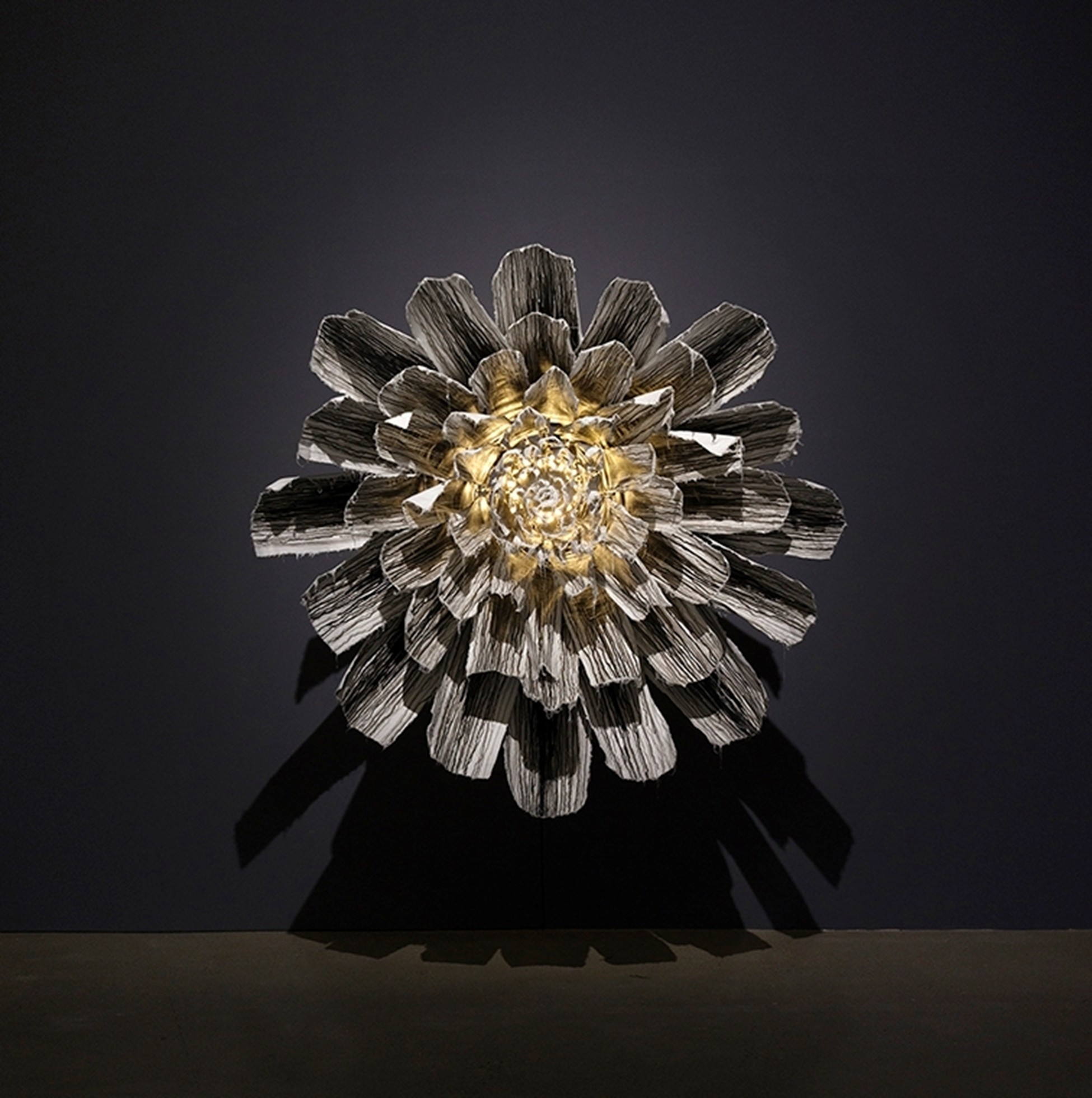
Hiatus (2004), a shark; Una Lumino (2008),
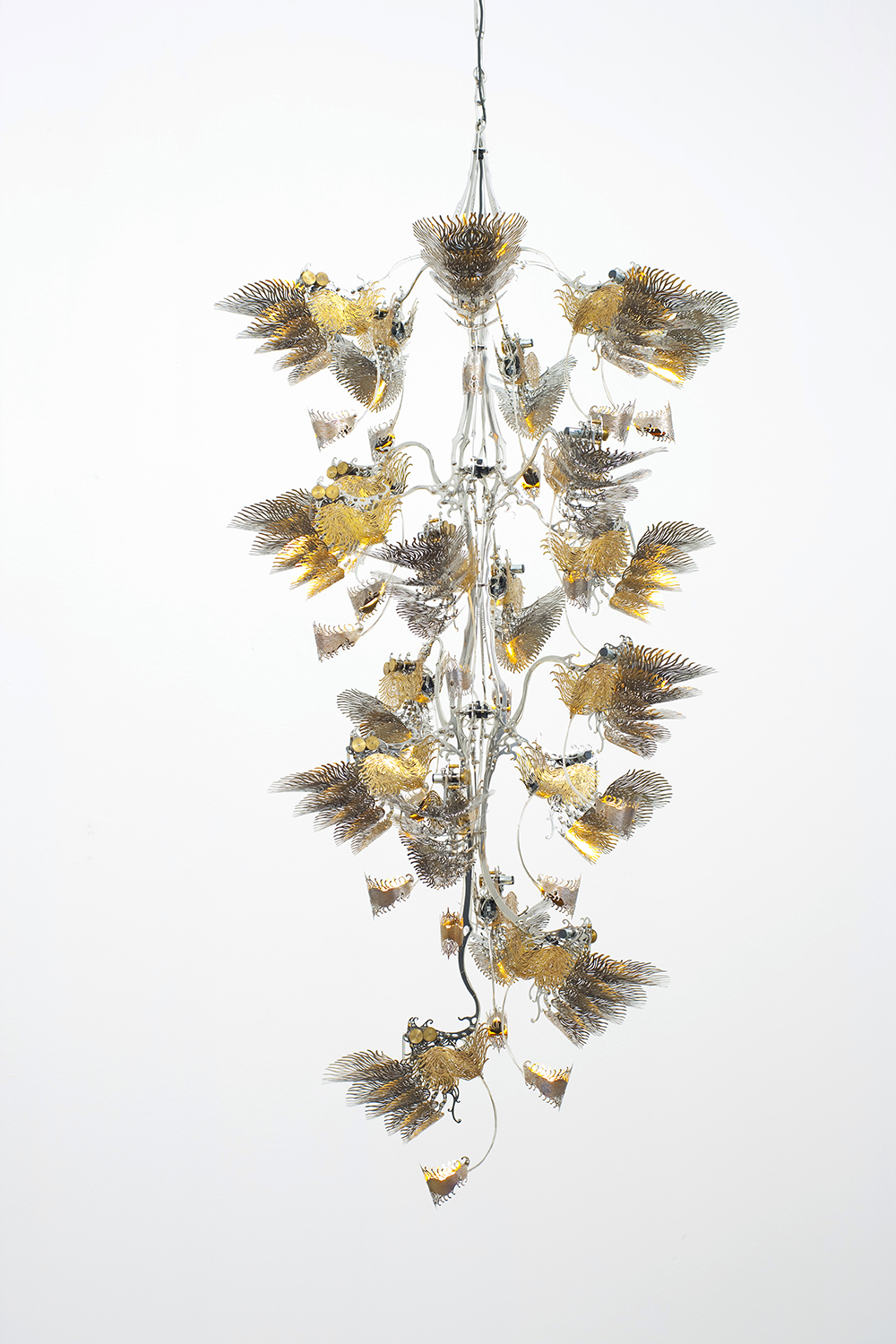
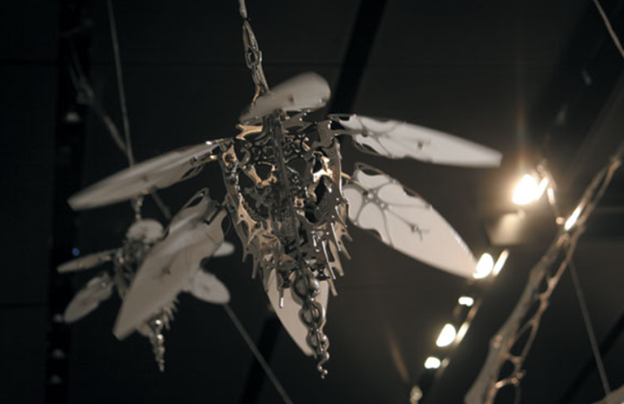
a flower; and Ixenta Lamp (2013), a fly. Besides
feeding on human-generated radio waves or energy to survive, some exhibit
characteristics of reproduction, as in the Urbanus series.
These are traits distinct from those of inanimate machines. Choe endows his
anima machines with biological settings and, through sophisticated mechanical
design composed of motors, gears, and drive units, achieves natural motion that
breathes reality into these imaginary entities. Such settings and movements
prompt contemplation of machinic vitality. Particularly telling is that many of
his anima machines “breathe.” Breath and life are intimately linked; the very
term “anima” in anima machines comes from the
Latin for breath. (Choe often uses Latin; he assigns each anima machine a
fictional scientific name in Latin.) For instance, Opertus Lunula
Umbra (2008) begins by heaving as if exhaling a great breath
with a structure reminiscent of ribs or a crustacean shell. The
sea-lion-like Custos Cavum (2011) rapidly swells
on inhalation and then slowly subsides on exhalation, exhibiting a natural
movement akin to real breathing. This expression of respiration is a core
device that leads us to believe the machines are living beings.
Beginning
in 2012, during the “period of expanded materials and forms,” when Choe served
as a professor at the Korea National University of Arts, a major shift occurs:
from a traditional emphasis on materiality and craftsmanship to a broader focus
on thought and concept. He no longer fabricated fictional origin myths or
biological information. Previously he primarily used metal and plastic for
permanence; in this phase, he adopted varied materials and unveiled works in
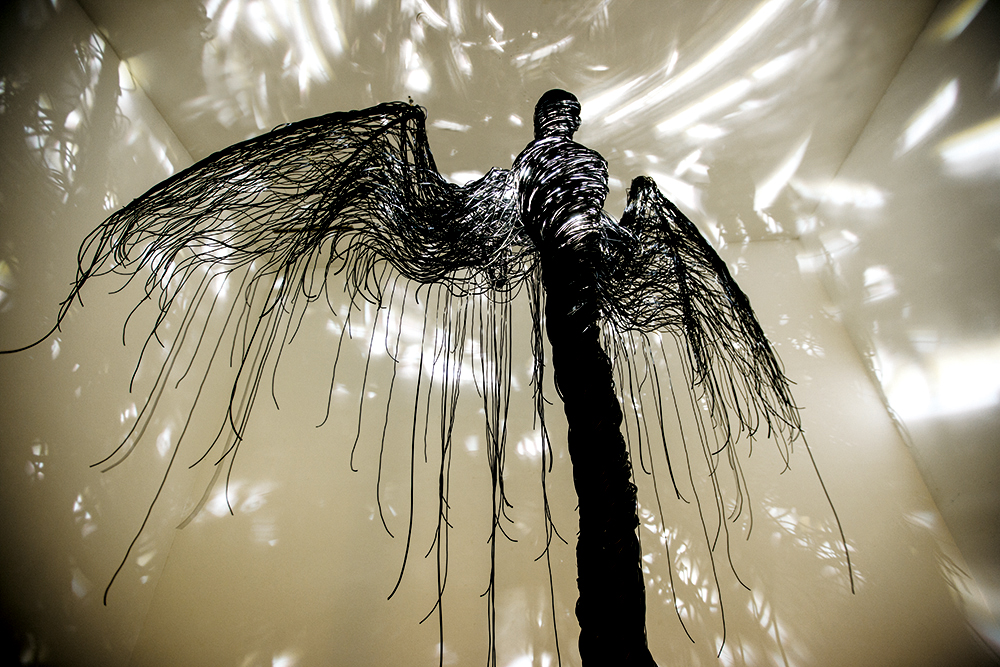
new formats. He fashioned an angel out of electrical cables (Scarecrow),
or placed a plastic bag amid architectural forms (Pavilion).
The materials changed, and so did the forms—expanding from animal- and
plant-like anima machines to angels, architectural structures, a carousel,
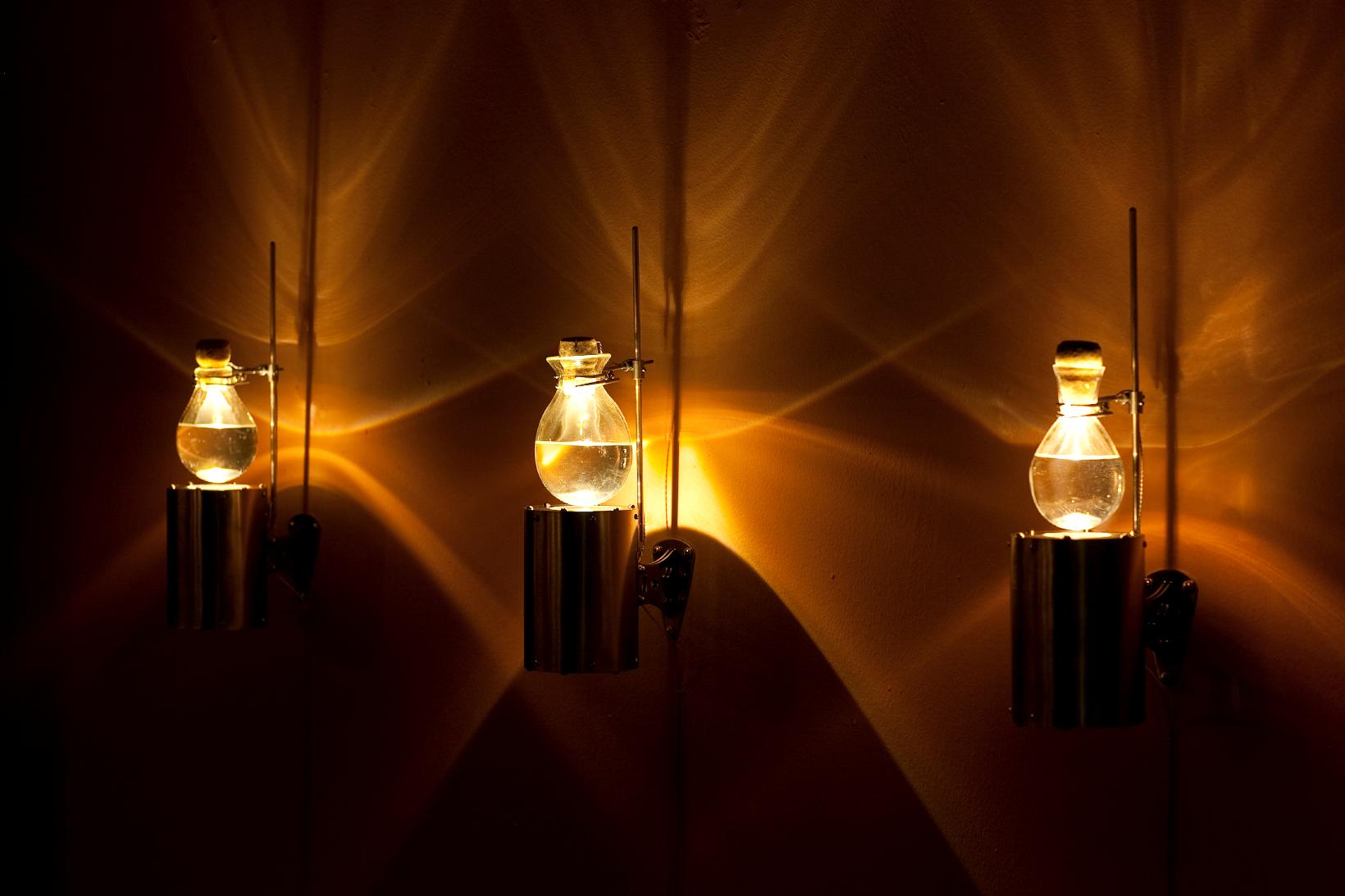
robots, and lamps. Notably, the symbolic dimension grew stronger. Works such as
the angelic Scarecrow (2012), the contrast between
golden opulence and an everyday black plastic bag in Pavilion (2012),
the serpent eating its tail in Ouroboros (2012),
and the vortex-like spiral bloom of Una Numino (2012)
all suggest social power and human desire through their forms. Although he has
continued to present animal- and plant-like anima machines, the post-2012 works
clearly pivot toward heightened symbolism.
From
2022 onward—beginning with 《MMCA Hyundai
Motor Series 2022: Choe U-Ram – Little Ark》—we enter a
“period of assemblies of machine-lives.” This continues the prior conceptual
trajectory but with much amplified symbolism. The crucial difference is this:
whereas earlier anima machines were placed in galleries as discrete entities,
here every machine is both an autonomous unit and, at the same time, part of an
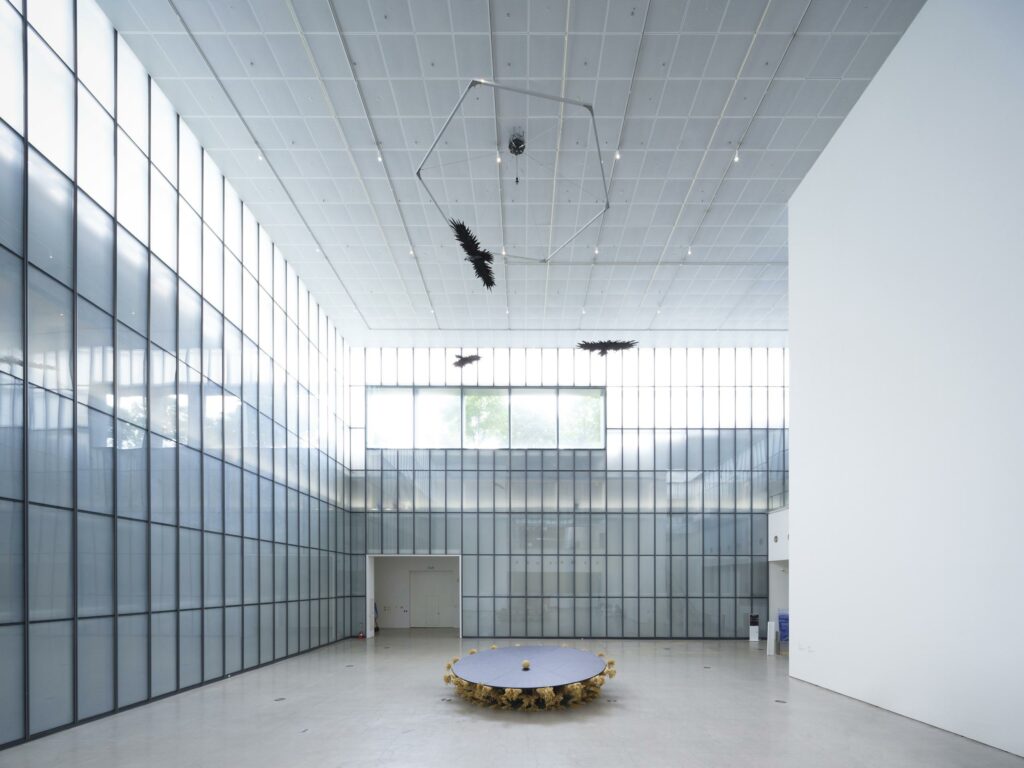
assembly that constitutes a megamachine. Round Table (2022),
in which eighteen headless strawmen support a circular top 4.5 meters in
diameter, visualizes desire for ownership. On the tabletop, strawmen strain
toward a head amid competition, while three Black Birds (2022)
glide overhead, gazing down at Round Table as if
waiting for those who fall behind. Each piece is singular, yet together they
assemble to amplify meaning.
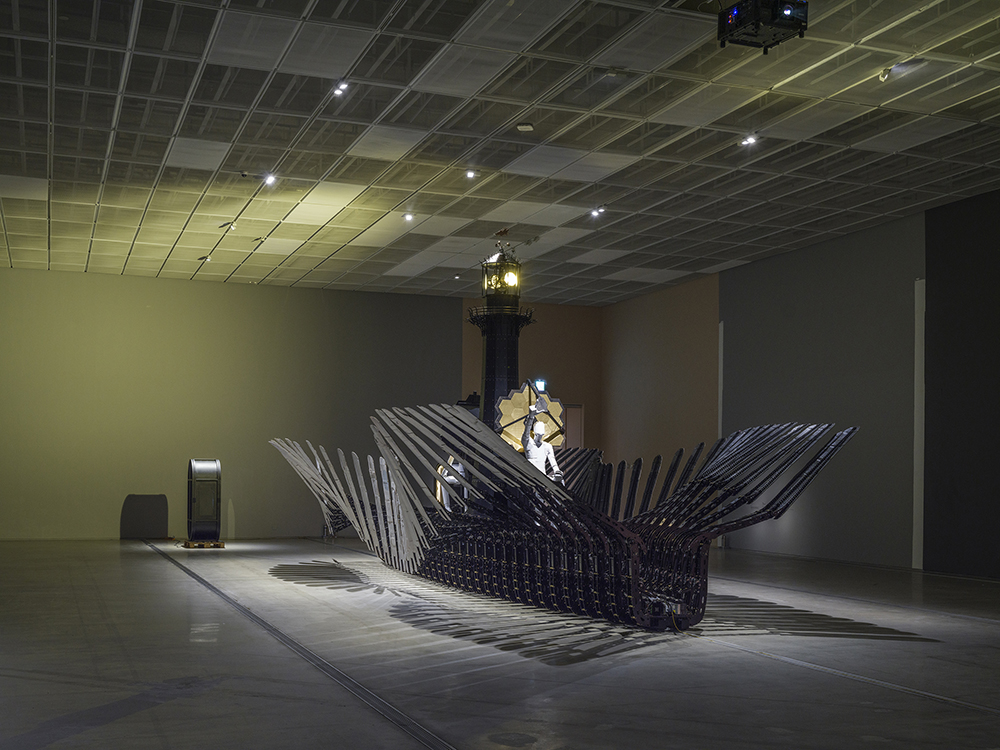
The same is true of Little Ark (2022).
Within the twelve-meter-long ark—its black iron frame patched with
white-painted discarded paper boxes and lined with thirty-five pairs of
oars—are Lighthouse, acting as a panopticon; Two
Captains pointing in opposite directions; and the space
telescope James Webb. An Anchor—whether
connected to or broken from the ark is unclear—juts from the wall beside it,
while a drooping Angel, a ship’s figurehead, hangs from
the ceiling. At one prow lies Infinite Space, showing
endlessly amplifying space; at the other, the video work Exit in
which doors open without end (Little Ark makes it
impossible to tell which side is the prow). The ark, its internal components,
and the surrounding works each possess meaning as singular entities; as an
assembly, they cohere into a single megamachine. This method of assembling
makes even more explicit that “the ark is ultimately a lump of empty desire
that cannot carry anything.”
Through
Choe U-Ram, desire bores through the society we inhabit and appears before us
as mechanical life-forms.
The
desire he reveals is a golden architectural structure,
a serpent devouring its own tail,
strawmen ceaselessly striving to seize a head,
black
birds lying in wait for stragglers,
an ark with no front or back,
two captains pointing different ways, and James Webb.
Desire
constructs infinitely amplifying spaces
and exits from which there is no escape.
Desire
is by no means invisible.