The dramatic rescue of 33 miners trapped 700 meters underground
for 69 days; I watched the scene live on the internet in Amherst, a small town
in Eastern U.S. I expected a breathtaking drama. To an “audience” like me who was used to sleek
equipments in science fiction movies, the rescue capsule in Chile looked rather
quite shabby. The whole atmosphere at the scene seemed kind of awkward without
the sound of noisy news anchors of Korean TV and usual excitements and
ceremonies common in Korean TV. I couldn’t stay up
until the end. The repeated journey of the rescue capsule named Phoenix “throwing up” miners one by one at one
hour each was just too long. I was not a tourist, nor an international student,
nor an immigrant in America. I was in an ill-defined state living an isolated
rural life. My desire to participate in an emotional conclusion of a disaster
as a world citizen faded away. - The End.
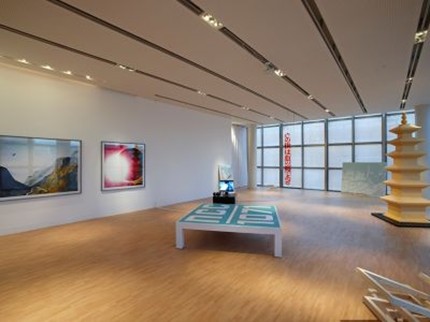
When I noticed Chilean Capsule among the list of
artworks for Rho Jae Oon’s solo
exhibition Mulian Mulian, I was reminded of the
actual rescue one year ago. It had already been buried deep in the back of my
memory bank. Is the new start always possible as long as there is someone who
remembers it, even though the event is over? I was curious how the artist would
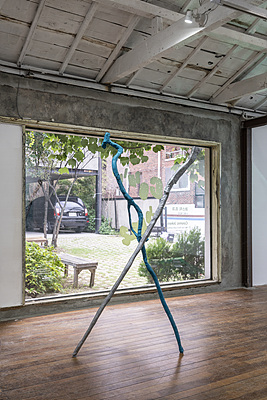
represent the event. Chilean Capsule was
standing abreast to the high pillar in the middle of the exhibition hall. The
colors of its Chilean flag were removed by white paint and the capsule was
reduced from the actual size so it’s too small to fit a
person in. Standing there slightly tilted without the real rescue
function, Chilean Capsule seemed to
reconstruct my impression in a way. For instance, it looked to be a humble,
simple, yet serious and careful symbol of salvation out of an audience’s expectation who remembers living in the time of hyper-marketing of
augmented reality beyond the spectacles of a society.
On the other hand, the structure looked like a small monument
encompassing all the subjects of the exhibition due to its color, shape and the
location. This is a research process about the artistic methods trying to
considerably offer the thinking about the ethical meaning that comes with the
act of watching or displaying someone else’s disaster. It stands there wondering as the result of an “artistic experiment or an adventure of Rho’s
style reasoning the globally spread disease, famine, and the hell.”[i] As a matter of fact, an artist cannot stay indifferent to the
pain of others. Still, the artist should not abuse his artistic right by
habitually using a disaster happened to someone else (even though
unintentional) as a subject matter or enjoy it as a bad taste. He cannot be too
apathetic or overdo it. The representation of a disaster must not be either too
realistic or too abstract. Facing the series of questions such as where do you
draw the line for the dignified artistic representation of a disaster or is it
really necessary to have the audience’s empathy and
affinity in the process[ii], the monument bounces them off instead of
answering right away.
Strictly speaking the monument is more closely related to the ‘post-event’ rather than the event itself. Of
course all the monuments conform to the representation of the post-event.
However, in this case, it means the total sum of all the consequences caused by
the disaster, including a will to settle and overcome the disaster and
providing preparation for a disaster as well as reshuffling of unexpected
encounters. In a sense, a disaster and post-disaster are indistinguishable, but
the experiences of post-disaster go beyond the area of the threshold of the
consciousness. For instance, the “capsule” might represent the miracle of all the survivors’ return and yet the miracle preoccupies the traces of trauma
surfacing in-between various events of daily lives the survivors had to endure
after the rescue. The disaster is officially recognized but the post-disaster
is just an individual existence; struggling in the sea of questions without
finding any answer. Such situation is what Chilean Capsule wants
to remember, as long as it can.
It is not important here to determine whether the adventure of Rho
trying to heal the collective post-traumatic memory loss is appropriating the
Baron Münchausen’s exaggeration
or his artistic restoration experiment is citing Bertolt Brecht’s estrangement effect. Also, even if his work method seems to
resemble the penance of Pillar Simeon of the 4th century who
stayed up on top of the column for 37 years or the “journey” of Howard Hughes who stayed in
a penthouse of a hotel watching multiple monitors in his later years, it does
not seem necessary to emphasize that here; although the artist rallies all
these quite often and Howard Hughes’ method seems to be
preferred. In this exhibition, Rho’s “remedy” rather reveals its detailed
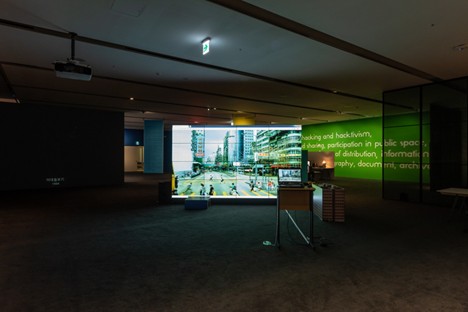
existence through Framesize that is played
in variation at different locations in the exhibition.
Paul Virilio said in electronic-information science, displaying
the information on monitoring screen is more important than storing it.[iii] Meanwhile, Rho considers the
monitoring screen itself, meaning the frame, as the more important information.
In the environment where various displays have become the core media and a
ubiquitous interface in our time, Framesize establishes
a kind of a frame-scape by modifying the frame’s color, shape, size, and material. Initially the idea came from the
fact that a movie or the concept of virtual reality is commonly used all too
voluntarily and conventionally. Then, it was devised to make a momentary lapse
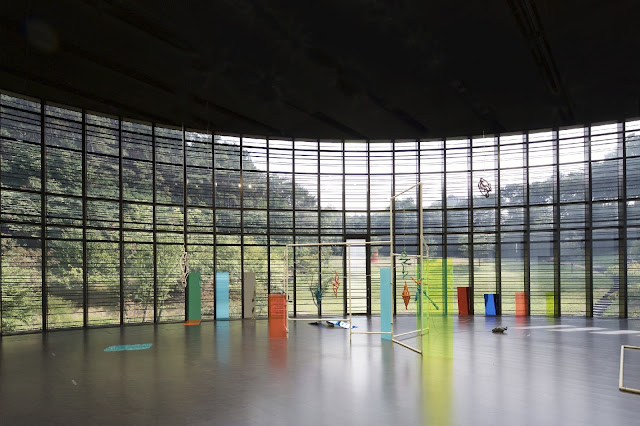
of reason or to place a temporary limit. The “framesizes” scattered over the exhibition hall
through the gap of momentary pause create infinitively expandable visual rhythm
through the sum, distribution and reiteration of the simplest geometric figure.
When this frame is written in musical notes in a melody and sung I realize the
point that the intrinsic rate arises from the traditional role of the frame
through reflection (simply through a mirror) and passing (for example, the
window of a running train). Now what’s more important
in Framesize is to make a link to
information, or even hacking information rather than uploading information.
In regard to disaster, Framesize originally
does not even bother trying to reproduce its conditions and details or
over-produce information. Instead the images reflected on the surface of the
frame make audience to link other works in the exhibition. In the process, it
is inviting the audience to put on their own conventions while fulfill the
different layers of different habitus built in the art works. Or they can
imagine passing through a hollow frame in a split second while moving
through Framesize filled with diffused
reflection of material. The void of meaning makes people to look at the
disaster from the opposite perspective of how it is usually portrayed in
disaster movies and asks them to look at special broadcast on disasters
sideways. While refusing the result and purpose the typical screening monitors
offer, people willingly slide into the frame and are agitated in the landscape
of a disaster. For instance, we may be able to hack into the existence of the
people remaining at the scene of a disaster through the path of Framesize. The
people affected by a disaster cannot view or show the scene of disaster in a
strict sense. There is no way of knowing how they view the world in front of an
indistinguishable and crushed mass in the landscape, or the elimination of
familiarity, or the addition of an anamorphosis. Henri-Pierre Jeudy says that the people’s view is closer to that of an artist when it slides away from our
view. The look in artist’s eyes[iv] here means the request for using the
principles of interlocking and reciprocity of different views in order to
activate the connivance within various, unknown, and different intimacies in
representing the landscape of a disaster.
The collapse of the Chilean mine suggests the most extreme
landscape of a disaster where habitus of the perspective is suddenly collapsed
and flattened. In the scenario of the collapse, the fact that there is no
casualty but survivors removes the feeling of distance at once by pulling us
violently up close to the scene. Being buried alive is a terrible-enough
nightmare just thinking about it. Even feeling claustrophobia seems natural.
Since the state of panic in normal life is caused by inputting wrong information
from body or sub-consciousness, it can be overcome by inputting correct
information. The healing method which helps one to overcome the fear of death
by repeatedly reminding the fact that one can never die from a panic disorder
is a good example. However, the fear of being buried alive escalates because of
the fact of being alive at the moment. The Chilean miners are said to have
endured the time in the blacked out underground mine shaft by watching movies
and making video calls. The scenes they watched are exactly the same as the
dreams and what would be displayed on the screen of their dreams during the RAM
state of sleeping. Perhaps the frame of this screen would be quite bigger in
aspect ratio than The Highest, The Lowest because
the “depth” would be at least 700 meters underground. The fact that the
deep sleep like death is one of the symptoms for posttraumatic stress can even
be very logical.
In his book, Kriegsfibel (War
Primer), Brecht displays a picture of soldiers napping in broad daylight. Be it
inside a trench or just on the ground, wherever they lie seem to be the tombs.
These young soldiers are taking a nap within the white line drawn up by the
engineering battalion after removing landmines to create safe passages.[v] In other words, they are sleeping
within the white frame set up for safety. We see Jataka
Mirrors (Mirrors of Previous Birth) in their sleep.
Rather, Jataka Mirrors is the dream we, together or alone,
imagine encountering a disaster. Jakata is the painting about Buddha’s whole life. The artist combines this painting with the idea of a
Karma Mirror, reflecting the sins one committed in his life, to create a new
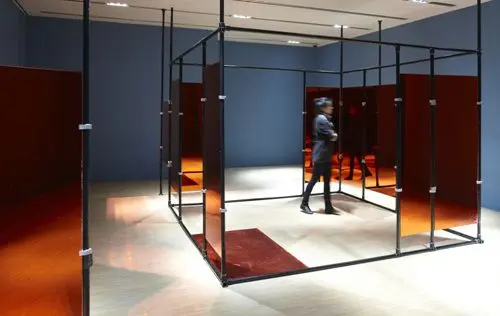
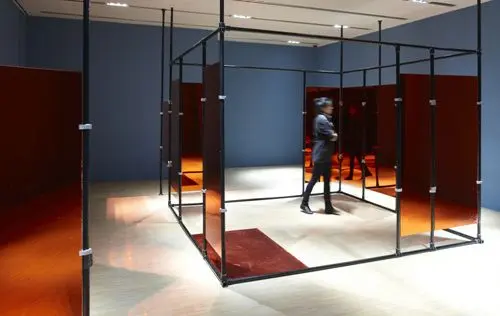
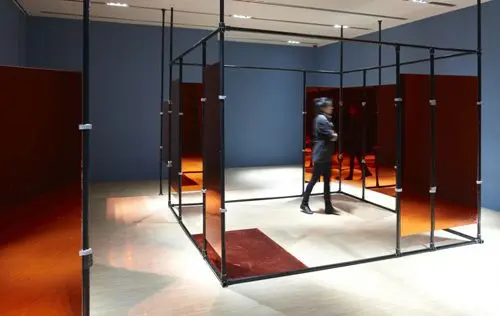
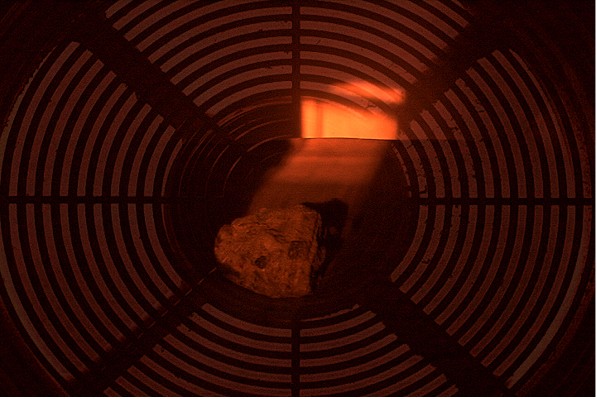
structure. The result is a kind of a mirror room constructed of red acrylic
mirrors and aluminum poles. Acrylic mirrors are the frames in various aspect
ratios shown throughout the 100 years of film history. Audience can see
themselves reflected on these frames and the reflections are reflected yet
again on other frames located left, right, and below them while they are moving
around dispersedly. Due to the incidental distortions of images created by
acrylic mirrors on this mirror room, and the red tone, audience may feel dizzy
from self-image, images of image, and infinite images of whirls.
Virilio explains that children usually repeat the same play over
and over in order to resist the adult’s logical time of disciplining them to fill the mental state of
void. Whirlwind, circle dance, and unbalanced play appearing commonly in
children’s play, which vaguely equalize the play with
disobedience, are said to be repeated as they increase the sense of vertigo and
confusion; and joy and pleasure are acquired through them. Unlike playing with
a ball where you need to keep your eyes on the ball constantly, such a children’s play as ‘what time is it, Mr. Wolf?’ a typical image play where a brief moment of Mr. Wolf twisting his
body between things seen and unseen are imagined.[vi] To see your past life and
karma, Jataka Mirrors makes you to immerse
in a familiar imagination play in a child’s body. The
forgotten past and future enter into the black hole of a play.
Virilio extracts the concept of the picnolepsie from the momentary
symptom of epilepsy such as children not being able to explain the event they
had seen during the day, or quite a normal grown-up dropping a cup in the blink
of an eye.[vii] Just like the RAM sleeping state,
where you are sleeping but you are dreaming, and you do not remember your
dream; this is related to the blind spot, the unseen areas of a moment
sandwiched in-between seeing. Virilio wants to ensure the normality of the
picnolepsie in contrast to modernity which is trying to wake this “entre-deux” up forcibly, the unseen and
lost moments, into the state of awareness. “Picno” is a prefix originated from Greek, meaning frequent or
perpetual. “Lepsis,” meaning
seizure, paralysis, or convulsion of nerve is added to it, and picnolepsie can
be interpreted as a frequent occurrence of temporary loss of memory. It has
become to mean the opposite of the rapid awakening of the level of awareness
from some time ago. In Jataka Mirrors, people are reflected off the
acrylic mirror surface of various aspect ratios and move around, and then pass
through the empty space in-between. In this process, people witness the simple
and pure pause, disintegration and reappearance of existence, and the
phenomenon of time separation; and finally through all these people restore the
capability of picnolepsie which had been suppressed by the speed of modern
society’s image. From this perspective, these artworks
can be said to prefer the montages of Georges Malis’
early movies where the nonexistence was shown just as is, while rejecting the
cinematic special effects which try to embrace the nonexistence in a film.
Consequently, at the moment when impossible, paranormal, and miraculous forms
break down in between frames, Jataka Mirrors elucidates
the “East-Asian” state
of picnolepsie that the movie is the Jataka painting of our era and the screen
is the clear Karma mirror standing in front of hell of the present time.
When we are training the skill of the picnolepsie exposing
the “in-between time” by reversing the current that is trying to fill the void of
memory with the probability of sequence led by the rationality, we can finally
be full of our own time by putting the unstable structure of mediating time
into common use. Like Jataka Mirrors, this technique can be applied
to other individual works[viii] or working methods. But when the
artist’s works are scattered in a public place like an
exhibition hall, now the picnolepsie is substituted as one method of viewing.
Compared to Rho’s previous exhibitions where various
images of collected scenes from internet, films, videos, and TV are displayed
on monitors, this method of viewing becomes especially apparent for Mulian,
Mulian which is composed of objets d’art, flat surfaces, installations, and paintings. This is due to the
possibility of the absent space appearing between objects by broadening the
view to be the perception as the points of view instead of using more common
viewing method of tuning one-on-one with monitors. Also all the art works with
quite different levels of sensation, different degrees of representation, and
different methods of installation all melt the boundaries between truth and
illusion, reality and appearance, and live sound and auditory hallucination by
securing the fundamental of the time of the moment where it is possible to
enter the different world of logic within the exhibition hall.
The Goryeojang, Burying the Starved
Alive of 2011 is a kind of double print where a scene from
the movie with the same title, directed by Kim Ki-Young (1922~1998) in 1963, is
processed and printed. It is also a dissolving view overlapping the moment of
the execution. From this, it becomes a foundation for another layer of a
meaning to stick out. There I can see a protrusion of a satellite picture
depicting the tombs of the victims of starvation in North Korea. To sum it
up; “if the hell exists within
the heart of human beings regardless of the density of the representation,” the method of viewing the analogous picnolepsie opens up the
exhibition hall towards the gap and something different beyond the universality
of the hell. Into the gap opened up by disturbance and disharmony, the kairos,
which Mario Perniola called “opportunity” meaning the epieikés[ix] requiring a distinguished definition
for a special moment, interferes.
In Confucianism, the discourse on disaster is treated as a more
comprehensive theory of natural catastrophe, or Jae-i-ron [재이론 in Korean, 災異論 in Chinese].
The word Jae-i is a compound word meaning a disaster [Jae-nan]
and a modification or variation [Byeon-i] where disaster is a direct
casualty to human such as famine, flood, or disease; a modification is a
strange development of a natural occurrence surrounding human. A disaster is
the realization of a torment while a modification is an appearance of an abnormal
phenomenon predicting the state of agony. The reason human beings fear the
modification is due to the horror uncertain and incomprehensible occurrence
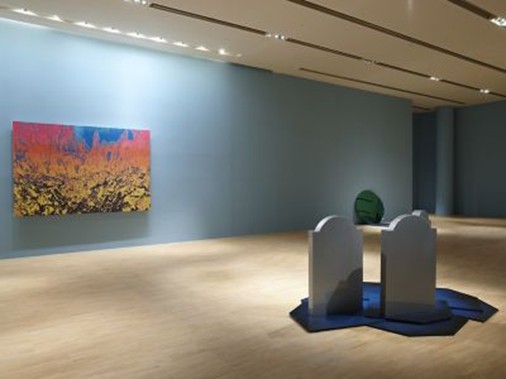
brings.[x] The Mountainring
Braindead-scape depicting the big rings hanging on the top
of the mountains seems to be a natural occurrence predicting some kind of
forthcoming calamities just like a tombstone in a Korean folktale which is said
to sweat right before the coming of a crisis. In fact, the artist says he did
not paint these landscapes from his own imagination, but rather he used
the “punctured scenes” he
discovered in nature for collage. The painting, which is supposedly done in a
short time using traditional Korean landscape painting technique for the rings
on the mountains, could be a serious joke or an accurate foresight. In his
series of Braindead-scape, which the artist said he drew with a
technique close to automatism, this Mountainring
Braindead-scape was inspired by his realization that the
rings on the summit reminded him of the holes in human brain caused by
Alzheimer’s disease or a mad cow disease. Rather, maybe
he said the dying brain gave a cue to him of the mountain rings.
Anyhow, the “young voyant” Rho going through the picnolepsie appropriates the form of
painting instead of photography or film, in order to prevent and defeat the
natural catastrophe. Perhaps it is because the painting can make us expect the
moment of a disaster only by the analogical method within the process of
representation, or with the aid of abstraction whereas photography or film can
do it by fixating the moment of a disaster.[xi] Also, another reason would be that
while photography or film deals with a disaster that is already happened or at
least there is an agreement it has happened; painting can reproduce the
prediction of a modification which has not happened yet. In this sense, the
automatism drawing of the artist can be seen as a ritual performance to prevent
or defeat a disaster. Comparing the Mountainring
Braindead-scape to the traditional Sea God Festival, a kind of a
rain calling ceremony, Rho’s ritual for crisis is
closer to Chimhodoo than Hwaryongje. The
former is a ritual where a head or bones of a tiger are thrown into the water
in order to awaken the sleeping dragon underwater. It is believed that the rain
would come down when a dragon arises to the sky. On the other hand, Hwaryongje
is also a rain calling ceremony, but it just uses a drawing of a dragon. Though Mountainring
Braindead-scape depicts the forms of mountains, it is intended to
draw out some kind of effect through invisible impact from the rings manifested
in the painting instead of copying.
In contrast to Sea God Festival such as Hwaryongje,
the figure of a dragon is not present at Chimhodoo as
it stays underwater all the time. Since it is historically said that the more
the shape of a dragon is shown and materialized the more miserable and
distressed the God-like status of a dragon becomes, emerging from underwater
and revealing its figure would be unhelpful to the dragon’s sacred status.[xii] Suddenly the dragon underwater
reminds me of a spy in Hitchcock style movies who often falls into the
picnolepsie. He would be hibernating until receiving an order for a mission
impossible, and then one day all of sudden he would be in disguise of a perfect
and yet fictional character achieving a common visibility. Usually a spy is the
coolest when he is an invisible being, just like the pick pocketing looks
magical only till the trick is revealed. I am quite curious to find out how our
spy, Rho the hyper pickpocket secretly dispatched to 21st century
world of hell, would distinguish himself in his next “film.” – The
End.
[i] Hereinafter all the quotes are transferred from the artist’s words.
[ii] Lee, Sang Gil, “Beyond the Memory of Faded Disasters – Five
Thoughts,” Humanities
and Arts Magazine F1: Disaster, Seoul: Moonji Cultural Institute
SAII, 2011, p. 16
[iii] Virilio, Paul, translated by Kim Kyeong On, The
Aesthetics of Disappearance, Seoul: Yonsei University Press, 2004, p. 94.
[iv] Jeudy, Henri-Pierre, translated by Lee Sang-Gil, “Propos sur les paysages de catastrophe: Tchernobyl,” Humanities and Arts Magazine F1: Disaster, Seoul:
Moonji Cultural Institute SAII, 2011, p. 31
[v] Brecht, Bertolt, translated by Bae Soo Ah, Kriegsfibel,
Seoul: Workroom Press, 2011, p. 52
[vi] Virilio, op. cit., p. 35
[vii] Hereinafter all the mentions related to picnolepsie are from
Paul Virilio’s same book, pp. 28-83.
[viii] In his text messages to me, Rho Jae Oon indicated that this
concept is related to the concept of Casta Diva in his
Aegibong Project (2006-2007).
[ix] Cited in Virilio, op. cit., pp. 76-77.
[x] Lee, Wook, Disasters and National Rituals of Chosun
Dynasty, Seoul: Changbi Publishers, 2009, p. 77.
[xi] Jeudy, op. cit., p. 35.
[xii] Lee, op. cit., pp. 191-192.