Floating life in the 21st century Republic of Korea
Kira Kim comprehensively addresses our floating lives in “Korea
Artist Prize 2015” under the theme of Floating Village.
He consumed an initial idea to transform the space in resemblance to a
40-pyeong apartment (approximately 130 m2) for his exhibition. This might
deliver a familiar sense of space to some audience who rarely visits the
museum. Coincidentally, large-scale development projects for building
apartments are underway in Hapjeong-dong, Seoul where Kim’s studio is located
and the residential areas and commercial districts adjacent to Hapjeong-dong
are currently being reorganized. Kim also has to move his studio due to the
skyrocketing rental cost caused by such development. He probably realized how
there are others who benefit from the current conditions of Korea’s residential
environment, often symbolized as the republic of apartments, while some had to
leave their household for the others. Images and messages that flow out of the
video installations in the exhibition space are contrary to our expectations
for the future as presented by the 40-pyeong apartments, the dream of Korean
middle class. While walking through the exhibition space from its entrance to
the exit, utopia turns into dystopia, with each room becoming the site of the
advent of the respective events.
This is not the place for slow leisurely appreciation of the
aesthetics, but a place where the inconvenient truths, we are unaware of or
want to avoid, are unlocked one by one. They are truths uncovered in a dark
room. It is indecent to convert a white cube redolent of a religious space of
the past into an apartment space. However, this is the way in which Kim weaves
reality into art. Most of the works he had produced raised controversial
issues. Isn’t debate the business of philosophers or politicians? Conveying
significance through art is becoming more and more difficult since the onset of
contemporary art. Why should an artist do such tough, rough work?
Paradoxically, the autonomous nature of art allows such interference. We can
interact with life when we are detached from it. On the contrary, if politics
is autonomous, people suffer from it. We can say with conviction that our
politics is very much so when facing a reality, in which sly old politicians
keep coming to the fore. If artistic autonomy is misunderstood, it is ‘art for
art’s sake’ but if it works properly, art could be the most ideal model of
autonomous life. Art is precious not because it is merely art but because it
guarantees the potential for ideal reality.
Art desires not only the freedom of artist but also the freedom of
others. Unlike individualism, liberal society stresses that art proves its real
worth in that one’s freedom does not clash with another’s freedom in its
territory. I have witnessed Kim’s work in person since the early 2000s. He has
consistently made comments on the reality from serious assertions to
light-hearted jokes. His art has not been a repetition of the same words but
comments on the realities he had faced. As both realities and subjects have
changed little by little, the content and the form of his remarks have also
been altered little by little. For this exhibition at the National Museum of
Modern and Contemporary Art, Korea, He did not have a bombastic intention to
showcase all his artistic capabilities, but intends to give full, detailed
account of reality, making the best use of the exhibition space of great public
attention. It would take considerable amount of time for someone to discover
all of the hidden messages in his works. Of course, reading, hearing, and
seeing are not the only components of his works. Such method even converts art
into consumer good. Don’t we receive enough shocking news from the Internet and
evening news reports? The realities he has excavated are shocking as well, but
they are not merely to shock, as contemporary art usually does. Kim affects us
in that his works come back to us even out of the exhibition space. He poses a
question and does not answer but these questions already include the answers within.
His works seem to depend on a virtuous cycle, in which viewers see reality
through his art and understand it through their own reality. He has
consistently executed participatory works but his facture is somewhat
individual. He would not think of himself as the one who represents others or
their positions. Such universal role of the intellectuals has faded into
history after completing their work since the 1980s. He is also not an expert
who is only devoted to the division of labor. Such experts have their own
limitation to use amazing technology merely as accessories for the dominant
system that contribute to the expansive reproduction of contradictions. Not the
general public or the people but the era of the multitude; Kira kim is also an
individual in this.
Engagement of Artist in Reality
Kira Kim stresses the importance of bonds between individual and
individual. In this exhibition, he collaborated with numerous professionals,
active in their own fields and worked to maximize these bonds, producing works
that evade the logic of any political parties, avoiding political
justifications and potency. He is an artist who lets us know how an
individual’s will and ability is important in the continuation and expansion of
the work beyond mere reflection of the times. The method and style of his work
is rather without purpose: he makes the next phase of his work possible by
pouring all his energy into solving the current problem rather than saving his
energy for an upcoming project. Looking at it from a long-term perspective, his
method is not actually unintended but is the only way to endure and survive
through reality. When facing his work and life, which are insurmountable by
other artists, the wisdom of life comes across, “If you hold onto life, you
will die. If you fight death, you will live.” Death appears often in his works
since the process of producing artwork itself is commonly imbued with death.
Just as a life that strives to forget death is considered ‘superficial,’ art
distanced from death is considered ‘surplus.’ Kim’s focus is on the social
death. Death in his works is not largely dependent on some ambiguous,
existential, or fatalistic reason. Does that make Kim’s art a tool for
politics? Art is not political by nature but may become so since the artistic
life is often desperate and thorough. Some artists say, “I am about to die if I
keep working but I will to die sooner if I cannot keep working.” These people
are right. Many insiders of the art scene have the illusion that they eat well
and live better through art. Could only the ones who gave up such false
expectations from early on become artists? Considering the current desperate
situation of artists including Kim, his title Floating Village seems
relaxed, as if the term ‘global village’ reminds us of a peaceful atmosphere.
This title harks back to a scene of exotic houses or futuristic architectural
structures.
His perspective toward the present, not past or future, is condensed in this
term. It was only a few decades ago that ghetto towns were lined along the
Cheonggye stream area. The artist believes that it wasn’t wealth but a concept
of ‘floating’ found in Korean society that helped Korea to achieve rapid
growth. ‘Floating’ is not a vision for the 21st century in which we can freely
surf in the sea of information or wander elsewhere like a nomad. It merely
stands for death. We cannot fully understand this connotation due to the
determined and dominant system that is consolidated behind Korea’s floating
reality. The concept of ‘floating’ in his work conveys tragic, paradoxical
images and connotations that may rise to the surface after death. Ubiquitous
death in our society is also found in many works such as On the
Bridge and Erased road, And who were without light (2015)
on display in this exhibition. Floating Village also
includes self-referential comments on the venue, which is merely a temporary
space during the 3 months exhibition period. Kim witnesses the unstable lives
of people here and now.
He draws attention to the most concrete space in the exhibition.
He accentuates that this place, despite of its resemblance to an apartment, is
rather an abstract space. Some areas in the republic of apartments situate an
individual into certain coordinates of horizontal and vertical axis. The
village, name, and size of the apartment one lives in define one’s class today.
However, such coordinates can be altered. All members of the society are
divided into two categories – those who manage and those being managed – and
multitudes of people are degraded to something like chessmen. There is a
structural power that causes many to undergo misfortune and tragedy. Kim tries
to unlock the nature of such a power that works with another in a dynamic
relationship. His works are thus loaded with both implicit and explicit hostile
relations. The concept of a ‘floating village’ refers to the relocation and
variability rather than individual placing roots in a land of concrete reality.
This variability is the hallmark of modernity in contrast with the tradition.
Contemporary men are individuals free from the traditions, however this freedom
is conditioned by possession, something that aggravates the phenomenon of ‘the
rich get richer and the poor get poorer’.
Whether you move into a broader apartment or get thrown out of
your home due to redevelopment project, both situations represent ‘floating’
within this era. There is a utopia far away from us and we draw near or grow
apart from it but there is no stability. There is no here and now, but only the
past we want to forget as soon as possible and the future towards ‘advanced
country’ in Floating Village. In this transitional state of reality – the
somewhat dynamism of becoming renewed day by day – the impression of Korea that
foreigners usually have – are made, but it takes away the crucial element of
stability in life. The artist elucidates that Floating Village conveys
three connotations. ‘One is the original meaning of information on individuals
and images floating online in cyber and Social Network Service spaces. The
other one is the social and cultural aspects that remain unsettled like social
phenomena and issues such as a lack of politics, temporary employees, lack of
households, goose fathers, the 880,000 won generation, political and labor
issues, the Sewol ferry incident, and suicides. The last one demonstrates just
how important the problems of such floating individuals really are’, Kim
reveals.
The innumerable conflicts he suggests arise from the underlying
contradictions between labor and capital. The contradiction that comes from the
division of Korea is also another significant axis in this exhibition,
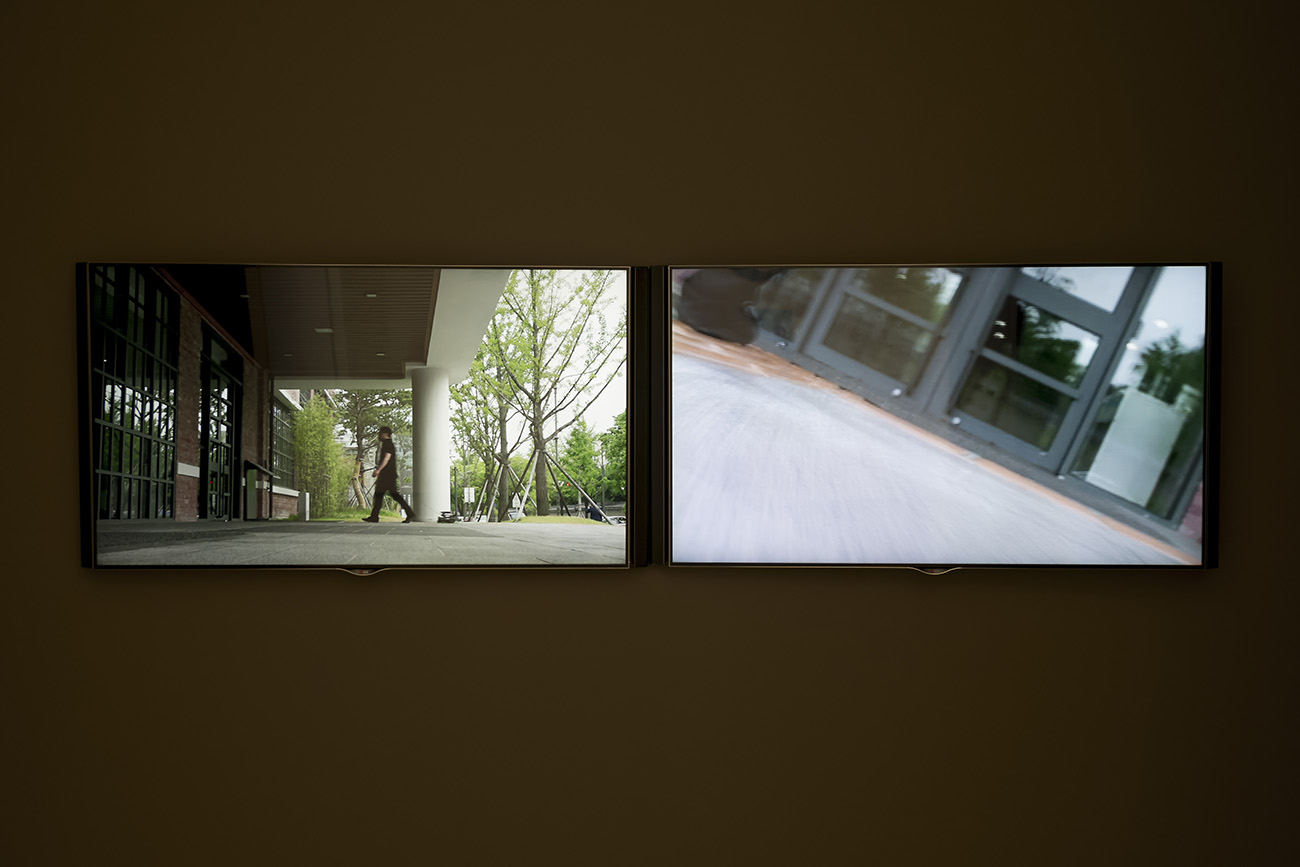
entangled with others between labor and capital. Floating
Village_Government_Consumer_ Individual_The sole in Seoul installed
in the entrance of the exhibition space demonstrates the locations where such
conflicts took place. This work assumes the role of prelude to his exploration
to come, videotaping the places where the conflicts actually occurred but not
the concrete aspect of the conflicts themselves. He documents such sites,
dragging the camera on the streets. The sites of conflicts include the Seoul
Railway Station, Namdaemun, City Hall, Gwanghwamun, and lastly the National
Museum of Modern and Contemporary Art, Seoul. Typical landmarks are included in
his journey, indicating that conflicts are omnipresent. His political economy
of conflict is explicitly described in its prelude, emphasized with the
symbolic color of red. Redolent of blood, red stands for a fray those results
in war. The four-channel video installation on display, features the primary
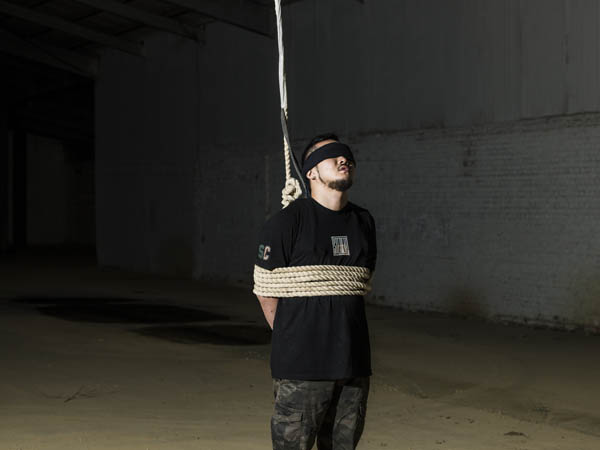
issues within Korean society. Two men whose necks are bound together
illustrates a metaphor for how different realities are tangled with one another
while a scene of sharing breaths to the dying person reminds of the meaning of
the common good.
The Wheel of History
A more macroscopic dimension unfolds after the introductory
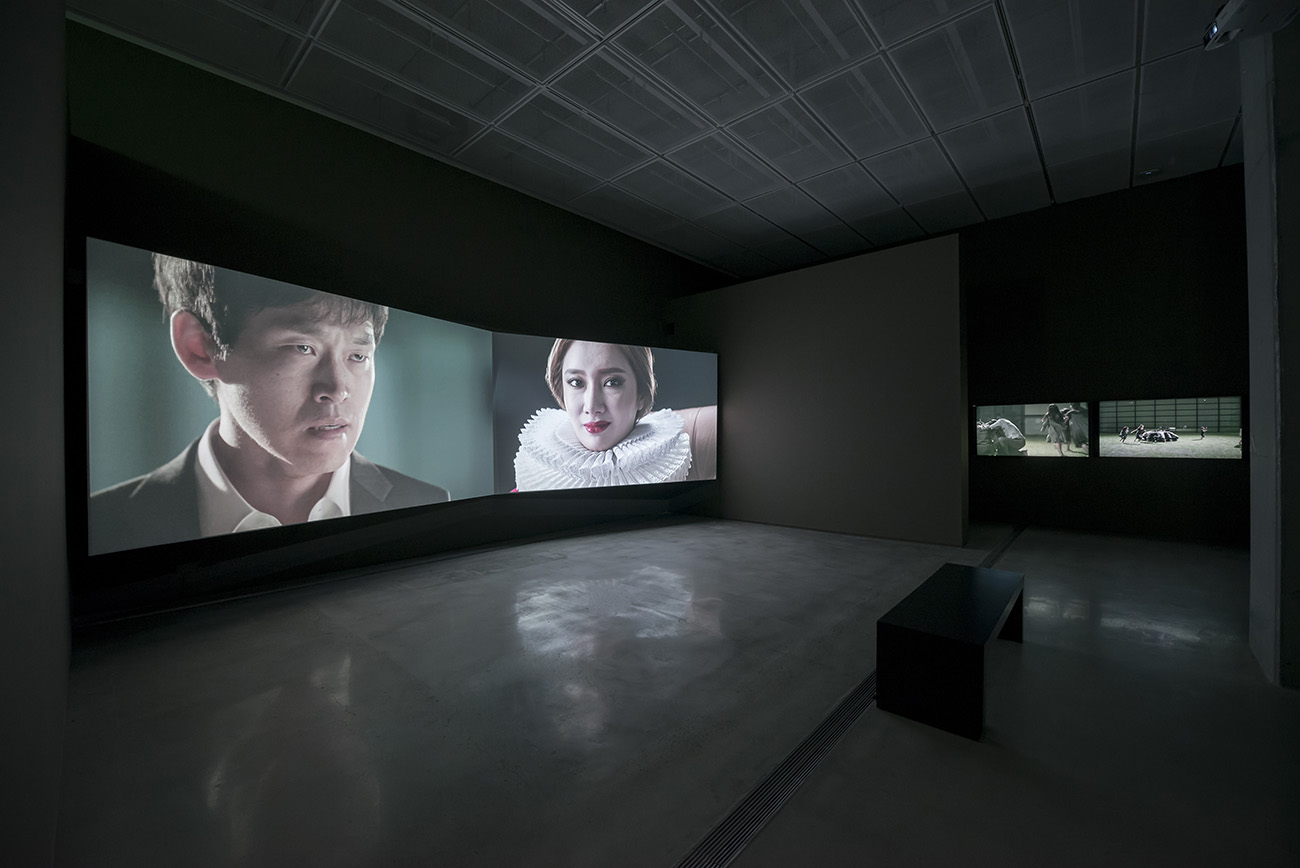
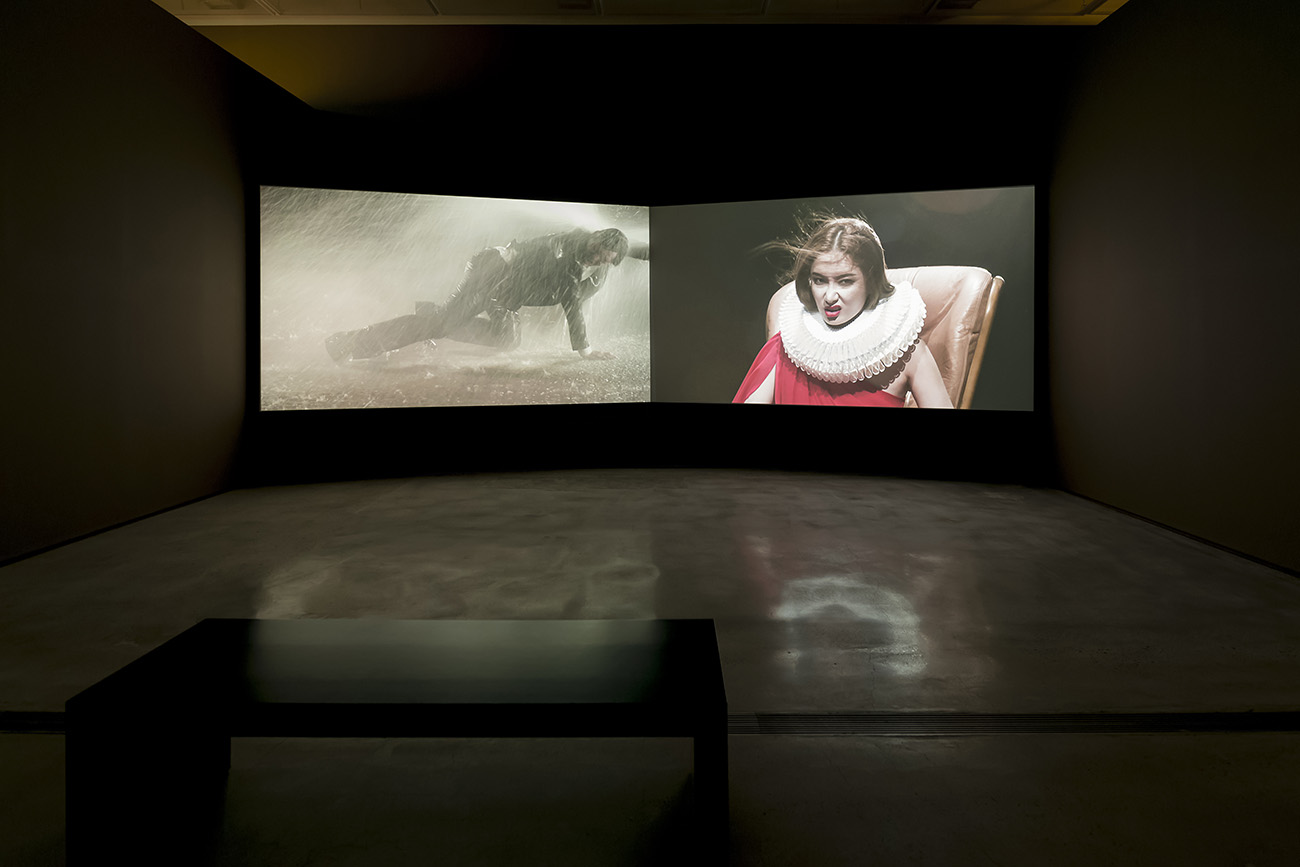
section of the exhibition. The Red Wheel_You Belong To Me presents
a stark contrast between cruel power and the victim who is harassed by the
authority. ‘Ideology is always beautiful and peaceful but history shaped by the
ideology is always violent and painful’, said the artist. A beautiful woman
wearing a ruff collar and a man beaten by water bomb are the metaphors for the
contrast of beauty and violence. Power is often decked with beauty but power is
violent per se. The countless monuments left on the earth clarify the
combination of power and beauty while power internalized in everyday life can
even be found in modern times when most monuments have been destroyed.
Exquisite portraits in art history were mostly portrayals of the ruling class
such as the royal family and other aristocrats. The archaic ruff collar
resembling a wheel is a metaphor for those living with wealth and honor. The
garment of the collar is adopted as a synecdoche in that it describes a part as
the whole and also as metonymy in that it uses an aspect to represent the
whole. A ruff collar places emphasis on its wearer’s dominant position, thus
leading a mob of angry people to decapitate their rulers in the historical events
like the French Revolution.
The body represents symbolic order. And it often becomes the venue
of violation. The represented order is where such condition of violation is
critically revealed. This is why Kim has collaborated with multitude of
professionals in the realm of body language such as actors, performers and
dancers. Workers cannot wear a ruff collar. This was the attire for the ruling
class (or it was often worn by clowns to satirize rulers). It is also
interesting in terms of structure. The pleats flowing to the center draw in
things around them. This process is repeated like the turning wheel. The wheel
turns here and perhaps have turned in the past.
Friedrich Nietzsche had claimed the idea of eternal recurrence against the
linear historicism of his time and stated that only the inevitable returns. In
this perspective, power is inevitable. Power will not vanish as long as human
society maintains. Power is more or less interactive. As is often the case with
history, people have selected their dictator. The wheel of history in Kim’s
work travels through the dual wheels.
Unlike the actual process of history, an ideology argues that
there may be a determined force leading the history. Kim defamiliarizes the
dominant ideology, displaying a gap between imagination and reality through the
two contrasting scenes. Whenever a man suffers, the cruel woman’s hysterical
laughter grows louder and her white collar gradually becomes red. The red
petals also fall to the ground. The figure of power seems to slowly lose
potency but exploitation will continue in a different manner. Liquid images of
blood and water blurring the two figures in different ways respectively
reproduce violent realities, alluding that the boundaries have to be
extinguished. The title of this video, The Red Wheel_You Belong
To Me, was appropriated from a novel by Aleksandr Solzhenitsyn.
The scenes of getting beaten by the water bomb came from his experience.
Pouring down water bombs, as if to suppress fire, is a primal way to cope with
danger. Past dictators cracked down on dissidents with violence. Water bombs
seem less violent but are the same in that the heterogeneity is removed to keep
homogeneity. An obsession with hygiene is reflected on politics: it is
particularly influential in the era of totalitarianism.
Discourse in which politics is combined with medicine offers
justification to get rid of external enemies who disturb the internal world.
This is the way one defines the other, and the way to suppress by exclusion.
The contrast between blood and water harks back to biopolitics (Michel
Foucault) commenced in the modern times. Unlike blood, water is neither
positive nor negative but feels neutral.
Blood is hot whereas water is cold. Water is microscopic power
working silently between meshes spreading around life. While blood works in a
revolutionary situation where macroscopic power operates, water is quotidian.
In Homo Sacer: Sovereign Power and Bare Life, Giorgio Agamben shows a process
of integrating natural life into the mechanism of state power and altering
politics to biopolitics through preceding research on Michel Foucault who
advocated the concept of biopolitics. “Politics here becomes something that
lends a certain form to people’s life.” Agamben asserts, “politics is the
determination of non-political things (bare life)”. A modern state is governed
not by bloody cruel violence but by legitimate violence.
As Walter Benjamin and Jacques Derrida stressed, the law and
violence are not opposite to each other. In From the Law to Justice Derrida
asks, “how can we distinguish the force of the law from violence we always
consider unjust?” In The Name of Benjamin, however, Derrida argues that
“Violence is not outside the order of law and things intimidating the law are
affiliated with the origin of law.” saying that “there is just a stake in the
law.” Like the de-constructivist philosophers, Kim intends to deconstruct the
base of legitimate violence. In From the Law to Justice, Derrida considers the
structure of law to be deconstructed by nature because its ultimate basis is
not founded on justice. As all historical progresses and political
opportunities can be found in this possibility of deconstruction,
“deconstruction is justice.” The deconstruction of binary oppositions is
deconstructivism’s first priority since it keeps up preexistent contradictions.
These structures often appear in Kim’s work. However, they do not fight with
one another but are used to struggle against invisible enemies.
Division, Ideology, and Peace in Everyday Life
Another contradiction in society that Kim points out is the
division of the Korean Peninsula. A Weight of Ideology_Darkness
at Noon features a painter whose life was devastated. He had
made several suicide attempts due to the trauma he suffered around the end of
the 1980s when the National Security Law wielded absolute power. This
middle-aged man is a real person who had a bitter experience on suspicion of
espionage due to his geolgae gurim, a hanging painting. What he had stated
during a hypnosis therapy session with a psychiatrist is shocking. The audience
is able to hear his statements pertaining to state violence inflicted on an
individual. The only thing Kim did was simply arranging a meeting with the
doctor and mediates the process of healing without intervention. There is no
fiction here, only a potent reality that seems like fiction. The paradoxical
title of this work is borrowed from Arthur Koestler’s novel of the same title.
The novel addresses the author’s realization that a bright ideology for the
revolution concludes to gloomy death in reality during the great purge after
the Russian Revolution.
The psychiatrist puts the painter under hypnosis and travels to
August 1989 when the event took place. The painter reveals the aspects of state
violence that have been imprinted on his body and mind, at times reacts
violently to the doctor’s questions. “I was just walking. Some strangers popped
out from a car. —– I resisted them, kicking the car door, but I was forcibly
pulled into the back seat. I was stuck there as if being flattened. ——- It
appeared like I was passing through a huge steel gate. —— There was a hallway
lined with steel doors on both sides. ——- They took turns asking different
questions and had me write down my answers with a ball-point pen. —- I wrote
down my answers, and they asked the same questions again and again. —— I was
with investigators around the clock. —– I wrote down my statement on countless
pieces of paper and used over 10 ball-point pens. —– I repeated the same
content. —— I wanted to stab them.”
The conversation between the doctor and the patient, which lasted
for about 40 minutes, reveal how the madness and violence of the system could
lead into the madness and violence of an individual. A Weight of
Ideology_Darkness at Noon also suggests that the form of
confession can be considered in the both the detectives and psychiatrists.
Criminals and madman are otherized. Power shifts from outrageous violence to
another form, meaning a transition from power is one-sided and suppressive to
an immanent power that makes us administer and control ourselves. This is the
subject of Michel Foucault’s Madness and Civilization: A History of Insanity in
the Age of Reason. The paradoxical articulation of ‘darkness at noon’ harks
back to madness. In the exhibition, madness is revealed and analyzed in the
public space of an exhibit hall. The origin of his way of addressing the
normal-abnormal can trace back to his early exhibition ‘Standard’ (2001). All
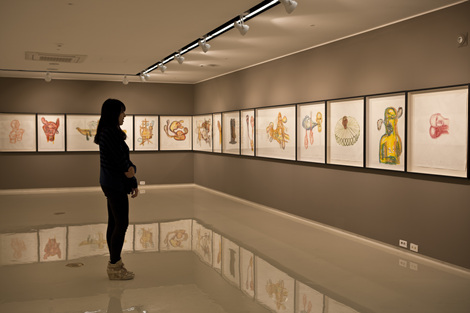
works on show at this exhibition are videos but drawing still plays a
significant role in his art. He has displayed a large number of drawings whose
concepts and images pertain to those of ‘The Last Leaf’, an exhibition held at
Perigee Gallery in 2014. He showcased immediate images instead of elaborately
honed images at the exhibition.
Images are excreted like a madman’s babbles or doodles. As art
seeks a multitude of paths, not a single one, and roundabout ways, not
shortcuts, rulers consider this an extravagant element. When the concept of
production as the highest value reaches its limit, such extravagance will show
its strength in earnest. Past communities used to get rid of the risk of
excessive production and accumulation by having opportunities to squandering
their time regularly as in a festival. However, this risk of excessive production
is resolved by war in the globalized era when the competition of all against
all is often encouraged. The cause of war is built in contemporary society in
which people seek infinite growth: war is not an exceptional event. A doodle
getting a clean wall dirty symbolizes an act of breaking taboo. Order in a
society is established and maintained through taboo but there have been no
taboos violated in history. Drawings done in the style of doodles show the
tangled aspects of a multitude of images. Energy that comes out from all holes
of his body is involved in and entangled with one another in his drawings that
are the basic of all genres of his works including video. His drawings are just
enumerated through conjunctions like ‘and’ and ‘or’ but are not constructed
organically.
They are not organisms suggestive of hierarchical order but are
‘bodies without organs’ (Gilles Deleuze) possible to be connected like
rhizomes. Organisms are faithful consistency while the ‘body without organs’ in
which organic order is deconstructed verges on deformation. Drawings often used
as the backdrops of his videos like A Weight of Ideology_Darkness
at Noon are charged with others’ desire in which power cannot
conquer. Drawings in this exhibition are behind the scene like shadows but
become a medium to unfold conceptions freely. His video images are not
connected smoothly. There are severe leaps and gaps as in his drawings. And an
important message is created in empty space and time. His works thus demands
imagination, moving beyond seeing and hearing given things. Representing
something is not everything in his videos as in drawings. He explains video
images in the exhibition are depicted like drawings one by one. A ruff collar
is portrayed as a doodle, and the video is completed by adding a narrative to
this.
His sculptures and sculptural installations that are not included
in this exhibition due to space limitations were also derived from his
drawings. This reflects his career: Kim initially pursued painting but later
studied sculpture and cultural theories. Drawing is in a sense a language he
used immediately after birth. It has been a seed for all types of his works
including painting but also sculpture, installation, video and conceptual work
in various forms. A Weight of Ideology_The Last Leaf focuses on the South-North
dialogue and offers an auditory experience of the current state of division.
Innumerable images pertaining to the division of the Korean Peninsula including
the first televised meeting of separated families have been put together but
unification is still. The artist tries to move beyond any fetishistic
visibility under this circumstance.
Representationalism triggered by visibility
solidifies visual consumption of subject matter. The scenes are sort of
spectacles. As Guy Debord concluded in The Society of the Spectacle, they help
conclude contradictions as contradictions. Only the voice of a radio actor is
heard in the gloomy room. He originally wanted to join in on the meeting of the
separated families but could not as the author refused his application. He thus
incarnated such a scene with his imagination. Absence and deficiency has been
the core of his work rather than making it impossible to achieve.
In terms of themes this work reminds viewers of his work A
Weight of Ideology_The Letters to North__Let me know how are you?_On the Yellow
Sea (2013). The message ‘Let’s meet and have cold noodles
together’ is delivered to the North by setting it adrift on the Yellow Sea. His
works dealing with the themes of the division of Korea portray a situation in
which both North and South Koreans cannot visit and see each other. Their
conversations are all recorded and people in authority from North and South Korea
join together, implying that discourse and power are in an immanent
relationship. Kim addresses not only the grand discourses like the issue of
division itself but also trifle discussions about daily life. He made use of
the news programs we watch every day on television in 99
Days_Back to the Future (2015). A news program begins with a
news anchor’s fresh remarks, “Hi, Everyone!” but these words are soon followed
by the images of various accidents and other incidents. He saves and edits only
the beginning of news programs rather than bringing the spotlight to something
special. He brings life to reality in a way that makes more of an impact than
artwork, leaving them as unprocessed as possible. Of course, artistic devices
have the ability to make reality look like reality. His works are the results
of his common practice but unveil the nature of seemingly peaceful everyday
life.
Beside this work is On the Bridge, which shows how various events
cause social death, not personal misfortune. A politician described the sinking
of the Sewol ferry as ‘a mere traffic accident,’ a comment that aroused public
indignation. Such a quiet death indicates that Korea’s suicide rate is the
highest in the OECD. The Sewol ferry disaster is perhaps the biggest event that
has greatly impacted our daily lives. This event let us realize that we are in
no way comfortable and safe and can never be so. Erased Road And
who were without Light (2015) was inspired by the work of Kathe
Kollwitz, a German painter who underwent the loss of her son and grandson
during the two world wars and became an ardent opponent of war. A maternal
image meant to protect children is represented in a dance that discloses the
feelings of parents who lost their children in the ferry sinking. Many child
performers as well as professional dancers appear in this work.
Kim has collaborated with more than 100 people on this exhibition.
Jaeryang Wi, an obscure poet, is one of them. He debuted as a poet while
working as a municipal scavenger in Seoul despite the hard labor involved with
the disposal of excrement. Kim produced a music video with his poem in
collaboration with a film director. He also joined hands with musicians from
subculture. A hip-hop performance associating poems with music will be
presented at the opening ceremony. Actors, dancers, musicians, filmmakers,
psychoanalysts, poets and others are all brought together under one roof. As
Kim’s works of engaging in reality are not meant to instrumentalize art, these
outsiders join the field of discourse, allowing the venue to become a public
sphere. The artist here is a mediator and a mutual subject rather than a
creator and subject. Thanks to his feast-like imagination that his themes
secured from weighty realities do not sink. They float like buoys, letting us
know of the coordinates in the vast sea.