The Past of the Artwork: Reading Through Dialectic Images
In
a past interview, Song Sanghee spoke about her “desire to stand up straight on
a spot, something like a blade of a knife.”1 Her works were
then engaging with a sharp identity politics as a non-disabled heterosexual
woman from South Korea. As I observed the two edges of her blade transform into
a daughter and a mother2, a prostitute and a classy lady3,
the first lady and Yeongja4, and later into a missionary and
indigenous people,5 I was picturing the artist perilously
standing on a blade each and every time.
In
her performance of the typical two edges that constitute cultural
systems—tradition and modernity, colonialism and globalization, the divine and
the secular, the normal and abnormal— Song Sanghee seems to be less following a
given role than she is following an acting technique that threatens the system
and discourse by embodying typicality. Perhaps she is so dedicated to the
roles, to the point of becoming one with each of them, that the artist
overwhelms the character—like Do Kum-bong did in Yun Bong-chun’s 1959
film Yu Gwan-sun, where she portrayed the Korean Jeanne d’Arc who
sacrificed herself for the liberation of her people. The physicality of the
actress, notably standing out during torture scenes, overwhelms the March 1st
Independence Movement’s historicity and transmutes a typical
nationalist film into a bizarre horror movie. Likewise, Song’s performance of
the first lady’s tears and Yeongja’s smile penetrates through the symbolism of
motherly love and diligence, spookily summoning the sacrifice, or even the
revengeful spirit, of the female oppressed by dictatorship and state-led
economic development. Here, the first lady and Yeongja are not separate
characters but rather multiple personalities hiding within the same body, which
are manifest according to social conditions and specific situations; any
control that prevents total breakdown belongs solely to the artist (or to
oneself who identifies with the artist). In other words, Song’s blade fractures
the collective memory and official history imposed by the nation-state onto the
individual and reveals mental traumas and personal secrets engraved on and
hidden in the individual body.6
Meanwhile,
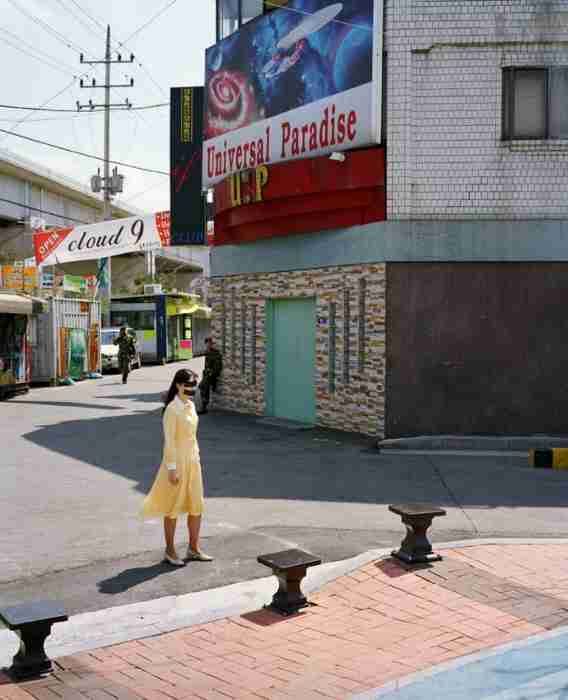
the locations of the photographs—Wolmido, Maehyang-ri, Dongducheon—are parts of
Korean territory that the U.S. military either attacked or was stationed at,
sometimes bringing Korea’s identity as a nation state into a crisis. In the
event-based system (as opposed to structure-based) of this photographic world,
the human body serves as an element of the social landscape. For instance, the
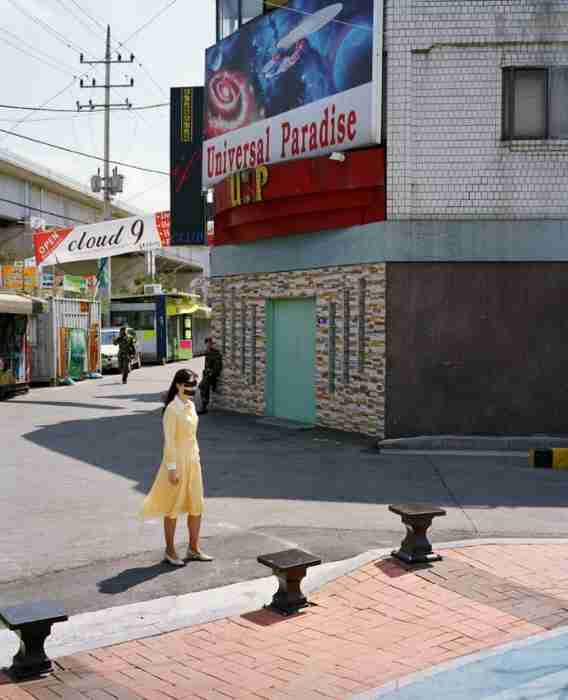
missing arm in Blue Hope, the marks of arrows that hit
young girls in Maehang-ri, as well as the black tape
over the woman’s eyes and mouth in Dongduchun, compose
the scene like fingerprints left on a victim’s body do. In terms of
geopolitical landscape, this is both a terrain bearing traces of the
patriarchal state and an empty lot signaling the absence of sovereignty. The
mise-en-scène of identity, constructed through inner oppression and outer
exclusion, quickly crumbles in a national territory occupied by international
superpowers; instead, a mise-en-abîme takes place that both oppresses and
excludes the interior, resulting in an endless void created by self-confronting
and self-reflecting national images. Mirage, a mid-air installation of
Gwanggaeto Stele made of plastic wrap, appears to be an empty and rebellious
memorial to the modern national identity in this context.
The Future of the Void: Reading Through Rhetoric
This
is perhaps why Song Sanghee confesses that she “believed [she] can stand up on
any place. But . . . it may well be that [she has] been floating in a void.”7 Once
dancing between blades and the void, the artist now attempts to levitate. The
weakening of national identities by intensified international political
dynamics dislocates gender politics in the process, providing Song Sanghee with
a chance to “rise up” to the international level.8 The further
she floats above the blade of identity politics, the larger the void captured
by nation-state ideology; a transnationalist mythology unfolds in a global
perspective, beyond a single nation’s territory and airspace.
Evening
Primrose, Song’s 2006 project during an artist residency in Amsterdam,
Netherlands, was initiated as poems written by sex workers were shared through
the network of the International Union of Sex Workers and other related
organizations. The poems were projected using lights installed above the walls
of a church in the middle of the Red Light District in Amsterdam; passersby and
sex buyers could read the light-poem projected on the sidewalk. Light and
poetry here, as media that cut across the red dark, effectively carry the
individual sensitivity and character of each woman who wrote the poems—instead
of objectifying or generalizing sex workers. The artist emotionally connected
with them, gaining self-awareness as a connected being within a certain world.9 Fittingly
to its title, Evening Primrose came to an end during the night after
a sex worker, discomforted by the unusual brightness, asked to have it taken
down. For Song Sanghee, who delicately coordinated the project since its
conception, the project’s abrupt halt was most likely an opportunity to
contemplate more radically on the artist’s relation to others in the world.
With
the residency over, Song Sanghee decided to relocate abroad. Unlike younger
generations who supposedly leave Korea for their “contempt towards Hell
Joseon,”10 she belongs to the last generation that experienced
the steady political and economic developments of post-war South Korea. Also,
unlike older generations, she belongs to the first generation of artists that
benefited from a systematic and accumulated cultural education as well as a
growth of public funding towards the arts. Immigration for Song Sanghee must
have meant more of an opportunity to become a better person. I imagine her
decision was made in order to secure personal freedom and independence as an
unmarried woman who grew up in South Korea’s compressed mixture of
pre-modernity and postmodernity, as well as to connect directly with a more
open knowledge and flexible technology as an artist. Around this time, Song
Sanghee went through a complex self-verification and efforts for adjustment
that she has to confront as “part of the emancipation of the fleeing
non-western artists,”11 attempting multiple artistic projects
that oscillate between skepticism and reckless courage. She even dies an early
death. Rather than the guilt of a rebellious patriot who ends up turning her
back to her country, or the shame of leaving one’s family and friends behind,12 Song
Sanghee willingly embraces near-death experience in Her
funeral (2006) and Ready to die (2006).
The year she applied for permanent residency in Netherlands, she
completed The 16th book of Metamorphoses (Metamorphoses,
2008). This work led Song Sanghee to be regarded as epitomizing the complex
identity of the artist in general, which is closely tied to the larger network
of identities within diverse social realities, in the context of post-colonialist
cultural politics.13
The
biggest change observed in Metamorphoses is that the
artist goes beyond dismantling the existing system and rigid typicality, moving
towards weaving new textual narratives. The piece’s protagonist is an asexual
creature that morphs between human and animal, between living and object,
traveling across Ovid’s Greek and Roman mythology and the Bible, creationism
and evolution, sciences and fables, and historical events and allegorical
spaces. The blinded and muted female character from Dongduchun starts
expressing thoughts and emotions in Evening Primrose,
before eventually obtaining a voice of its own as the narrator of Metamorphoses.
The voice follows tragic protagonists who are murdered, kill
themselves, and finally self-destruct along with the Earth, before giving way
to whale sounds in the end credits; it maintains a prudent and considerate, yet
hesitant tone. The narration here does not reduce the polymorphic creatures
into the single voice of the artist, nor does it take an omniscient and
objective perspective. The protagonists pursue love and revenge while being
precariously swayed by war, cannibalism, self-replication and sonar systems;
they are fully exposed to the instability and vulnerability of contemporary
life, closely tied with capitalism, military industry, and financial networks.
The artist’s voice is but a receptacle of such feelings.14
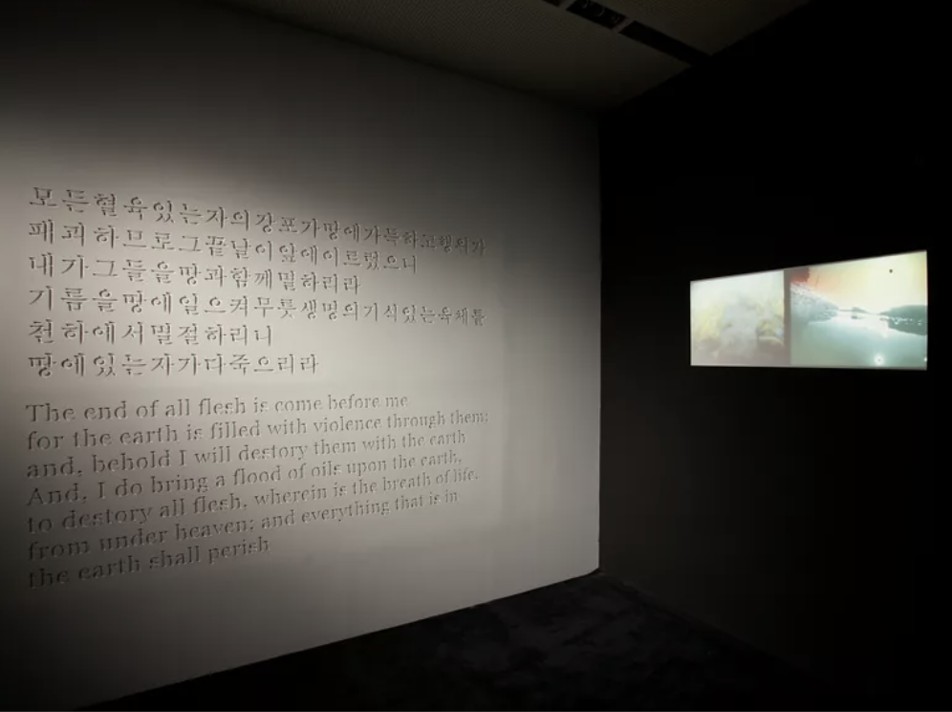
The
pencil-drawn animation lively illustrates the main theme—metamorphosis—before
ending on the Earth being catastrophically covered by oil. The 2010 blowout in
the Gulf of Mexico of the Deepwater Horizon, owned by the multinational oil and
gas company as well as oil flooding forerunner BP, remains one of the worst
recorded disasters on the marine ecosystem, along with the Samsung-owned Hebei
Spirit’s oil spill in Taean, an accident addressed in Song’s Mohang (2008).15 The
massive amount of spilled oil devastates not only natural environment but also
the very human existence and modes of perception. Faced with the boundless
ocean covered with sticky black oil, we realize that the end is nigh.
Ecological theorist Timothy Morton writes that oil allowed us to “[burn] a hole
in the notion of world.”16 In a world where the scale and
impact of disasters have surpassed the capacity of any single nation, and the
post-Anthropocene acceleration of Earth’s destruction is beyond control,
ecology is much more than just natural environment. Global warming, ultrafine
dust, radioactive waste, and sonic weapons spread like invisible toxic gas, not
only altering a wide range of relations but eventually disabling the human
subject’s perception of the world. Hyperobjects that stick to, penetrate, and
coat the subject with their oil-like viscosity, reveal that “[i]t’s not reality
but the subject that dissolves, the very capacity to ‘mirror’ things, to be
separate from the world like someone looking at a reflection in a mirror.”17
For
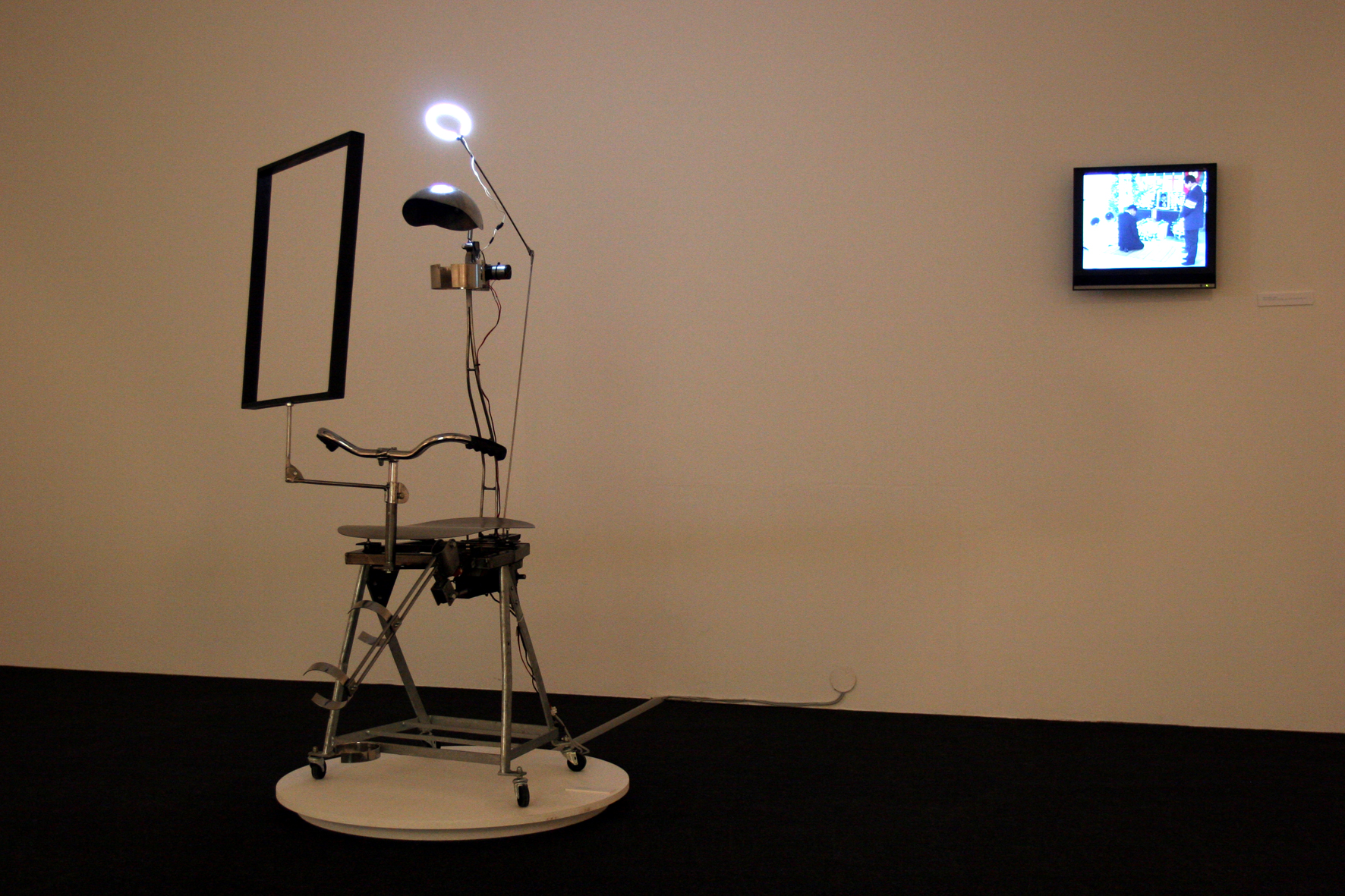
the Korea Artist Prize 2017, Song Sanghee installed
two flat pieces at opposing sides of an empty
space that is larger than 20 meters in every direction. First of all, this
empty and deserted space is significant. Some of Song’s works are, in fact,
large and empty.18 The importance of void in her work relates
to the size of the piece: the bigger, the emptier. While this might invite an
environmental interpretation on material, or be seen as a feminist parody on
size, it seems more than anything that Song Sanghee attempts to compose the
void. The bleak and desolate atmosphere of the exhibition space presents a
fast-forwarded post-apocalypse to our senses—in a Korean peninsula threatened
by an unprecedented US-North Korea nuclear crisis. So reemerges the distance
between the world and I—the relationship between a world-reflecting artwork and
I, which had once vanished in the era of viscosity.
Come Back Alive Baby
Song
Sanghee explains that the protagonist’s name in Metamorphoses,
Khora, comes from Plato’s notion of khôra, which designates a receptacle of
being. Khôra is a space that was already formed before the very first matter
was composed. It is neither existence nor creation, form nor imitation, being
nor nonbeing; it is a space in-between. Moreover, khôra is a receptacle as well
as a stomach and a womb; rather than merely being an empty recipient that can
only be shaped by matter, it wields a certain power to distinguish and arrange
incoming objects and to attribute heterogeneous motility.19 In
Metamorphoses, Khora was a creature that transformed constantly by eating and
being eaten; at the same time, it only existed through this relationship. In
this exhibition, Khora transforms into a “nurse (tithēnē)-like”20 space
which nourishes the post-apocalyptic ecology and brings it to creation; the
space embraces the baby and brings it back to life.
-
An Intermedia Mosaic
Come
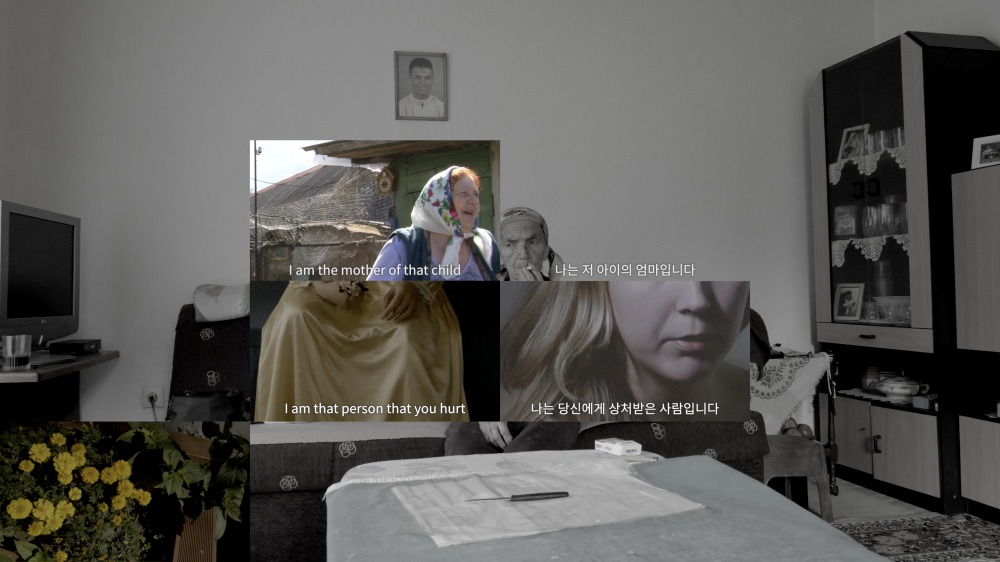
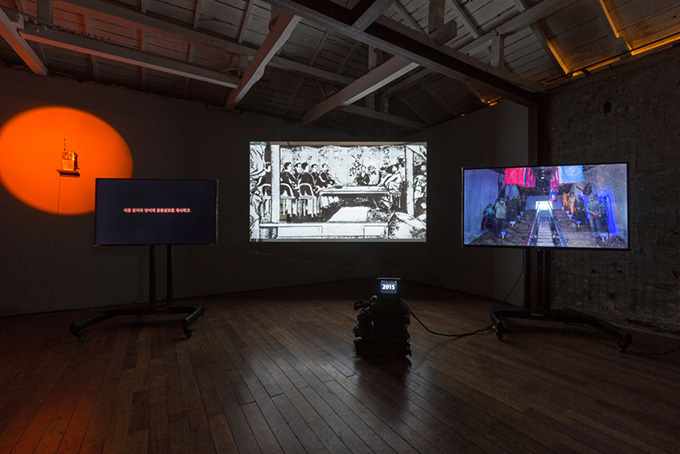
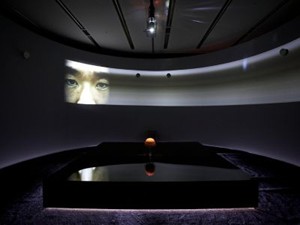
Back Alive Baby (Baby, 2017) takes as motif the Agijangsu (“Mighty
Baby”) tale, a Korean folk legend which revolves around loops of birth and
death, revolt and suppression, massacre and resurrection. Similar in format
to Anyang at the Dawn of the Day, The City Dreaming of a Utopia (Anyang,
2014) and The Story of Byeongangsoe 2015: In Search of Humanity (Byeongangsoe,
2015),21 its montage of archival film, documentary videos and
photos, staged footage, pencil drawings, text, and sound attests to the
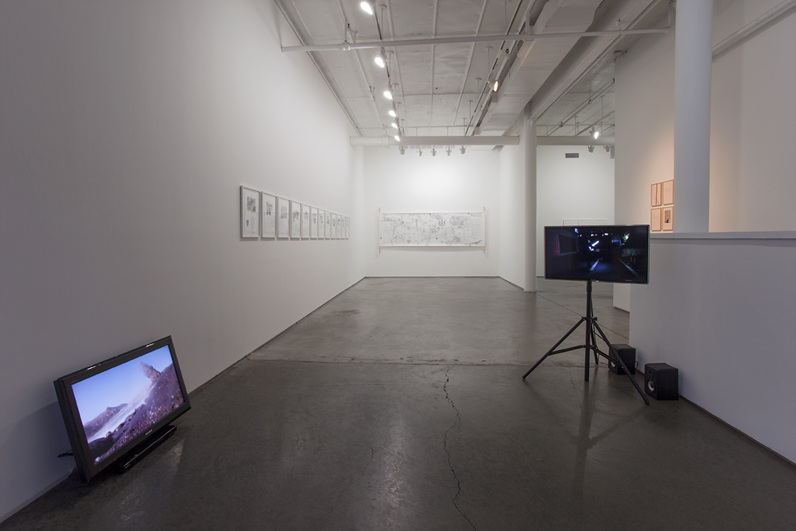
establishment of a certain visual grammar. Anyang mainly consists of
documentary videos of the city’s nightscape with minimal movements or events.
While the modern industrial city’s name means a utopian space where all can
rest comfortably, Anyang in Song Sanghee’s 2014 piece is set up as a
post-nuclear explosion society of the future; Anyang functions as
science fiction by exposing the dystopia that is already here. Two scrolls of
pencil drawing hung next to the screen, partially highlighted by moving head
multicolor lights that are synced with the video, contribute to the piece’s
kaleidoscopic diversity. Byeongangsoe, completed the
next year, is an installation which involves three monitors of different sizes
and a projection screen that display videos and text, while moving spotlights
illuminate different parts of the exhibition space. The work is seen as a
multilayered video opera which adapts the iconic and classic Korean
pornographic tale of Byeon Gang-soe and Ong-nyeo into a corpse trading story.22 This
is likely due to the images and text densely compressed into each channel,
reminding one of an opera stage where chapters are led by a monitor-prima
donna. In contrast, Baby keeps the large and empty screening space as
its constitutive outside and incorporates drawings and spotlights into its
three video channels, maintaining genre conventions of essay films.
In
the three works, Song Sanghee connects and arranges images of different
textures, inviting a heterogeneous spatiotemporal intermedia experience. This
experience, synchronized with technologies that borrow from and transform
conventions of the genre,23 helps to bootstrap historical
orientation and sensibility. In Baby, archival material
is carved onto an intermedia mosaic as its principal pattern. The compilation
of archival footage and photos from around the world mostly consists of
documentations of horrible events committed by state powers such as fabricated
espionage cases, famines, and concentration camps. We tend to think of these
historic events as familiar. However, when montaged together with other images,
text, and sound within the piece, the archival image clips notably stand out;
the indices were created through direct contact with the historical event.
Archival photos of the East Berlin Case, that seem to be developed in real
time, come across as more tactual, than visual, facts. Re-recorded footages of
documentary monitor screens in the Ukrainian National Chernobyl Museum are less
historical indices than they are real cinematic objects that touch and react
with our present body. The large eggs on the beach in Ouddorp or the giant
mutant catfish in Chernobyl’s cooling pond, projected on the other screens, are
other organisms/environments that induce this interaction.
-
Hyper-Archival Impulse
A
sequential review of the three formally similar pieces reveals that the archive
is not only a component of these works but also a cinematic device that leads
to a creative and ethical confrontation of the real. In this complex
representation process of history and memory, the artistic mnemonics required
from the attentive observer is activated as well. The three pieces could be
called an archival trilogy, respectively emphasizing and cycling through the
future, past, and present. Anyang‘s mechanic and cold documentation of a
dystopian future not only is an early record of the post-apocalypse but also
leaves the city of Anyang as an archive for the future. The following
year’s Byeongangsoe archives the deaths of homo sacer, pervasive
throughout East Asia from the 19th to 21st centuries. Notably, it establishes a
non-chronological, yet almost compulsive, death archive. This piece, along with
drawings of victims’ faces and mid-air installations of empty scarves that
chant The Story of a Desperate Lady, transforms Art
Space Pool, with its exposed walls and ceiling, into an archival space for
Gothic summoning. The artist states that the idea
for Byeongangsoe came at a period of collective depression and
lethargy in South Korea, following the Sewol sinking disaster. As the aftermath
of the horrific man-made disaster stuck to one’s skin like the epidemics
mentioned in the piece, the stubbornly material and fragmented structure of the
archive is none but the symptom resulting from an existential shock and the artist’s
responsibility.24 Meanwhile, Baby, the last piece of the
trilogy which was shown after the Korean “candlelight revolution,” is filled
with the present. Eggs roll around a scifi-esque beach, next to photos of
victims of the Committee for Re-establishment of the People’s Revolutionary
Party Incident; an interview of J. Robert Oppenheimer, the father of the atomic
bomb, is juxtaposed with landscapes of Pripyat, Ukraine; dolmens and drawings
of babies’ hands from around the world are put one next to another. The past
archive, rather than being an absolute origin, provides vague clues to pursue;
the documentary scenes and staged footage constantly flow towards the future,
as yet unfinished projects without ampliative meanings.
Debates
over the objectivity of historical accounts and the historical-philosophical
questions involved in the selection, categorization, and accumulation of
records also apply to the hierarchy of knowledge and information that
constitute the archive. The fact that archival films have greatly increased
after the World Wars point to the inevitability of confronting key issues of
ethics and aesthetic power as one attempts to document death using film.25 Accordingly,
any work that attempts to collect ‘the deaths left in the field’ by modernity
(and its archive)—such as war, genocide, famine, human experimentation, and
epidemics—necessarily demands a perspective and stance regarding the archive as
an institution. Artists faced with such challenge often emphasize poetic
approaches and metonymy while exploring fantasies and the unconscious, in order
to deconstruct the existing archives and archival ideologies; in this sense,
they have strong anti-archival tendencies. Furthermore, Song’s archival works
eventually engender counter-memory, as the candle in Baby, invoking people
abandoned by the state power, symbolizes. Her archive can be described as a
nurse-khôra which nurtures and embraces “orphaned” films.26 More
than anything, Song’s archival pieces firmly reject the nostalgic
kitschification of the archive, or an abstraction which overlooks relevance for
the sake of formal beauty. Instead, the artist chooses to exaggeratedly expose
the existence of the archive, through a disorderly, unsystematic, and random
over-accumulation. Hence her creation of a hyper-archival situation by
tenaciously overlapping unfamiliar images, poetic text and solemn sounds over
existing archives. While this is an allusion to the contemporary media
environment where one supposedly no longer needs to shoot any new images, it is
also a reaction to the Korean history which is void of any archive at all.27
-
One Image, Two Skins28
The
first image that appears on the middle screen of Baby‘s three-channel
video installation is a glossy tile floor. Decorated and rough brick walls
follow, while the two screens on the side show barren land, gravels, dusty
roads, and such. The index printout indicates that all the locations are
related to massacres or other tragedies. As Song Sanghee visited these places
to film them, the world-historical scenes were not merely places with traces of
past events, but rather living skins of history.29 All skins of
history have wounds, especially when we read literally the ending scene where a
hand caresses the burnt skin of another hand.
In
André Bazin’s definition of film as the skin of history, the important part was
less the skin itself but the wound revealed as the skin tore; the wound would
be what reveals the true skin of history, the factual flesh and bones concealed
under the surface of the film. Documentary footages that make up most archival
films play back the skin of history, thanks to cameras everywhere and even more
screens, but “[a]s soon as it forms, History’s skin peels off again.” On the
other hand, by ripping archival footage out of its original fabric and
reassembling it into a new film of the present, we are confronted with a
previously unconceived reality of history. The second skin, created by wounding
the ever-peeling skin of history, emits a certain aura. This aura allows one to
sense the other strange and unintended meaning, which has always existed behind
the surface of the original subject.
For
instance, let us consider the footage of a baby farm where Nazis led racial
crossbreeding experiments. The image of the babies and the pretty baby as
described in the Agijangsu tale, displayed textually, are severely disparate;
the wiggling lives are juxtaposed with drawings of insects, which emphasizes
the stubbornness of reproduction. Ironically, as the on-screen movement
intensifies, the living creatures only emit a corpse-like strangeness. The
wiggling babies create wounds which reveal deaths that are not portrayed on the
screen; from the revealed true skin emerge massacres in Auschwitz, murders of
disabled babies in crossbreeding experiments, and the killing of refugees on a
boat. Then we return to the textual surface, only to be faced with the wings of
Mighty Baby, born “abnormal” and repeatedly killed by its parents. The
superimposed images ask: Are we not men?
If
a cut is literally a wound on a film, an editing that reveals the relationship
between coincidence and reality can develop the signification of wounds beneath
the skin-image more radically. Baby is an essay film written on three
screens. While three-channel films are not uncommon in contemporary exhibition
spaces, a notable thing about this piece is its maximized horizontal field of
view, stretched across screens separated by gutter-cuts. Tilt shots taken by
the artist create movement on the side screens; one needs to look left and
right between text and image in order to read the essay film. The heterogeneous
textures of images, text, sound, and black- and white-outs are assembled
through a “horizontal” montage “as opposed to traditional montage that plays
with the sense of duration through the relationship of shot to shot.”30 Baby juxtaposes
images that ventriloquize notions and theories in a lateral expansion of
time-space. This editing rhythm eventually turns Baby‘s semantic structure
into a sort of complex network, open in all directions and all dimensions.
The
eggs laid on the beach in Ouddorp is reminiscent of legends of egg-born babies.
As the eggs, once alive and moving, are stacked onto a cart with plants growing
all over them, their meaning diverges. Juxtaposed with unjustly killed souls,
the scene appears to depict a bier sending off babies that did not hatch. As
the white round eggs transition into circular patterns, which transform
successively into bullet marks on a wall, eyespots on butterfly wings, cuckoo
eggs, algae cells, and then again into beans described in the text. This
sequence leads one to think that the plants thickening over the eggs may be a
life-image that summarizes this cycle of creation. Moreover, the circular
patterns that repeatedly enter the screen seem to serve as a memorial symbolizing
the self-sustaining elasticity of the archive, in which “[w]hat’s known [as
existing, happening, or problematic] but ignored takes its revenge.”31 Or
perhaps the eggs are empty, temporal buoys which inform the rhythm of
horizontal editing.
This is the way the world ends / Not with a bang but a
whimper
Baby
and This is the way the world ends / Not with a bang but a whimper (This
is the way, 2017), which are installed more than 20 meters apart, are connected
via sound. As Baby‘s video installation approaches the end, and one
follows distant sounds until reaching a tile-wall, unfamiliar speeches come out
of intermittently installed speakers: greetings in 55 different languages that
were included in the Golden Record sent along with the Voyager unmanned solar
system probe, played back through the Google text-to-speech system. As this
sound crossfades with The Song of Earth played back on Baby‘s screen and
creates the soundscape of the empty space, blinking speaker lights seem to
communicate with other speakers or with us, like satellites. The
machine-produced broken Korean is strange and bizarre, as one would expect of
earthly sounds that returned from space.
Tiles
used as interior material are ordinary and familiar, like greetings would be.
But when linked with music by Isang Yun, the Korean-born German composer who
was imprisoned during the East Berlin Case, a fabricated espionage case, which
returns us to Baby‘s footage, This is the way‘s
tile wall obtains a whole new meaning. Holes in the wall and scratches across
bed surface tiles of the human experimentation lab causes historical wounds to
the giant smooth tile wall, as one comprehends that domestic tiles have also
been used to cover the walls of laboratories and torture chambers. A close look
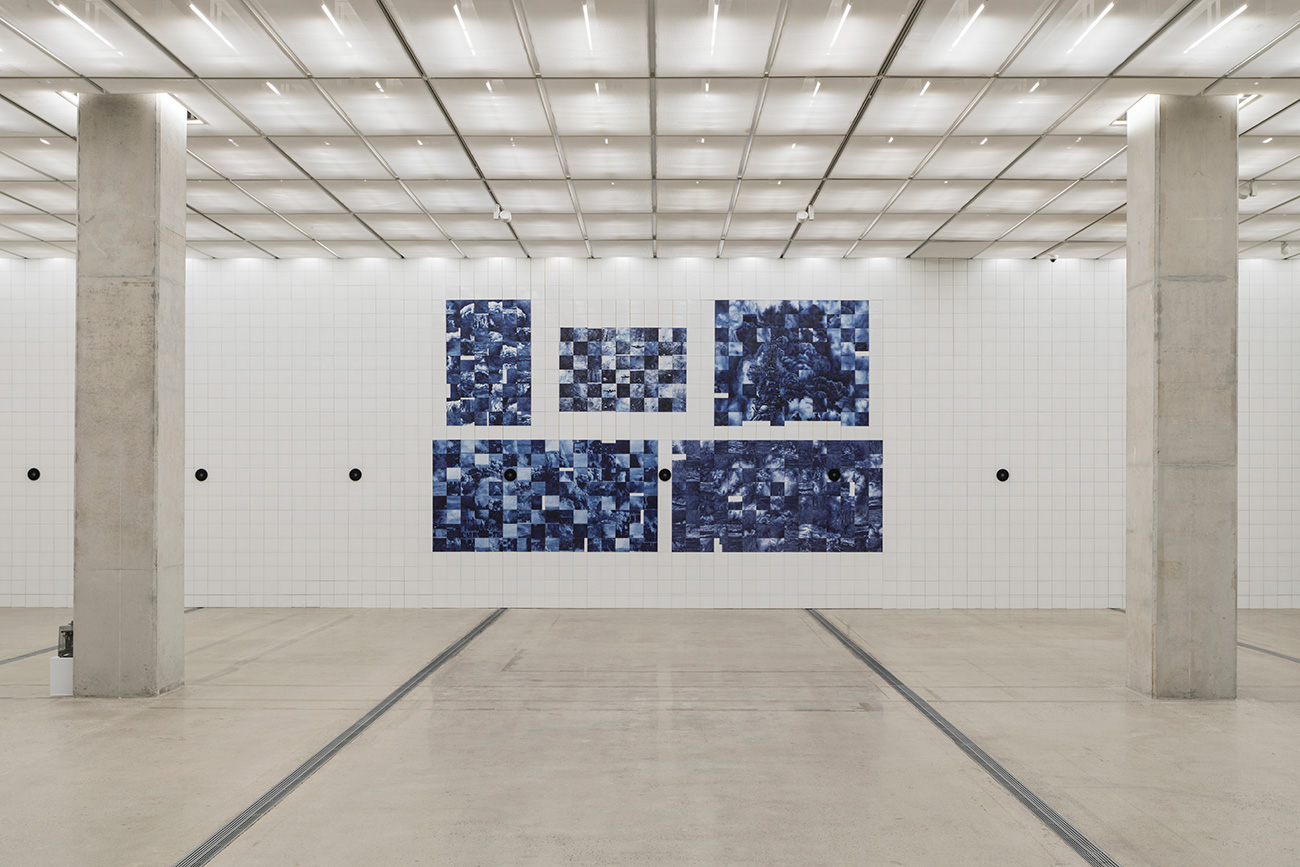
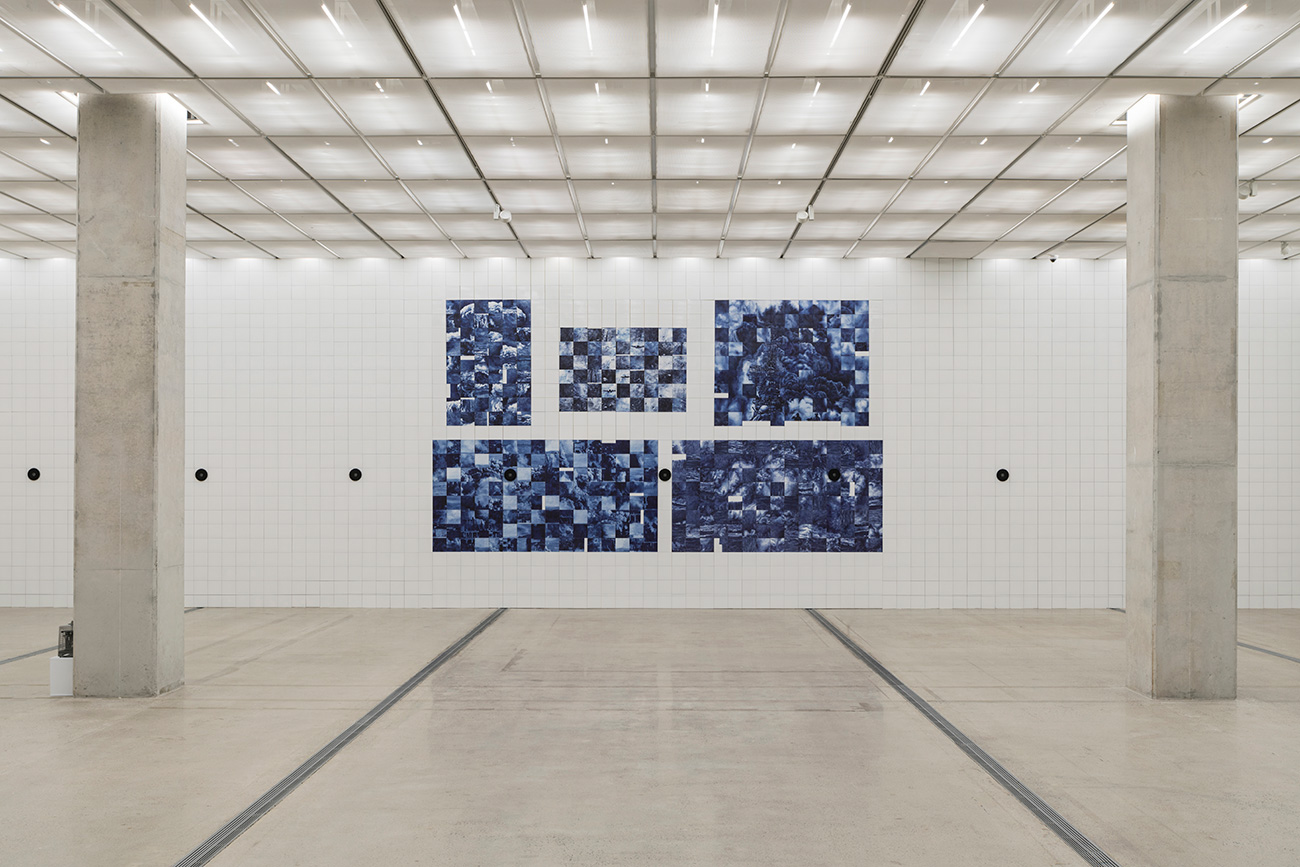
reveals that the drawings on Delft Blue tiles are processed images of explosion
scenes, familiar to us through mass media. Delft pottery, which was localized
in the Netherlands based on Chinese porcelain, seems at first glance to attest
to a rich and stable life. But once the deadly and fearsome exterior scenery is
projected onto the interior wall, This is the way becomes a trigger
that enlightens our reason, desensitized to violence. The tile wall is hence
another second skin, which protects yet easily breaks; hides yet reveals; and
connects yet peels off immediately.
This
is the way belongs, in some sense, to Song Sanghee’s series of
archival works. The drawings printed on the grid of tiles distills the history
of Sino-Dutch trade, while hinting at the intersection of religious and
monochrome paintings. On top of this are overlaid images of explosion collected
from different periods and areas, from atomic mushrooms from 1945 to clouds
caused by airstrikes of ISIS. Like the bath-archive discovered in France after
World War II,32 This is a way‘s tile-made sound
archive bears the contradiction and irony of simultaneous preservation and
destruction. For instance, as voices extracted from the earthly archive that is
the Golden Record pass through Google’s archive, it becomes clear that defunct
languages are preserved on the record. Meanwhile, one realizes that the
knowledge, information, and data once monopolized and distorted by superpowers
during the Space age are now even more explosively modified and processed by
transnational companies in this globalized age. Faced with the skin surface of
history, where screen and monitors montage images of violence over a saturated
Earth, I begin to doubt: perhaps these images are, as if confined within smooth
tile walls, merely assembled together without a bang.
The
title of this piece comes from the last line of The Hollow Men by
T. S. Eliot. The poem, written while Europe was in flames due to World War I,
was also quoted in Chris Marker’s digital image piece of the early 21st century
along with incessant explosive sounds.33 In Song Sanghee’s
piece, The Hollow Men is connected once again, this time with
soundless images of explosions that cover the Earth. The skin of history only
keeps being revealed as one follows with sensitivity and sincerity the relation
of art and the world. In order to conceal this skin, Song Sanghee chooses to
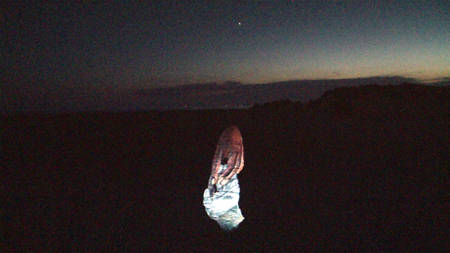
rely neither on leaves nor on leather. Instead, she covers herself with
double-sided transparent tape.34 She then rolls her entire body
and meticulously collects the dust, produced by explosions and covering the
Earth, using her sticky second skin.
1. Song
Sanghee, interview by Woo Hyesoo (Chief Curator, Leeum), 2006.
2. Gesture
to be a good daughter (2001); A pieta who lost her son (2002).
3. Dongduchun (2005).
4. The
first lady A (2004); Blue hope (2004). In Cho Seon-Jak’s 1973
novel Yeongja’s Heyday, the protagonist, Yeongja, moves from the
countryside to Seoul to become a conductor on a bus; she later loses one arm in
a traffic accident and becomes a prostitute.
5. Free
trade Bartering project (2012).
6. In
an unpublished artist’s statement (2004), Song Sanghee writes that she was
deeply moved by “heartbreakingly sublime female figures who sacrificed their
bodies unsparingly for the country or a lover” in television and cinema, and
that “the crueler and more shocking the sacrifice was, the more deeply and
strongly I was moved, to the point where it was difficult to calm down.”
7. Song
Sanghee, ibid.
8. Manray
Hsu, “Myths, Hopes and Other Truths – Recent works of Sanghee Song,” 2008
Hermes Foundation Missulsang (catalogue), 2008.
9. eun
young jung interprets this as an empathy towards “non-substantive beings.” eun
young jung, “Return of Non-Substance,” The Ewha Weekly, no. 54 (2006).
10. Chang
Kang-myoung, Because I hate Korea (Korean Edition), 2015.
11. Manray
Hsu, ibid.
12. In
Mohsin Hamid’s 2017 novel Exit West, protagonist and refugee Saeed
expresses how he feels about leaving his father and relatives in his hometown:
“when we migrate, we murder from our lives those we leave behind.”
13. Manray
Hsu, ibid.
14. In Metamorphoses,
as Khora says “I want to be just feelings,” Leviathan replies: “I am a
receptacle.”
15. Whereas Mohang was
created after the oil spill, Metamorphoses was completed before the
accident, prophesying the impact of the disaster.
16. Timothy
Morton, “Viscosity,” Hyperobjects: Philosophy and Ecology After the End of
the World, 2013. Re-cited from SeMA Biennale Mediacity Seoul 2016 NERIRI
KIRURU HARARA (catalogue), 2016.
17. Timothy
Morton, ibid.
18. This
is well seen in Mirage, as well as in Yongary panty (1999). The 1999
work is a large-scale panty, 4 metres in length, composed of flyers
meticulously put together; it is decorated with lace trims, and hung in the air
so people can enter it.
19. Lee
Hyun-Jae, “A Post-Structural Approach to Plato’s Chora: focused on the concepts
of articulation and constitutive outside,” Space &
Environment 26, no. 3 (2016): 155-182.
20. Lee
Hyun-Jae, ibid.
21. Two
editions of Byeongangsoe, respectively completed in 2015 and in 2016,
exist; the 2016 edition includes an additional monitor for subtitles and
partially re-edited videos. This article refers to the 2015 edition.
22. Ahn
Sohyun, Recommendation for the 2017 Korea Artist Prize, 2017.
23. Technologies
here correspond less to cutting-edge developments than to self-developed
systems that were either built or modified in order to fit the situation. Kees
Reedijk provides technical support for the works of Song Sanghee.
24. While
working on a publication that reinterprets Chris Marker, an iconic artist in
the genre of essay films, Korean artist Rho Jae Oon confesses that “just as
this book was about to be complete, the Sewol sinking disaster happened. For
quite a while, I was lethargic and could not do anything at all” (Chris Marker
and Coréens, ed. Rho Jae Oon, Seoul: Fondation d’entreprise Hermès, 2014). In
contrast, Song Sanghee recalls that she seems to have “kept moving at a hurried
pace, without breathing, in order not to give way to lethargy” (Interview with
Chung Hee Young, Contemporary Art Journal 24, 2015).
25. Védrès’s
Paris 1900 (1947),” Representations 130 (Spring 2015): 84-118.
26. Paula
Amad, ibid.
27. The
Sewol Archive (http://sewolarchive.org/), established voluntarily by citizens
almost three years after the Sewol ferry disaster, attests to a social
consensus over the importance of records as historical collective memory.
However, in a society lacking a history of learned disaster documentation
system, investigation, documentation, classification, and accumulation must all
be done quasi-simultaneously. Salvaging records from the obstruction by the
state and time takes priority over judging the historic value of each item.
28. Song
Sanghee, Artist’s statement: 2017 Korea Artist Prize, Wolgan
Misool (October 2017).
29. The
interpretation of film as the skin of history in this chapter is based on Paula
Amad’s article, especially her description and interpretation of archival film
with regards to André Bazin and Nicole Védrès’ work.
30. Laura
Rascaroli, “The Essay Film: Problems, Definitions, Textual
Commitments,” Framework 49, no. 2 (Fall 2008): 24-47.
31. Matthias,
the protagonist in Martha Cooley’s 1998 novel The Archivist, is an
archivist at a university library that holds original letters written by T. S.
Eliot. His wife Judith has committed suicide after suffering from the guilt and
debt consciousness of being ignorant about the Holocaust. In her journal,
Matthias finds the following phrase: “What’s known but ignored takes its
revenge.”
32. Paula
Amad, ibid.
33. Chris
Marker, OWLS AT NOON Prelude: The Hollow Men, 2005.
34. Song
Sanghee, Cleaning, performance photography (series), 2002.