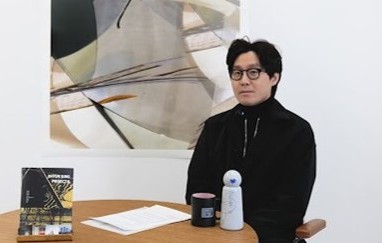
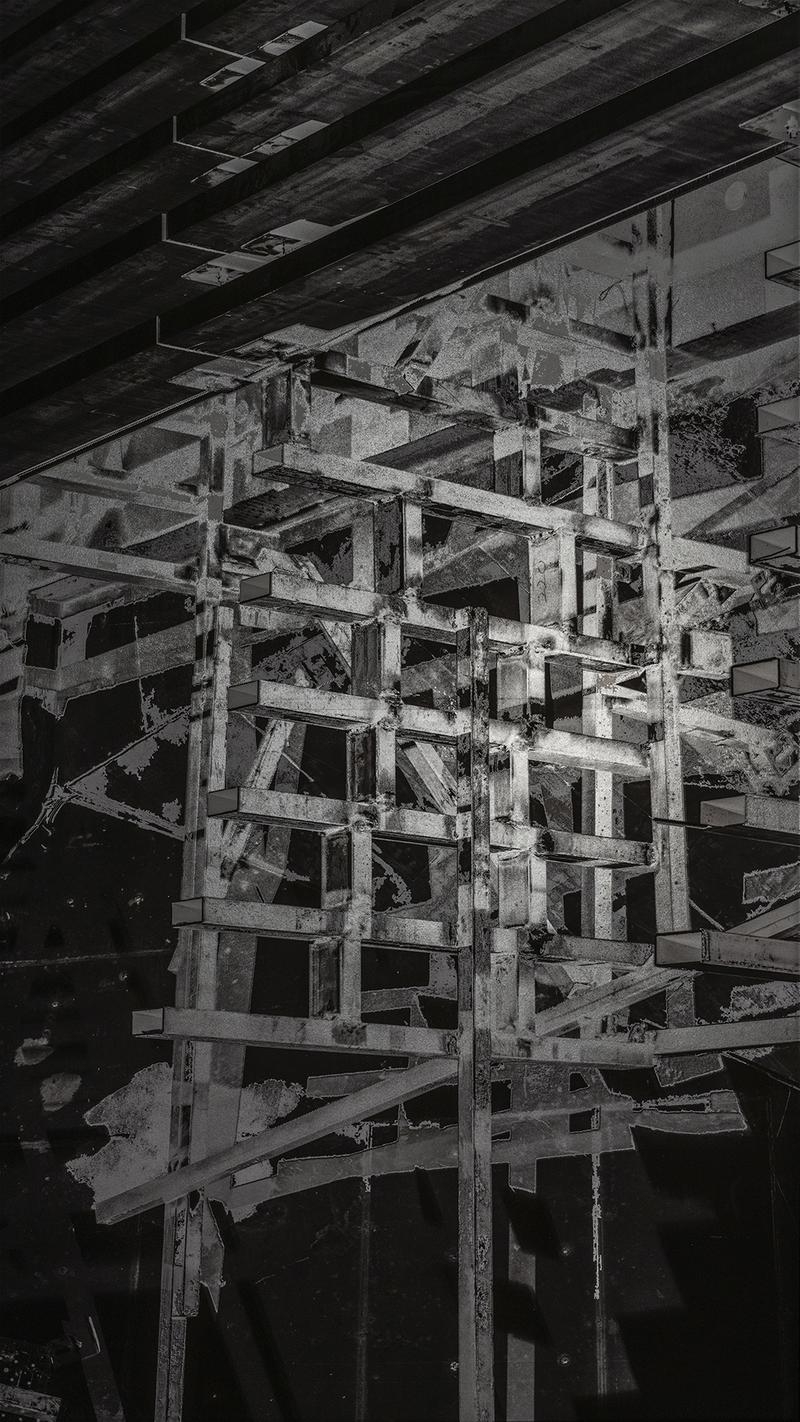
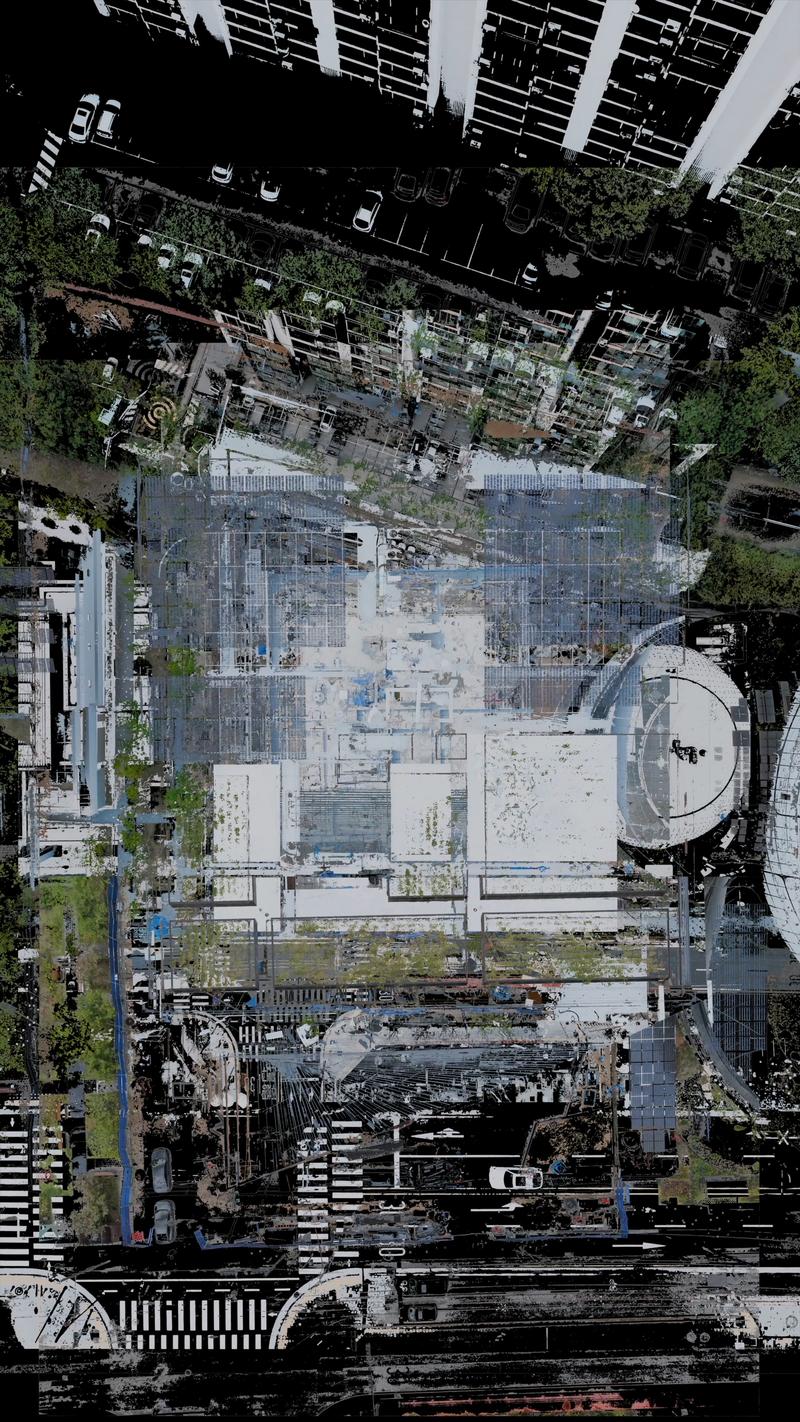
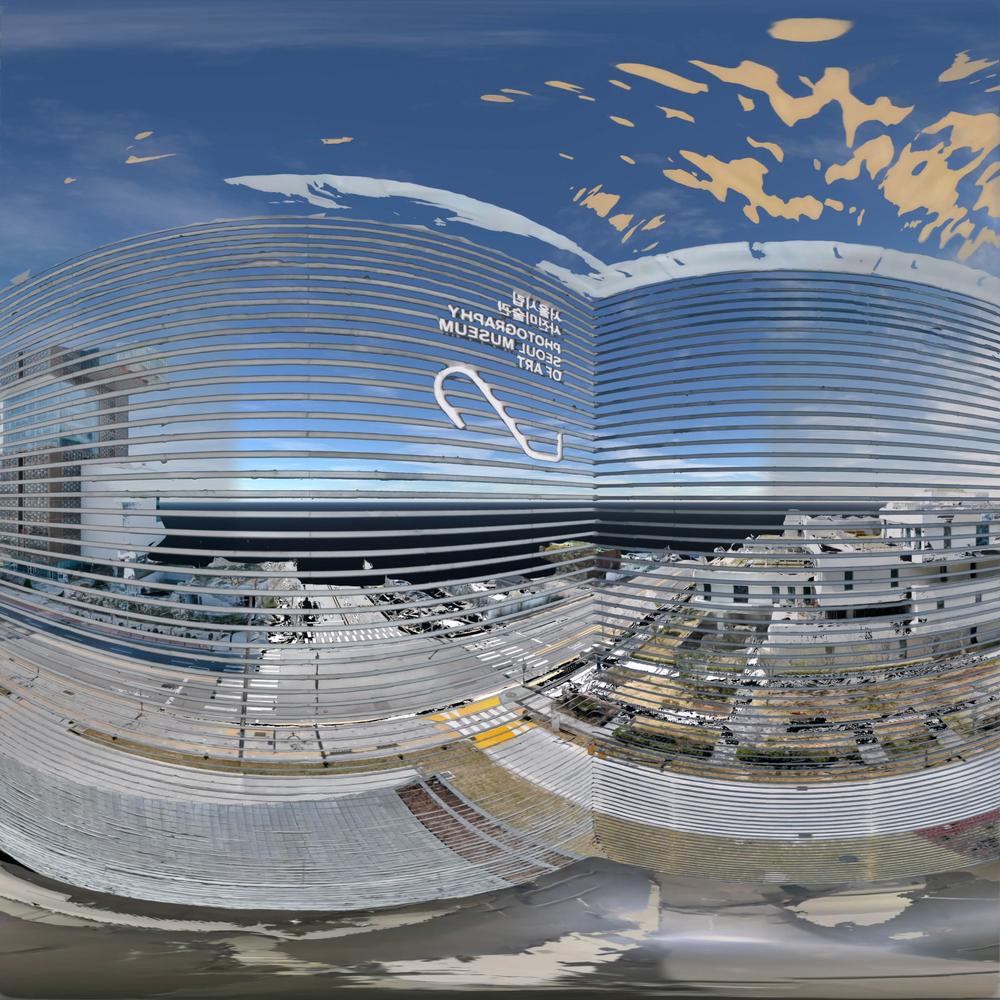
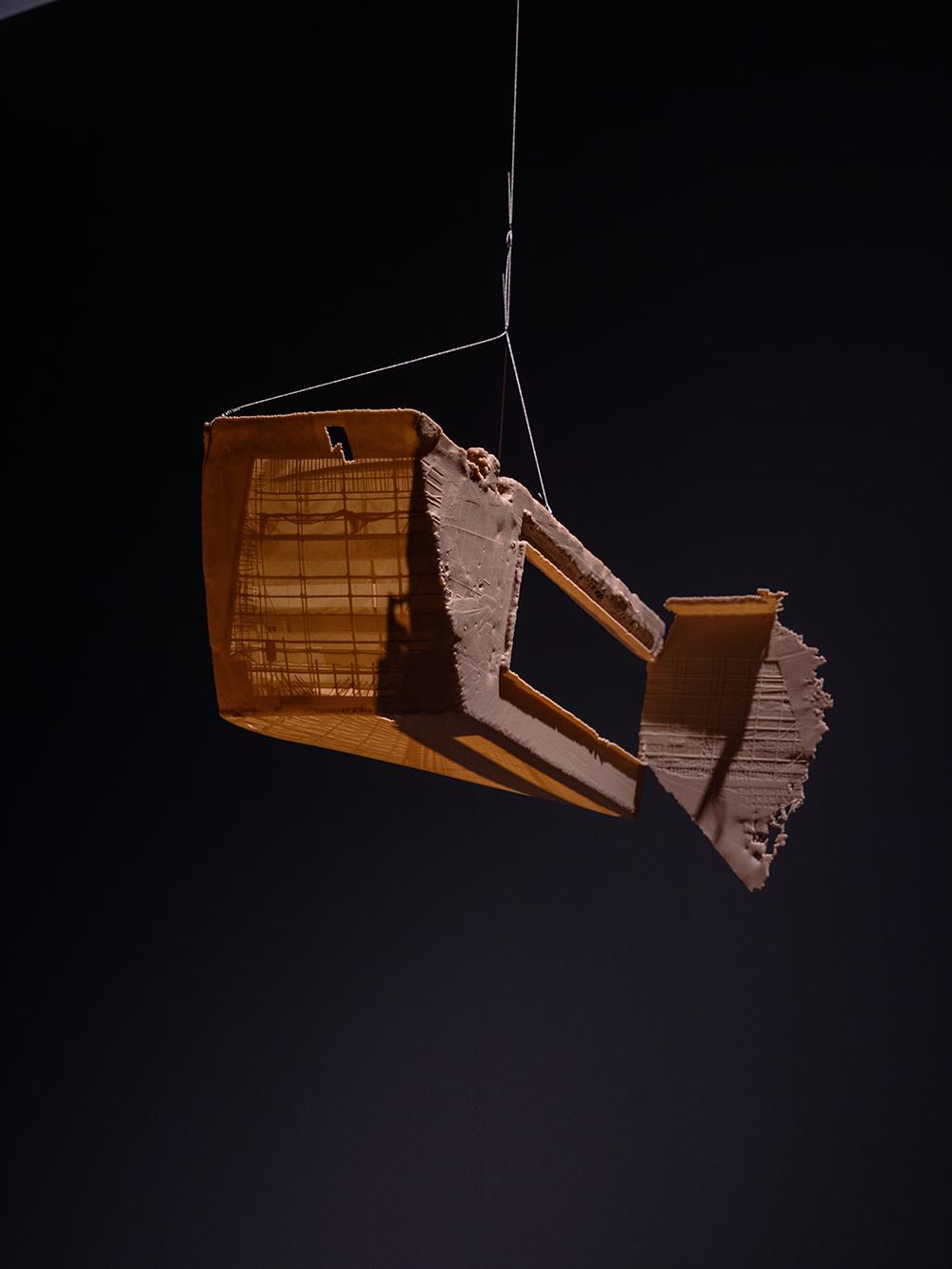
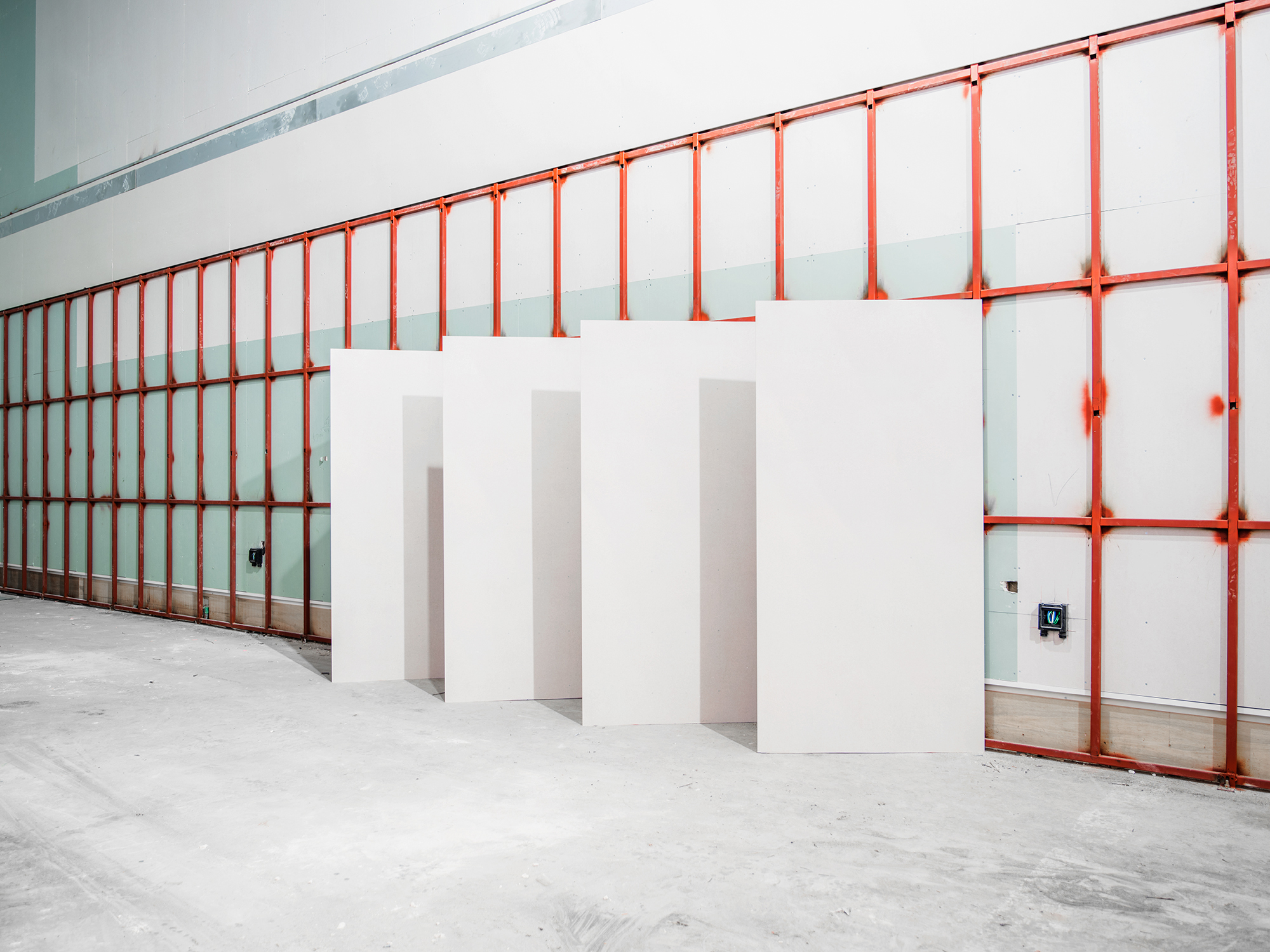
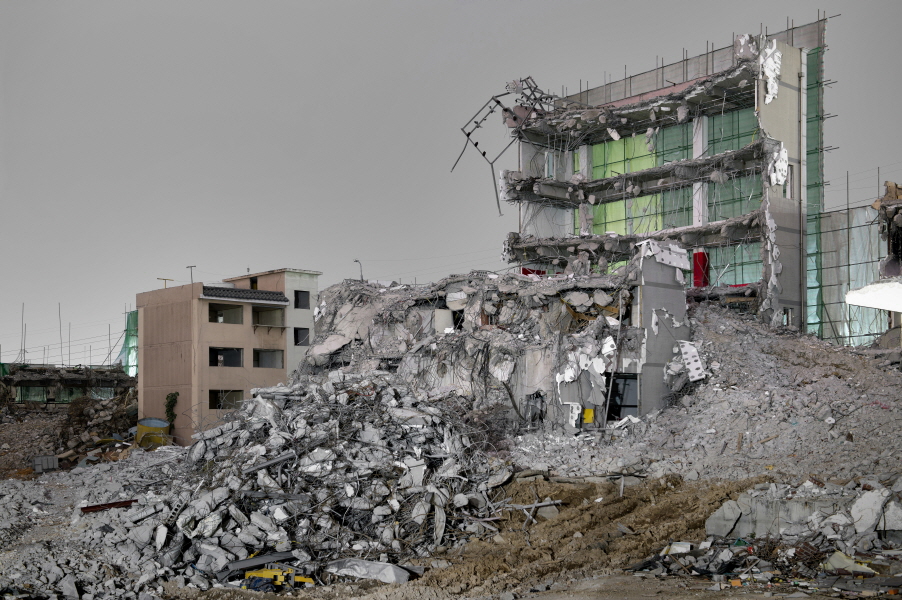
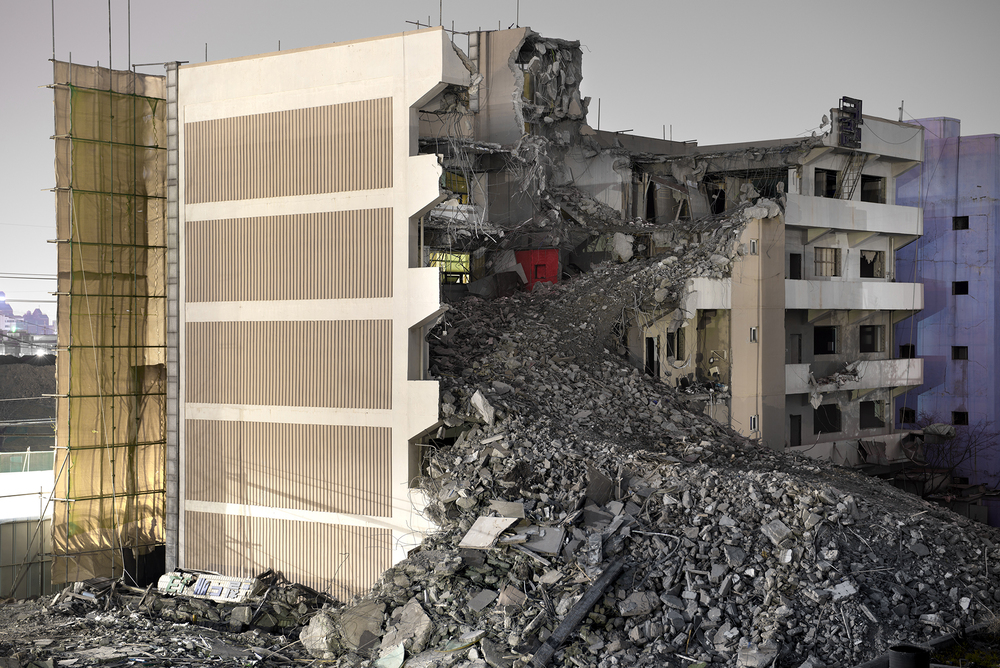
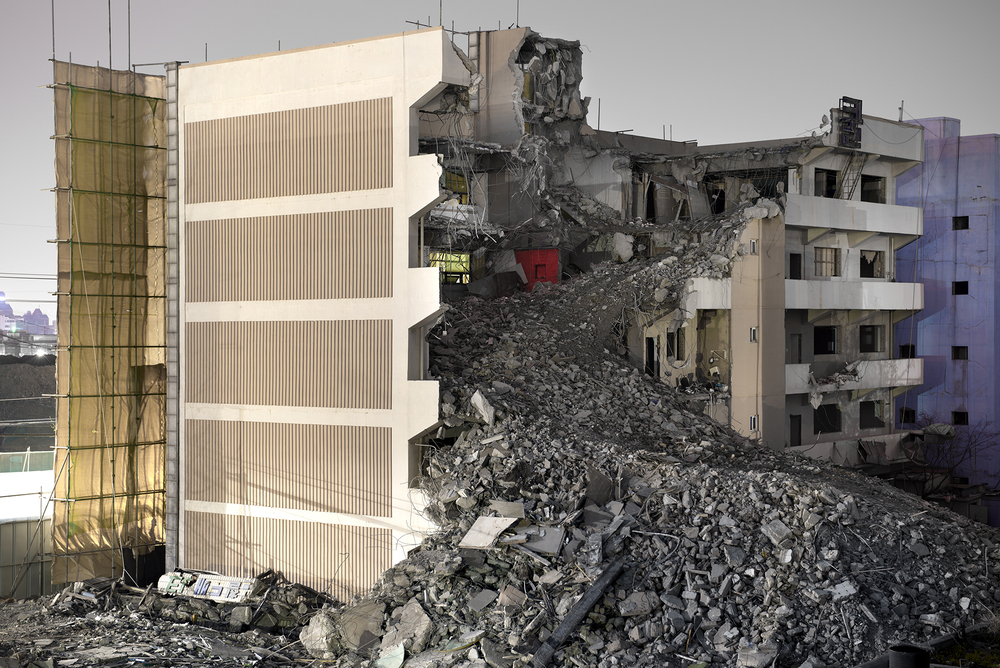
Jung Jihyun is a photographer who primarily photographs collapsing buildings. In other words, his work consists of witnessing the moment a building breaks apart. Once such a scene is captured in a photograph, the question of how to present it inevitably follows. Of course, the question of how to photograph the witnessed scene must also be considered. Within this impulse—the photographic urge to capture and preserve—lie various complex conditions specific to the artist.
However, before addressing the artist’s personal circumstances, there is something that must first be understood: the Korean context in which buildings are being demolished—the very subject toward which the artist directs his camera and where the impulse to press the shutter arises.
Although it continues to this day, there was a time when the fever of redevelopment swept across Korea for quite a long period. As I recall, many people initially welcomed it. Under the pretext of reorganizing the old cityscape and alleviating the housing shortage, most people, as is well known, were drawn to redevelopment projects like swarms of ants, lured by the sweet prospect of capital gains from buying and selling apartments. These projects, often described in terms of frenzy, unfolded simultaneously across various parts of Seoul in the mid-2000s.
It was not merely the demolition of a single small building, but rather a modern form of urban planning—one that could not be fully grasped with the naked eye, as if lines were being drawn from above the clouds across an expansive territory. In other words, for the government that devised policies and for the few large corporations that carried out the construction, the city of Seoul was nothing more than a flat map.
But what about the people who actually lived there? They were often referred to as “original residents,” a term carrying a peculiar nuance. The temptation of having new apartments built in their somewhat worn-down neighborhoods came with multiple layers, but ultimately, once they came to internalize the logic of the market economy (if such a thing exists), they relinquished their homes in pursuit of a better life. In this process, nostalgic sentiment toward the spaces they had long inhabited, or personal reflections intertwined with memory, were not major considerations.
In other words, the ruins were created through the rational collusion of several interest groups. The land desired by large corporations seeking profit through construction was, for those who had lived there, the very capital upon which they could gamble to renew their lives.
However, whether this rational logic was accepted as genuine by those who were not directly involved is another matter. At this point, voices began to emerge—from simple criticisms rooted in envy toward those few ordinary citizens who struck it rich through redevelopment, to sociologists and cultural critics wielding imported terms like “gentrification” as catch-all explanations. Together, they raised concerns that the apartment as a form of dwelling was “not befitting of human life”—where “human” here exceeds mere biological definition—or concluded with self-satisfied analyses blaming everything on the axis of neoliberalism. But…
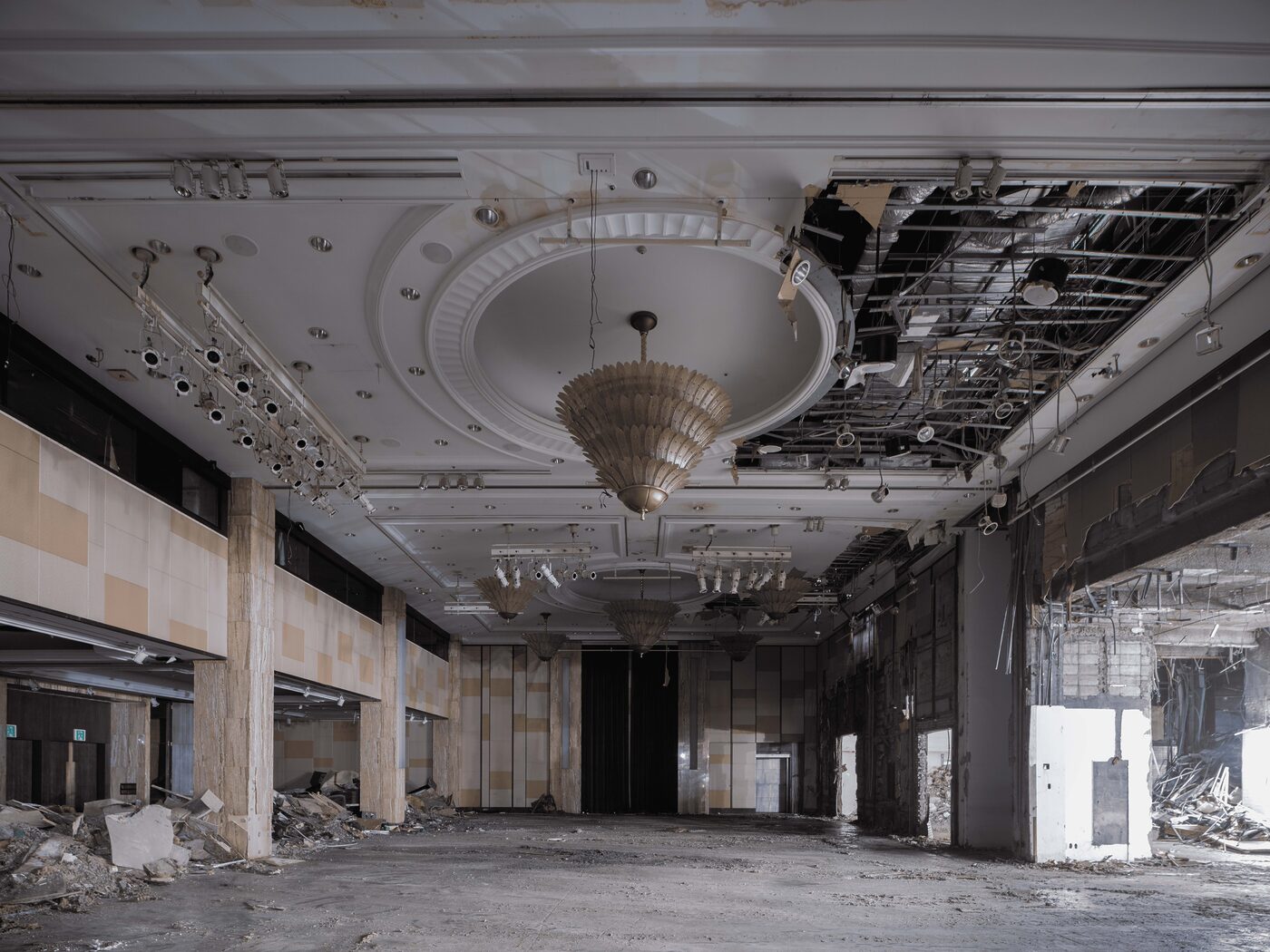
Thus, for the mere observer, encountering the landscape of urban redevelopment inevitably became entangled in various self-serving interpretations. These interpretations interfered with simply perceiving the strange sight of sinkhole-like voids scattered throughout the city. Though covered by crude recycled dust screens, the fields of broken concrete glimpsed through the gaps evoked emotions that were at once immediate and complex. It was an experience of seeing the inner workings of the environment or system in which one had lived, while at the same time peering into the intimate private spaces of others—strangers who, by chance, could have been oneself.
Therefore, those who studied art in Seoul throughout the 2000s could not help but become interested in ruins at least once. Students who possessed the class-based resources necessary to pursue art or photography found it difficult to recognize a world beyond the visual order imposed by large-scale apartment complexes.
Upon entering university and encountering neighborhoods other than their own, riding buses through the city, observing hills densely packed with low-rise housing, and witnessing those hills transform into piles of broken concrete—these experiences were felt with striking clarity, as though recalling something never before experienced, a kind of emotional possession so intense that it bordered on fetishistic fascination.
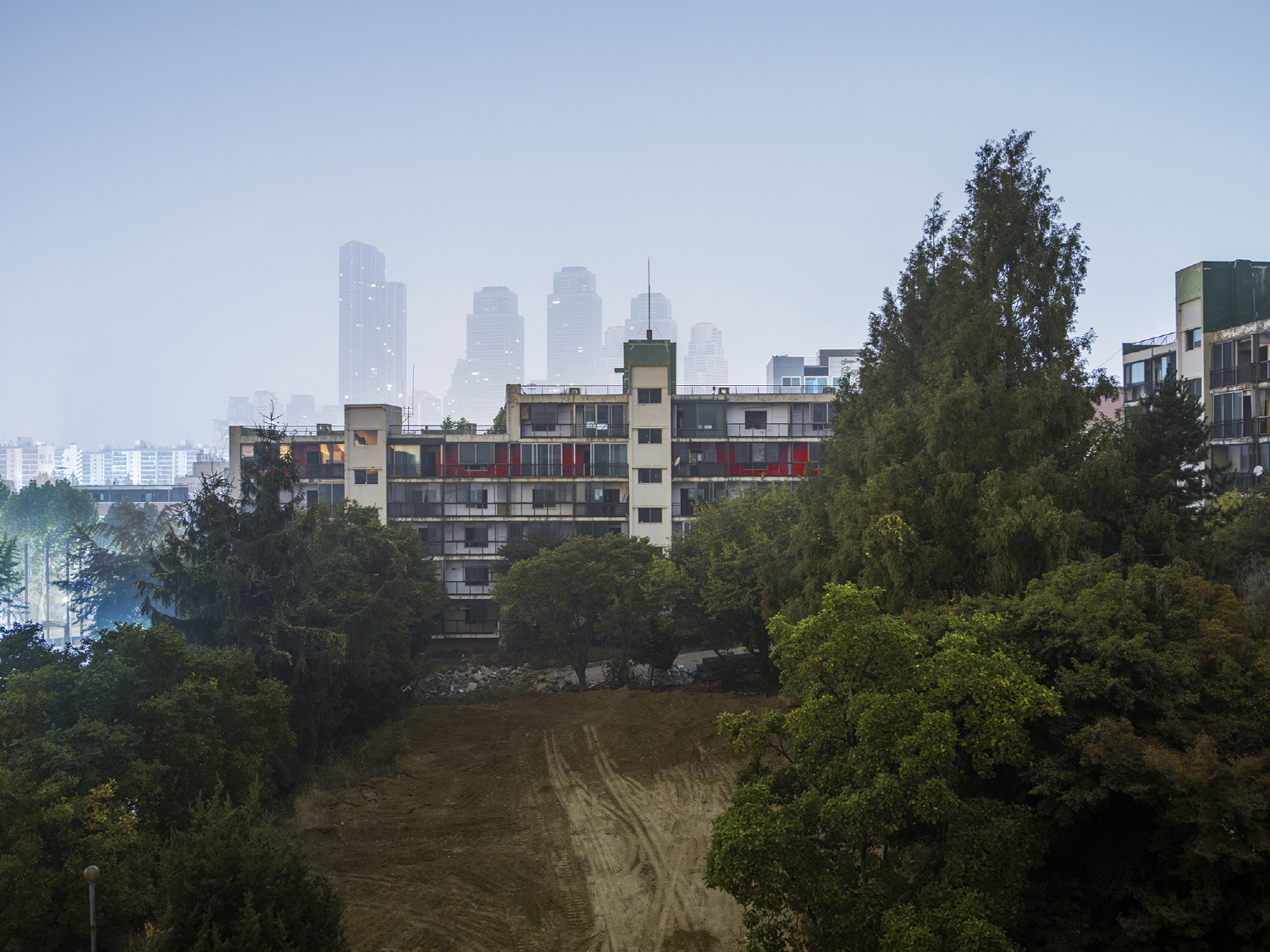
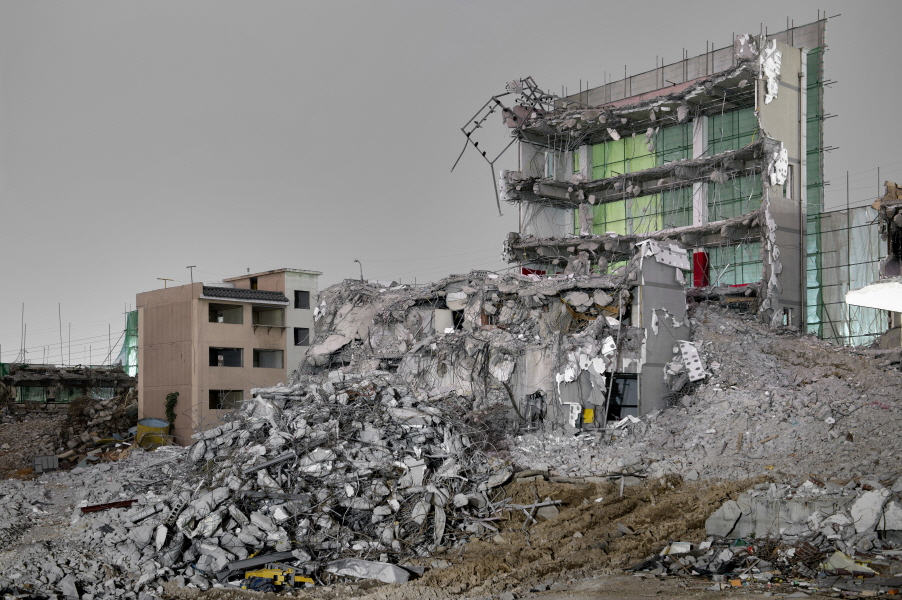
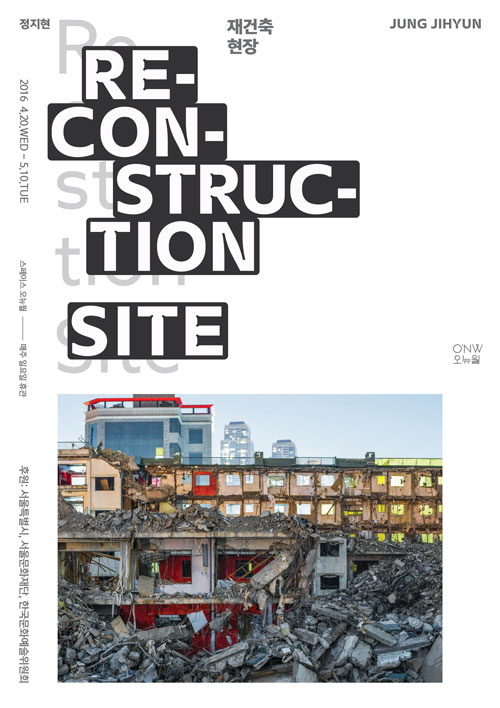
Returning now to Jung Jihyun: what does it mean for him to photograph ruins? The artist first speaks of his personal memories of having lived for a long time around Jamsil. He frames as the alibi for his current work the experience of directly witnessing how the Jugong apartment complex of Jamsil—likely the entirety of his childhood world—transformed in an instant, as if the heavens and earth had been overturned. If so, how did his series ‘Demolition Site’ (2013) move beyond a fetishistic fascination with the spectacle of ruins and personal memory into a method capable of acquiring contemporary artistic significance?
Let us first take a closer look at his working process. He discovers spaces undergoing large-scale redevelopment. This discovery does not begin from a macroscopic perspective on national planning or the grand logic of urban formation and dissolution, but rather from a realm he can observe directly at eye level. Visual discovery emerges from spaces where personal experience can be embodied—neighborhoods he has inhabited, streets he has walked, places he has lived. In other words, this discovery becomes the initial preparation for re-entering, as an observer, spaces from which people have departed—spaces once charged with the collision of modernist euphoria and middle-class aspiration.
Once discovery is complete, he begins the process of negotiation. Here, negotiation includes not only the technical aspects required to facilitate shooting, but also involves repeatedly entering and exiting the ruins, gradually building an emotional texture. By interacting with individuals ranging from employees of large construction companies to site laborers, he refines the locations available for shooting.
This process resembles the gradual transition from unfamiliarity to familiarity experienced when first moving into a new neighborhood. In other words, rather than merely collecting traces of a community as an observer entering an abandoned space, he undertakes a series of preparations to enter that space as a human being, as part of a community.
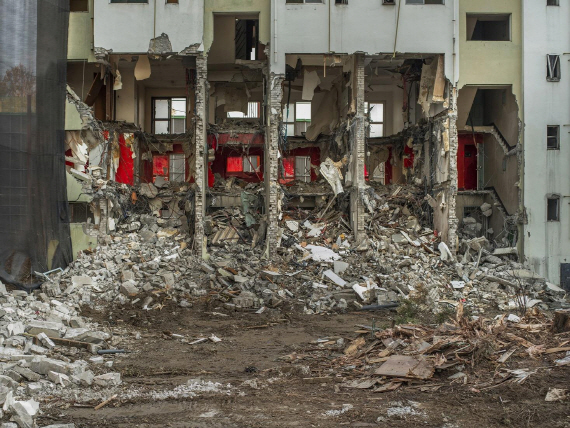
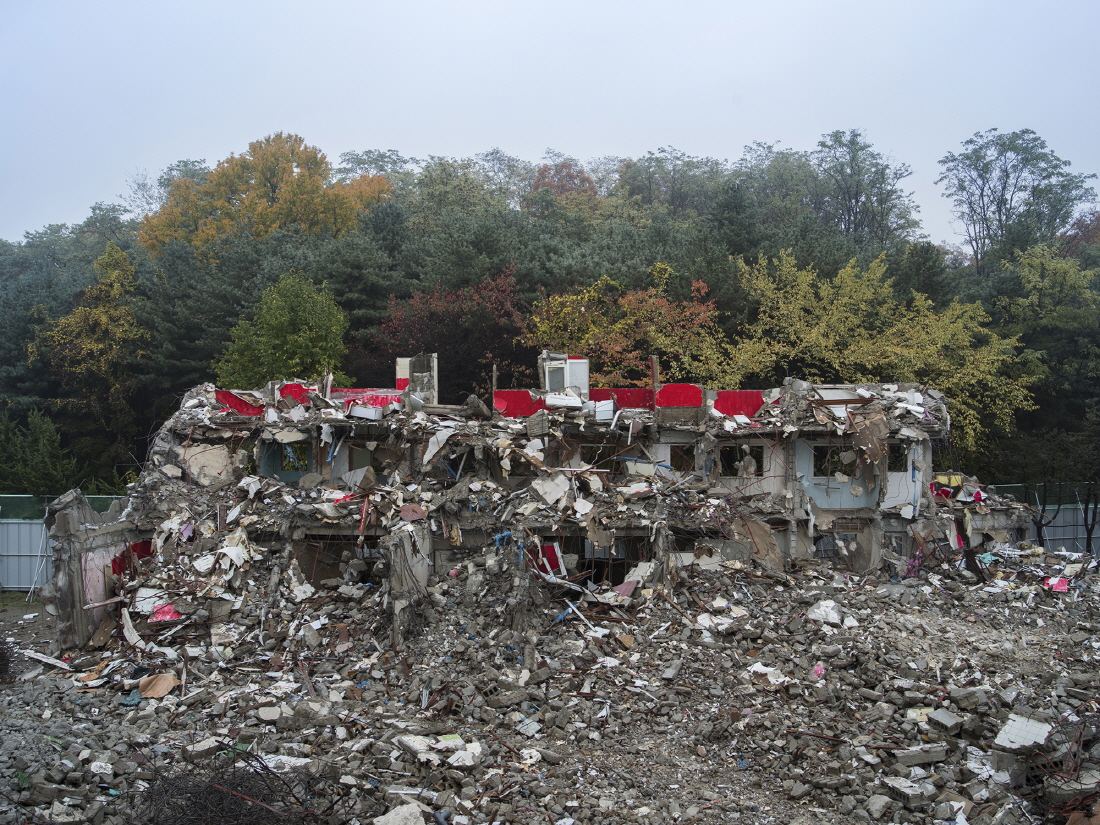
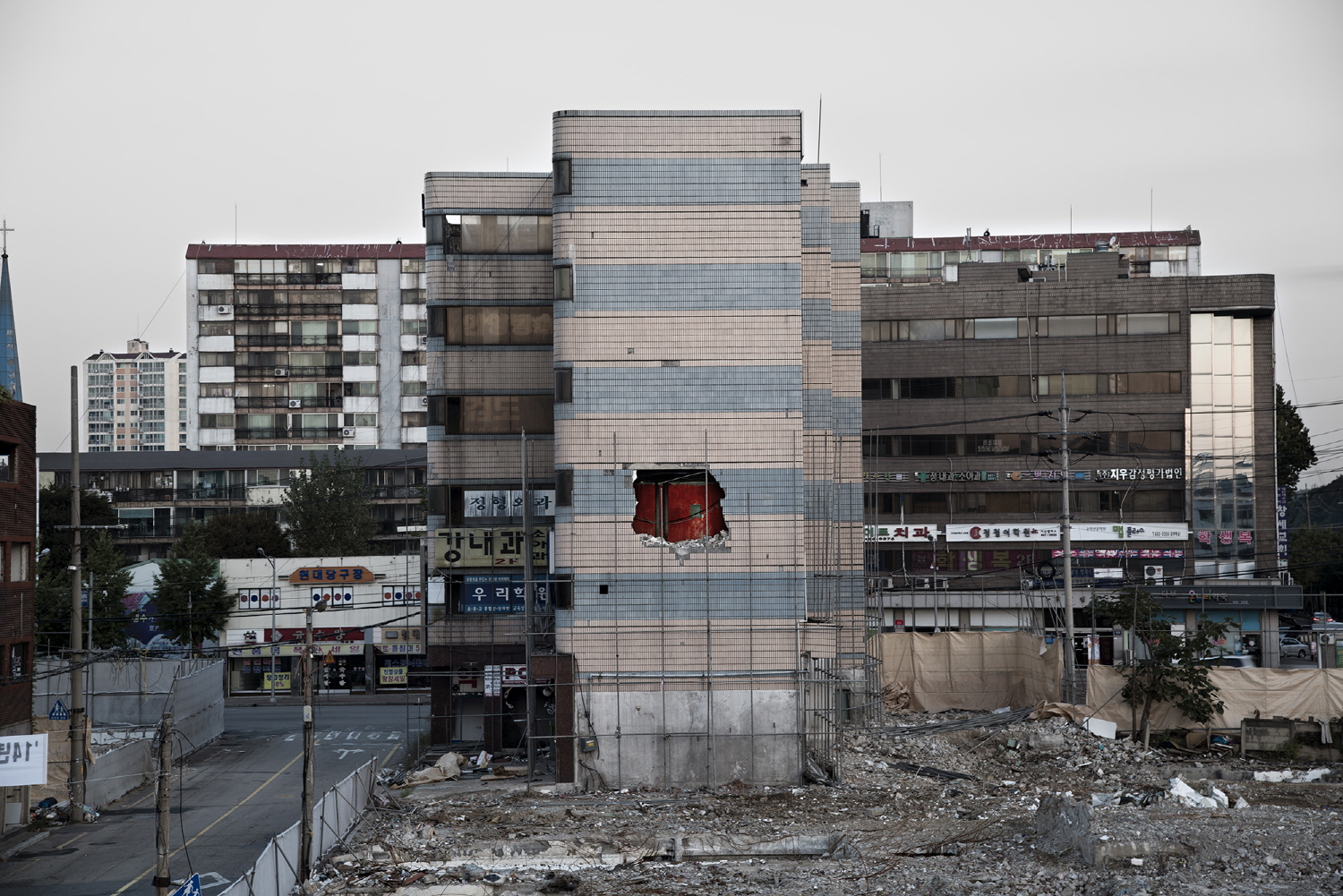
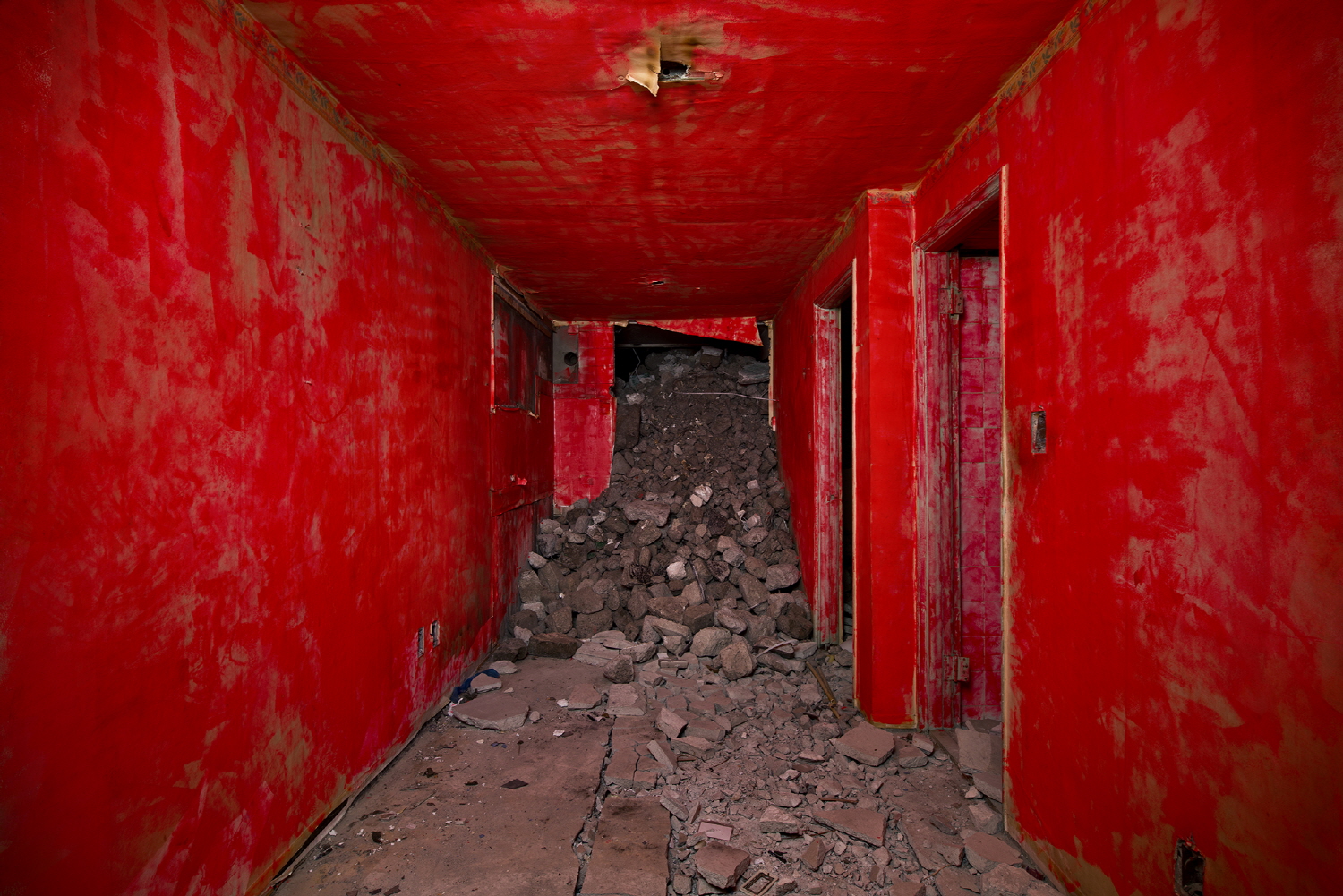
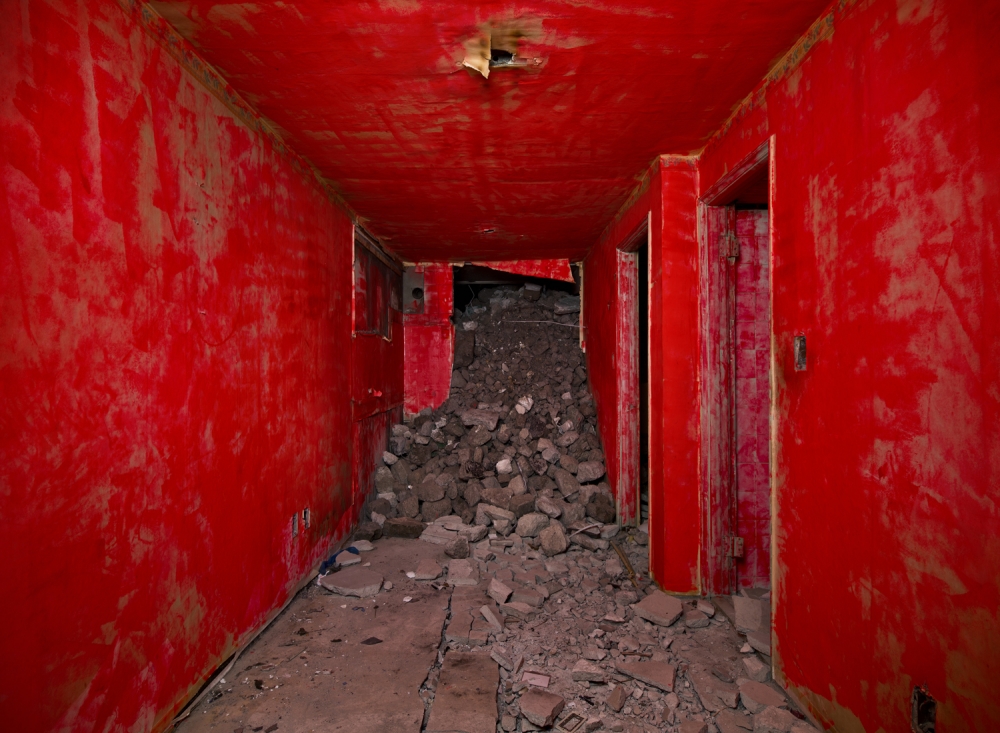
Within this process of personalizing unfamiliar ruins, the most crucial act is painting certain parts of the ruin in red. This act naturally functions as a way of tracing the paths once traversed by people. Just as identically designed apartment units become individualized according to their inhabitants, Jung adds his own trace directly to the selected room. The associations of blood and life evoked by the color red are temporarily imposed through matte paint; yet this is not so much the trace of the former “original residents” as it is a kind of shamanistic ritual enacted by the artist himself, as the final member of an imagined community.
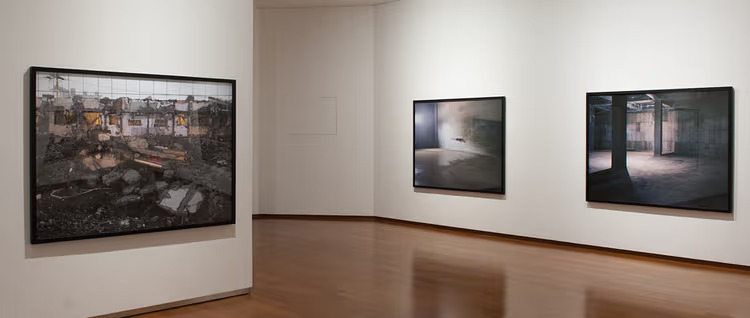
Finally, he waits for the demolition schedule and photographs the scene. To take the photograph, he must once again exit the ruins and observe them from the outside. This act is both the search for an angle that the lens can capture and an act akin to leaving the space—like the “original residents” once did—after having left behind his traces, as a temporary inhabitant. He then positions himself where his painted marks are most visible and captures neutral images, as if refusing any imposed meaning, presenting them in the most conventional photographic format.
This process is akin to calling the name of a ruin. In order for each ruin to escape from the hollow descriptors that define ruins in general, the artist repeatedly enacts a process through which the ruin becomes symbolized for himself. Only then can he more carefully observe the universal meaning of ruins that can be found in any city in the world. In other words, beginning from an ethical concern about capturing redevelopment sites merely for visual outcomes, he employs devices to fill emptiness, refining an impulse akin to calmly observing the decomposition of a dying companion animal.
The attempt to capture the one-time nature inherent in so-called site-specific art inevitably carries a sense of emptiness, precisely because the site is a singular, unrepeatable space. To frame the act of constructing and demolishing as an artistic gesture is, in the end, a kind of decadence or spiritual detachment aimed at capturing that emptiness—allowing only the concept to stand out. Then, even if Jung Jihyun’s photographs permanently record the site-specific conditions in which they were produced, can they escape the emptiness of false consolation? Is calling the name of a ruin and laying it beside him all that he can do?
This, in turn, may be compared to the characteristics of the ecology of the contemporary city. As discussed earlier, demolition and reconstruction ultimately return to the logic of capital. Yet the construction industry of a time when capital fully performed its role differs from that of a declining capitalism, sustained by temporary measures like an intravenous drip. Even if Jung’s work appears to set aside such overarching logic, it nevertheless carries a faint desire to speak about the contemporary city.
However, while his work may be effective in personally substituting for the once-blessed lifecycle of the construction industry, it still cannot gather the fragmented memories of individual histories in the face of overarching structures. This is not so much an obstacle the artist must overcome as it is a fate that must be acknowledged.
The moment this irreversibility is recognized as one of the primary reasons for the collapse of the ecology of the contemporary city, Jung Jihyun’s work may finally acquire a direction through which it can speak to reality. What remains to be observed after the collapse of overarching structures has yet to arrive in the present.