Nakhee
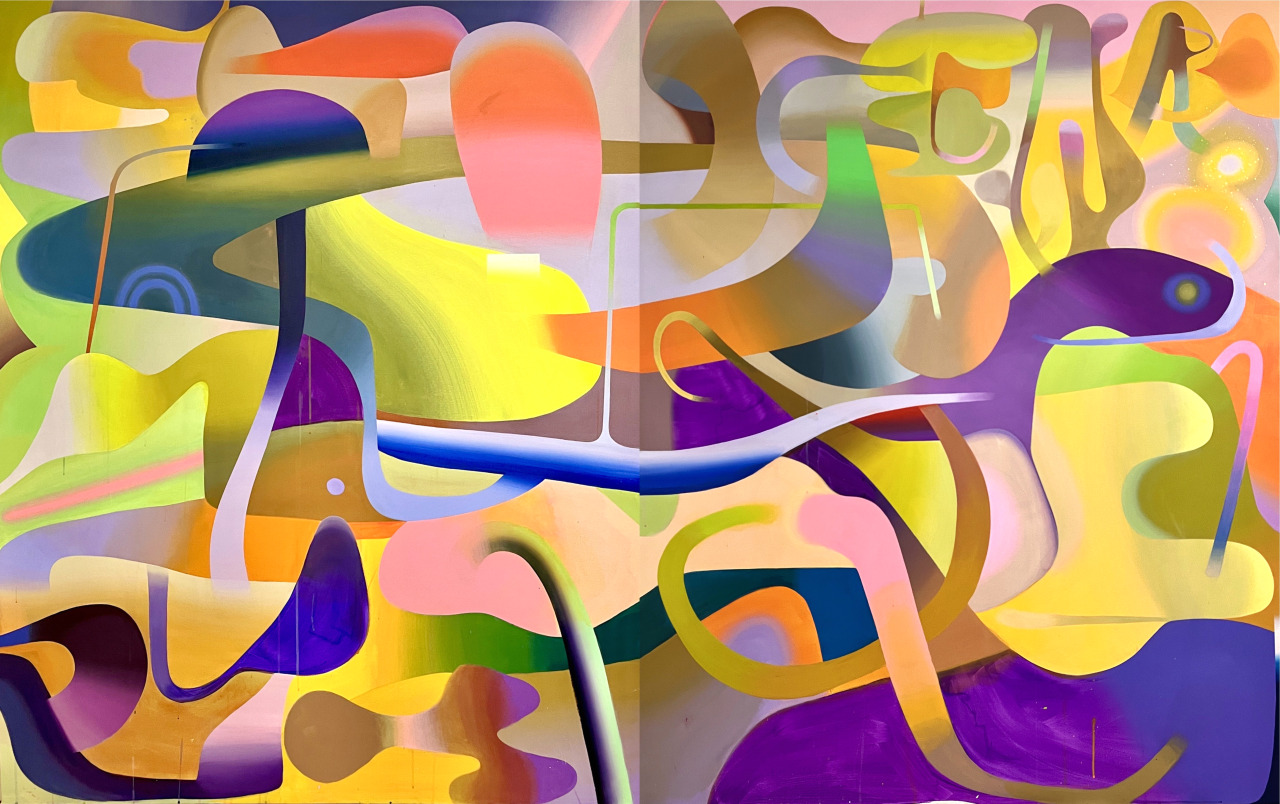
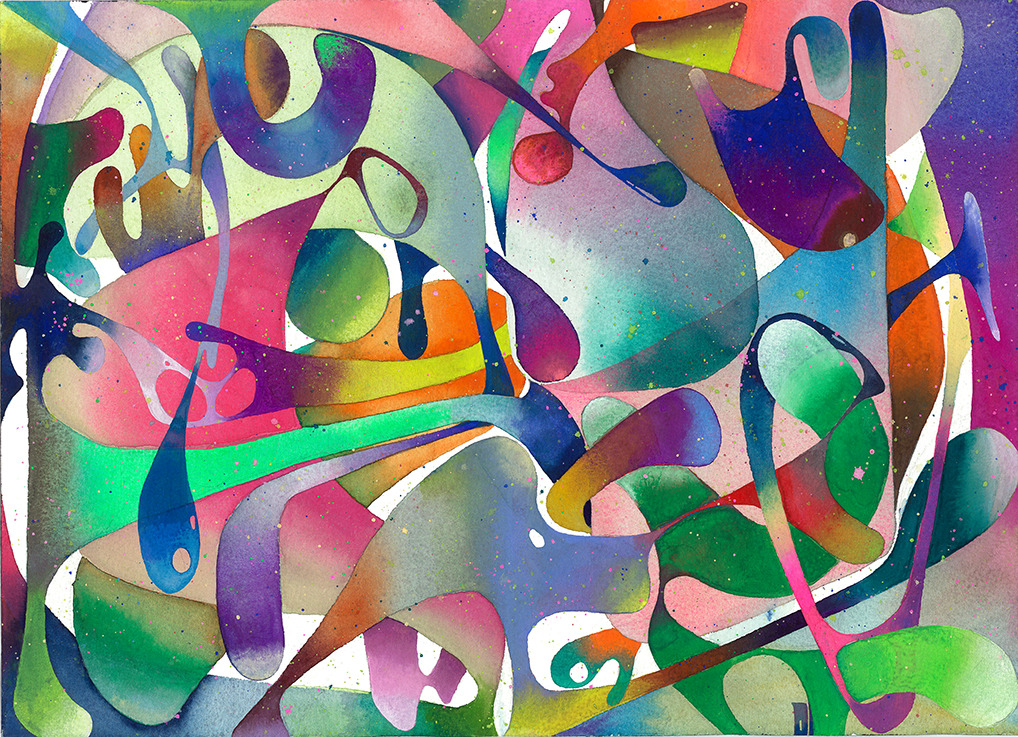
Sung has continued to bring about musical rhythms and cadences using the most
fundamental elements of painting, points, lines, and planes and has
demonstrated a sense of movement begot by organically gliding and freely
flowing hues. Lately, however, unlike in her previous pieces, Sung has been
displaying works which feature prominent wide color fields. What can be
interpreted from such a shift?
As
we can surmise from her use of musical terms for her exhibition title and the
names of her works, Sung has done her utmost to attain her own distinctive
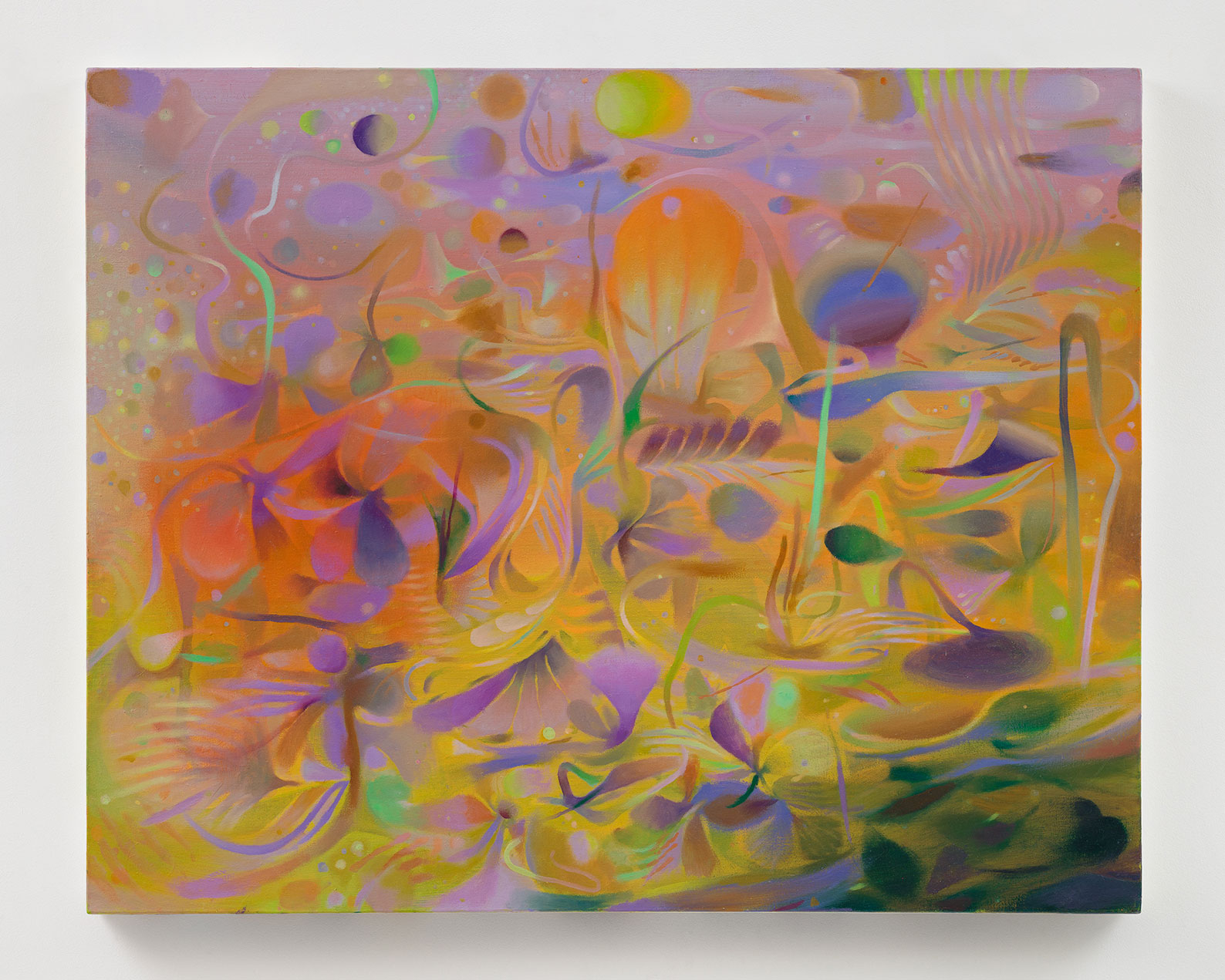
idioms through a wide variety of materials and unrestricted brushwork. Her work
relies on a method of creating a scene by intentionally filling empty spaces
when contrasting parts are in an unbalanced state. As a result, her work seems
to depend ostensibly on intuitive expression, but she resigns herself to
following where her brush leads, consciously putting forth her intentions, even
in her unconsciousness.
As her choices are instantly made, variations often
take place. Her works appear as scenes of events fraught with tension where
mutually disparate elements push and pull one another and become entangled. All
the same, the artist does not tread a preposterous, bizarre path thanks to the
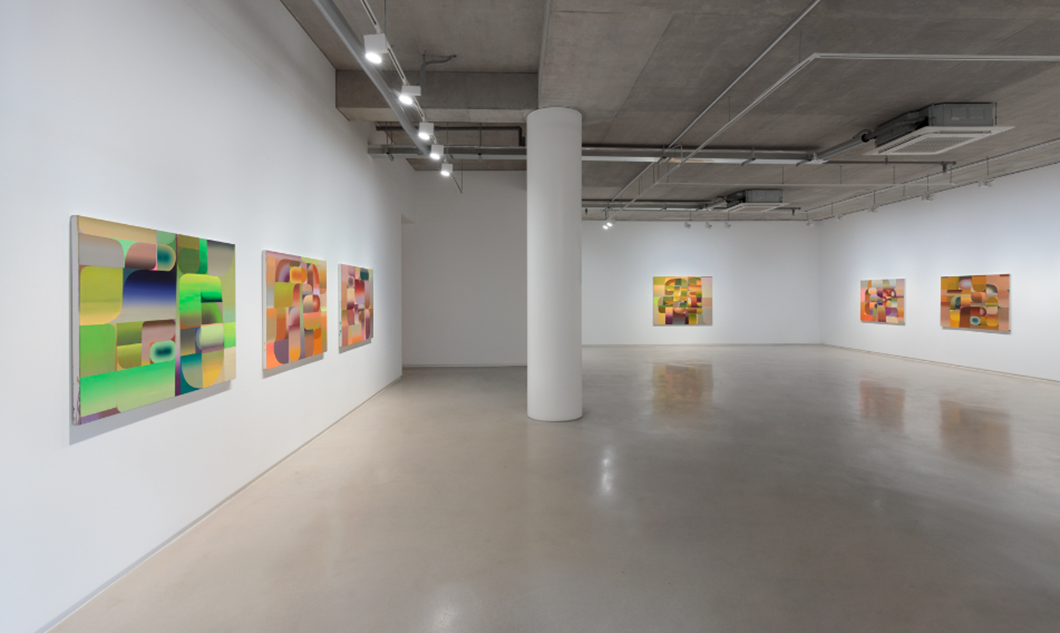
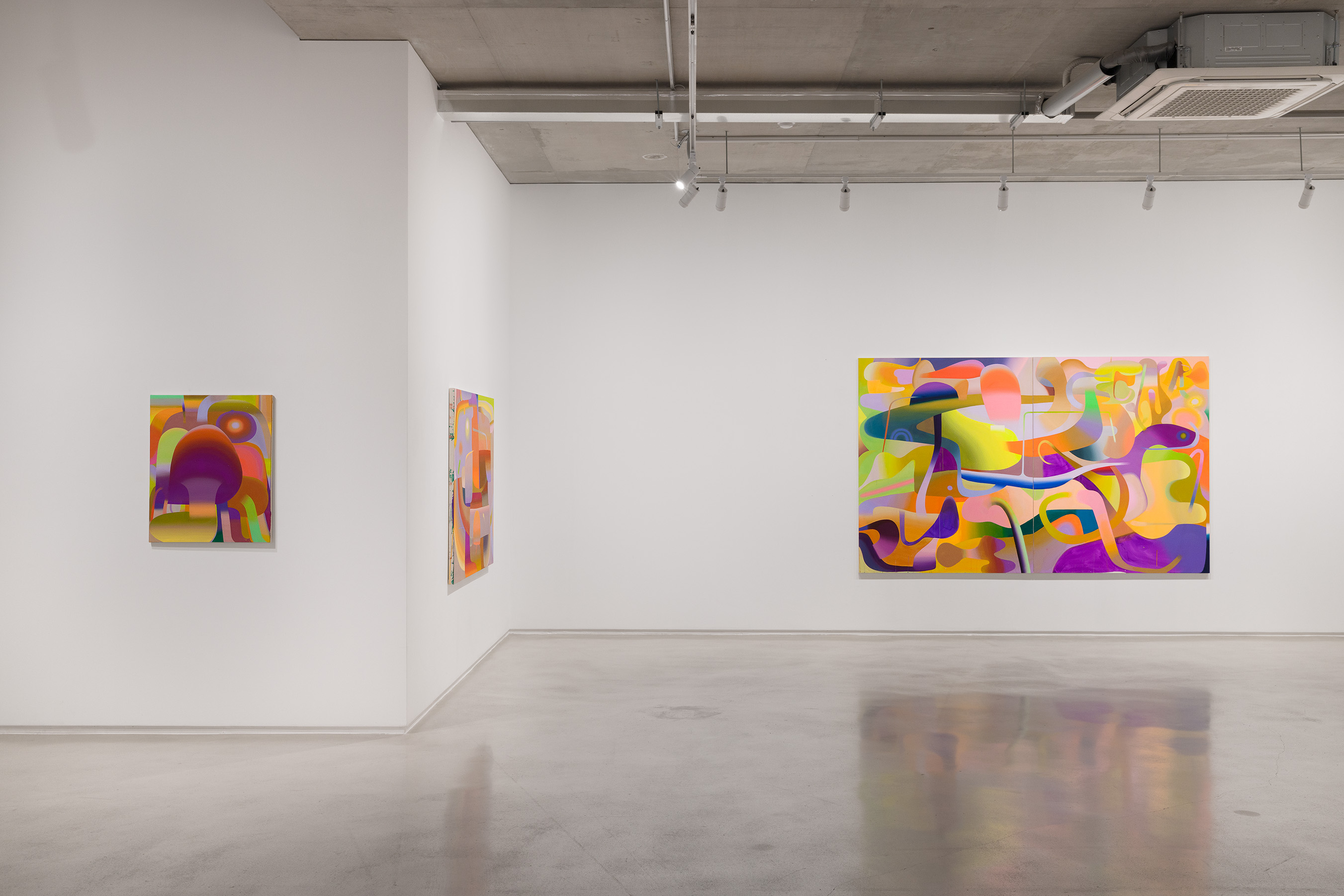
obvious structure she has chosen. The ‘Sequence’ series on display at this
exhibition, however, is a showcase of methods that are different from her
previous works. While her previous pieces were accompanied by a dynamic and
pungently sensual pleasure and viewers made attempts to follow her intention,
her new works create a sense of space as opposed to a sense of movement since
they remain restrained and static. Her exploration of this new method is seen
to have begun with her ‘Transpose’ series.
The definition of this title meaning
“to write or perform a composition in a key other
than the original or given one” enables us to make the
analogy that the artist has explored some sort of seismic change in order to
embark on a new chapter instead of searching for variations anchored in
preexisting situations. We can also perceive from the exhibition title 《Modulate》 that she has continued her
experiment with this subject. Aside from the title, the use of tools that are
different from the ones she has previously worked with is also a great change:
she has adopted the use of wider brushes and smaller canvases than before.
Let
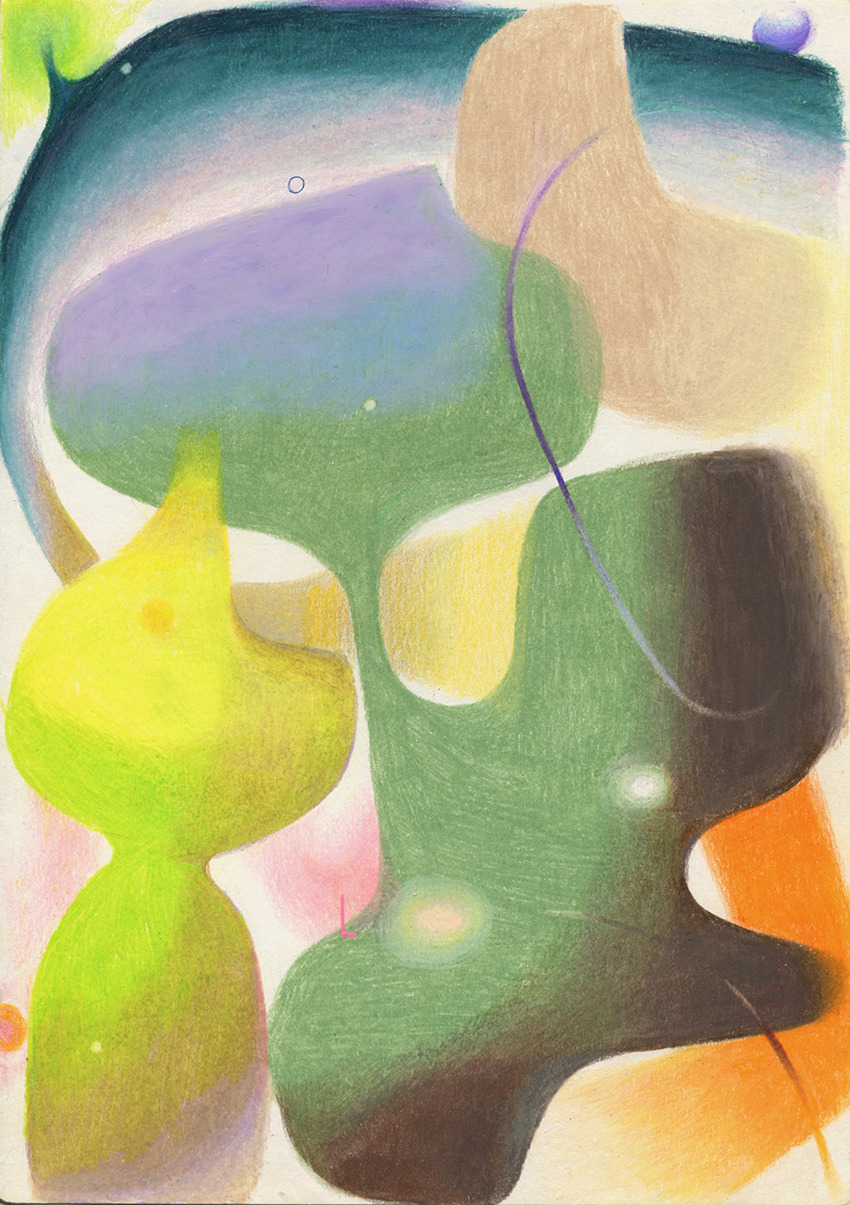
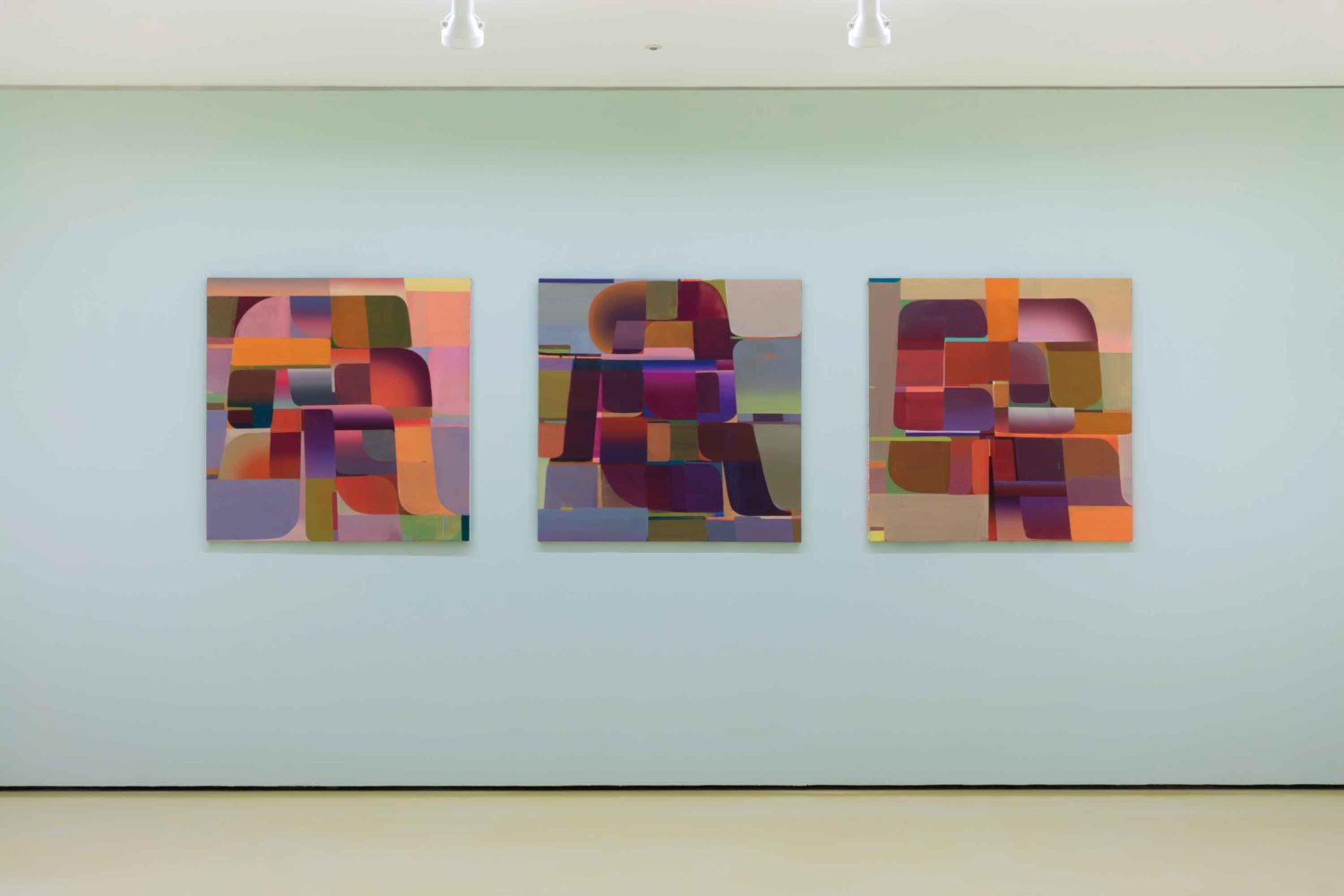
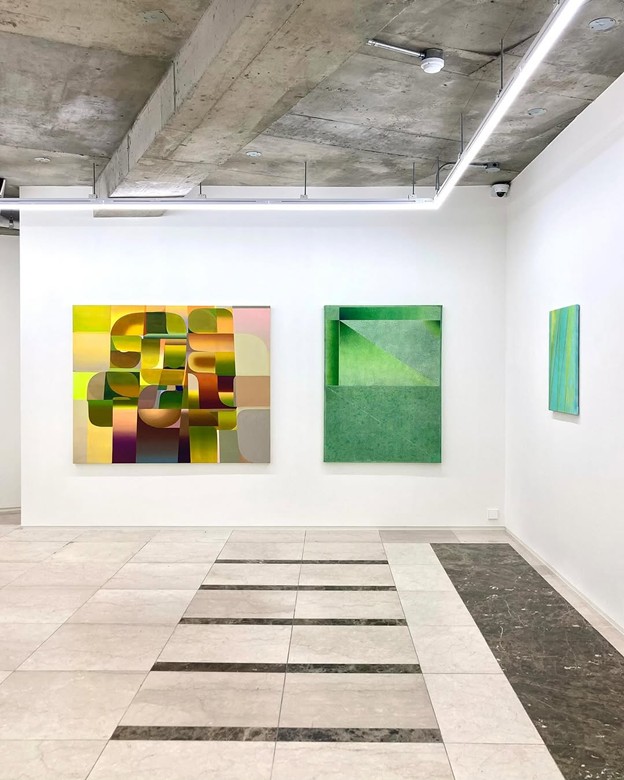
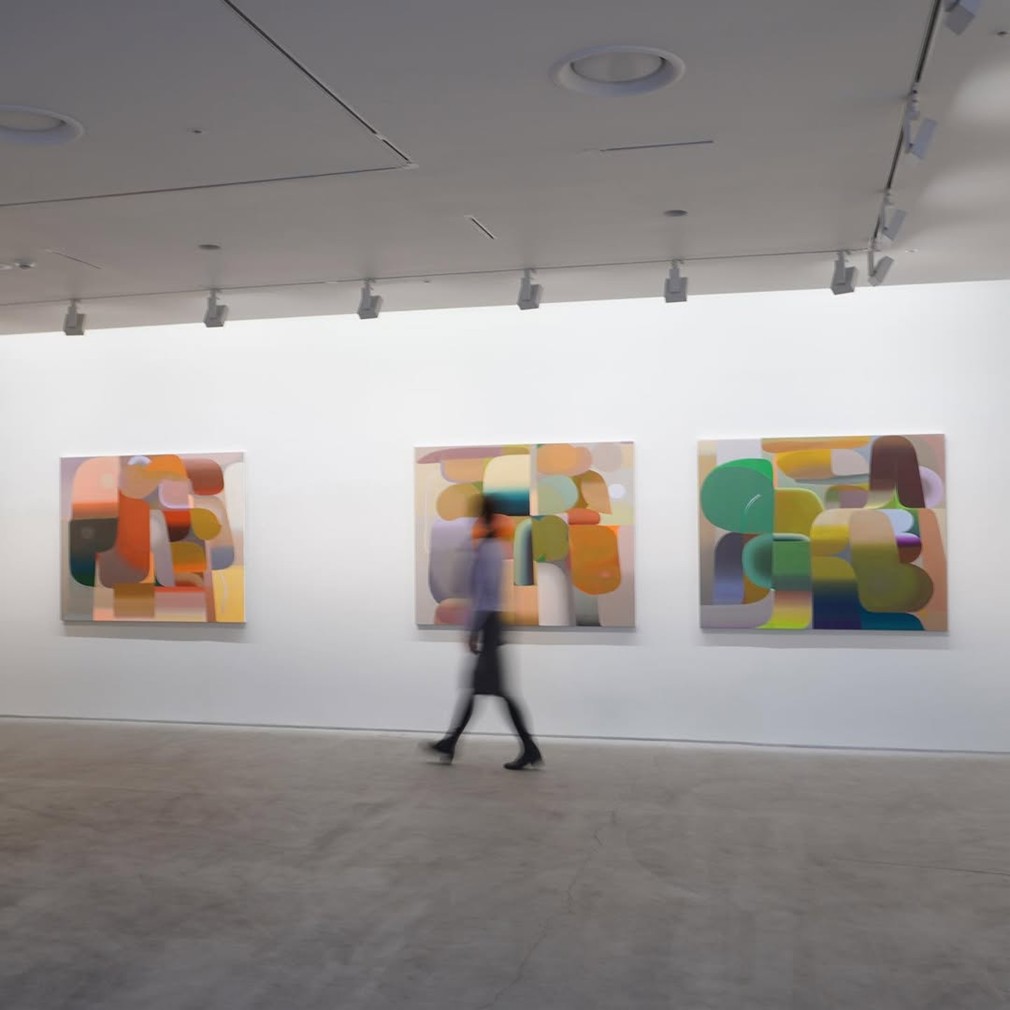
us take a closer look at the ‘Sequence’ series. This series seems to enlarge
her preexisting work. Sleek forms derived from color fields that are
geographically connected and neatly stacked up appear as digital pixels.
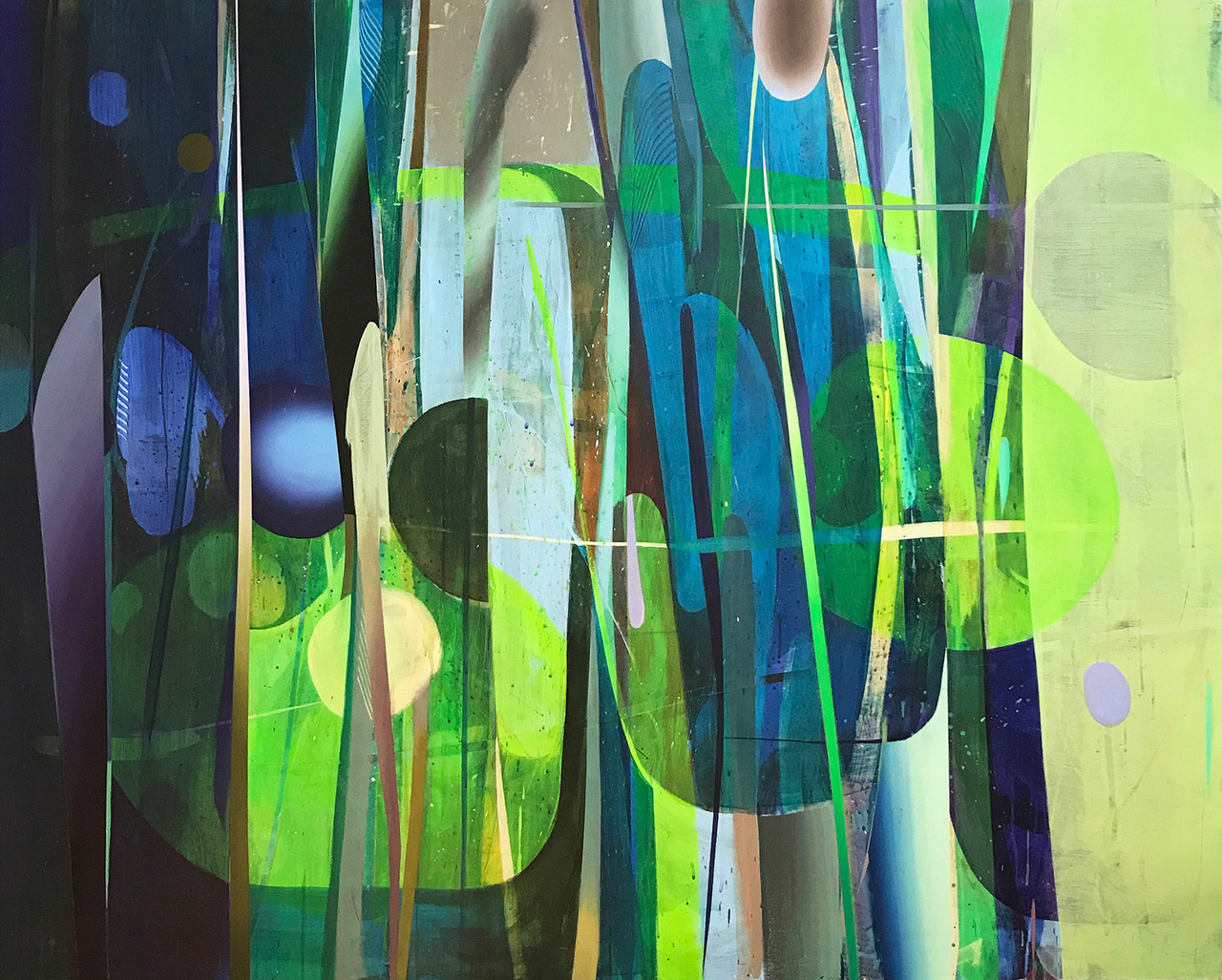
Looking closer, these color fields laden with brush strokes seem to overlap in
many layers as if they are soaking into the surface. Her brushwork demonstrates
a fusion of straight lines and curves and creates continuously fluid images,
dividing a scene vertically, horizontally, or diagonally and refracting it into
curves. The traces of colors flowing around the edge of a canvas enable viewers
to sense the masked subtle construction of her scenes. As a result, a sense of
movement and space is immanent in such images and bears resemblance to scenes
seen from the windows of a train that go up and down or are pushed backward.
What did she choose through such changes? Her works represent an overlap of
restraint and freedom with brushstrokes and color fields that have been laid
one upon another. While her previous works were an attempt to look for
something in a composition that seems not composed, she seems to concentrate on
maintaining a distance that arises when doing something, freed from the control
given by what is constructed. The method she previously adopted involved
merging parts together to achieve the whole, resting on the directivity of
forging the whole by putting parts together. A frame of harmony in which other
factors are determined by parts is inevitable in her work.
This invisible
process is a boundary she taps into as a crucial way to create her art. Her
work inevitably undergoes a process of filling and emptying to release the
feelings innate in herself to the outside world while being conscious of a
sense of balance. This has helped her to naturally capture musical propensities
like a sense of rhythm and dynamism within her painting. In contrast, however,
the ‘Transpose’ and ‘Sequence’ series view things that grow apart and become
vague, even when she makes efforts to find or complete something and keeps at a
spatial and temporal distance.
Taking
a closer look at the ‘Sequence’ series, its images seem to be still pictures
that swirl by the artist and halt before an unidentified external force before
they are captured on camera. As examined above, her color fields are connected
and stacked, taking up each part of the work. They coexist instead of pulling
or pushing one another. Based on some clues that can be gained from her
remarks, Sung has recently spent a lot of time thinking about gravity. This can
be a critical clue to understanding the new direction of her work. Unlike how
she previously concentrated on an emission of energy innate in herself,
recently she has been perceiving and embracing external strength, something
which implies a big change in her ideas.
Thus, she focuses primarily on the
result itself that comes about when her work is completed through slow
movements made over a long period of time, fully aware of both the material and
non-material influences from her surroundings. This is in contrast to a method
that focuses on the actual process that she keeps in balance through a rapid
change in her attitude. In this way, her brushstrokes and hues unmask something
in an apparent way and erase previous marks by blending her instinctive senses,
gradually covering their surfaces in the process. This outgrowth is not a
simple kind of harmony; while it does involve the oneness of the interior and
exterior, it is not an artificial union that is in sync with different things.
That is, these “parts” call to mind their dim existence instead of being “parts” that vie in dynamic ways to take the
place of others. In the end, she brings a non-material force to her own inner
world and delivers her work as an outgrowth of this process to a condensed
scene.
With
this in mind, what does Sung consider to be important in her recent works?
Starting from the minor parts, she has thus far created artworks while filling
necessary portions of her works and abandoning unnecessary ones. Her painting
derives from a constant interest in these “parts” that she has consistently honed. She
focuses primarily on the process of completing a minor part by a choice gained
or rejected from her ever-changing real circumstances and her inner world. As a
result, she winds up with a composition in which things that are foreign to one
another in terms of characteristics have been arranged. The artist merges parts
that have been amassed in this way and showcases newly invoked things through
endlessly repeating acts of painting.
In terms of her work, of most importance
is the choice of how to perceive filled or empty parts and how to react to
them. After all, her paintings appear both filled and not filled at the same
time since they reflect the life she has chosen. She is minutely interested in
each part. Sung displays new works in this way, but there is no change in her
demeanor. The only difference is that she chooses insufficient parts in her
recent work since she wants to attain the whole with condensed parts. All the
same, each whole work on display at this exhibition appears altered in its
position as a part of the entire exhibition. In a broad sense, these works have
no fixed position since they are organically associated with all of her
previous pieces as parts or completed ones.
Therefore, her seemingly completed
works are both completed yet not completed, and remain filled but still empty.
The new type of a shift on show in this exhibition seems more suitable for the
revelation of parts as the result than the process of her choice. To do this,
she has time to thoroughly perceive and comprehend something. Unlike her
previous work, she forges images that coexist, sharing part and whole as well
as interior and exterior, gradually filling parts entangled with points, lines,
and planes in addition to colors on a small canvas. Her new paintings appear
orderly with moderate brushwork but hold an inherent invisible strength. That’s because some unrestricted movement is sensed within her controlled
pieces.
In
conclusion, this act of distancing is meant to consciously eschew a state of
being that is fixed to an unstable situation in which each sphere and strength
are maintained as harmonies among parts that are recurring more frequently.
Thus, the ‘Sequence’ series produced in this new way resembles fake images or
empty things in which every force returns to nothing, consequently resulting in
a state of repleteness through the fusion of these parts’ diverse characteristics. What she tries to reach in the end is a
state of zero where her work strikes a balance between an external force (like
gravity) and an internal force that a subject (like “me”) retains, or a perfect situation in which everything becomes one
without any distinction between the parts and the whole.
Nevertheless, this is
an unknown destination that we cannot easily reach and whose location we do not
even know. As addressed several times above, she has continued to work on
merging “parts” that are in an
endless cycle between her eagerness for completeness and repleteness in her
inner world and her doubts about incompleteness and insufficiency. This is
concerned with the theme of “parts” that takes root in the relationship between Sung’s painting and her life or the way she showcases herself.