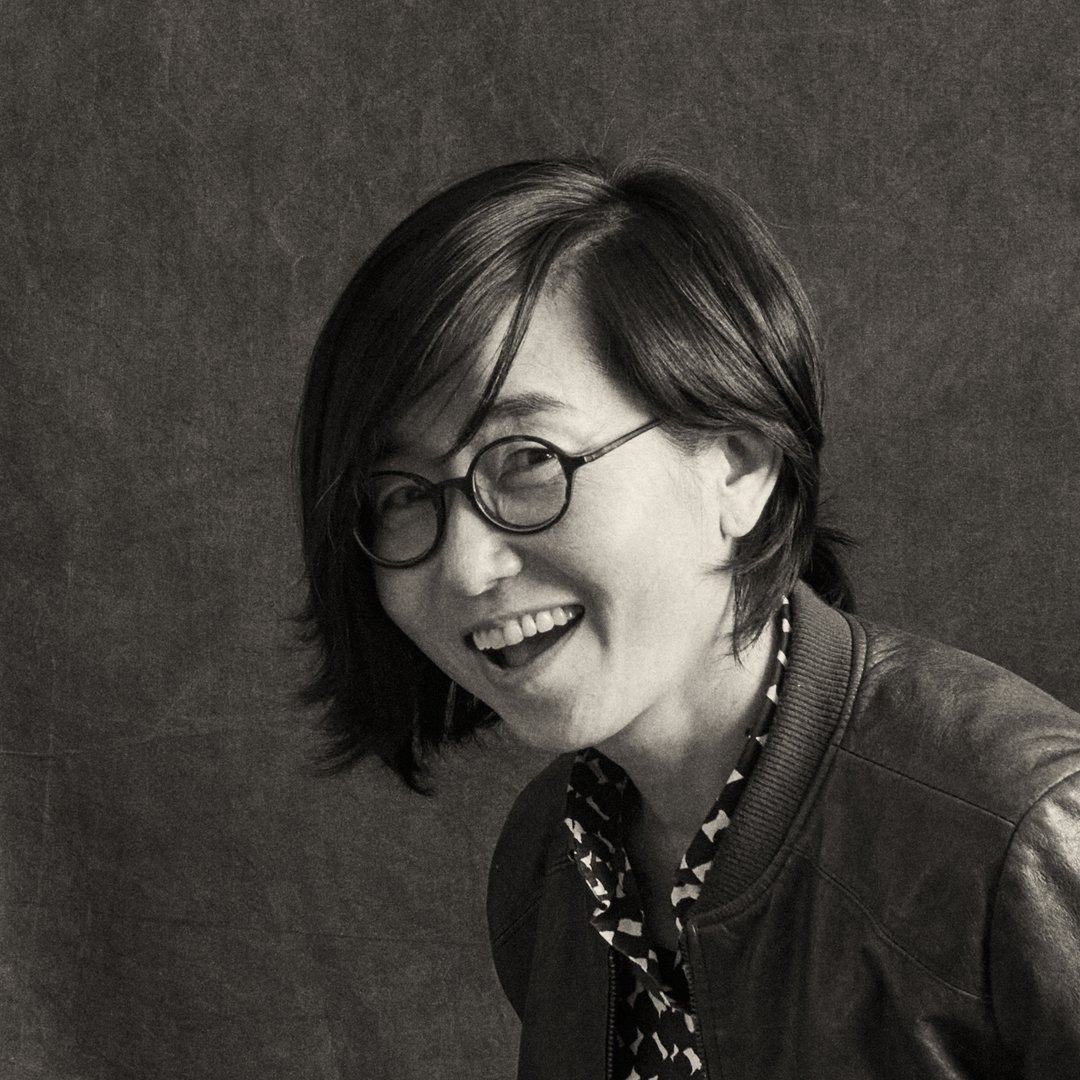
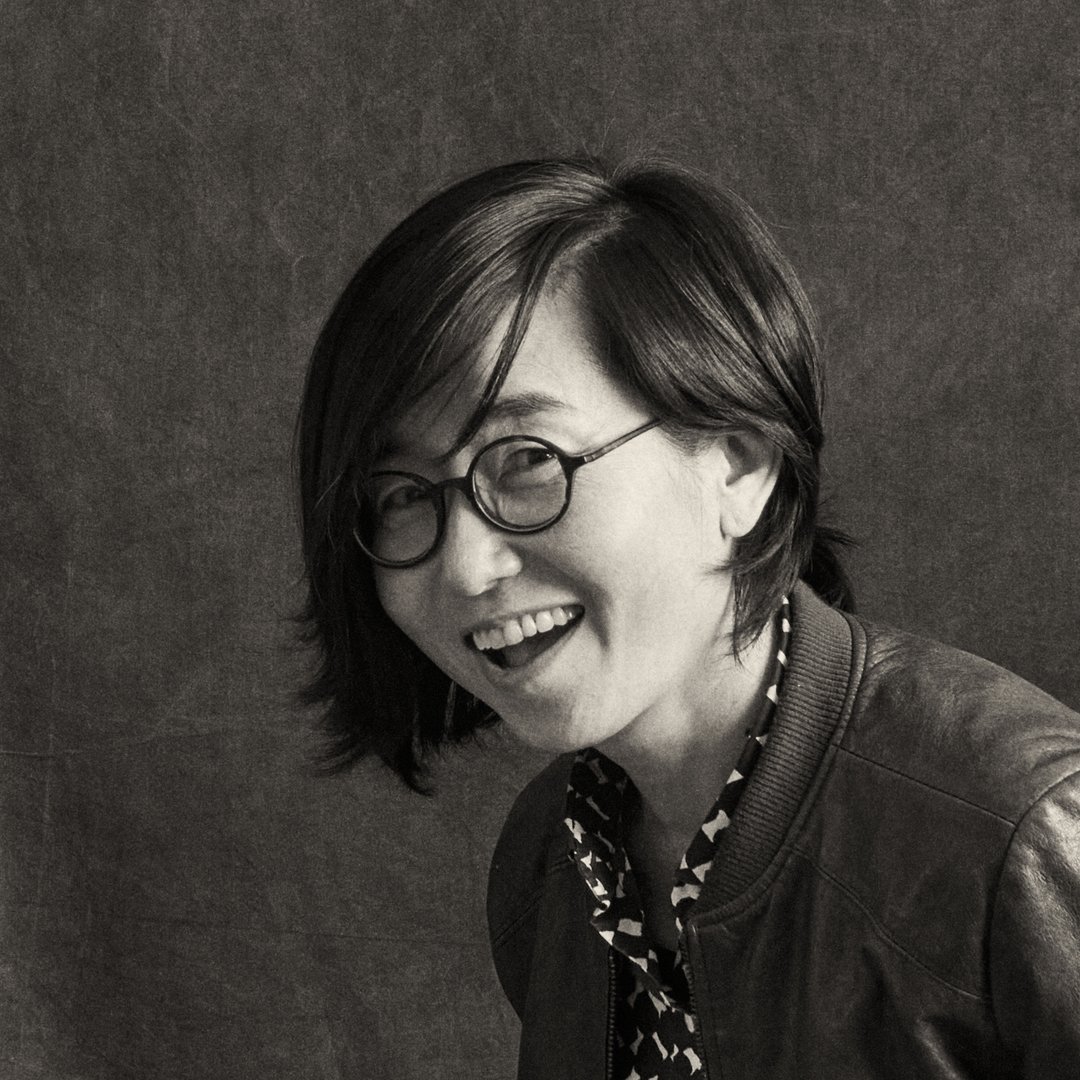
Won Seoungwon received M.F.A. from Kunstakademie Dusseldorf in 2002 and Kunsthochschule für Medien Köln in 2005. She is represented by Arario Gallery and currently lives and works in Seoul.

Won
Seoungwon’s artistic practice begins with the question, “Where do stories come
from?” Her early work My Life(1999) documented the small
objects inside a 2×4m room—pill packets, letters from her mother, socks, and
pieces of bread—through 628 photographs that were then compiled as a single
work, marking the starting point of transforming the most ordinary traces of
her life into a visual narrative. From this work onward, her interest shifted
toward “the life she can actually hold onto,” leading to a belief that a small
room, its objects, and individual memories can form an entire ‘world.’
Thereafter,
‘space and desire’ became the core axis of her practice. In the
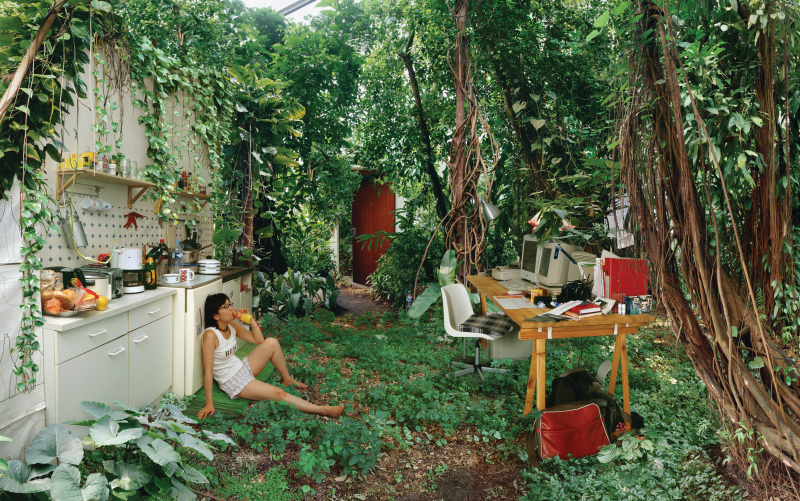
‘Dreamroom’(2000–2004) series, she traveled around the world to collect images
that construct the ideal rooms desired by herself and her friends. On top of
real one-room apartment photographs, she overlays landscapes such as swamps,
rocks, and primeval forests to construct surreal environments. Works such as Dreamroom-Seoungwon
(2003) and Dreamroom-Tina(2000) place the narrow,
suffocating spaces of reality against “the landscapes of desire lying beneath,”
foreshadowing the consistent attitude across her practice—seeing reality and
imagination simultaneously.
From the
late 2000s, her subject matter expanded outward—from herself, to those around
her, and then to broader members of society.
The Tomorrow(2008) series and the exhibition 《Tomorrow》(Alternative Space LOOP, 2008)
begin from daily episodes of family, friends, and colleagues, forming fictional
village scenes where past, present, and imagined future intertwine. The ‘Seven
Years Old’(2010) series presented in the solo exhibition 《1978, Seven Years Old》 reconstructs the
artist’s first experience of separation from her mother through her niece and a
symbolic tree, turning a personal trauma into a narrative of healing. Here, the
young niece stands in for the artist at age seven, and the tree symbolizes the
absent mother, demonstrating how rewriting one’s own life can open up a path
toward empathy.
Since the
2010s, she has expanded from personal narratives to the identities and
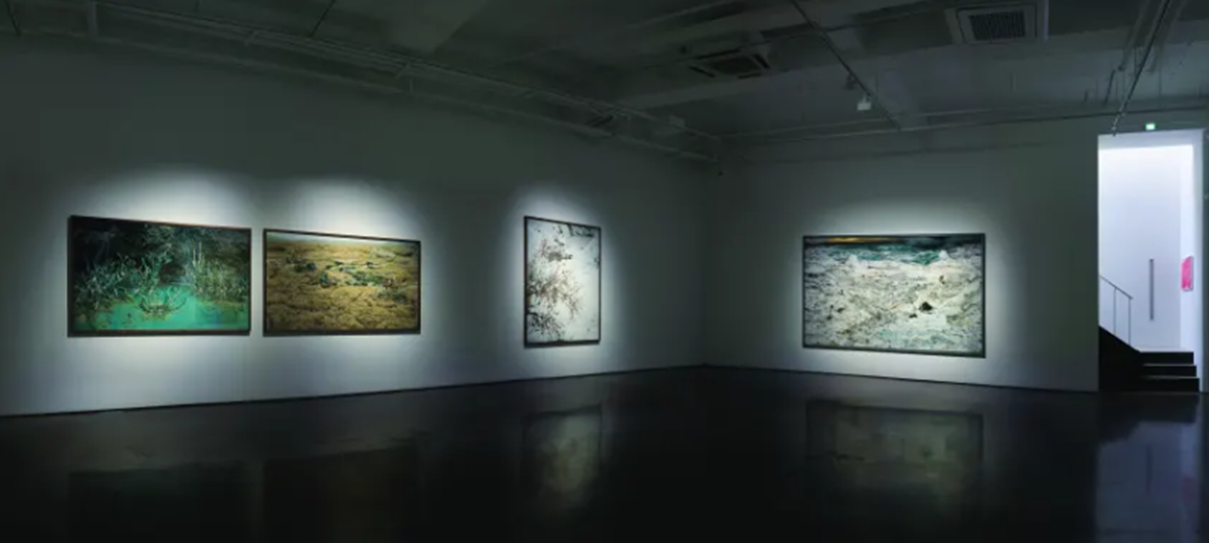
emotional structures of ‘social subjects.’ In her solo exhibition 《The Sight of the Others》(Arario Gallery,
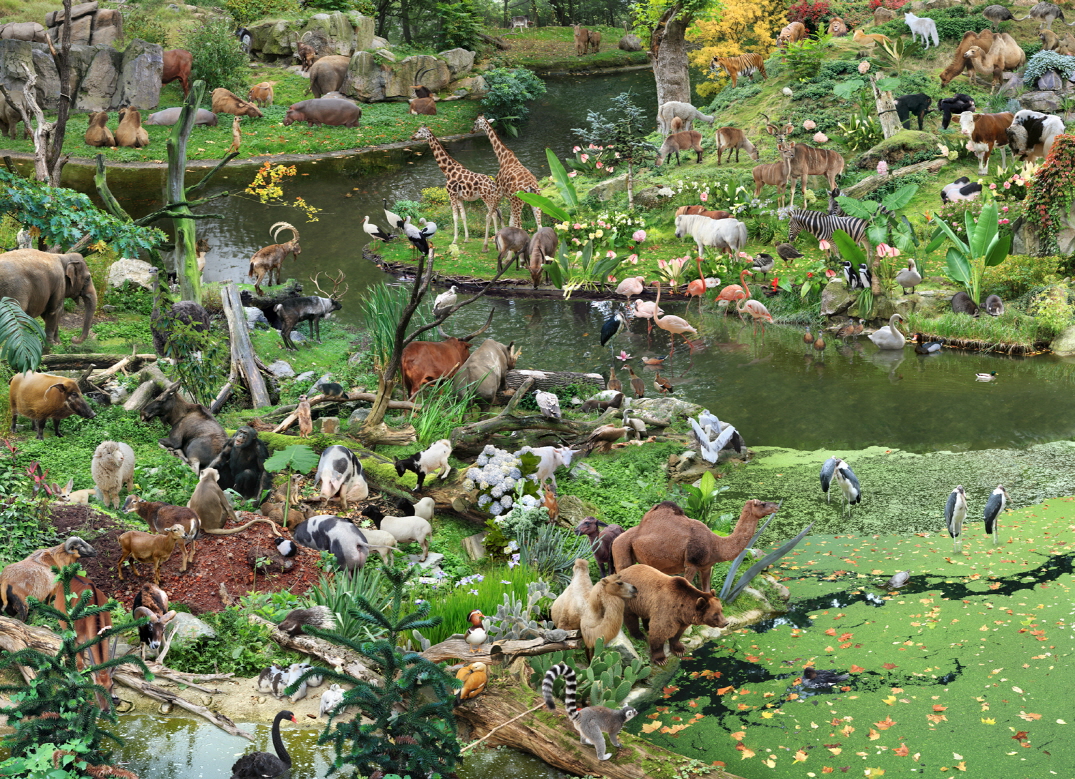
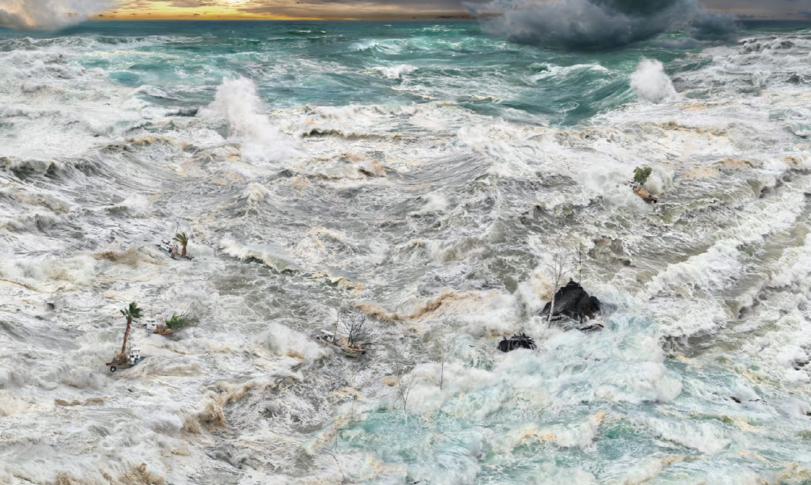
2017), works such as The Quarries of Financiers(2017) and The
Sea of Journalists(2017) metaphorically transform specific
professional groups—public officials, journalists, financiers—into rocky
mountains, seas, or clusters of animals, questioning how occupations define
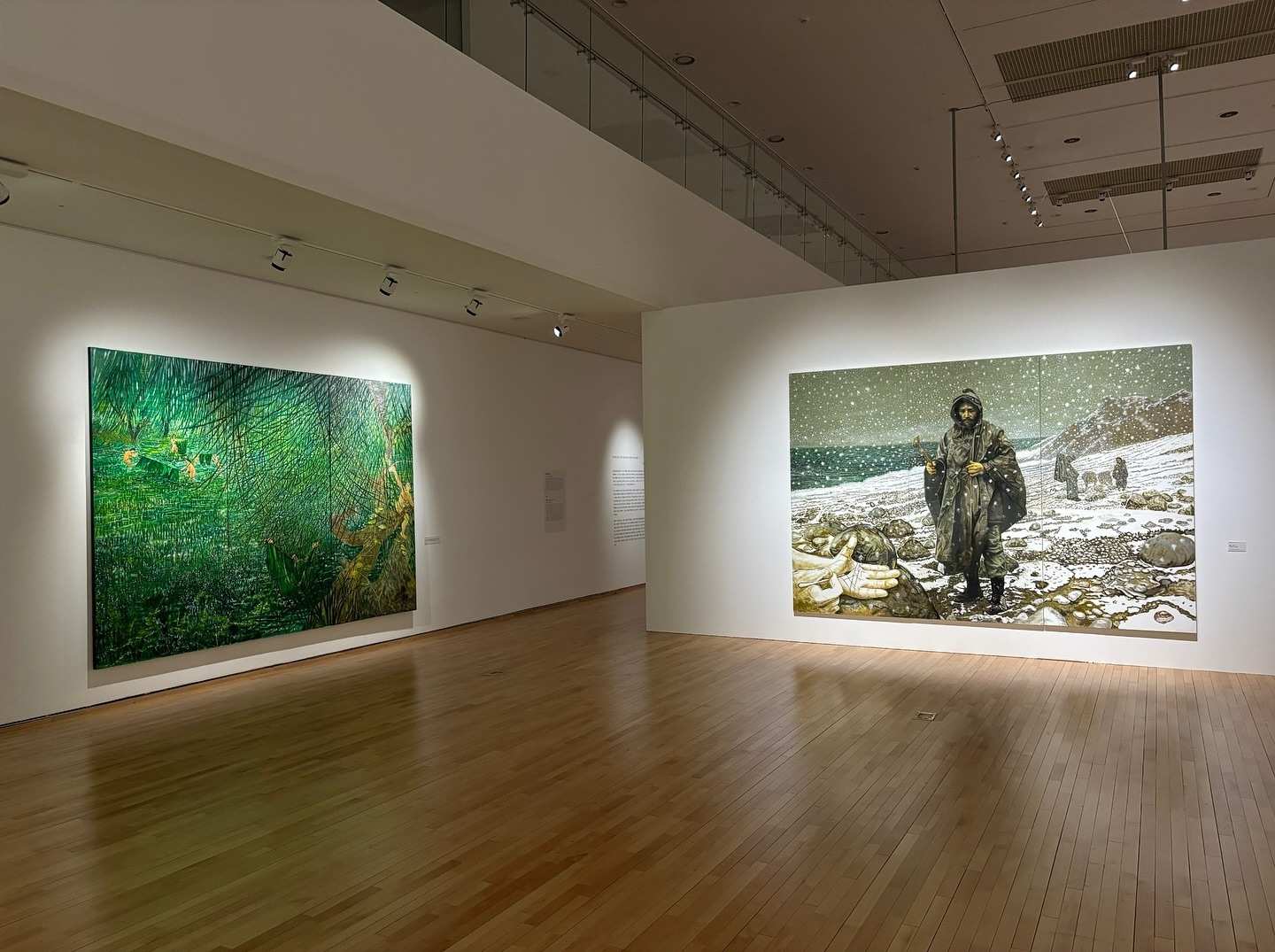
lives and identities. In her recent solo exhibitions 《Freezing
Point of All》(Museum Hanmi, 2022–2023) and 《The Inaudible Audible》(Arario Gallery,
2021), she visualizes superiority and inferiority coexisting within “successful
people,” as well as loose networks and anxious mental states, through motifs
such as icy mountains, trees, droplets of water, and ‘Ordinary Loose Network,’
thus addressing the psychological landscapes of contemporary individuals on a
more universal level.
Formally,
Won Seoungwon’s work is based on digital photo-collage, while in content it
encompasses a hybrid of painting, installation, and literary narratives. She
records subjects with meticulous precision—photographing a single tree in as
many as 60 segments—and assembles hundreds to thousands of images into a single
scene as if composing an “image novel.” While My Life
constructed an installation-like arrangement of objects inside a room, this
spatial sensibility later becomes absorbed into fictional landscapes, making
the picture plane itself a stage and a world.
In series
such as ‘Dreamroom,’ ‘Tomorrow’, and ‘Seven Years Old’(2012), the imagery
always contains “fragments of reality we have seen somewhere,” yet through
their unconventional combinations they form worlds of entirely different
layers. Works such as Seven Years Old–The Chaos Kitchen(2010),
Seven Years Old–Azalea Boiled Rice and Chrysanthemum(2010),
and Seven Years Old–Bed-Wetter’s Laundering(2010) transform
familiar domestic spaces into psychological environments that simultaneously
hold anxiety and comfort, through excessive objects, flora and fauna, and
strangely scaled elements. The narrative is conveyed without text, with each
scene composed like a children’s story—carrying emotional rise and resolution.
Over time,
her collage approach has evolved into more complex and increasingly abstract
forms. In 《The Sight of the Others》, the barren rocky terrain, naked trees, sagging electric wires, and
lightbulbs in The Quarries of Financiers symbolize
professional desires and insecurities, and the circulation of capital.
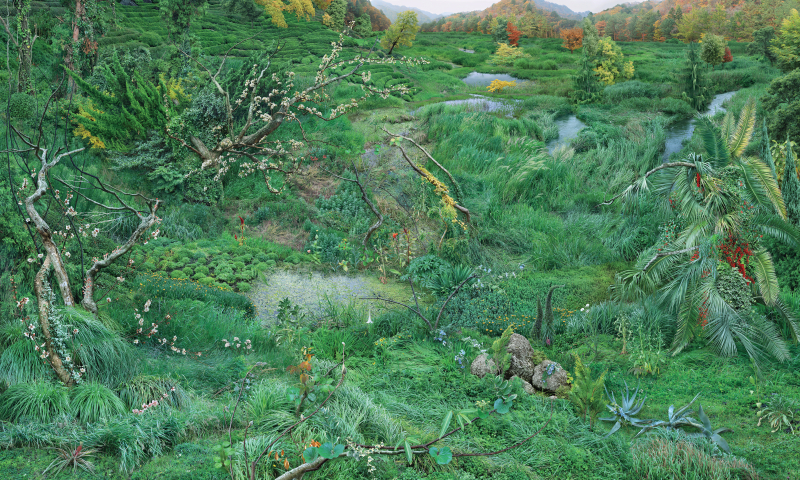
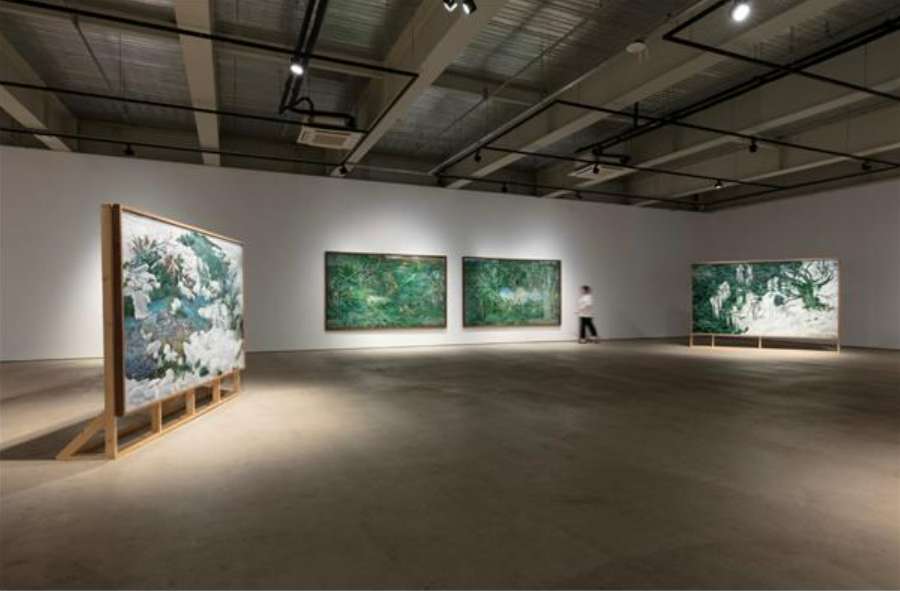
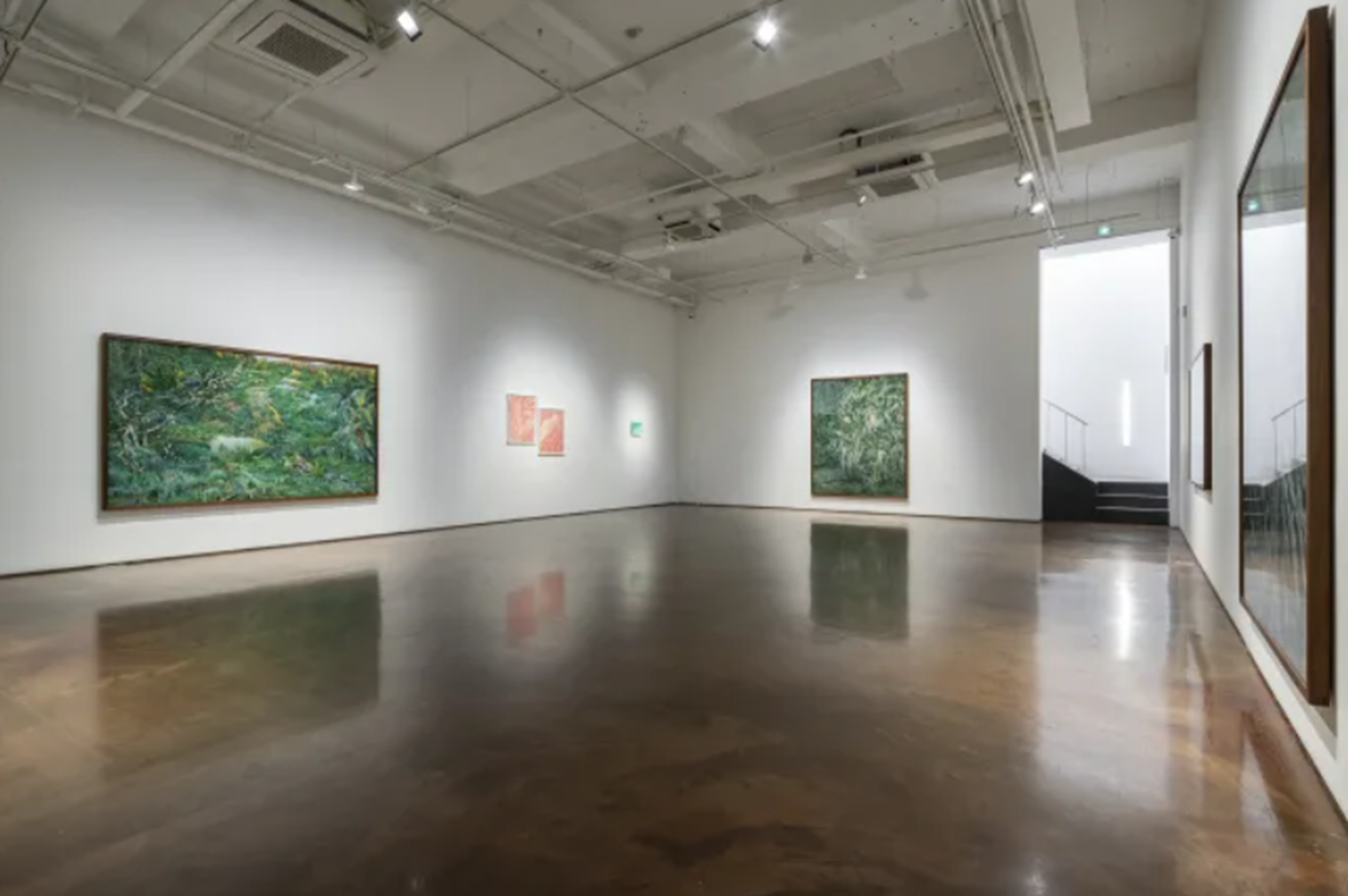
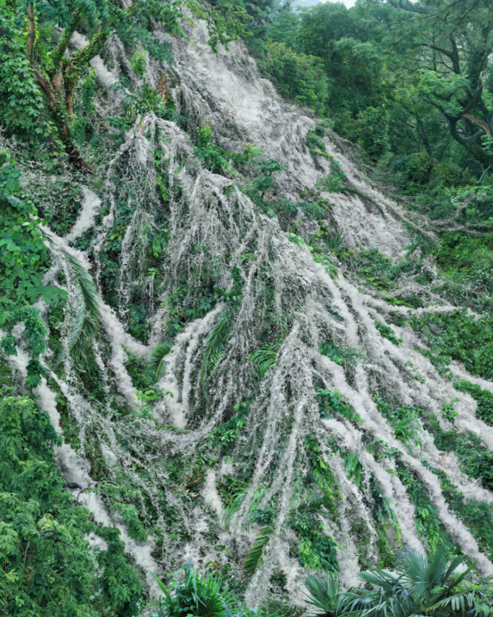
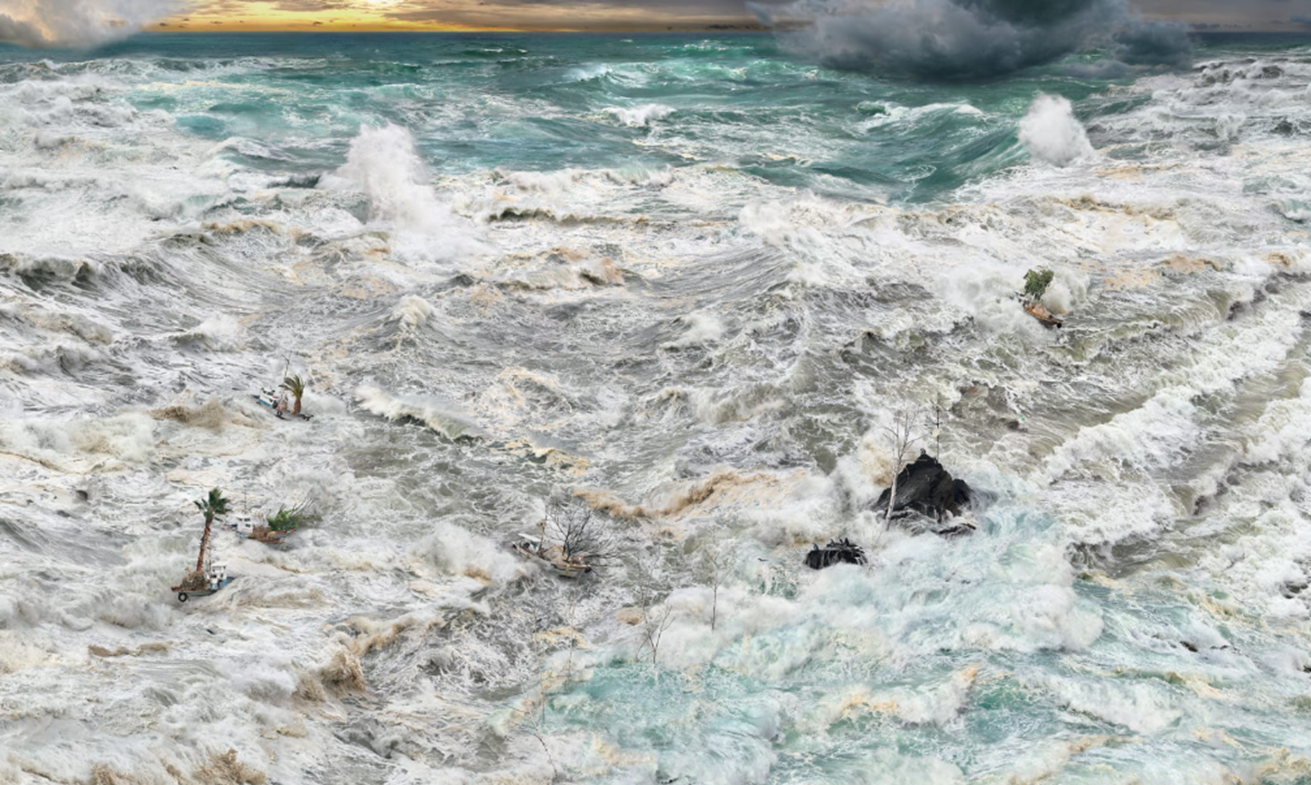
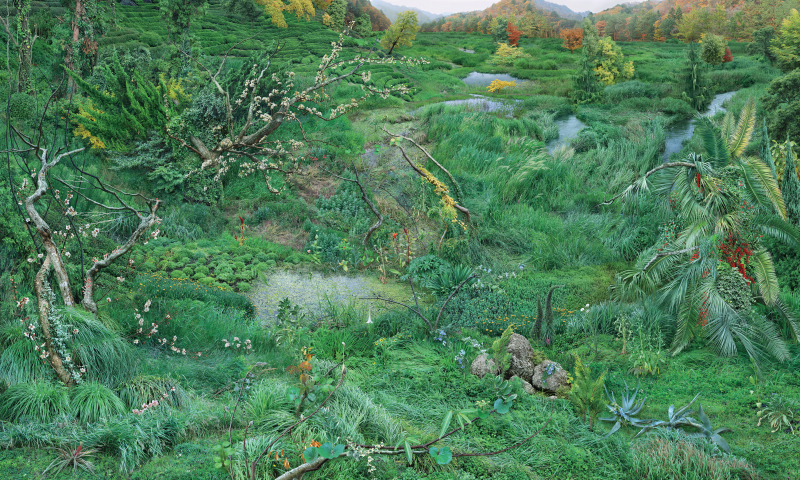
Meanwhile, works such as The Grass That Used to Be There(2022)
from 《Freezing Point of All》
and Grand Waterfall(2021) and Ordinary Network(2021)
from 《The Inaudible Audible》no
longer reveal specific figures or occupations directly. Instead, motifs such as
ice, droplets, branches, grass, and loose networks metaphorize “poorly handled
inferiority,” “fragile bonds,” and “willpower that grows even in frozen conditions,”
shifting the content toward psychological and emotional planes.
The
distinct sense of estrangement in her compositions stems from technical
decisions. Although based on real landscapes, the scenes are never taken in a
single shot but stitched from many segments with slightly mismatched
perspectives and vanishing points, producing “impossible landscapes.” The near
absence of shadows flattens the image, yet within it coexist multiple times,
seasons, elevations, and distances simultaneously. Tens of thousands of shots,
thousands of selected elements, and thousands of hand-crafted layers—along with
up to ten hours of daily labor—reinsert analog temporality and physicality into
a digitally constructed medium. In this way, form and content are inseparable:
as she describes, “it’s not the forest, but the story of each tree”—the forest
in her work is not a natural sum, but a fabricated relationship formed by
thousands of edited fragments.
Won Seoungwon has established a distinct position in contemporary
Korean photography and image-making by merging staged photography with
narrative-based imagery. Within the strong documentary tradition of Korean
photography, she has built a unique middle ground of “fiction grounded in
reality” by capturing real objects and landscapes and reconstructing them into
newly imagined worlds. Over the past 20 years since My Life,
her work has demonstrated that photography can exceed documentation and become
a psychological and narrative space.
This approach is reflected in her recognition and institutional
presence. Through solo exhibitions such as 《The Sight of the Others》, 《Freezing Point of All》, and 《The Inaudible Audible》, she has examined the
lives of social others, her own childhood anxieties, and the inner structures
of the successful. She has been selected as the recipient of the 23rd DongGang
Photography Award in 2025, establishing her as a key figure in contemporary
Korean photography. Her works are housed in major Korean museums—including the
National Museum of Modern and Contemporary Art, Seoul Museum of Art, Gyeonggi
Museum of Modern Art, Museum Hanmi, and GoEun Museum of Photography—as well as
international institutions such as the Osthaus Museum (Germany), Santa Barbara
Museum of Art (USA), and Mori Art Museum (Japan), enabling diverse
interpretations of her work across cultural contexts.
Her practice holds strong potential for broader international
reception, thanks to the universal resonance of her themes—superiority and
inferiority, anxiety and relationships, profession and identity, childhood
wounds and adult self-understanding. At the same time, the dense symbolic codes
drawn from Korean professional structures, social systems, and familial
dynamics maintain a grounded locality. It is anticipated that she will continue
to develop “expanded narratives dealing with social subjects, collectives, and
psychological structures,” persistently generating new scenes at the boundary
between reality and imagination.
 Won Seoungwon, Ordinary Network, 2021 © Won Seoungwon
Won
Seoungwon is a natural-born storyteller. This is evident not only when speaking
with her but also in her artworks, which are filled with rich and abundant
narratives. Just as words come together to form sentences, and sentences
accumulate to create a novel, she combines around two thousand individual
photographic images into the construction of a single intriguing story. The
characteristics she had since childhood—talking incessantly when someone was
around and drawing when alone—manifest most vividly in her work today.
Since
her first photographic work My Life in 1999, Won
has spent the past twenty years presenting collage-based works grounded in
photography. She has constructed stories about herself, the people around her,
and the members of our society, often through allegorical or symbolic language.
As more people find her stories compelling and relatable, her narratives have
grown stronger and more captivating. And before anyone realized it, the artist
who once appeared in her show as 《1978, My Age of Seven》 has now reached middle age.
Anxiety at Seven
One
morning, she overslept and awoke to an unnervingly quiet house. Her mother was
nowhere to be found. She checked the kitchen and every corner of the home, but
everything was empty. A sudden surge of fear, anxiety, and the feeling of being
abandoned overwhelmed her. Such a chilling experience is likely not hers alone.
Her exhibition 《1978,
My Age of Seven》 unfolds
against this emotional backdrop.
What can a seven-year-old child do in such a situation? The only possible
action is to swing open the front door and run out in search of her mother. But
the world outside is far from kind to a child.
In
the deepest, most hidden room of the artist’s inner world—the room that led her
to choose the demanding yet fulfilling path of an artist—lived that
seven-year-old child who had experienced the absence of her mother and vaguely
sensed that she had to separate from her and step into the world.
That young
girl filled every spare moment with drawing, and her love for making things
eventually led her to major in sculpture at Chung-Ang University. After
graduation, she left for Germany, where at the renowned Kunstakademie
Düsseldorf she learned, in earnest, what it means to live as an artist.
“My
professor once told me, ‘You are young, so your work will continue to grow. But
what matters is that no matter what hardships come, no matter what criticisms
arise, you must never shrink away. You must be able to explain and justify your
work with confidence.’”
For
Won, Professor Klaus Rinke was a mentor who trained her to speak
about her work with bravery and conviction in front of others. He also played a
critical role in leading her toward the photographic, collage-based practice
she pursues today.
“Actually,
when I first entered the Kunstakademie Düsseldorf, I chose installation art.
Though I’m physically small, I’ve always loved large-scale installations and
big works.”
But
that choice backfired. She ambitiously presented a large-scale piece during her
first-semester critique and received praise, but the effort exhausted her so
severely that she had to be hospitalized. Because of repeated hospital stays
and outpatient treatments, she could not properly attend class.
“At
the end of each semester, the professor must decide whether to keep the student
in their class. If you don’t get your professor’s signature, you can’t stay at
the school unless another professor chooses to take you. My professor struggled
for a week before ultimately deciding not to sign. He told me, ‘Large-scale
installation work is too much for you. You’re not strong enough physically, and
you don’t speak well. It will be difficult for you to be an artist. I won’t
sign because I want you to have time to find another career.’ In short, I was
kicked out.”
It
was a moment of complete despair. She returned to her tiny 2m x 4m room and,
before packing her belongings, decided to photograph everything in it. Laying
white paper in the center of the room, she photographed every trivial
object—medicine packets, her mother’s letters, worn socks, bits of leftover
bread—one by one. The images totaled 628. Wanting to see them all at once, she
went early one morning to an empty school building, arranged them on the wall,
and sat contemplating them for a long time. She sensed someone standing beside
her, quietly looking at the photographs. It was Professor Rinke.
After hearing the story behind the photographs, he made an unexpected proposal: “This
is incredibly honest work. Can you come to my class tomorrow and explain this
piece?”

The Beginning of Her Photographic Practice
The
1999 work My Life became the piece that pulled her
back from the edge of a cliff and opened a path toward new possibilities. From
that moment, she began producing digital, photography-based work in earnest. It
also became the turning point that led her to graduate from Kunstakademie
Düsseldorf in 2002 and continue her studies at the Academy of Media Arts
Cologne.
“I
ended up spending eleven years in Germany—from 1995 to 2006—during which I
found the direction of my work as an artist.”
My
Life, a project in which she narrated her own story through her room
and personal objects, developed into Dreamroom, where
she transformed the spaces of people around her into the dream rooms they
longed for. Her friends lived in cramped real-life quarters—one friend who
loved water received an aquarium-like room; another, fascinated by prehistoric
life, was given a room reminiscent of a natural cave; and for herself, always
longing for warmth and nature, she created a room filled with primeval forest.
After
returning to Korea, Won presented 《1978, My Age of Seven》 in 2010, gaining
major attention in the Korean art scene. Her shift from the stories of those
around her back to her own narrative stemmed from a growing psychological
unease—inner anxiety and panic disorder. During therapy and psychoanalytic
sessions, she realized that the seven-year-old child, still crouched in fear
within her, remained unresolved.
“When
I was little, I lived with a large extended family. But when I was seven, my
mother began working. From then on, without understanding why, I waited all day
for her to return. I lived in constant fear of what might happen if she didn’t
come back.”

Afterward,
the themes of Won’s work expanded again—from herself to the stories of people
around her, and ultimately to the stories of broader social groups. Her 2017
exhibition 《The Sight of
the Others》 explicitly identifies
professions—public officials, journalists, professors, financiers—in the titles
of the works, making her intentions unmistakably clear.
The
work The Quarries of Financiers depicts a barren
landscape: dry stone mountains, withered trees, sagging electric wires, and
lamps glowing intermittently. She portrays financiers as people who have the
power to turn stones into gold. The drooping electrical wires resemble fluctuating
stock-market graphs, and the glowing bulbs hint at incoming money. However, the
implication that gold can turn back into stone at any moment contains an
inherent irony.
Her
works embed dense symbolic codes, and deciphering these symbols—connecting
them, inferring them—creates the pleasure of reading her images as stories.
As
for her most recent exhibition, the 2021 series 《The Inaudible Audible》, the puzzle-like
process of reading her stories becomes far simpler, while the visual
completeness of each work becomes far more pronounced. Even the titles—such
as The Weight-Clad Light, Ordinary
Network, and The Blue Potential of a White Branch—are
less concrete than before. Thus, compared to earlier works, narrative elements
are reduced, but their visual impact is immediate and powerful. If one were to
describe the shift in literary terms, it feels like moving from prose to
poetry.
A Work Composed of Two Thousand Parts
“In
the past, a single work might have used around a thousand images; gradually the
number increased, and now it surpasses two thousand. But I no longer want to
count how many images I use. It’s not essential. What matters is the completion
of the work itself.”
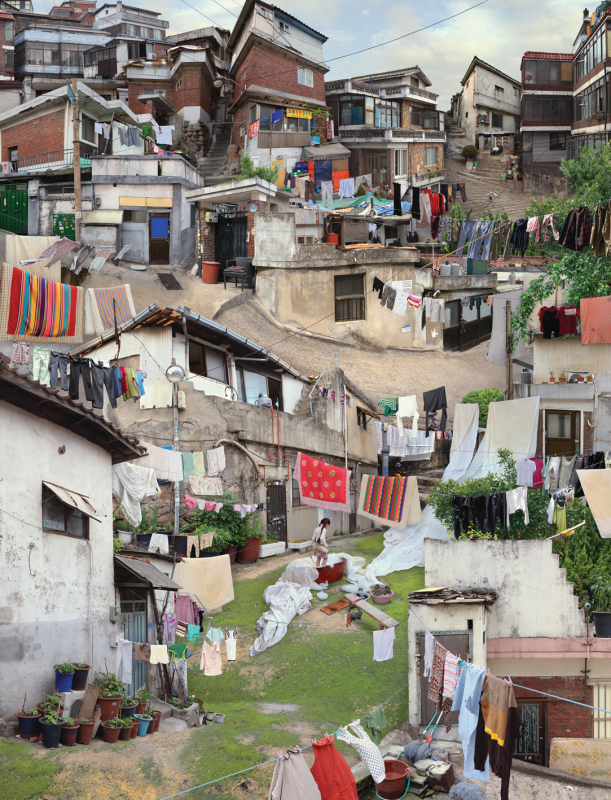
Looking
closely at her work, one finds landscapes that appear realistic yet strangely
unfamiliar. The trees, water, grass, and fields that fill the frame are all
based on photographs she physically collects—making them grounded in reality.
But she does not photograph a subject in a single shot. For example, one tree
might be photographed in sixty separate cuts, all to maintain consistent
distance and perspective. Because she stitches these images together, the final
scene carries an uncanny dissonance that does not align with normal optical
perception. It’s the kind of perspective that would only be possible if one
were floating in the air looking down, yet it unfolds naturally across the
image.
“When
I have collected the photographic materials, I sit in front of the computer and
begin assembling each small fragment to construct the story. Through adding,
erasing, and adjusting colors in Photoshop, I create a landscape that both
exists in this world and does not.”
Each
fragment once belonged to a completely different context, but as the tiny
pieces accumulate and merge, they evolve into entirely new narratives. Because
of this process, Won produces at most one or two works a year—the creation time
is extraordinarily long and strenuous.
To produce a single work, she takes tens of thousands of photographs, selects
thousands, and pastes them one by one into a single frame. This collage process
requires months, sometimes years.
Once
she has a concept, she makes a drawing to envision how the final work will
appear. Then she goes out to shoot the images she needs. If a work typically
requires around two thousand photographic fragments, one can imagine how many
total shots are needed—and even then, suitable weather, seasons, and landscapes
must align. The photographic stage alone is extremely demanding, but the
digital process that follows is even more so.
“Working
ten hours a day is normal for me. Sometimes I ask myself, ‘Do I really need to
work this hard?’ But if I start choosing easier paths, I feel like I would lose
the attraction of the work itself.
Life may be hardship—but the process of immersing myself in the world of the
computer, imagining endlessly, and creating that imagination into images,
that’s joy. It’s closer to meditation than suffering.”
Because
she works alone from beginning to end, she is always short on time. She
dedicates as much of her life as possible to her work and reduces her everyday
life to its minimum, living in a simplified, almost ascetic way.
In her words: “My
life may not go the way I want, but my work can. When I sit at the computer, I
live in a world where nothing is impossible. Even if I had all the comfort and
abundance in life, if I weren’t an artist—if I lived an ordinary life—I don’t
think I would be happy.”
 Won Seoungwon, Dreamroom-Seoungwon,
2003 © Won Seoungwon
Won Seoungwon, Dreamroom-Seoungwon,
2003 © Won Seoungwon
The Desire for Space
When
examined closely, the long arc of Won’s artistic narrative ultimately begins
with space. Her earliest collage work, My Life,
was born from the 3-pyeong (approximately 9.9 square meters) room in which she
lived, where she photographed and revealed the small, ordinary objects that
structured her daily life.
Later, Dreamroom emerged
from her attention to the spaces of her friends. And the subsequent works,
which unfold across vast and expansive landscapes, likewise reveal how deeply
the artist is drawn to, and desires, space.
“I’ve
always been drawn to things that are big and vast. Reality may impose
limitations, but through the camera I can bring these grand environments into
my world and create expansive realms, sharing the vastness inside my mind with
others.”
Because
she enters the world inside her monitor every day, she says her real-life room
no longer feels small. She begins with a blank white space, and as more and
more fragments accumulate within it, mountains and seas, forests and rivers
gradually appear. Within these paradisiacal landscapes, she experiences a sense
of freedom and happiness. And as this happiness unfolds into vivid, flavorful
stories, the eyes and ears of the viewer, too, are delighted.