The Ecstasy of Transference and Dialektik
His
father disliked Father. But this doesn’t mean he didn’t like himself: he did
not like his own father—that is, the grandfather. His father lived like someone
who didn’t have a father—he was ashamed of his father. His grandfather was a
shaman—a male shaman, called Cheonhodong Shaman.
But
the grandfather wasn’t a shaman while he was living in Ongjin just below the
38th Parallel. People said that he must have been a Christian like a lot of
people from the same area. Who knows? He might have been a Buddhist. At any
rate, some time before the Korean War, he traveled upstream on a boat on the
Han River to Seoul and unloaded at the Gwangnaru Ferry. He had lived in an
affluent household in Ongjin. In Cheonhodong, he was doing all right. As often
found in mythical descriptions of a wealthy man, he could travel about 10
kilometers from Maljuk-geori to Cheonhodong without leaving his own land.
That’s what they say. This was all before his second son had had his second
son.
Nobody
knows why the following happened. And there’s no way to know. One night his
grandfather woke up suddenly and went straight toward a mountain, as if he knew
his destination. His sons and daughters followed him and tried to dissuade him,
seeing that he acted as if he was possessed. Then they saw him dig with his
bare hands at a spot on a slope somewhere in Gwangju, today called Gangnam,
finding a sword, bells, and a folding fan, and bringing them back.
Clearly, he
was possessed or bewitched. Right away, he invited a spirit into his home and
established a shrine. Whether his main spirit was General Choe Yeong (1316-88;
a Goryeo general) or General Im Gyeong-eop (1594-1646; a Joseon general), we
don’t know. He hung a worn-out portrait on the wall of the shrine, a Sinjangdo
Divine Guardian portrait.
His
grandfather lived in a house inside a couple of inner gates, past a few
apartments let to other families. After pushing open the door, people would
find a shrine at the farthest end of the left side of the house. His second
son’s family lived in a house about 100 steps from his first son’s house, where
he himself lived. His second daughter-in-law would leave her two sons at his
first son’s house when she worked. Thus, the artist lived seven years under the
care of his grandfather, but did not realize then or afterward that his
grandfather’s spirit would always stay with him. This second son of his second
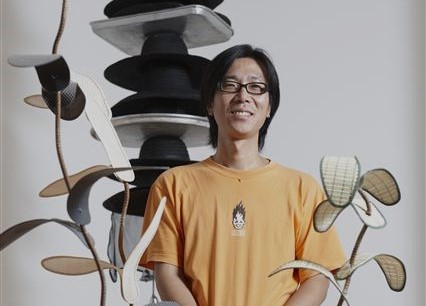
son was the artist Sangdon Kim, who suffered from dyslexia.
During
his years at Cheonho Elementary School, Sangdon Kim was a handy child with
artistic talent. He didn’t know why this was a good thing, though, nor where to
use it. His homeroom teacher gave him various tasks, and she also encouraged
him when he graduated. He drew more attention with his talents in the art club
at Cheonho Middle School. Although he didn’t put much importance on it, he
wanted to try out his talent because his elder brother was recognized for his
artistic talent.
At Dongbuk High School, to which he commuted by bicycle, he
joined both the art club and the Judo club. Like most boys growing up in a poor
neighborhood at that time, he felt he needed to be strong. A private art-school
teacher at the Gildong Crossroads guided him into the Department of
Environmental Sculpture at the University of Seoul, an option whose tuition
costs were lower than most other universities.
His
college life was not satisfying to him, although, whenever a demonstration
occurred on the campus, he liked to participate with performance art and his
artistic expression. They were different from other, usual forms of
demonstrations, so at some point he realized that he was leading them. Around
that time, he also thought that he needed to go to France to study art, so he
registered in YMCA language courses to learn the language.
He had dropped out
of the college, and then attended a special program at Kaywon University of Art
and Design in Uiwang on the outskirts of Seoul, which had an exchange program
with Düsseldorf Art Academy in Germany. There, he encountered Nam June Paik,
Tadao Ando, and many German artists. In that program, which did not even require
exams, his close relationship with Germany began.
One
night, during his military service, Sangdon Kim had a strange dream: mountains
collapsed and the sky crashed down to the earth. That day, he was given an
unexpected leave of absence, so he went home—where he found that his
grandfather had just passed away. He arrived there even before his family had
tried to reach him in the military. Absentmindedly, he had gotten off the bus a
stop before his house and had dropped by his uncle’s house. When he arrived, he
found them hanging funeral lanterns in front of the house. It was a strange
incident, yet it did not feel strange to him.
Somehow,
he managed to go to Germany to study photography. To earn the tuition, he had
worked all kinds of odd jobs: snow removal, carrying boxes at a fish cannery,
and dishwashing in clubs and restaurants. It did not feel unfair to him. For
his graduation photography project, he studied trees. He followed and recorded
the lives of the Tannenbaum Christmas trees in Berlin. Each year, some 400,000
such trees were imported from Denmark, the Czech Republic, and Poland. After
the season, they were sent back to Poland, to be ground up, mixed with potting
soil, and resold in Berlin.
By getting lifts on buses and trucks, he diligently
traced the birth of these special trees, their injection with auxetic, an
artificial strengthening agent, their sale into a wealthy city, and their end
as soil in Berlin, leaving no trace of their former existence. In Germany,
although he did not think overly about his grandfather, his ability to
empathize with trees, that animistic ability, might have come from him. His
grandfather no longer lived, but he lived inside Kim, and appeared
everywhere—as liquid, as vapor.
Although
he lived on German sausage and bread and learned German for years, Sangdon
Kim’s dyslexia did not improve. As a student, he had read not only letters—he
also read spots and wrinkles on the paper. He could not understand why he
should only read letters. He looked at the book in its entirety. He memorized
the great art critic Walter Benjamin just by sight. Although the speed of his
reading, from cover to cover, was much slower than normal, he chewed books like
rice and swallowed them with his eyes. Like that, books entered his body in
their entirety, and he felt entranced.