It goes without saying that when one appreciates a work of art,
one simultaneously perceives both the subject in a work of art and how the
artist represents this subject. Of the two, it is much easier to
talk about the former as the viewer can recognize and appreciate the subject
matter within conventionally recognized systems of perception. In
this regard, the viewer is confident that he or she is on the same page as the
artist as to what the subject is. It is a completely different story
when it comes to discussing the latter, that is, how the artist represents the
subject. Here, all the elements within the conventional based system
of perception dream of escape. This happens both on a conscious and
subconscious level since the artist’s intention works on both a conscious and
subconscious plane. The artist’s subliminal intention can be found
in the artist’s technique, i.e. the way they paint, thereby allowing the viewer
to sense the artist’s attitudes in ways that go beyond simply viewing the
subject matter of the work. It is in this space that the disconnect
with the viewer and the artist occurs. When the artist evokes
something that lies beyond the cognitive grasp of the viewer, the viewer begins
to feel uneasy for being pressured or obliged to see beyond the habitual
confines of his or her traditional bounds of perception. That being
said, the viewer should pay attention to this place, for no more reason than
the intrinsic meaning of a work inhabits this very place. So, let us
now turn our attention to the works of the artist Jina Park.
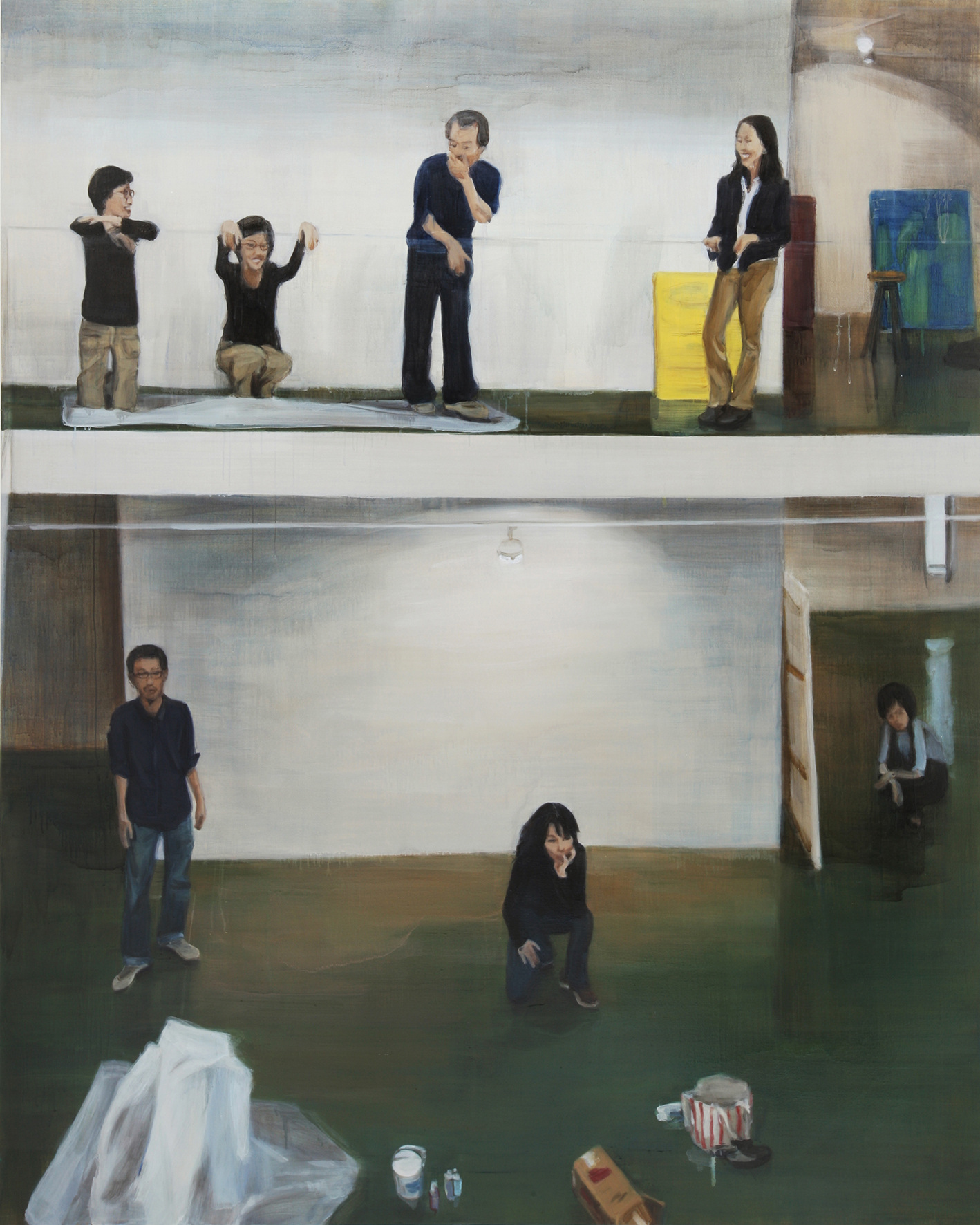
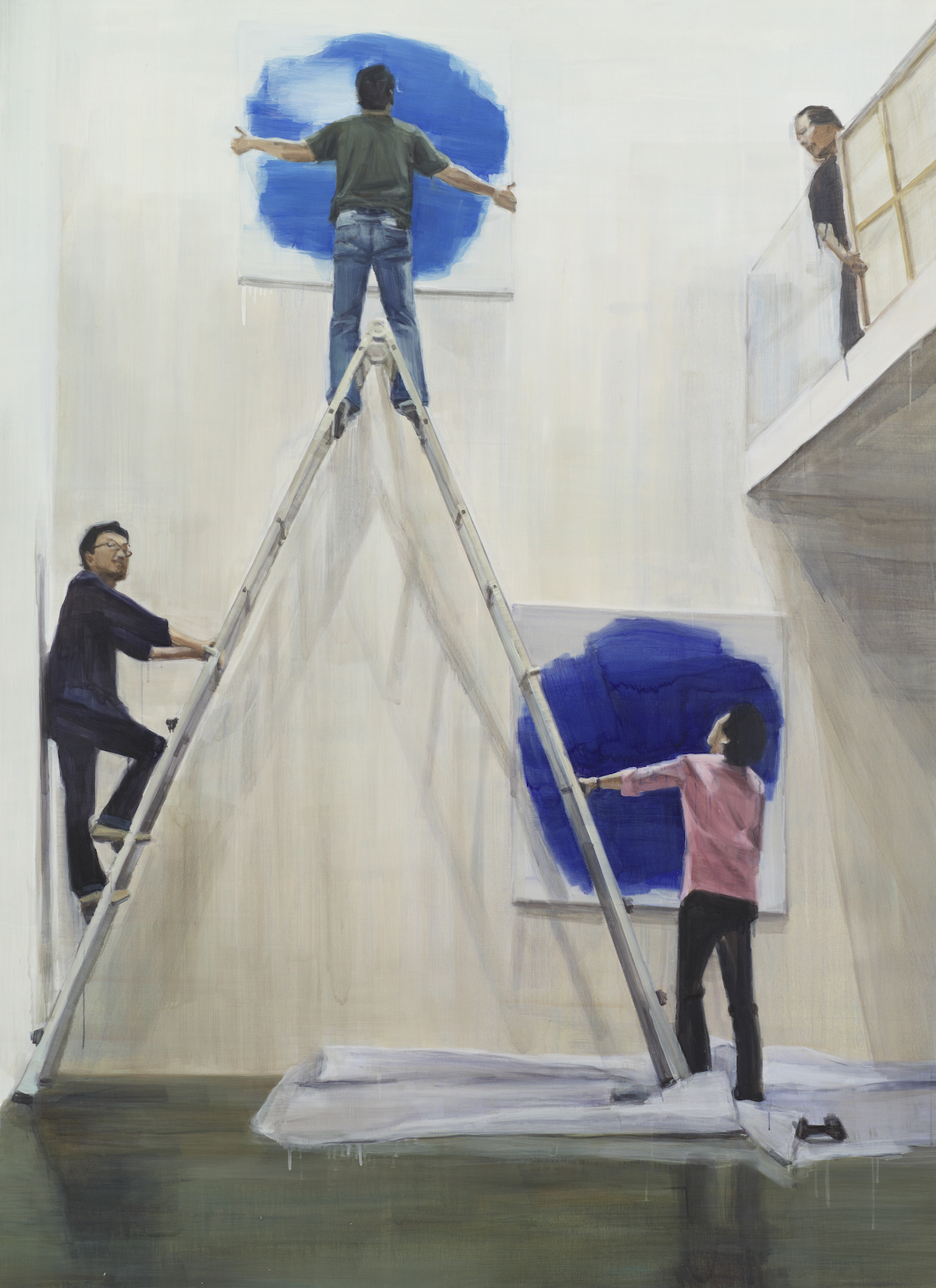
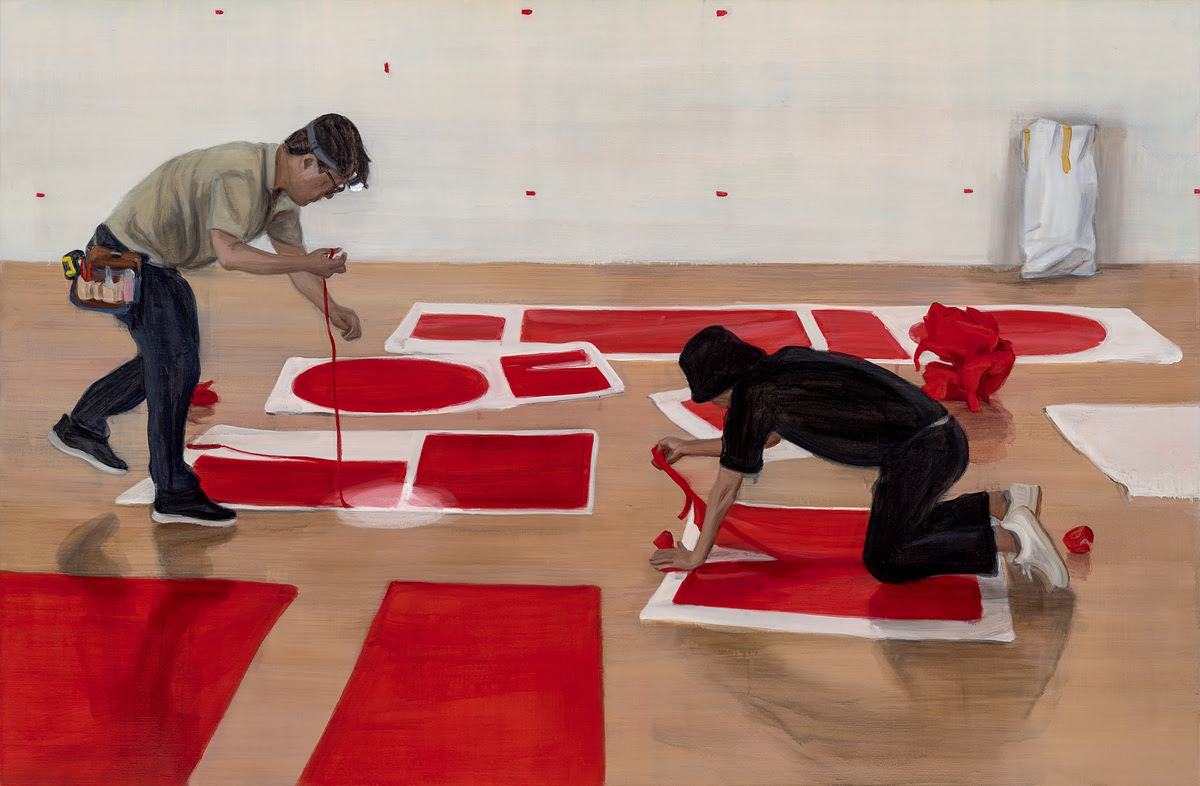
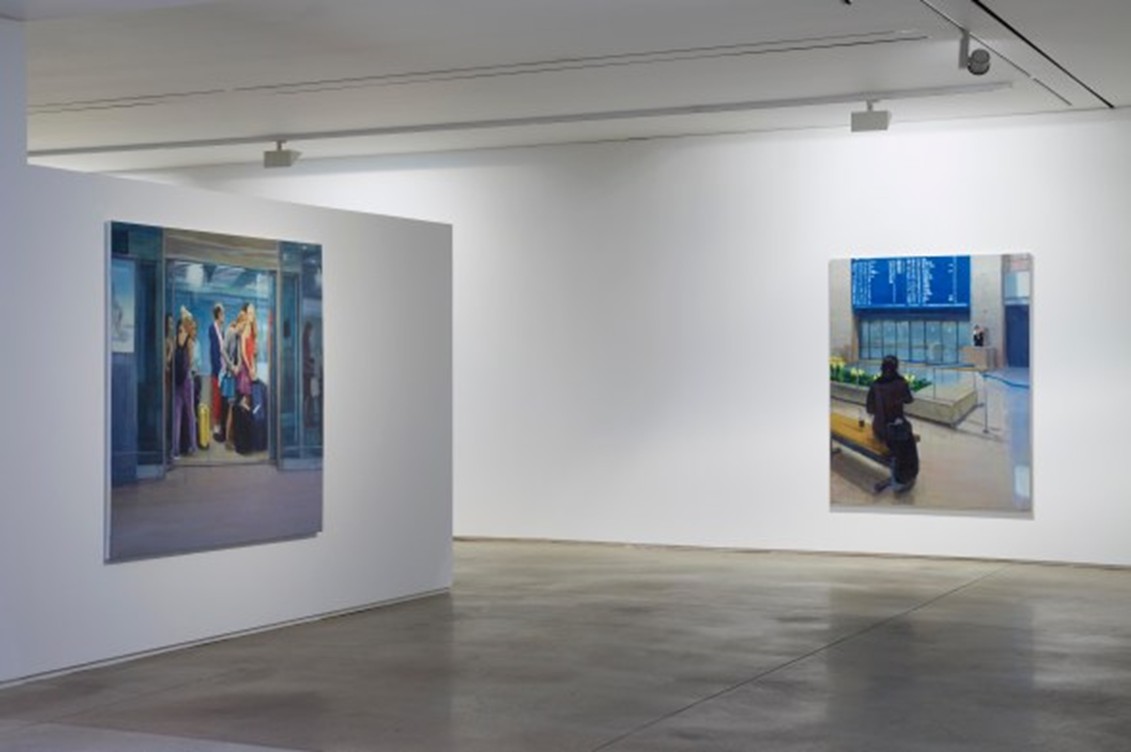
1. What Is Represented : What
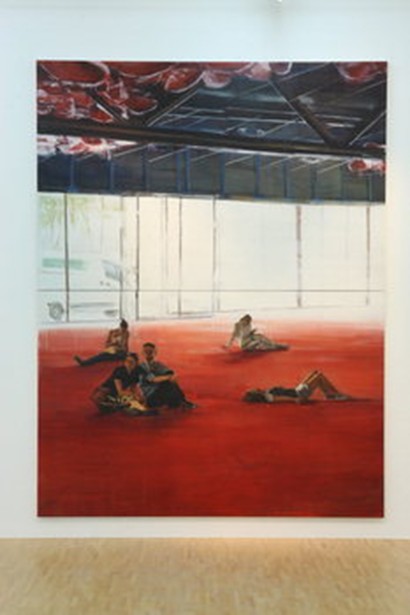
can you see in the works? For starters, there are people in particular places
(e.g. the open air, a party, a park at night, an exhibition). They do not seem
to be engaged in any special activities. Maybe they are taking a rest, eating
something, standing around or sitting idly. Whether alone or with other people,
the people in the works are situated as such, like nobodies. The artist seems
to indicate her acquaintances but this fact seems not to be so important as
each are merely “someone” who engages in an activity.
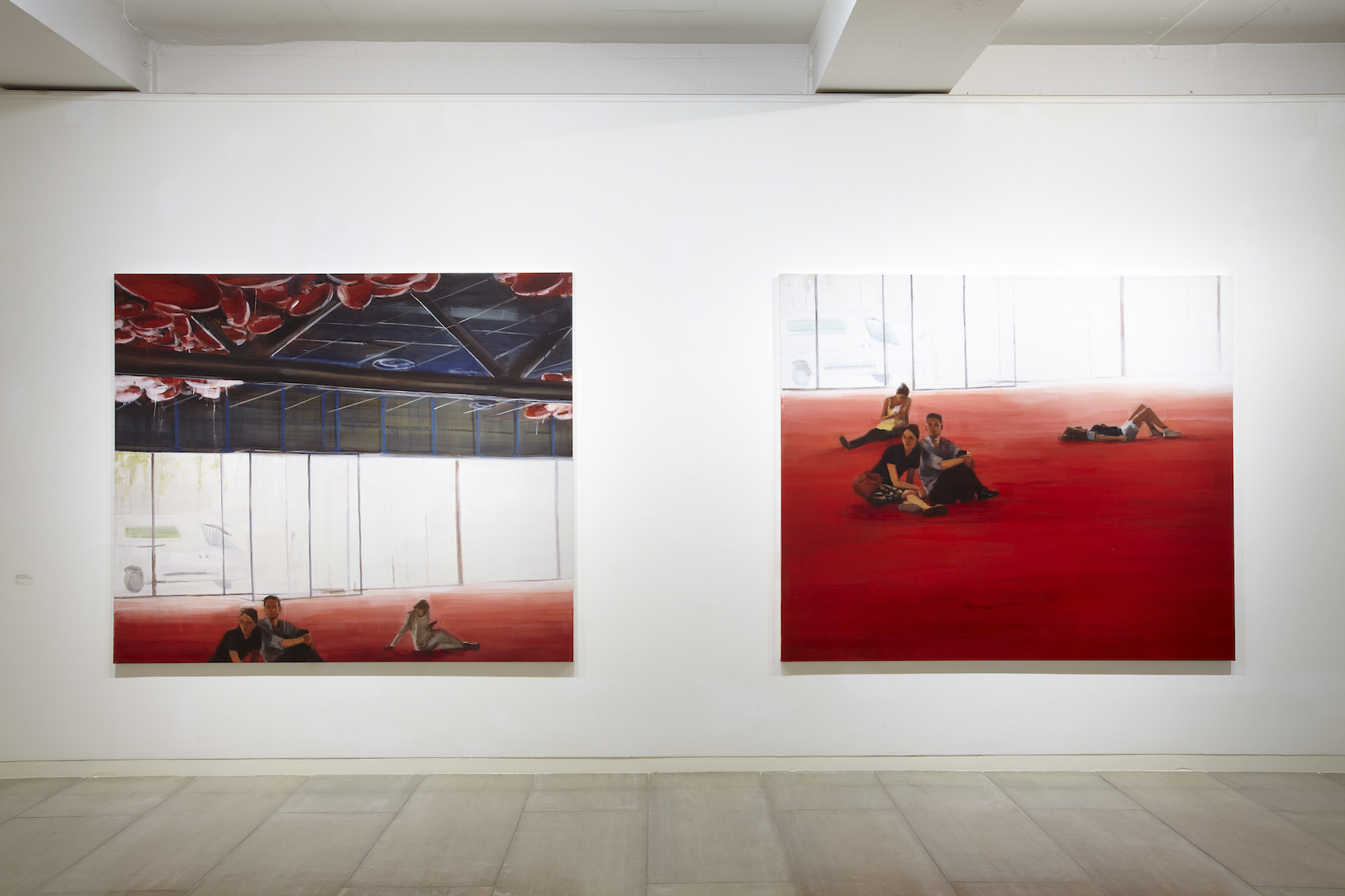
2: How Are the Subjects Represented : What
can you see about the subjects? The tracks of brush strokes passing across
swiftly on the canvas do not depict every detail of the subjects but represent
them only suggestively. The subjects are settled on the canvas
somewhat awkwardly. The viewers’ eyes that could be directed to the represented
subjects themselves are instead captured by the traces of the
brushes. Nevertheless, the subjects are not reduced to meaningless
things. While it is true that the subjects are not described in
detail, the rapidly running brush strokes act to catch momentary memories and
feelings. The colors and tones created by the multiple layers of
paint and the composition of the paintings represent the subjects in a simple
and more distinct manner. What are most important are the eyes of
the artist. The painter keeps an objective and psychological distance from the
subjects. She occupies the standpoint of a sheer observer almost as a voyeur
even though she paints her acquaintances. Those who are in the
picture planes do not make eye contact amongst themselves. They, as
individuals, are just devoted to doing their own things which are in no way
special. While lively and clamorous spaces are packed with people, the figures
in the space, the people she spends time with, are separated from one another
like lonely islands. Thus, the artist does not focus on each of the subjects or
the relations between them but rather the emotional and psychological
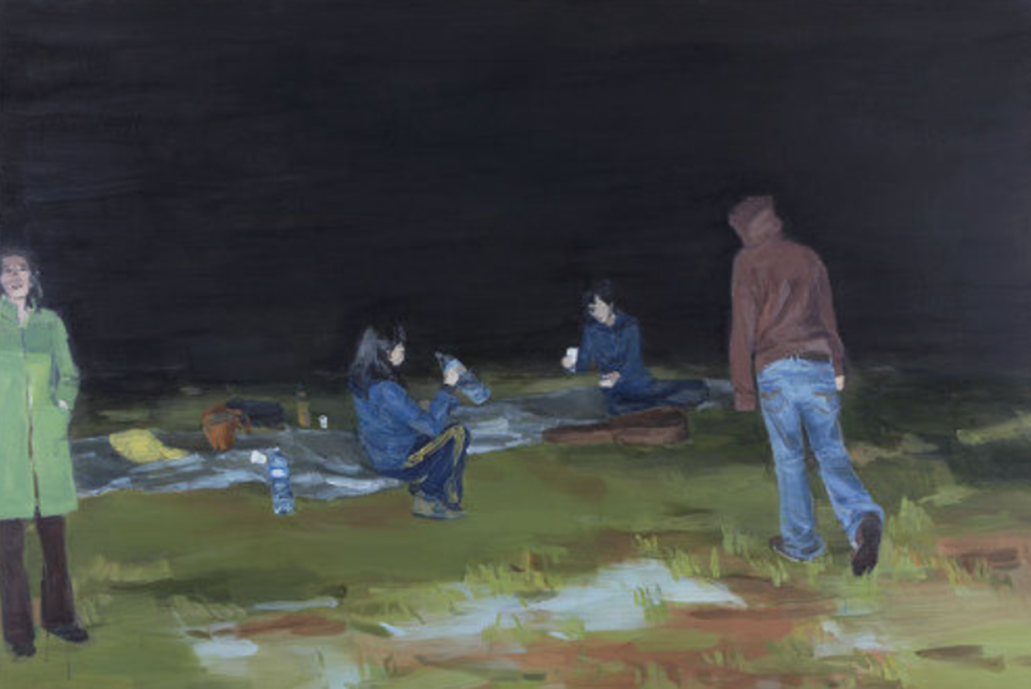
sentimentality created by them. [This is most obviously shown by the Moontan series.
A group of people are doing the same thing in the same place, but their
activities are not unified as one. The word ‘same’
becomes ‘different’ or ‘individual.’ At the same time, what the
artist depicts is not the subjects she paints (i.e. she is not trying to
describe them) but what is outside of them and what she creates is then
diffused back to include the subjects that are depicted.]
EAT, SLEEP, HAVE VISIONS.
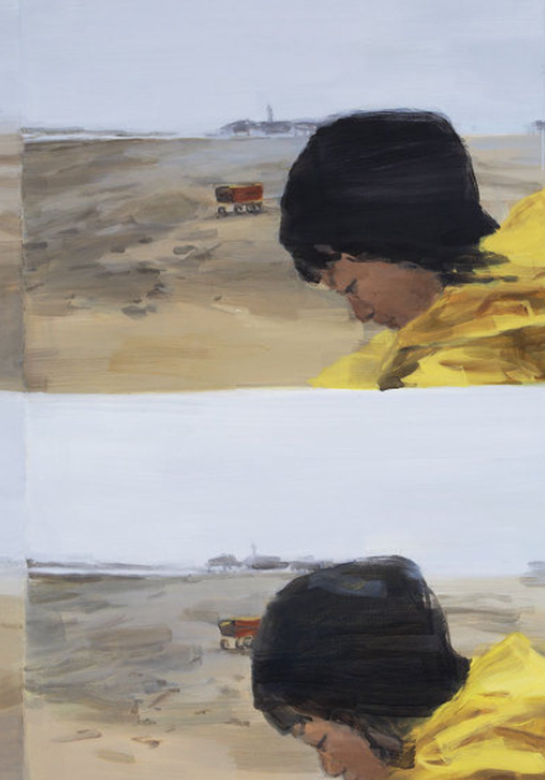
The notions of both ‘what to represent’ and ‘how to represent’
have been constant throughout Park’s earlier work, If there appears a change in
this show it is that the divided picture plane moves to a unified one but there
is more significance than the fact that two or four pictures planes are merged
into one. As is implied by the titles of her past solo
shows, “Leisure” and “Excursion,” the artist has worked on
those trivial actions found in a social system that lauds productivity. These
behaviors are particularly exemplified by the figures’ delicate motions on
the canvases. The similar but different four picture planes are suited for
expressing not only the temporal difference but also the pictorial one through
simple composition and brush work. They are one, but simultaneously,
they are not for the subtle differences in both time and the pictures
themselves.
The divided picture plane is fused into one in the Moontan series.
As is suggested by a mat spread in the center, the figures are gathered here
for one purpose. However, Park presents them lacking unity: they are scattered
and respectively immersed in their own trivial activities. The minute
differences found in the divided picture plane are combined in the same picture
through different figures. Accordingly, they cannot gather on the mat in the
center but hang around it irrespective of their intent to be there. [The dark
background occupying the large part of the series has another meaning. It makes
the viewer focus on the situation by cutting off the periphery of the canvas.
As the figures exist individually and off-center, the space is presented as
isolated, floating, and disconnected from the whole].
In this exhibition, Park chooses only some particular activities
and more crowded places. People should meet, talk, smile, and make connections
in these spaces but the subjects in Park’s paintings deviate from time and
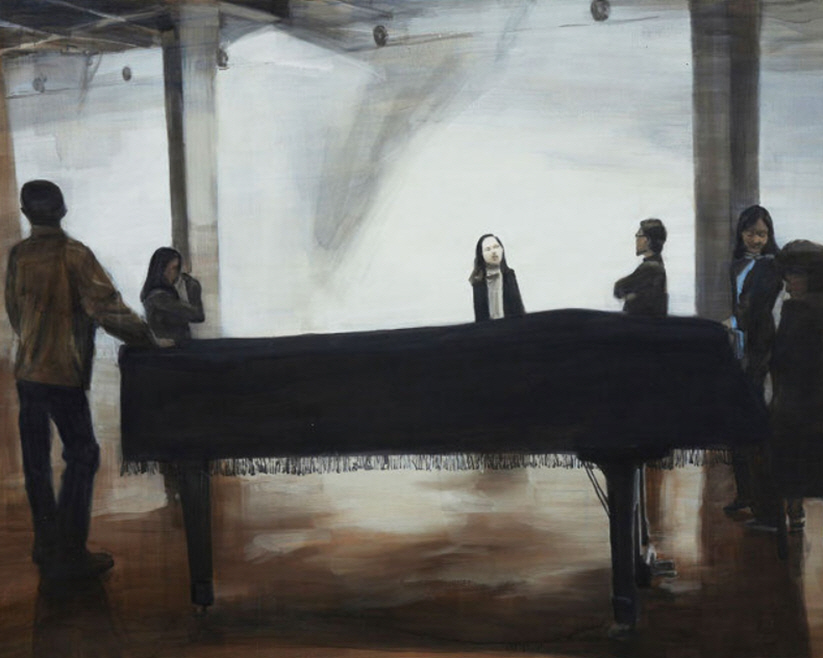
space while engaged in their activities. In the work Everybody’s
Leaving, when the viewers’ eyes travel along the big table
in the center they meet the moment when the figure in the middle is on the
brink of eating something. Considering the situation, the room that had
previously been filled with many people seems to have just been emptied: there
are no people but only the traces of them. All situational aspects are missing
and only the figure’s act of eating is emphasized. The space of deviation from
the everyday life intersects this most visceral activity. In the work Sleeping
at the Corner, a figure who has fallen asleep is leaning back in
the chair and also seems isolated from the party. Though placed in the center,
the figure is sleeping in a space where the party is undoubtedly being
held. This type of figure who is out of place is also found in the
work Man eating Pizza Under a Persimmon Tree.
The subject is eating pizza in great haste and the combination of the persimmon
tree and pizza is unfamiliar. In a way, the man is out of place where people
eat pizza. Unlike the figures in other paintings, the subjects who inhabit the
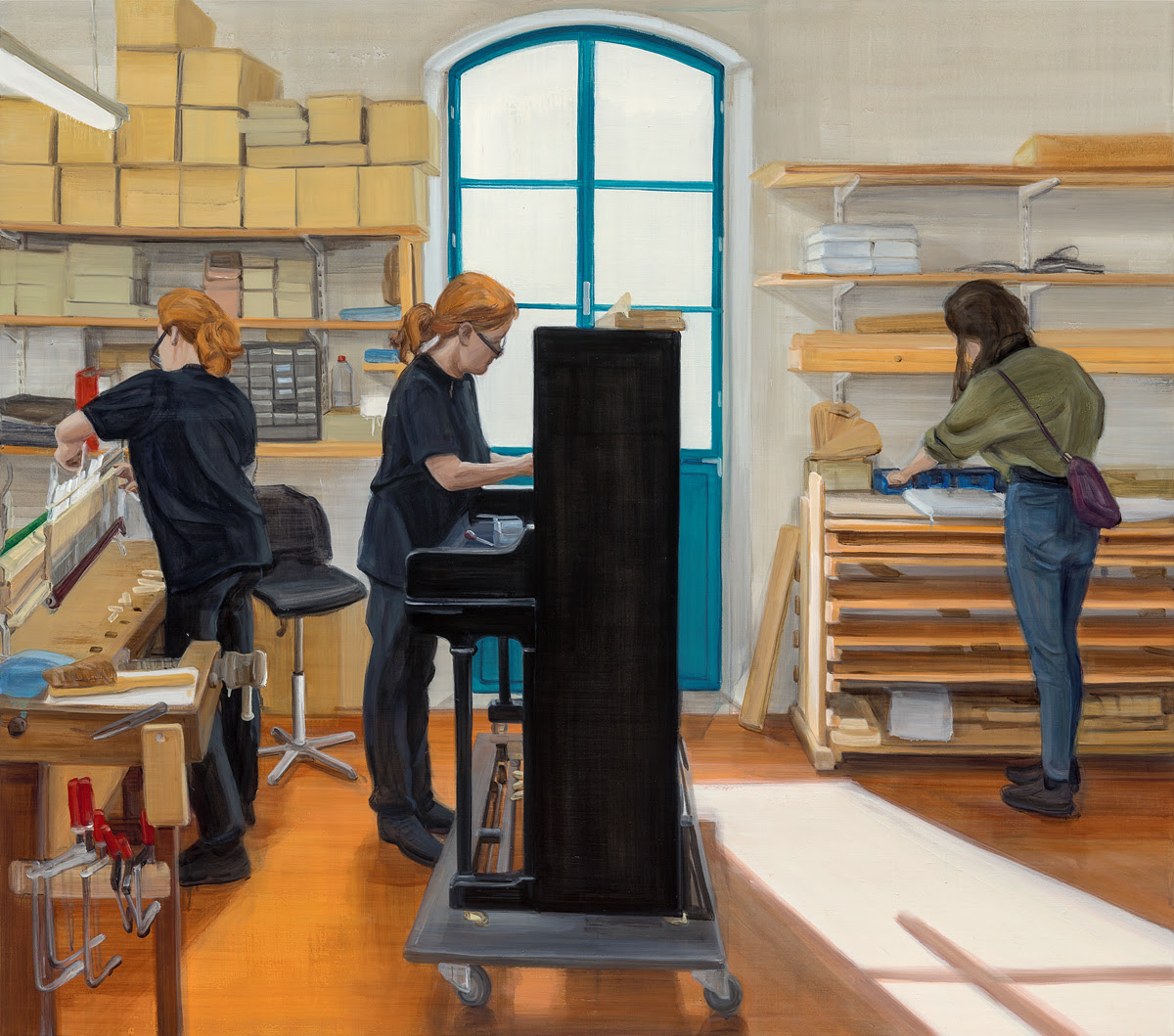
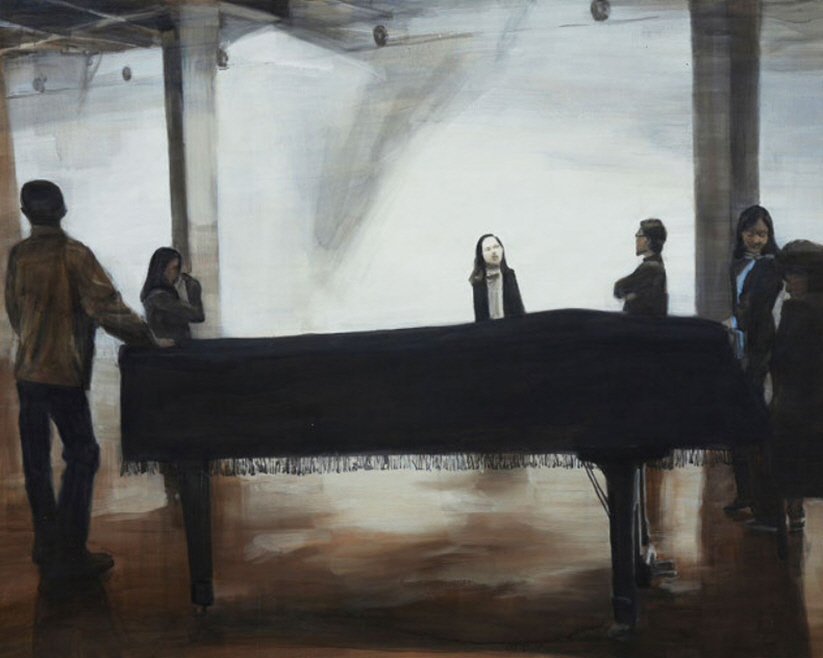
works Projector Test and Grand
Piano are together engaged in an activity and even their
eyes meet or go in the same direction. However, they are overwhelmed by the
space. Previously, Park has given weight more to figures than to space and to
the behaviors than to the figures. In these two works, space overpowers figures
and their acts. The blue light of the projector and the grand piano lying in
the center like a coffin create the atmosphere of the whole space.
Jina Park paints moments of everyday life. Thus, they can be
easily found by us who live in the same age. However, those moments do not stop
as personal ones, but have lingering effects on the viewers. The reason for
this is that the artist does not focus on “what to represent” but
on “how to represent.” Park presents the most routine moments yet the
viewer is unsettled by the provocation caused by the deviation from the common
norms of perception to which he is accustomed. Might these moments
be the only moments when the everyday reality of man reveals itself?