In the Name of History
“How
do you remember the scent of your city or hometown? Koo Jeong A is collecting
Korea’s scent memories.”
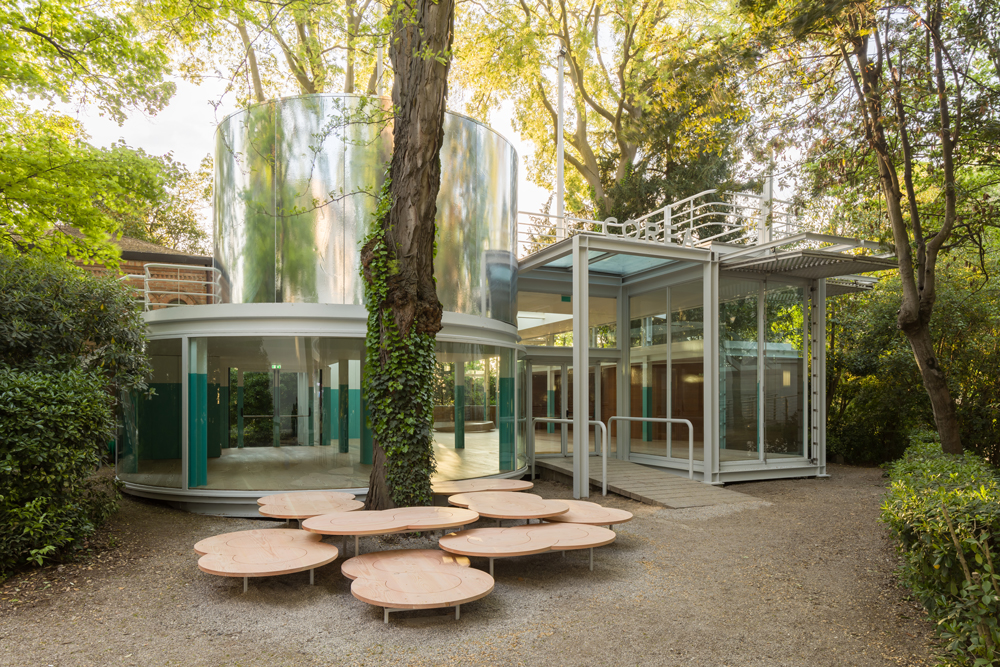
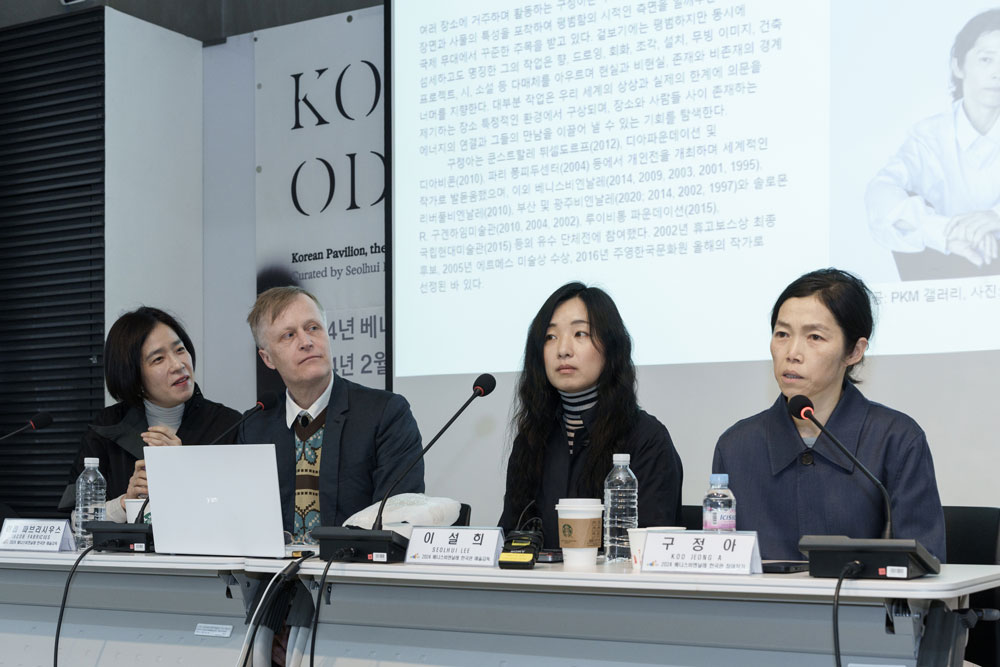
Ahead of the Korean Pavilion exhibition at the 2024 Venice Biennale, Koo Jeong
A—selected as the representative artist—together with co-artistic directors
Seolhee Lee and Jacob Fabricius, launched an open call inviting anyone to share
memories connected to scent. One participant recorded the smell of coal and
goat milk once encountered in South Hamgyong Province before division; another
recalled the scent lingering inside a traditional mother-of-pearl cabinet,
where fabric bedding and naphthalene subtly mingled.
The participants’ places
of origin extended beyond Korea to North Korea, Japan, Singapore, Croatia, and
beyond. Over the course of several months, more than 600 heterogeneous “scent
memories” were gathered without restrictions of nationality, residence, or
generation, and dispersed throughout the exhibition space under the
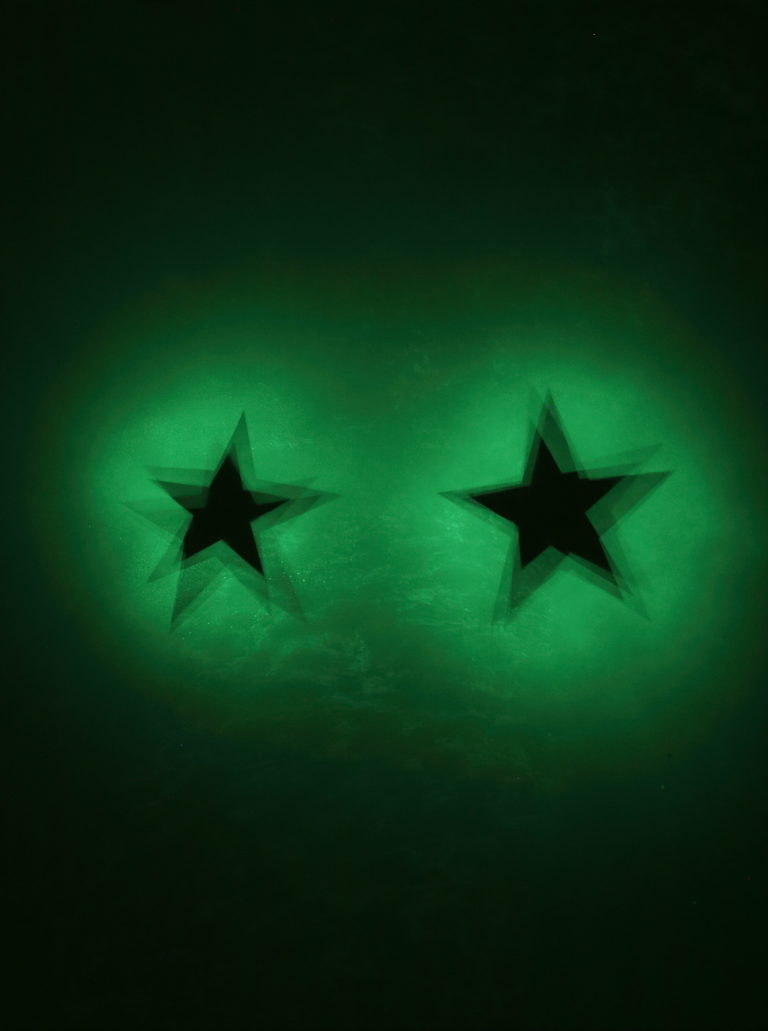
title ‘Odorama Cities’. Koo Jeong A, who has long interwoven diverse sensations
from everyday imagery with delicacy, once again expanded the domain of
perception at this biennale, firing a signal flare into a spacetime of gaps and
absences.
The
artist’s synesthetic experimentation dates back to the mid-1990s. After various
trials, the work Odorama(2016), presented at Charing
Cross Station in London, can be interpreted as a prequel to the current
exhibition. The term “odorama,” a neologism combining “odor” and “rama,” plays
a central role once again in the Korean Pavilion exhibition. In the abandoned
subway platform where scent and light once transparently blossomed, the work
now intersects with countless private experiences gathered in 2024, assuming an
unprecedented form. In short, this is an instance in which a social space
constructed from human experience becomes realized as physical space.
Furthermore, the texts accumulated from others’ memories function not merely as
raw responses but as materials for editing and translation. Through
collaboration with the Korean brand Nonfiction, scent keywords were selected:
city, night, people, Seoul, salty smell, hydrangea, sunlight, fog, wood,
earthenware jars, rice, firewood, grandparents’ home, fish market, public
bathhouse, old electronic devices. These individual voices—drawn from
explorations of long-inhabited land—were classified by city, year, and keyword,
sustaining the exhibition as sixteen scents that compress Korea’s modern and
contemporary history into olfactory form: the scent of dawn sea mist, the smell
of rice cooking in an old hanok, exhaust fumes mingled with asphalt, and more.
Scent Infinitely Differentiated
Meanwhile,
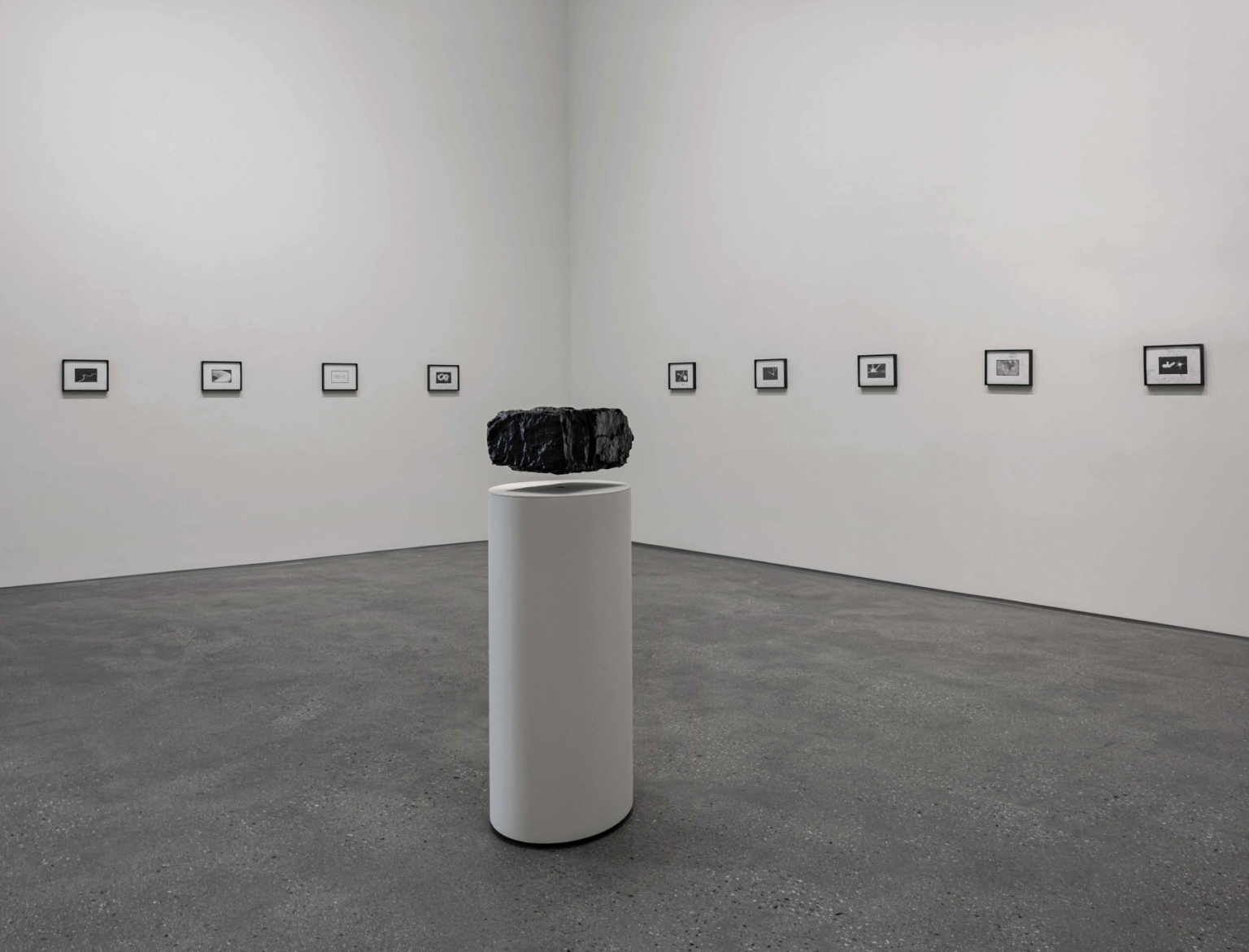
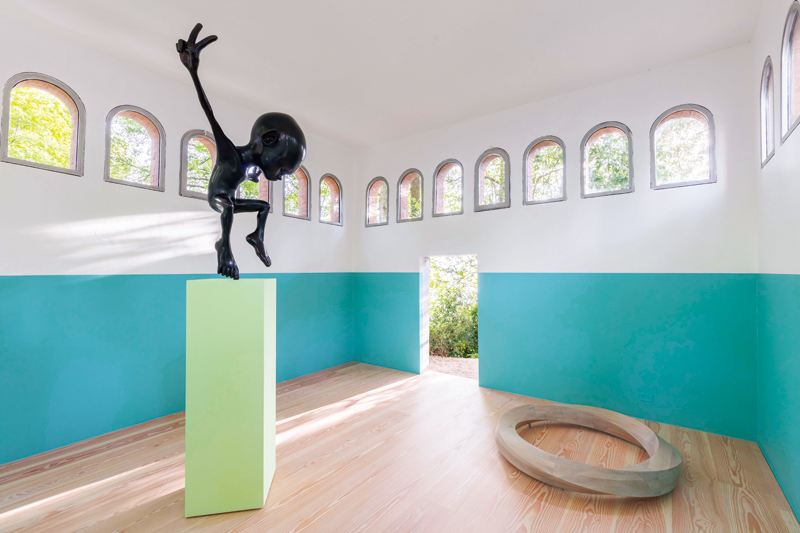
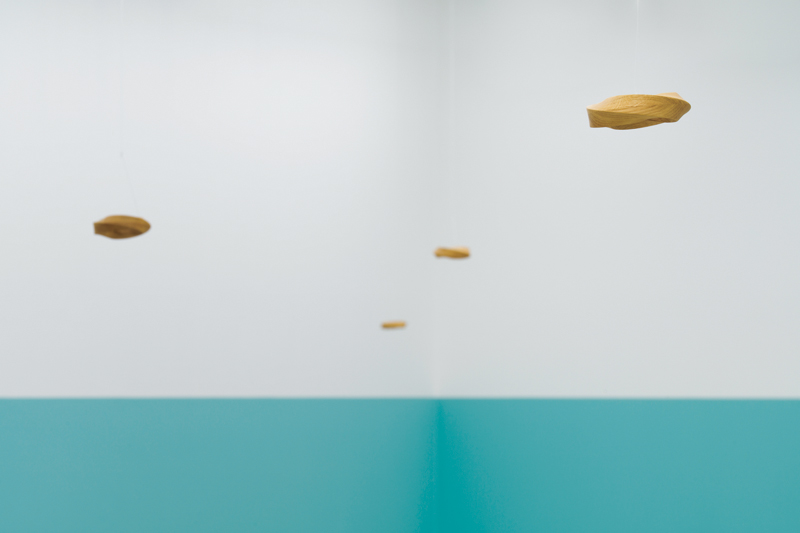
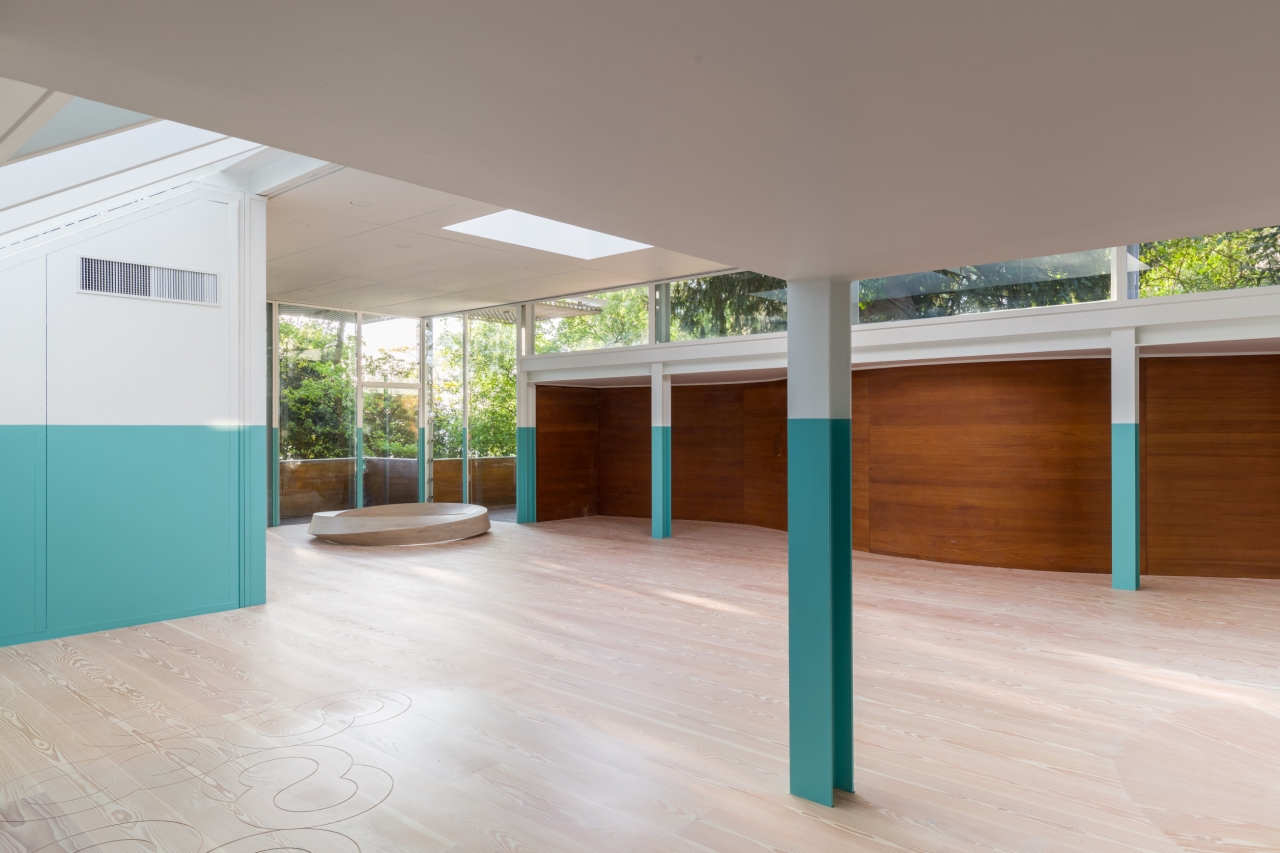
wooden sculptures placed inside and outside the exhibition space in the form of
Möbius strips—such as OCV DIFFERENTIAL PEFS(2024)—and
the floor pattern OCV COLLECTIVE SFEP(2024) serve as
foreshadowing devices for a broader historical portrait. The recurring infinity
motif encountered throughout the exhibition becomes a unifying theme that
recalls Ousss, a concept coined by Koo Jeong A. Appearing since 1998 as a
mutable entity traversing various domains, Ousss is both a living
being and the world itself.
Although it lacks a clearly visible form, its
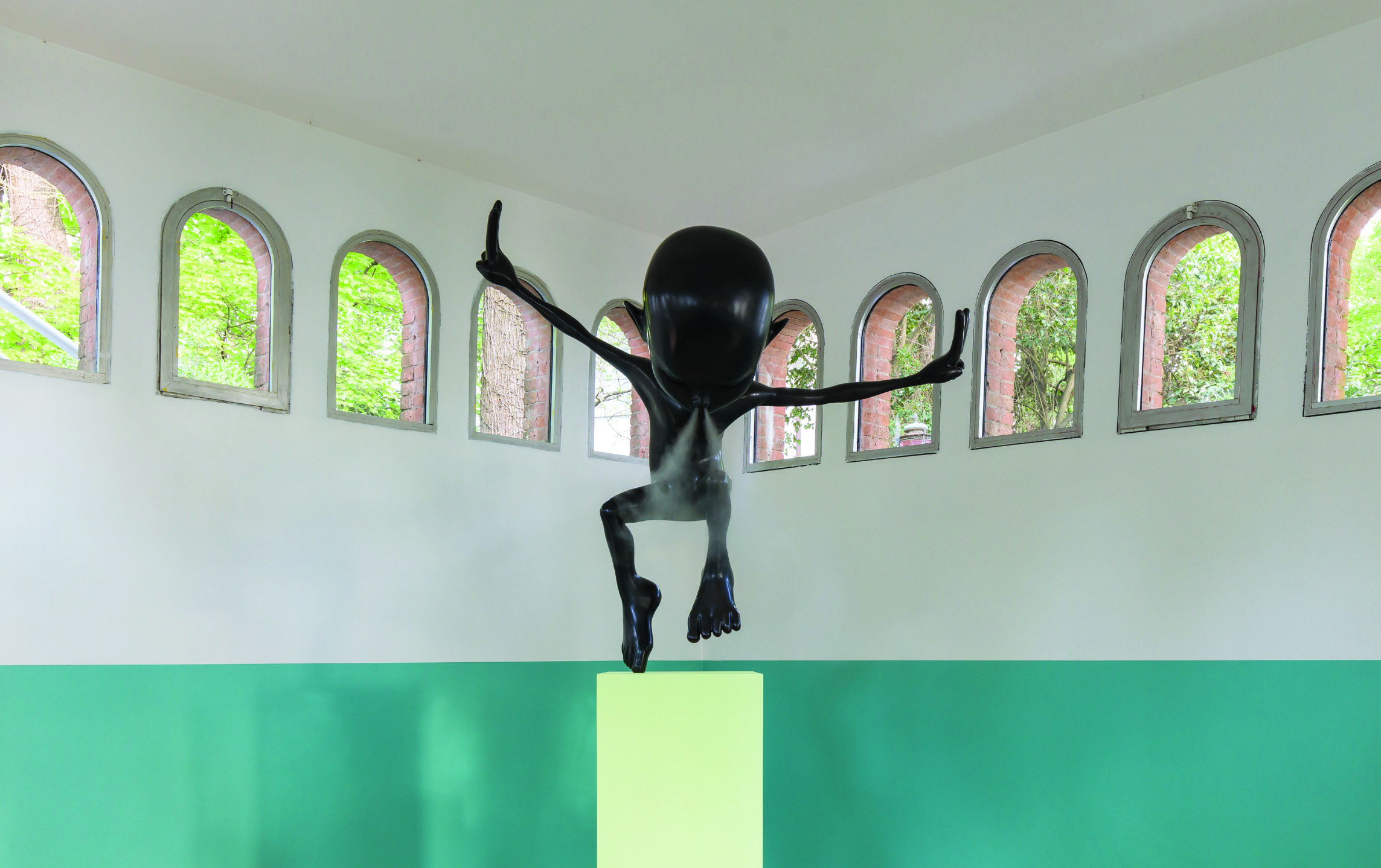
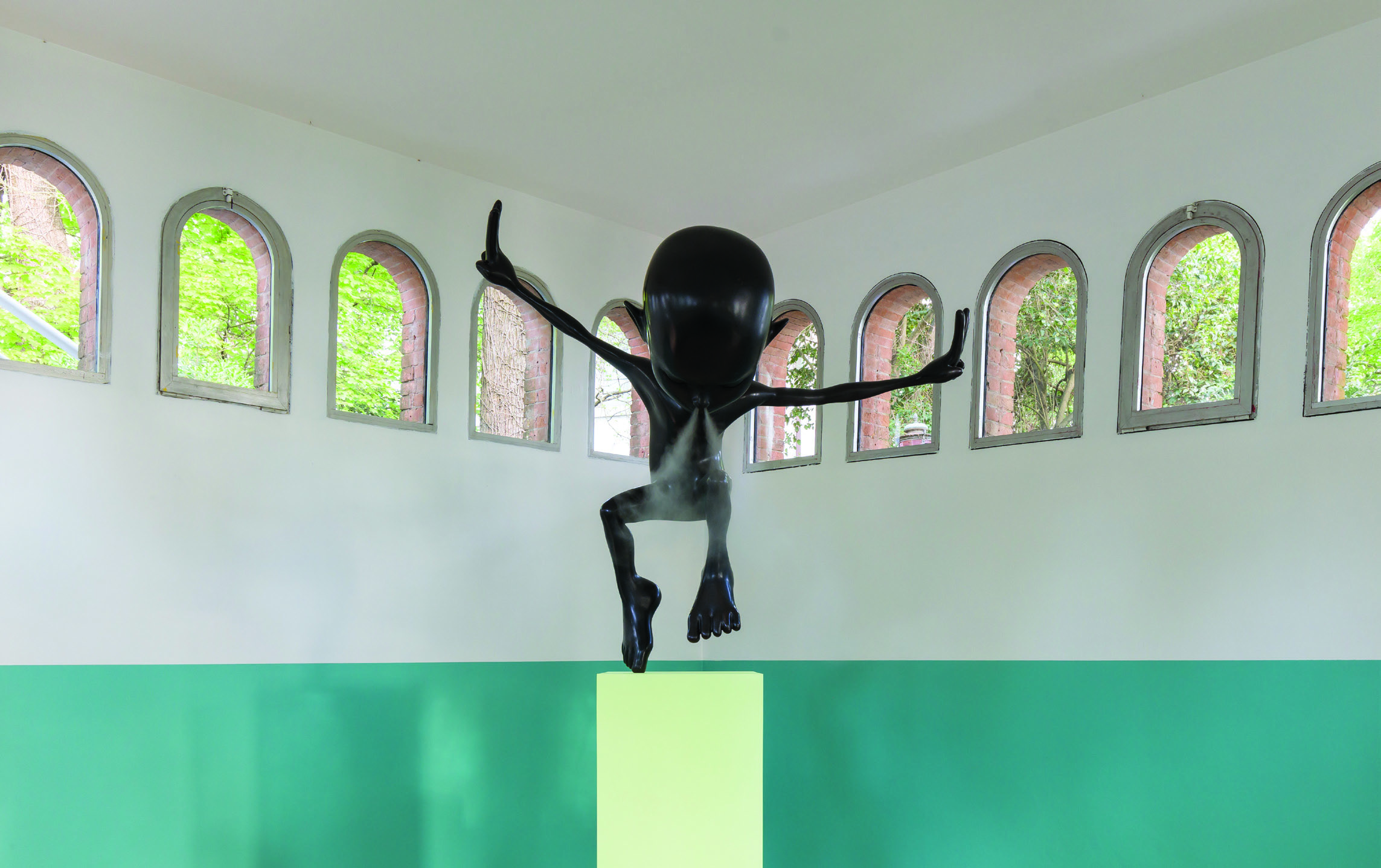
existence is unmistakable. In this exhibition, Ousss materializes
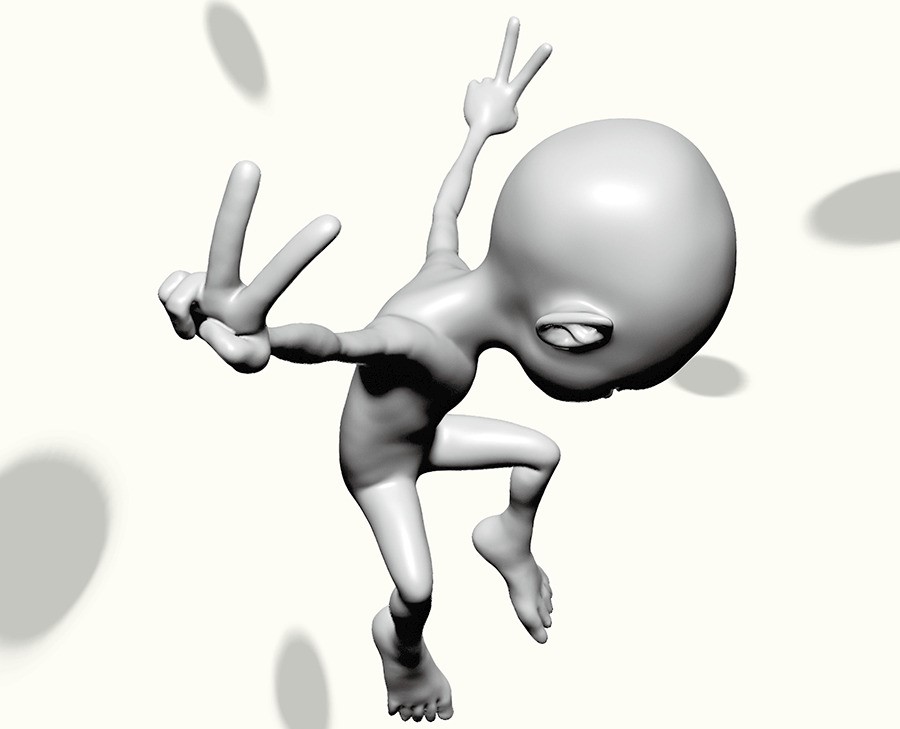
as KANGSE SpSt(2024), a neutral posthuman statue and
diffuser sculpture. Appearing as if it had just flown in and arrived at the
Korean Pavilion, its cartoon-like presence evokes a certain playful humor. The
vapor it exhales from its nose—another olfactory composition made from extracts
such as sandalwood and eucalyptus—overlaps with the foliage visible beyond the
windows, creating a distinctive olfactory experience.¹
In
addition, the sixteen core scents of the exhibition, [OCV RC
1–16] REMOTELY CONNECTED(2024), perform acrobatics in unseen spaces.
Rather than enumerating objects, Koo Jeong A chose to “hide” the scents behind
columns or near ceilings—places that are relatively inconspicuous. Scattered
like an archipelago across the cardinal directions, these unsealed scents
lightly moisten the nose within an open space. The Korean Pavilion website,
accessible via QR codes inside the exhibition, includes a scent index that
functions as a guide. However, identifying specific scents is nearly
impossible.
This appears to be an intentional design, refusing to limit the
imagination of Korea to fixed parameters. Yet the absence of detailed
information about each scent causes the pathways of thought taken by individual
viewers to diverge. Considering the site-specific context of a national
pavilion at a biennale, the historical background implicitly presupposed by the
exhibition—such as modern Korean history—may not apply to non-Korean audiences.
Blaise Pascal once remarked on the “immeasurability” of space: “The eternal
silence of these infinite spaces frightens me.”² For similar reasons, the space
in which scent molecules drift and endlessly expand may remain an unknowable
object, gradually moving beyond the realm of anyone’s experience.
From Gas as Atmosphere to Ground
Can
this olfactory landscape thus formed become a complete mirror of Korea? Koo
Jeong A’s artist statement—“lives and works everywhere,” without reliance on
any specific region—functions both as a manifesto³ and as a concise response to
this question. Here, where borders of nation, generation, and identity quietly
subside, an immaterial portrait of the Korean Peninsula emerges. Yet this
portrait is also an unfinished abstraction. Rather, the artist’s attempt
paradoxically emphasizes that even when traversing Korea’s long history, a work
that fully represents a nation can never be completed.
One might surmise that
the artist’s transnational stance—dismantling the geographic category of the
peninsula through sensation—aligns with an intention to neutralize the
exclusive and modern system of the “national pavilion” at the Venice Biennale.
This does not signify the end of the nation-state, but the once-solid notion of
locality is renegotiated here daily. Perhaps, as Peter Handke wrote
in Offending the Audience(1966), boundaries may neither collapse nor be
crossed—or may never have existed at all. This resonates precisely with the
overarching theme of this year’s biennale: “Foreigners Everywhere.”
On
the way out of the Korean Pavilion, visitors once again encounter foliage.
Sunlight flowing through the open doorway and wind that has traveled across the
northeastern Italian sea slowly erase the traces of scent. Yet the dense forest
aroma encountered near the exit continues strangely into the Giardini park
itself. The boundary between inside and outside—once believed to be
definitive—proves indistinct. In this way, the gaseous mixture of inner and
outer scents becomes the underlying medium supporting the exhibition as a
whole, rewriting the place called the Korean Pavilion.
Each time viewers pass
through, the exhibition halts them momentarily, breathing time into which fixed
concepts may be dismantled. Thus, the space presented by Koo Jeong A this year
is no more than a temporary station. Where, then, does the invisible entity
beyond territory—the one the artist speaks of—lead us? Gazing toward a place
long out of reach, we can only set one foot each at the starting lines of the
poetic world and the real world, awaiting another conversation.
Notes
1.
The fact that Nonfiction sells a perfume titled Odorama City Eau de
Parfum for KRW 258,000 also exemplifies the commercialization of
contemporary art through brand partnerships. As Jeong Jun-mo has asked, is the
biennale a “war of money” and a “festival of luxury brands”?
2.
Markus Schroer, Space, Place, and Boundary, trans. Jung In-mo and Bae
Jung-hee, Ecorivres, 2010, pp. 10–11.
3.
Stephanie Bailey, “At the Venice Biennale, immerse yourself in the evocative
scents of Korea,” Art Basel, 2024.