I. The Emergence of “New Generation” Art in the 1990s and Its
Background
When discussing Yongbaek Lee, the first thing that comes to mind
is the so-called emergence of the “New Generation.” The discourse surrounding
the “New Generation,” represented by the “Museum” group in 1987, coincided with
the full-scale appearance of postmodernism in the Korean art scene after the
war, forming the starting point for discussions on New Generation art. Yongbaek
Lee, more precisely, belongs to a similar generation as members of the “Museum”
group—Go Nak-beom, Noh Kyung-ae, Myung Hye-kyung, Lee Bul, Jung Seung, Choi
Jeong-hwa, Hong Sung-min, among others—and is connected to them as seniors and
juniors from the College of Fine Arts at Hongik University.
Thus, rather than
there being an aesthetic rupture between the early-1960s-born “Museum” members
and the mid-1960s-born “Golden Apple” members, it would be more accurate to say
that a shared sensibility was formed between them. In an interview, Lee
revealed that the “Golden Apple” group—comprising Lee Ki-bum, Park Ki-hyun,
Baek Kwang-hyun, Baek Jong-sung, Yoon Gap-yong, Lee Sang-yoon, Yongbaek Lee,
Jang Hyung-jin, Jung Jae-young, Hong Dong-hee, and others—had already begun to
take shape around 1987. Although the group officially debuted in 1990 at
Kwanhun Gallery, this indicates that its formative signs were evident even
earlier.
In my essay “New Generation Art: The Imagination of Rebellion,” I
examined the art-historical significance of these two groups. What was referred
to as “New Generation,” “X Generation,” or “Apgujeong Culture” represented
postmodernist art. In that text, I argued that the postmodern art represented
by these groups was aesthetically distinct from the previous generation, and I
elaborated on its characteristics.
To quote a key passage: “At least within the trajectory of Korean
contemporary art since the 1970s, the status and aesthetic qualities of these
New Generation artists lie in their adoption of creative methodologies capable
of transcending the polarized confrontation between modernism and Minjung art
that dominated from the 1970s to the mid-1980s. They paid attention to various
media such as performance, computers, multimedia, print, technology, and kitsch
objects. By focusing on the characteristics of media and treating it as a
singular tool for expressing self-consciousness, their discourse began with a
claim for de-ideologization.”
As another experimental group of the time, “Sub Club,” described
the art scene of the 1980s as “black-and-white television,” the “Golden Apple”
manifesto similarly described the ideological conflicts of the period as
“embracing contradictions in which coexistence of diversity and internally
divided extremes were embedded.” At the center of this was Yongbaek Lee. Among
the more than ten members of “Golden Apple,” he has uniquely secured a firm
position as one of the most active and provocative artists today. While many of
his contemporaries dispersed, abandoned painting, or focused primarily on
painting, Lee has immersed himself in artistic experimentation, encompassing
media art as well as painting, sculpture, installation, photography, objects,
and performance.
II. Study in Germany, Wandering, and Spiritual Maturity
After organizing several curated exhibitions centered around the
“Golden Apple” group in the early 1990s, Lee left for Germany to study abroad.
He returned in 1996, about a year before Korea was struck by the unprecedented
IMF crisis. Before leaving Korea, he wandered within the rigid social structure
and dichotomous ideological confrontations characteristic of Korean society, as
well as within the suffocating atmosphere of academia. In Germany, however, he
experienced a form of spiritual relief. Through encountering major exhibitions
by Joseph Beuys, Nam June Paik, Bill Viola, Bruce Nauman, and others, Lee
rearmed himself intellectually.
This European art scene experience became an
important turning point in his growth into the promising media artist he is
today in his mid-forties. In various interviews, he has stated that his
experiences in Germany were crucial in allowing him to be reborn as an artist.
This was the result of long contemplation on the relationship between
interiority and exteriority surrounding his place in the world. Reading Lee’s
interviews and writings, one frequently encounters clear insight and in-depth
analysis of social phenomena and the art world. This forms the solid
theoretical foundation underlying his works.
Lee carries a psychological “trauma” rooted in the rigidity of
Korean society caused by ideological conflicts. While this psychological trait
is not unique to his generation but shared with earlier ones, he internalized
it and consciously attempted to maintain critical distance. In one interview,
he recalled that during his university years, his mother repeatedly told him
not to participate in demonstrations. For the artist, society—like a mother’s
womb—is the matrix from which artworks are born. Even in art, the purest formal
experiment carries a paradoxical social dimension precisely because social
relations appear to be erased.
In 1996, shortly after returning from Germany, Lee held his first
solo exhibition in 1999 at Sungkok Art Museum. To fill the vast 240-pyeong
(approximately 793 square meters) space, six truckloads of works were
transported. Yet the exhibition was met with a strangely indifferent art scene
and critical silence, and at one point he fell into deep disappointment. Centered
on installation and interactive media art—clearly a new attempt within the
Korean art scene at the time—the exhibition and subsequent presentations were
largely ignored domestically. This indifference seems to have led Lee to
develop a certain distrust toward criticism.
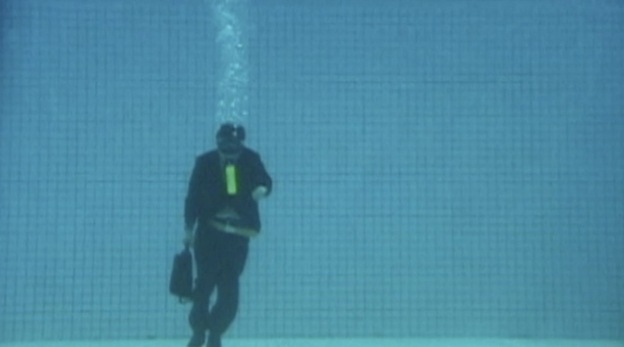
In 2002, Lee presented Vaporized Things (2-channel
video installation, 7 minutes), a performance work based on the wandering
condition of young Korean office workers during the IMF crisis. In this piece,
a man dressed in a suit, with a compressed air tank in his mouth, appears in a
swimming pool filled with water, delivering a social statement. In this
performance, the performer—symbolizing a laid-off worker—wears black swimming
goggles and carries a black briefcase while advancing forward with a yellow
oxygen tank in his mouth.
An underwater camera records this simple action of
moving forward against the pressure of water from multiple angles—left, right,
front, back, and above. Although the action consists merely of slowly walking
from one end of the pool to the other, its symbolic resonance was immense
precisely because of its simplicity. It is an outstanding work that captures
the anguish and conflict of an intellectual confronting the unprecedented IMF
crisis in Korean society. In particular, the yellow belt strapped around the
performer’s waist—resembling a bomb—creates an ominous impression and functions
as a powerful symbol of a “self-destructive society.”
Despite the continued critical silence from the mid-to-late 1990s
through the early 2000s, Lee steadily conceived and presented new works,
demonstrating remarkable perseverance. In this sense, Lee can clearly be
described as a “media-expansive” artist. Rather than indulging in media
experimentation for its own sake, he is a media-utilizing artist who remains
unconcerned with medium or genre so long as it serves the realization of his
ideas within an open consciousness. The fact that he turns not only to media
art but also to traditional genres such as painting and sculpture when
necessary makes this point evident. Even in these cases, however, his
experimental attitude is clearly present.
III. A Period of Challenge and Experimentation: Activities Since
2000
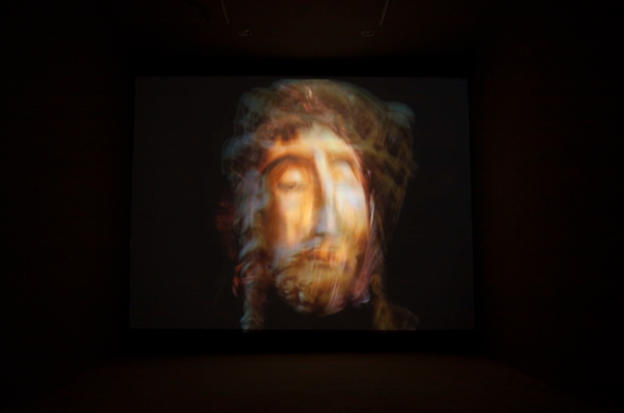
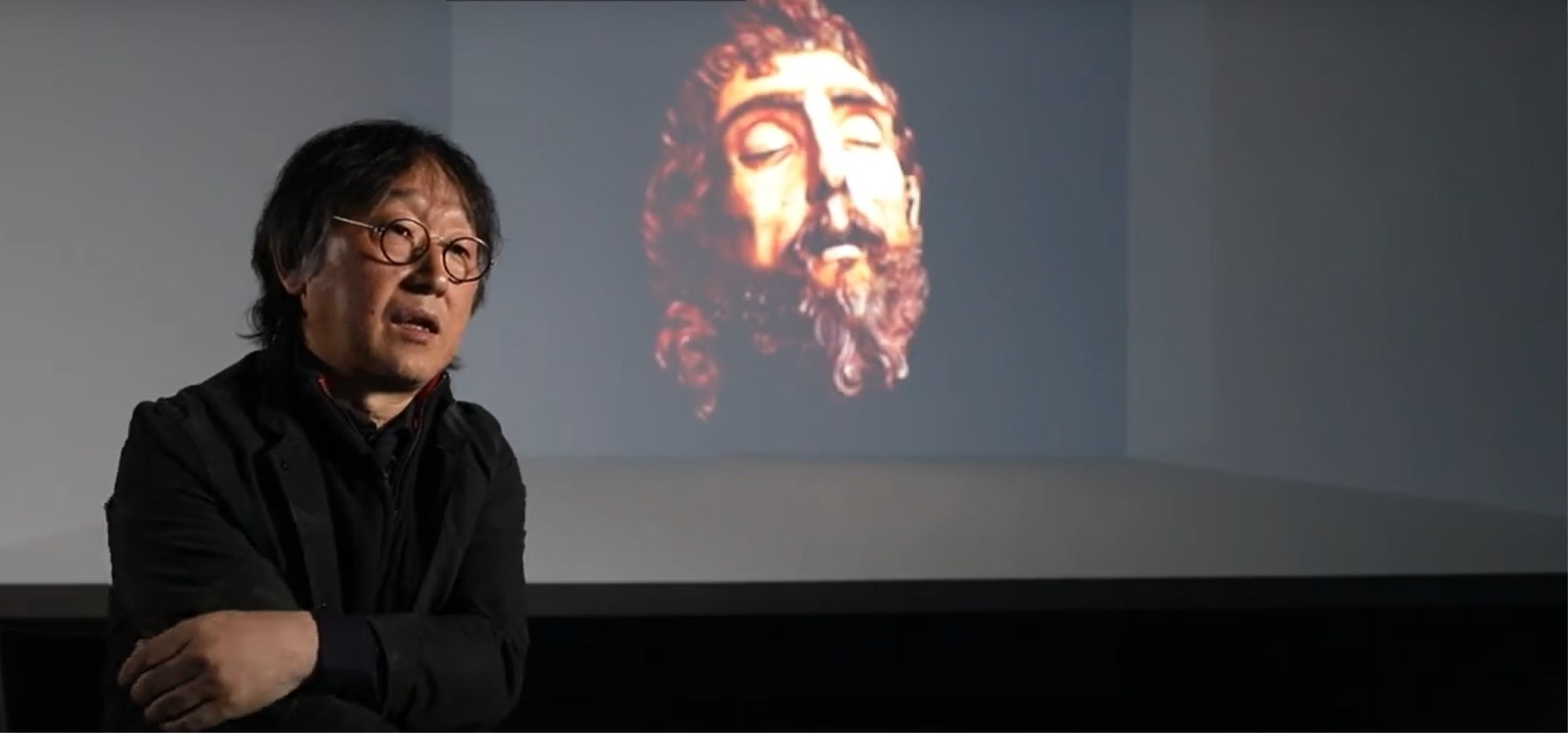
Jesus–Buddha (1994–2000, single-channel
video, 5 minutes) is a work originally produced in 1993 and remade in 2002. The
piece was created using a morphing technique, transforming various still images
of the suffering, bleeding Christ into smiling images of the Buddha. Lee
photographed images of Jesus and Buddha from different eras and countries and
digitally composited countless photographs through computer processing. The
result is a gradually shifting, androgynous figure that transforms from Christ
into Buddha. After completing the video image, Lee deleted the original still
images.
He considers this act extremely important because what the audience
sees is neither Jesus nor Buddha, but a “digitized simulation.” What, then, is
a digitized simulation? Is it not a question posed to the fixed, stereotypical
image of saints? Rather than presenting taxidermied, static representations of
Jesus or Buddha, the work evokes a more human figure—one who struggles,
breathes, and possesses emotion. In other words, through computer compositing
technology, Lee has realized an image of a saint that is fundamentally human.
Another work that attempts interaction between artwork and viewer
is Artificial Emotion (2000, ASTA). This
five-channel interactive installation centers on a dialogue between a
taxidermied cow and the audience. Of course, this “dialogue” is not direct
speech between cow and human. In the center of the exhibition space lies a
stuffed cow on a platform, and opposite it stands a sculptural structure
equipped with five respirators. A motor is installed in the cow’s chest bone, a
balloon in its abdomen, and stepping motors in its eyes, allowing it to move
when stimulated.
The work is designed so that when viewers breathe into the
respirators, the connected devices activate different parts of the cow’s body
in response. Through this experiment of granting life to a dead object, the
piece foregrounds a participatory dimension of art. As introduced earlier, for Yongbaek
Lee, the remnants of military culture function as an inerasable scar—an
enduring theme that follows him persistently. In one interview, he mentioned
that when he went to Germany, his European friends often struggled to find
subject matter, whereas he, having grown up in ever-changing Korea, always felt
confident in the abundance of material available to him.
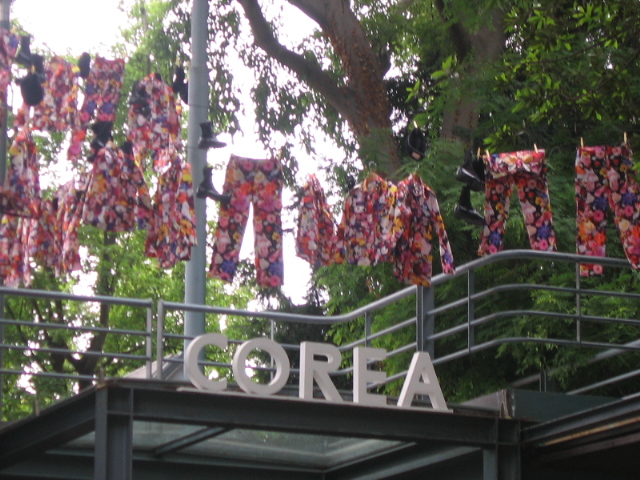
Angel-Soldier is a work born from a Korean
society shaped by military culture. The image of the soldier, which the
artist—born in 1966—encountered throughout his childhood and youth, runs deeply
through the foundation of this work. As the word “angel” implies, he envisions
a society in which people can love and care for one another. He has stated that
the work begins from the hypothesis, “What if the entire world were flowers?” The
contrapuntal relationship between the seemingly incompatible words “angel” and
“soldier” thus takes as its central strategy the subversion of meaning. Presented
in 2005, Angel-Soldier is a major work that
mobilizes diverse media—including single-channel video, digital photography,
objects, and performance—and it served as the pivotal piece that brought Lee’s
presence to prominence in the art world.
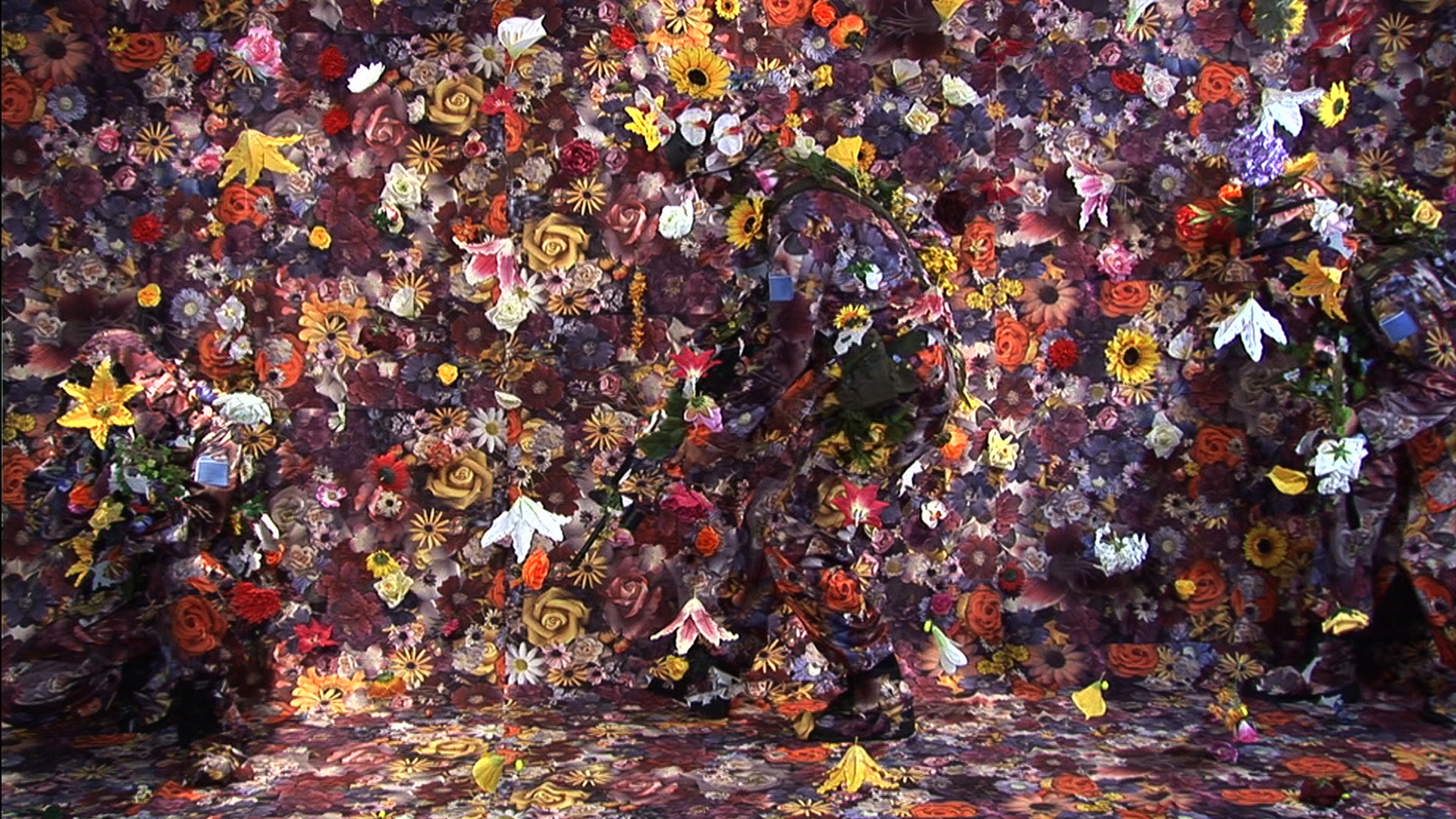
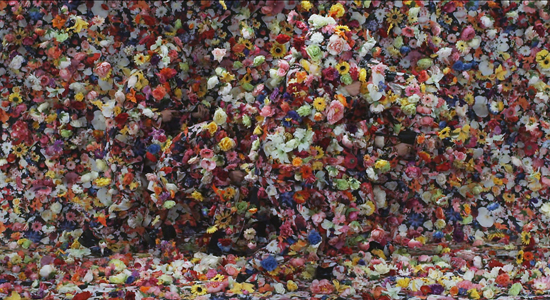
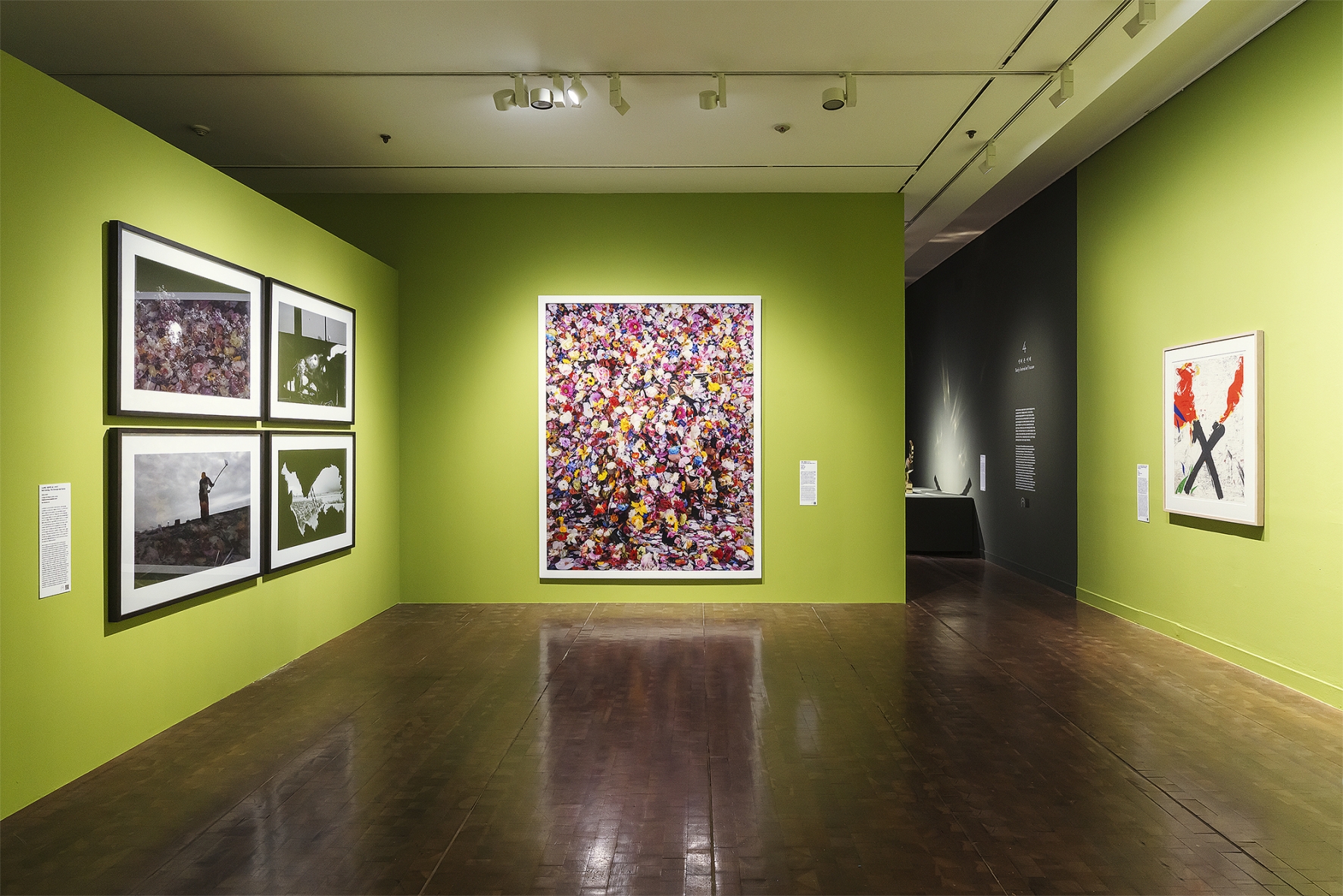
Let us first examine the performance. Filmed underwater in a large
swimming pool, the background is decorated with various flowers. Against walls
completely covered with dazzling piles of blossoms, soldiers disguised in
floral camouflage uniforms slowly emerge and walk forward. Appearing one by one
on screen, the soldiers line up in formation, gazing ahead in a vigilant
stance. Even the rifles they hold are covered in flowers.
In an interview, Lee once mentioned that highly skilled young
hackers sometimes enter corporations to build firewalls for company computers,
and such figures are called “angels.” He learned this from a friend. This work,
which attempts to transform the strong, masculine, and aggressive image of the
soldier into a friendly, feminine one through floral patterns, is thus deeply
ambivalent. On one hand, it indirectly criticizes the harmful legacy of
military culture that has shaped Korea since the 1960s. On the other, it
reflects upon the information-based society that Korea entered after the 1990s
through metaphor.
The work was also presented in object form. Military uniforms
bearing the rank insignia of a major general and name tags inscribed with
figures such as Leonardo da Vinci, Pablo Picasso, Marcel Duchamp, John Cage,
Joseph Beuys, and Nam June Paik were displayed. While inscribing the names of
great masters of world art on floral combat uniforms may appear humorous, it
can also be read as a satire on art history through the subversion of fixed
images. For an artist to become a master is to have passed through countless
combative situations, is it not?
Lee spent the turbulent political era represented by the 1980s
observing from the standpoint of a bystander. In a social atmosphere that
demanded dichotomous thinking, maintaining one’s own center of gravity must
have been an arduous task. He has stated that his work is free from the
zeitgeist of the 1980s. As time moved into the 1990s, while various sectors of
society—borrowing his words—languished idly, Korea rapidly entered a highly
advanced information society. In this context, was it not entirely natural that
he developed an interest in media art?
Lee’s ability to remain free from being dominated by media stems
from the maturity of his perspective on society. His understanding of media
allowed him to avoid becoming absorbed in technical experimentation for its own
sake in computer- and internet-based media art, instead using it thoroughly as
a tool of artistic expression. Advanced media technologies symbolized by the
computer have frequently caused harm to humanity—from computer-controlled
missiles to electronic games, they have contributed to mass destruction and
spiritual desolation. A soldier in a bunker operating computer-guided weaponry
conducts war almost like a game, unaware of how many lives his missile destroys
hundreds of kilometers away.
Conversely, technology’s positive function in art
has expanded aesthetic experience. Among these developments, the “interactive”
dimension—where viewers intervene in or participate in the artwork, creating
more direct and compelling artistic situations—is one of the great achievements
of media art. However, recent tendencies in media art reveal an inclination
toward fascination with technology itself. Without serious feedback, immersion
in media experimentation alone is an empty endeavor. Lee deeply perceives this
pitfall of media art and proceeds with his work accordingly.
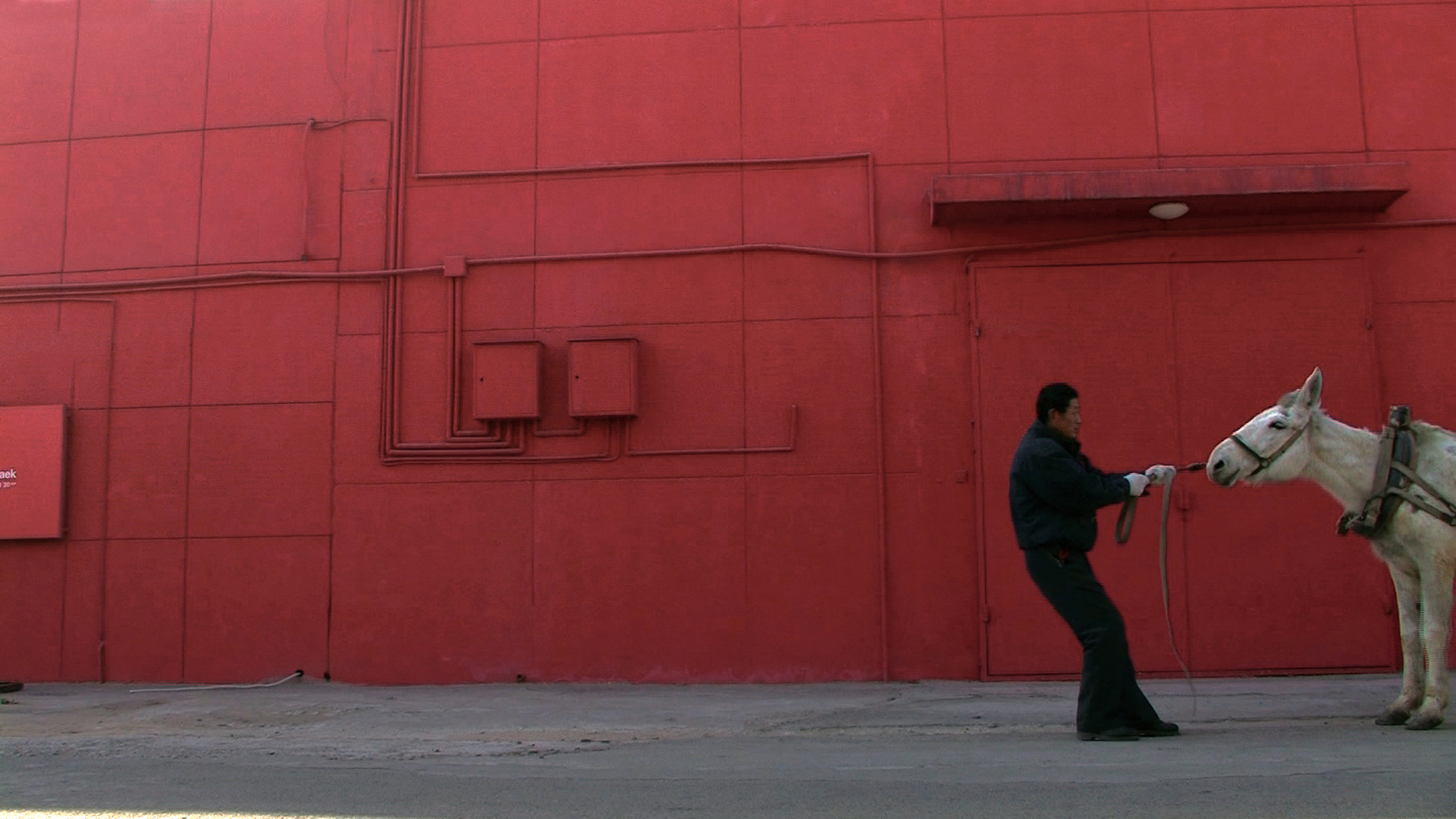
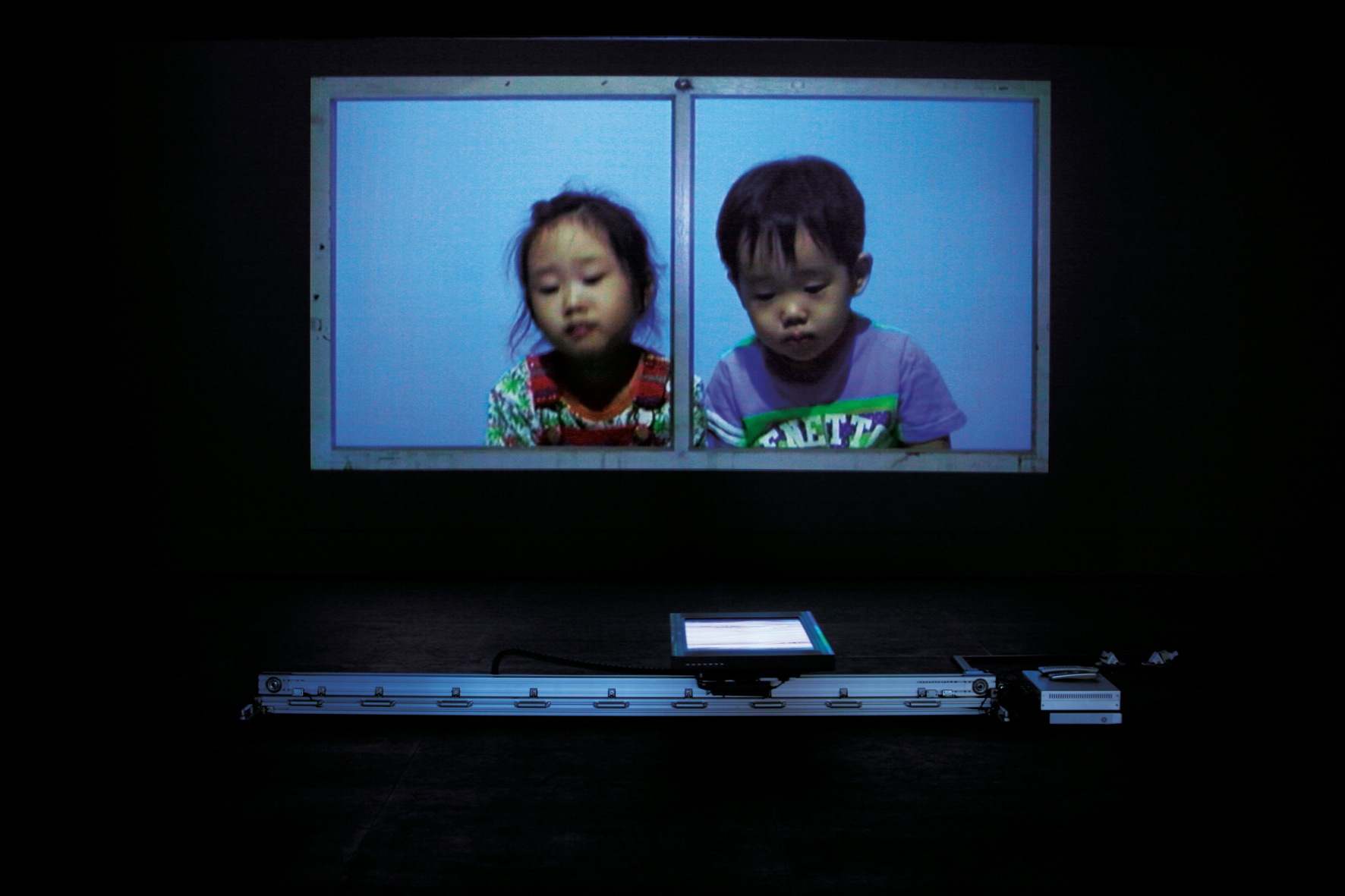
New Folder–Drag (2007) collapses the gap
between the virtual and the real. A rectangular folder icon displayed on a
computer monitor is merely an image weighing zero grams. Yet when sculpted in
artificial marble weighing 400 kilograms in the real world, dragging it
requires commensurate labor. Lee realized this idea through a performance
involving Chinese children. He has stated that through this work, he sought to
demonstrate the interaction and transformation occurring between virtual space
and real space. However, in my view, it reads as a biting satire on the gap
between digital civilization and analog civilization.
A digital folder, as a
container of signs and information, can in certain cases generate greater value
than goods contained within a 400-kilogram block of artificial marble in
reality. Folders containing information are transmitted instantaneously through
the internet, while the marble folder-shaped container must be transported
physically by human labor. It evokes the slaves dragging massive stones used to
construct the pyramids of Egypt seven thousand years ago. Lee himself confessed
in an interview that he felt apologetic toward the Chinese children involved in
the performance.
As we know, the exchange value of goods in cyberspace is
equivalent to that of currency in reality. From this perspective, the economic
exploitation of Third World nations by powerful countries through hedge funds
can be symbolized by the cyber folder. Seen in this light, the meaning of Lee’s
media art practice becomes even more amplified.
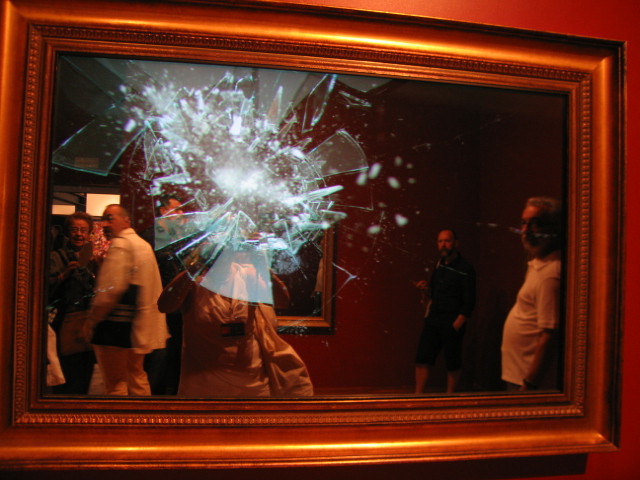
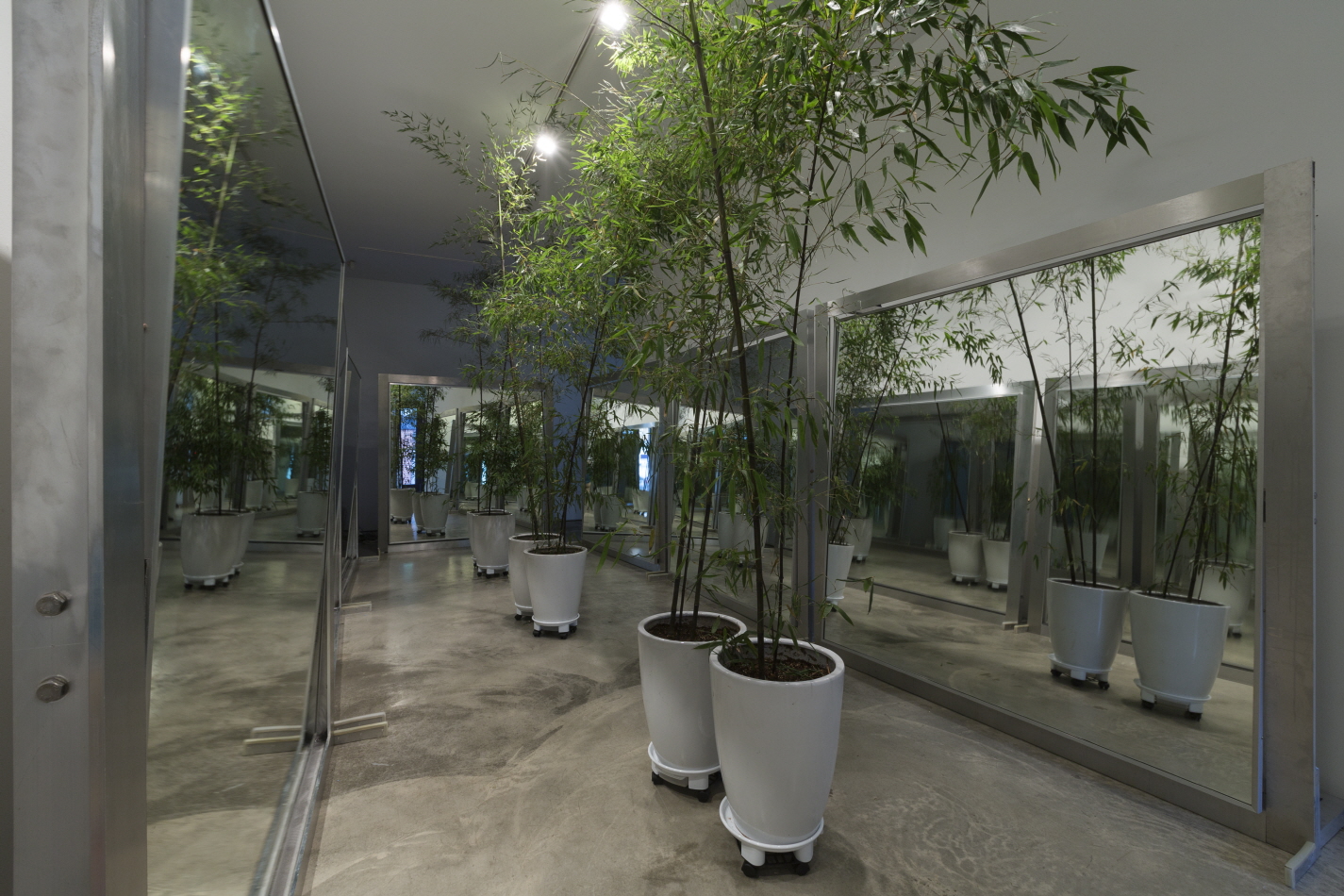
Lee’s 2008 solo exhibition at Arario Cheonan provided a valuable
opportunity to examine the breadth of his practice, as it mobilized not only
media works using mirrors but also painting and sculpture—forms often regarded
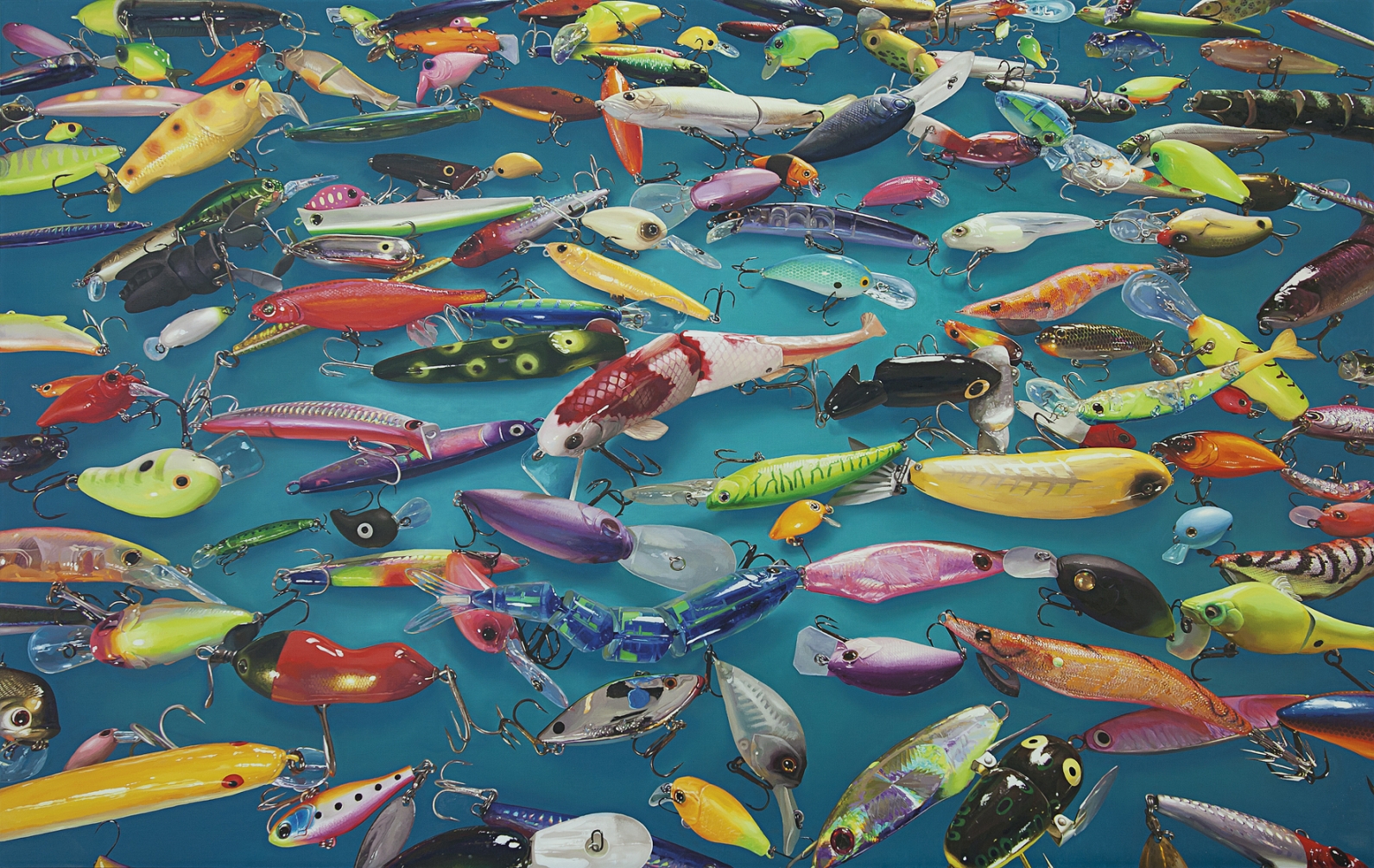
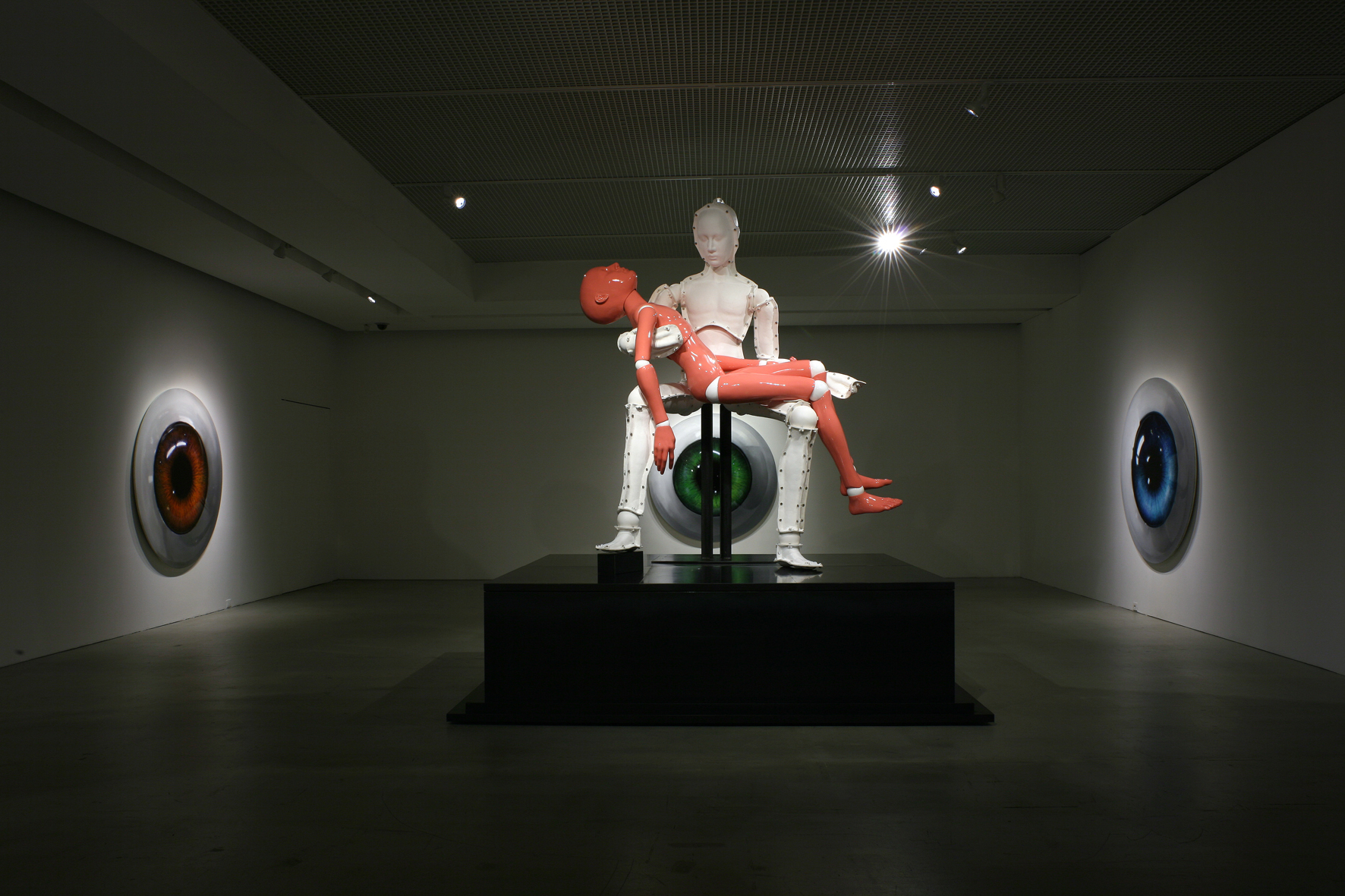
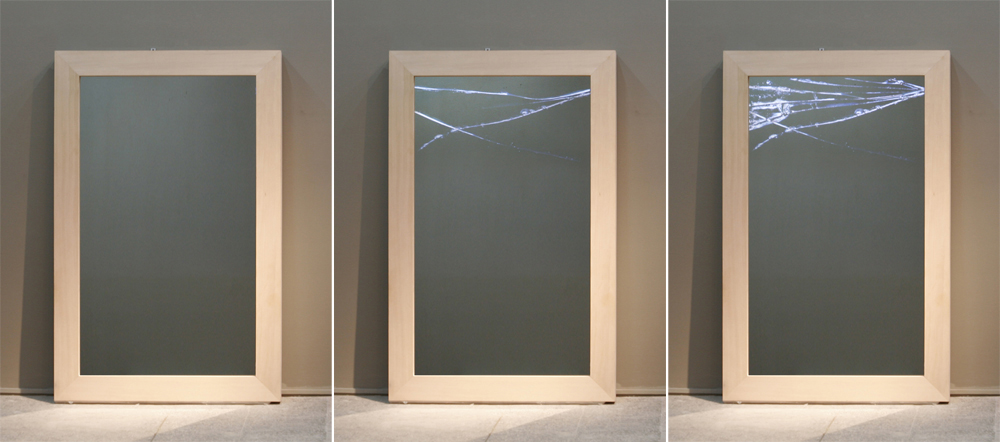
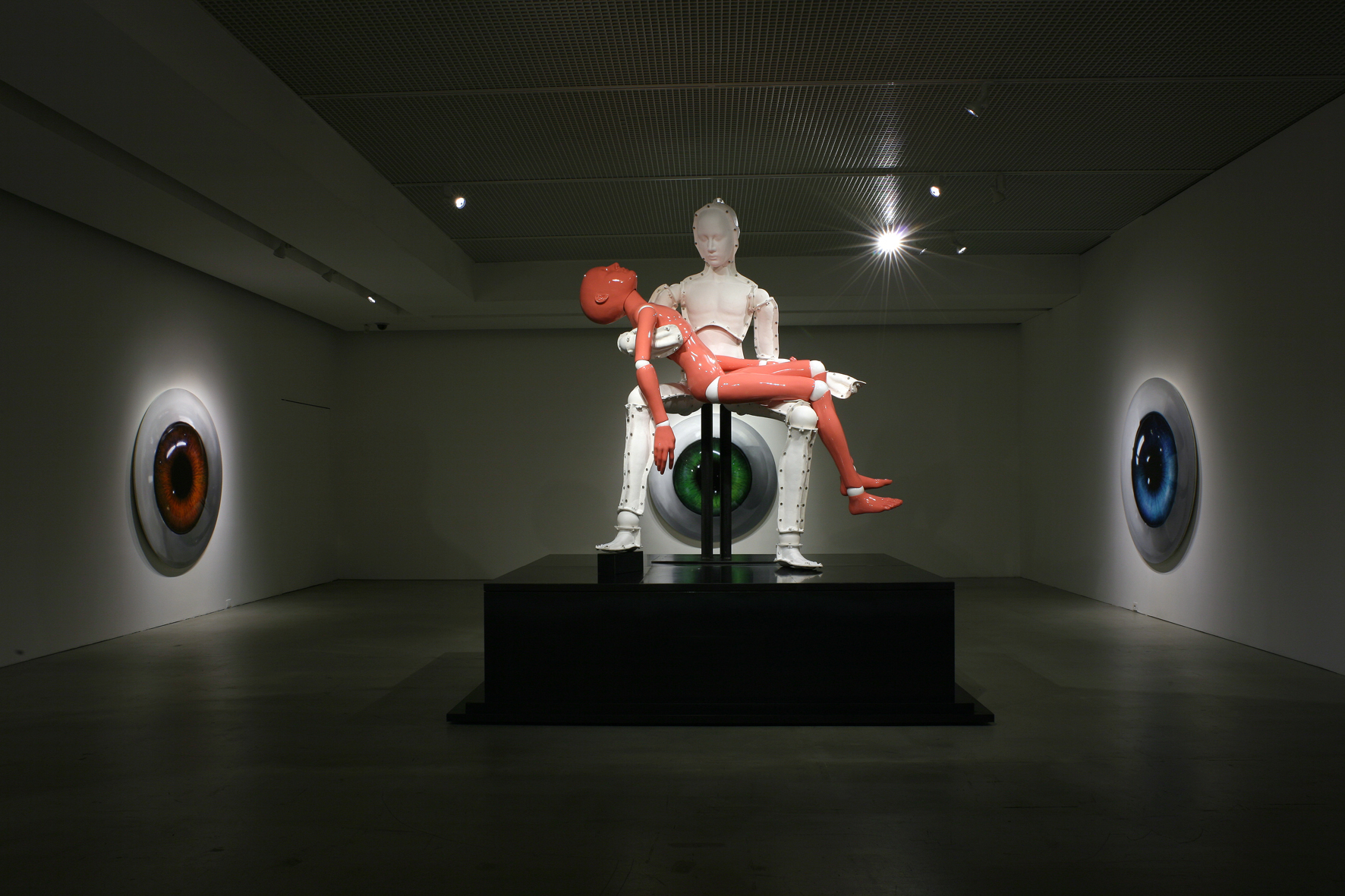
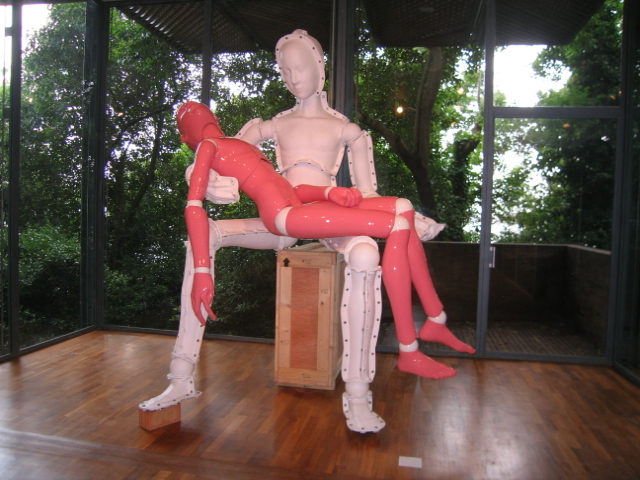
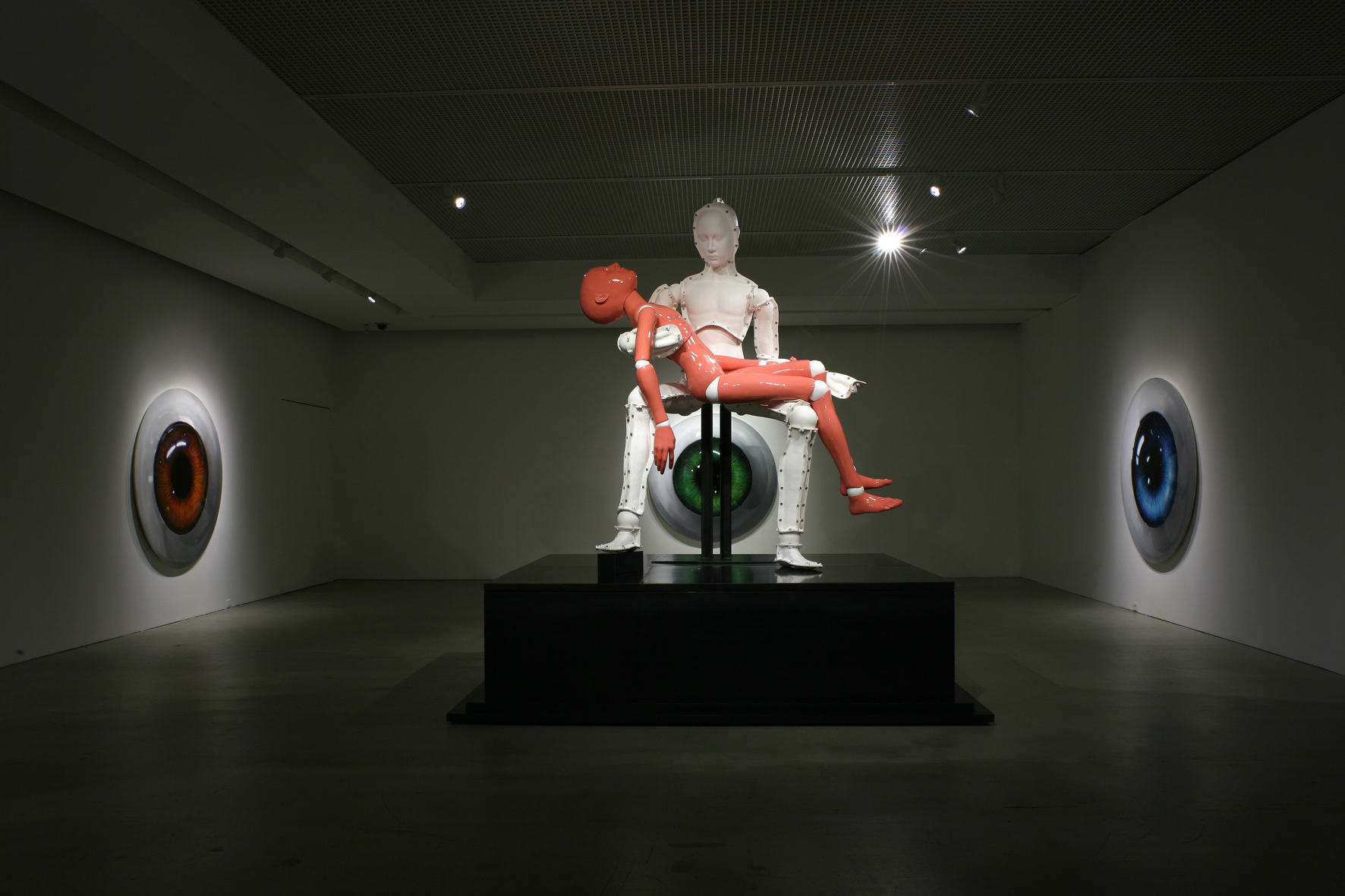
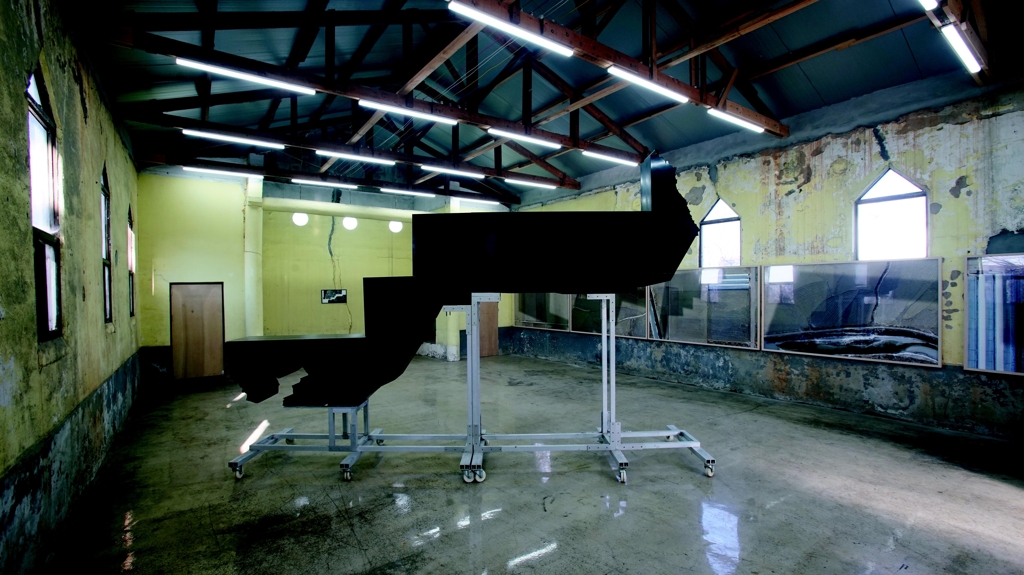
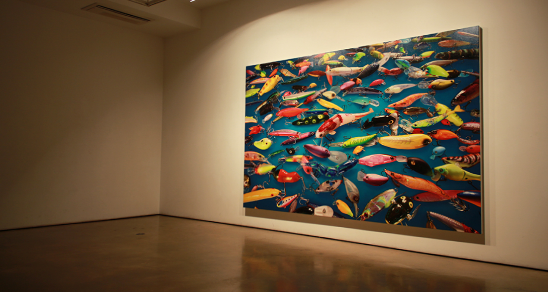
as analog genres. The exhibition featured the sculptural work Pieta,
along with paintings titled Lure and Plastic
Eye, drawing considerable attention. Pieta depicts
the Virgin Mary holding Jesus. This monumental sculpture—measuring 4 meters
high and 3.4 meters wide—repurposes the casting mold of Mary used in the
sculpting process, rather than discarding it, and transforms it into the body
of Jesus.
This unusual example of “same form, different body” merits detailed
analysis, which must be reserved for another occasion. Nevertheless,
alongside Plastic Eye—a 2-meter-diameter circular
sculptural object made of synthetic resin with a painted female eye—and the
large-scale ‘Lure’ series depicting plastic fishing bait in dazzling colors,
the work reveals Lee’s open attitude toward media. As the theme of “plastic”
implies, what Lee seeks to address may be a reconsideration of the cultural
condition represented by simulacra—that is, a situation in which it has become
difficult to distinguish between the real and the fake.
A contemporary society driven by computers and the internet easily
exposes humanity to environments where subjectivity may be lost. Cosmetic
surgery through computer simulation produces artificial beauties and leads to
the homogenization of beauty. In an age when fake beauty displaces real beauty,
Lee’s work carries profound implications. From the Busan Biennale and the
Nanjing Triennale to the recent overseas touring exhibition 《Peppermint Candy》
organized by the National Museum of Modern and Contemporary Art, Lee’s work has
attracted attention both domestically and internationally. Supported by his
open working attitude, the scope of Yongbaek Lee’s artistic practice is
expected to expand even further in the future.