Ik-Joong Kang 《The Moon is Rising》, Gallery Hyundai, 2022 © Gallery Hyundai

A Polycentric Universe

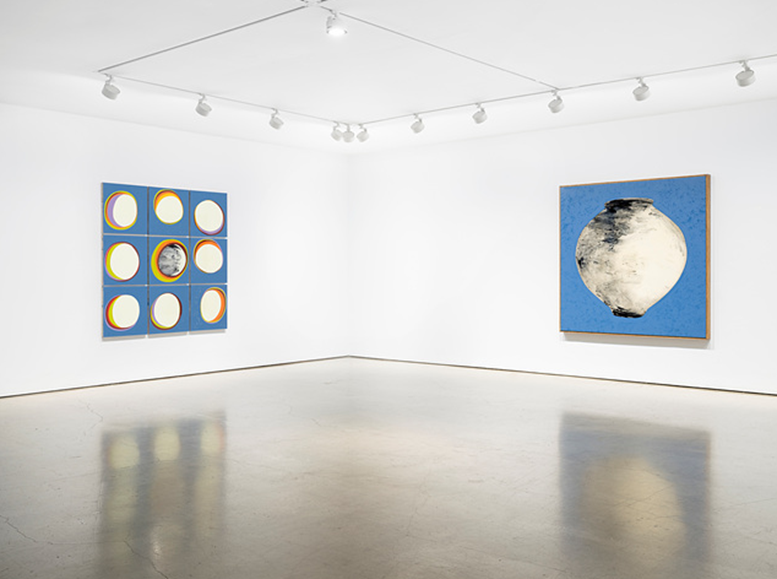
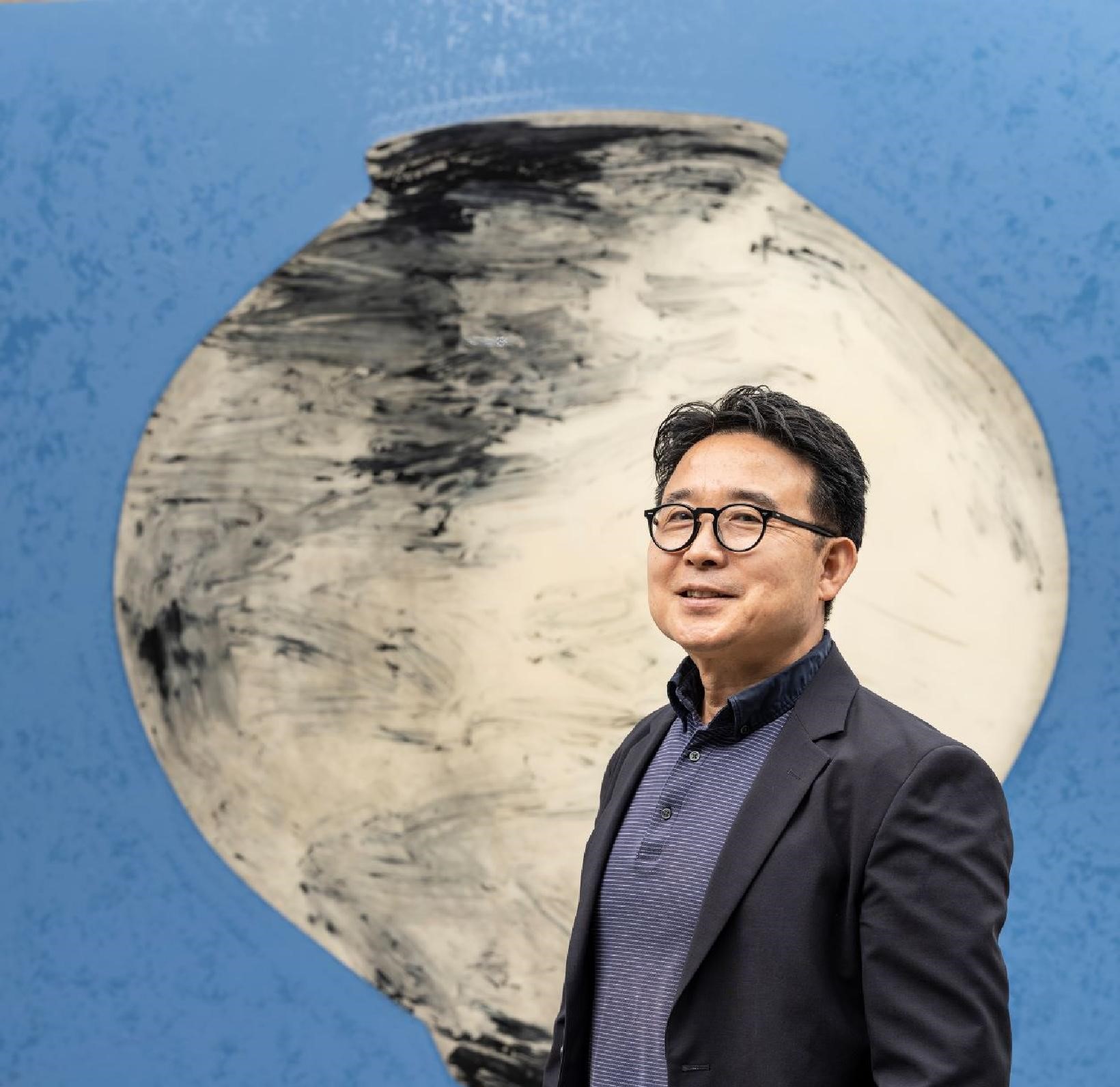
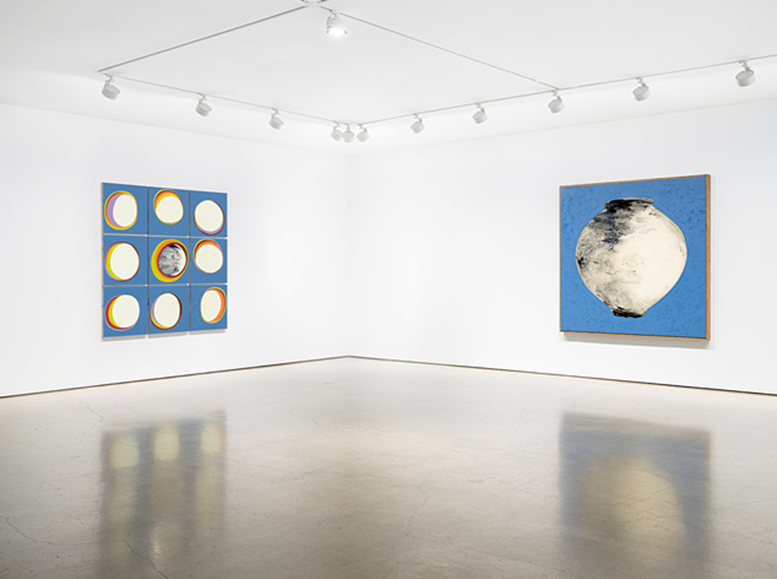
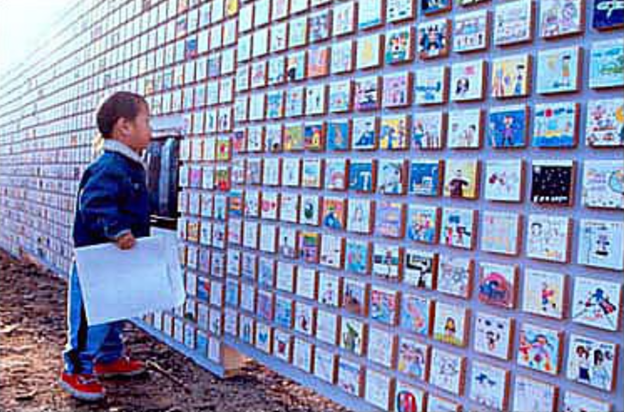
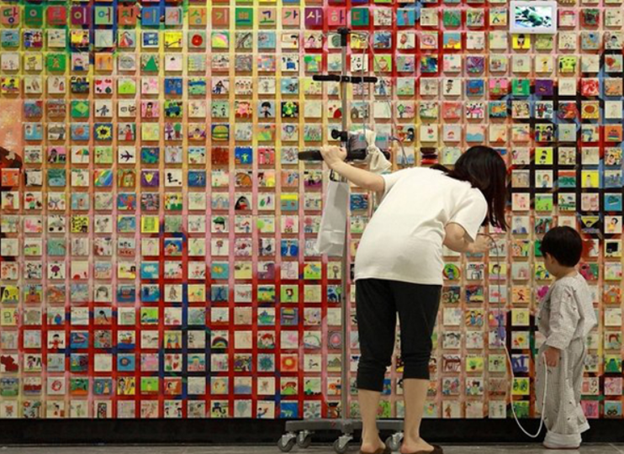
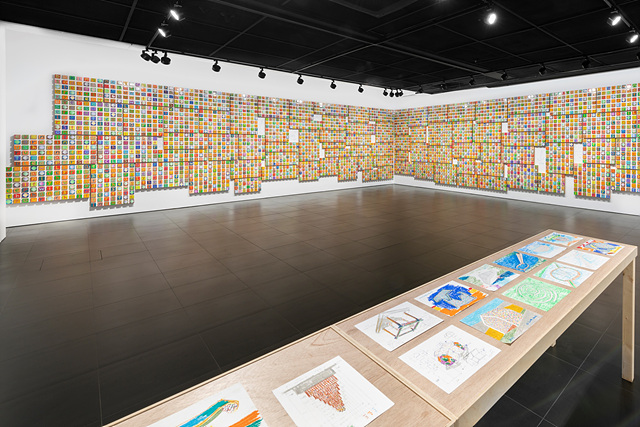
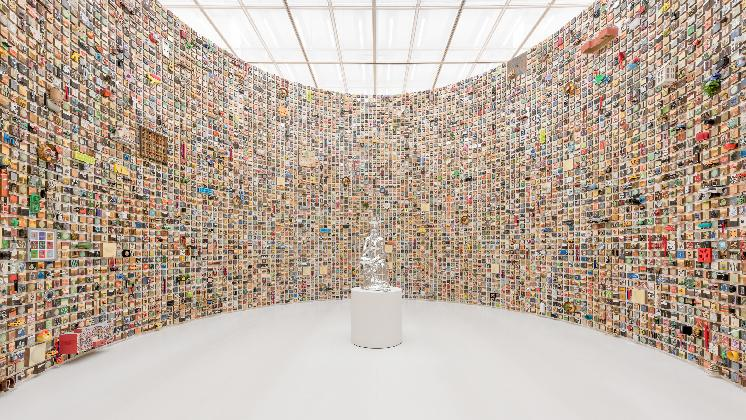
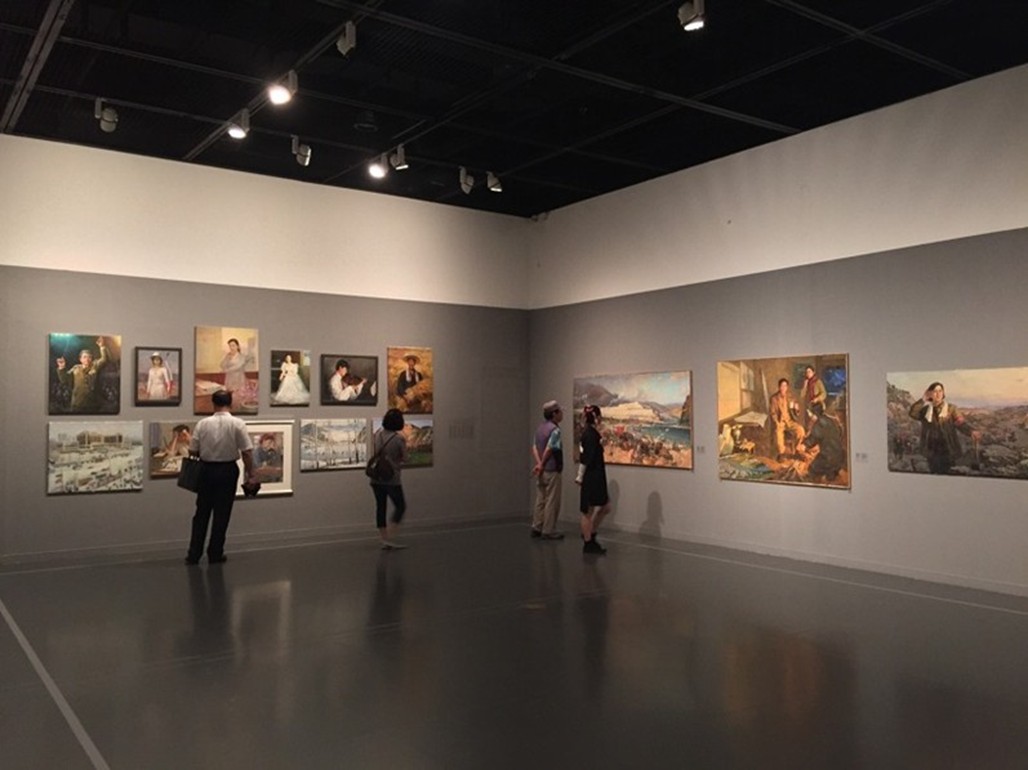
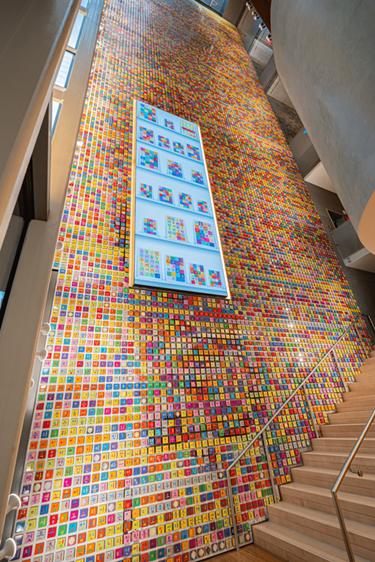
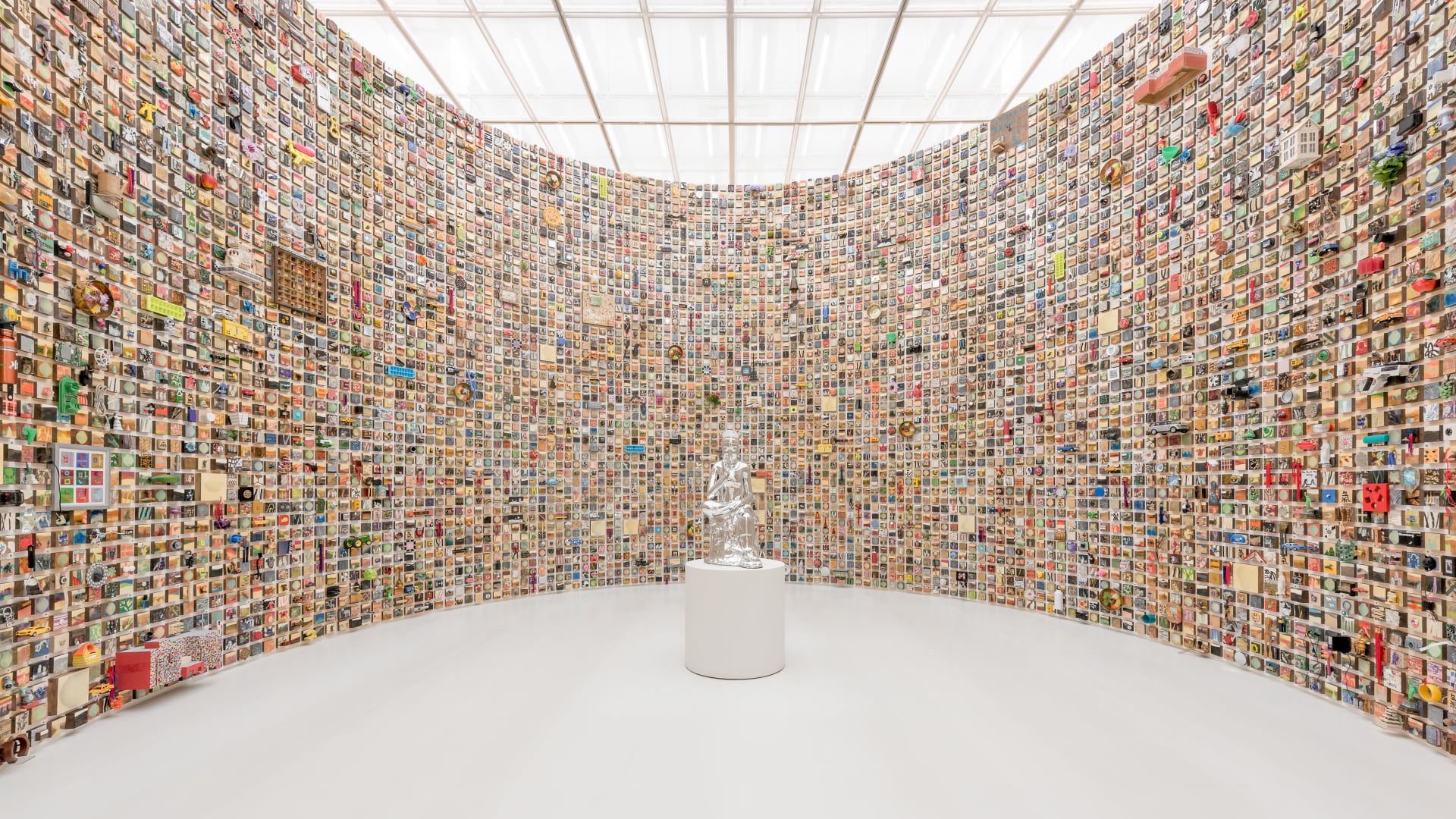
Ik-Joong Kang’s solo exhibition 《The Moon Is Rising》, held in Korea for the first time in 12 years, presented a large number of works featuring the moon jar alongside his pixel-like formal structures, prompting curiosity about the relationship between these two motifs. His works resemble microcosms contained within small squares, suggesting patterns in which microcosms gather to form a macrocosm, and intimate, hand-sized works expand into the public realm.

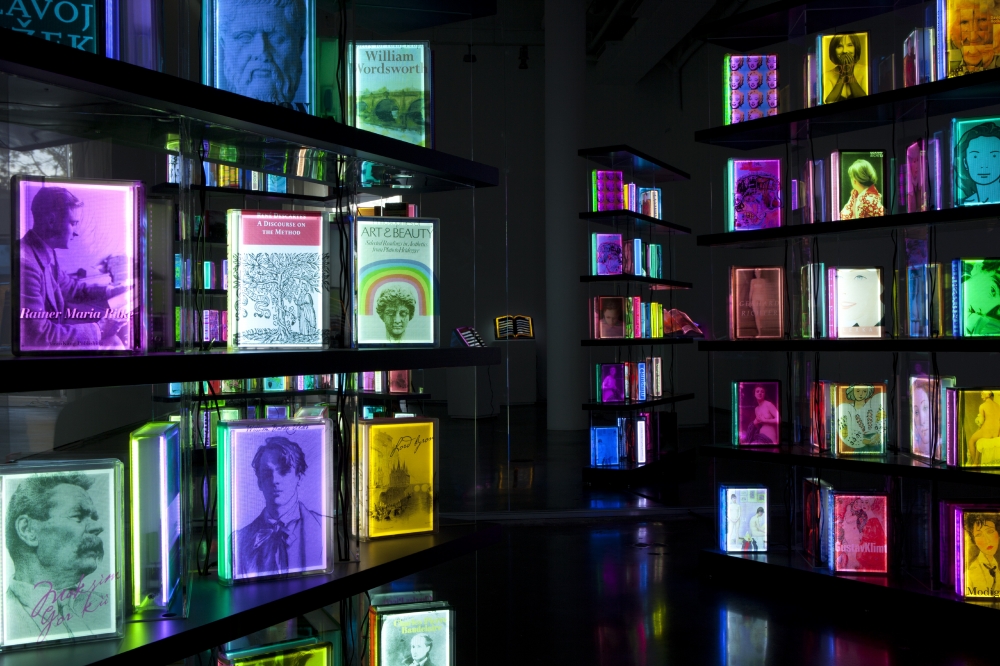
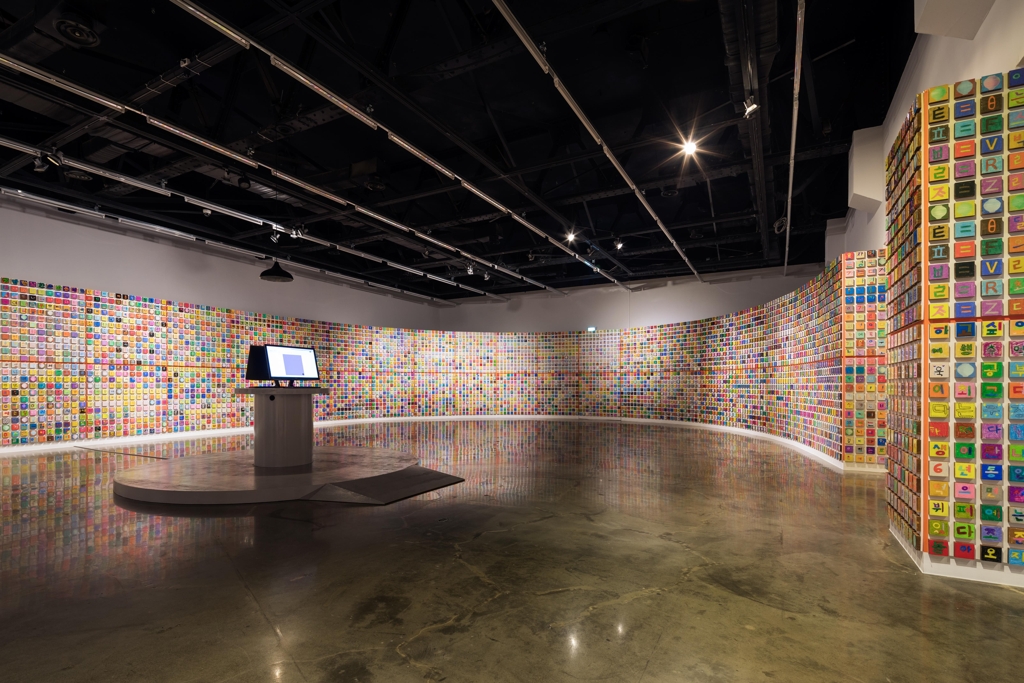
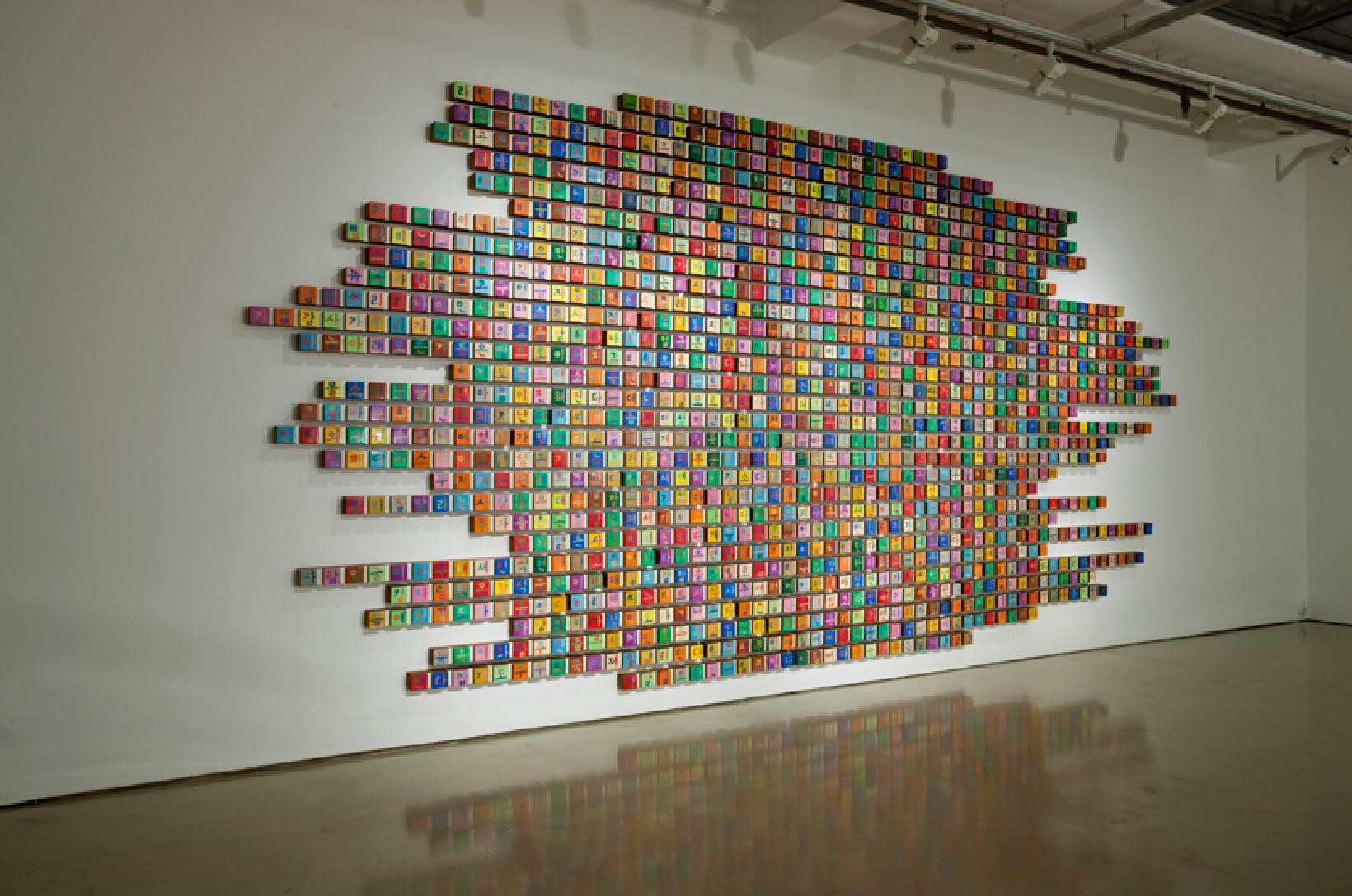
The square is urban. What is the value of a single pyeong of land in a metropolis? Works composed of countless small squares containing letters, symbols, and images evoke cities densely packed with small shops and apartment buildings. Pieces in which letters contained within individual squares form words and sentences also speak to the relationship between literacy and print culture.

Media theorist Marshall McLuhan, in “The Gutenberg Galaxy”, argued that literacy marked the end of oral culture and opened the door to modernity. When letters were combined with print—each character occupying its own fixed space—it enabled an explosive information revolution. The cube structure also becomes a landscape.

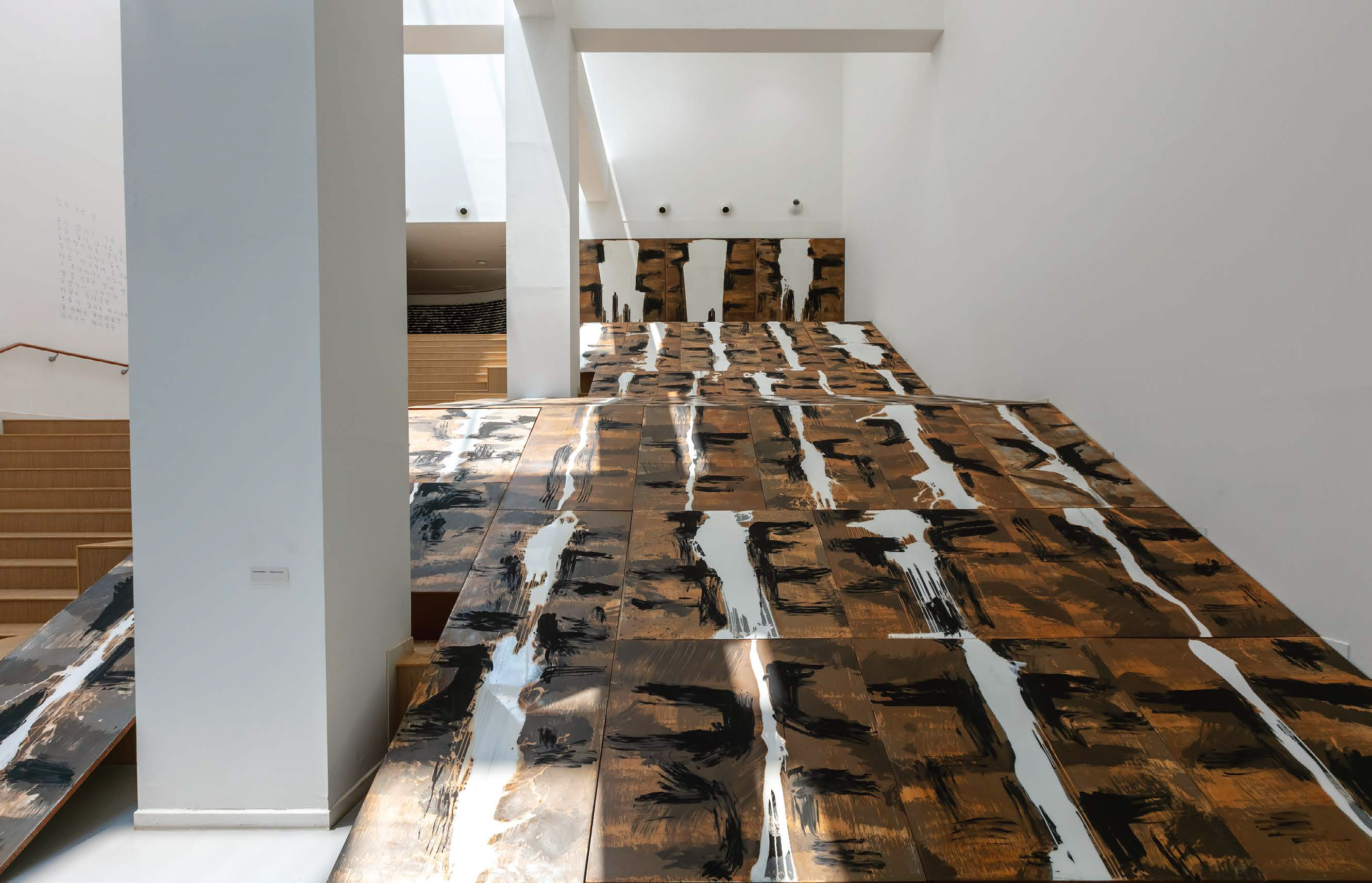
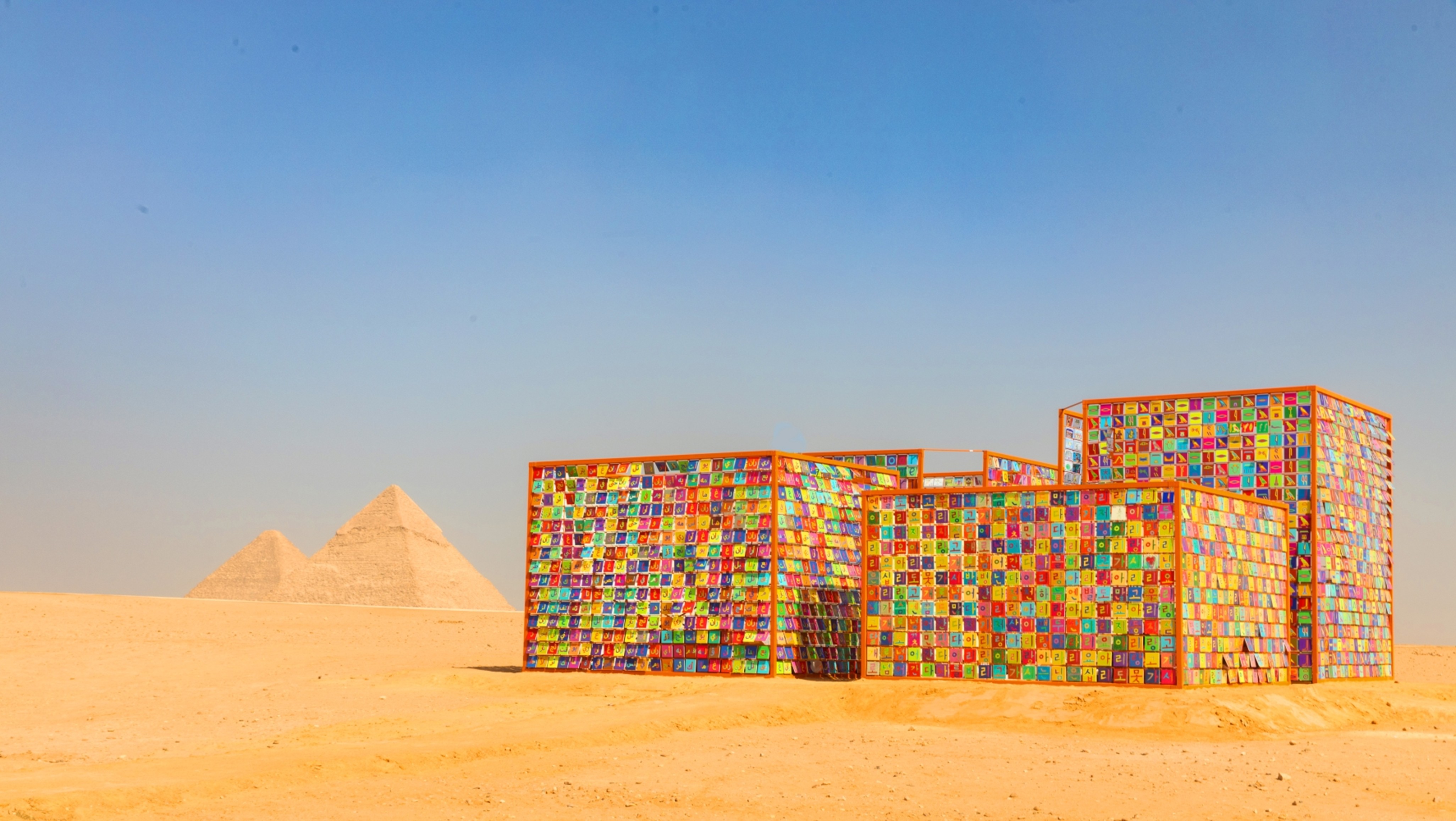
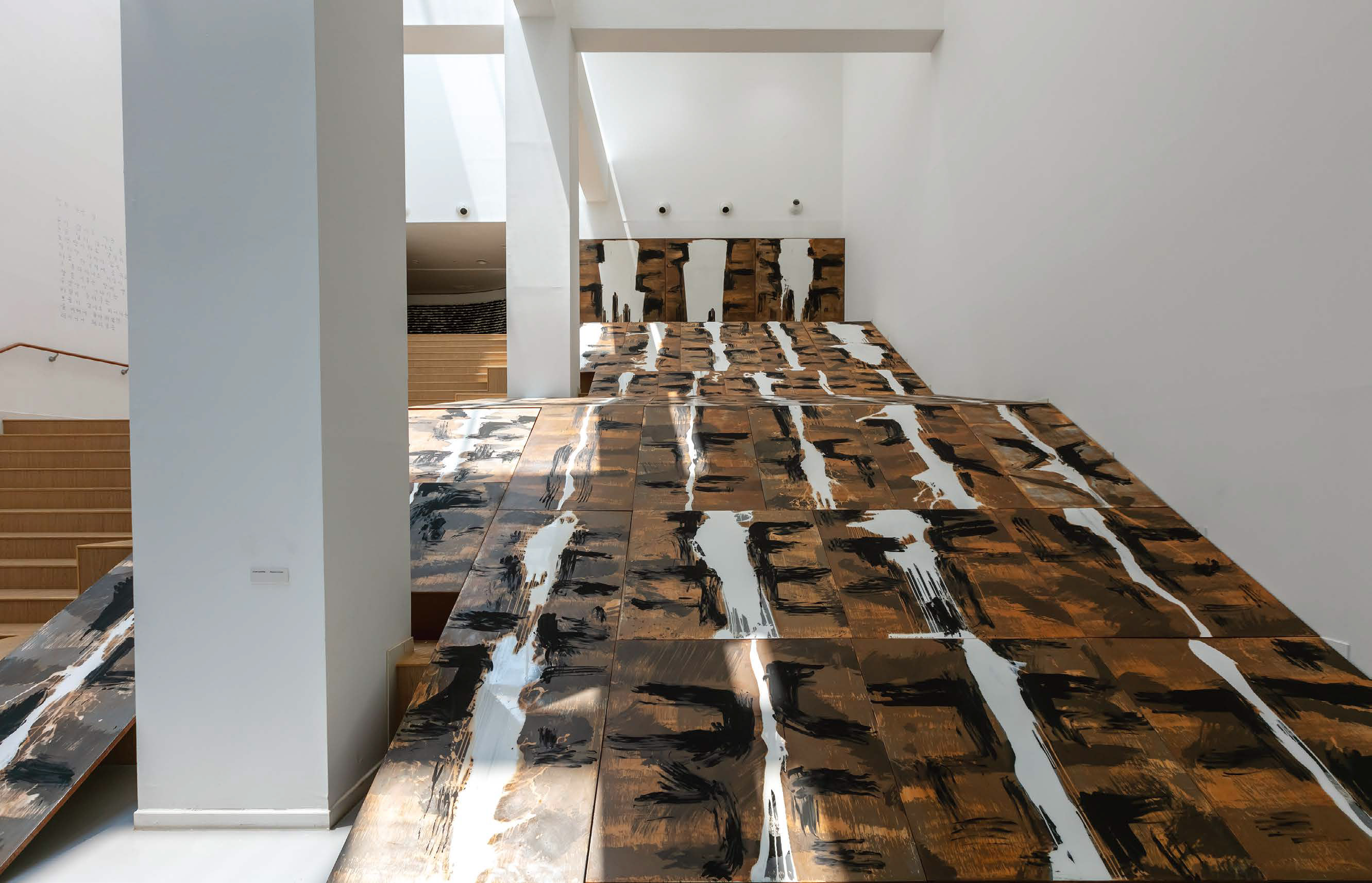
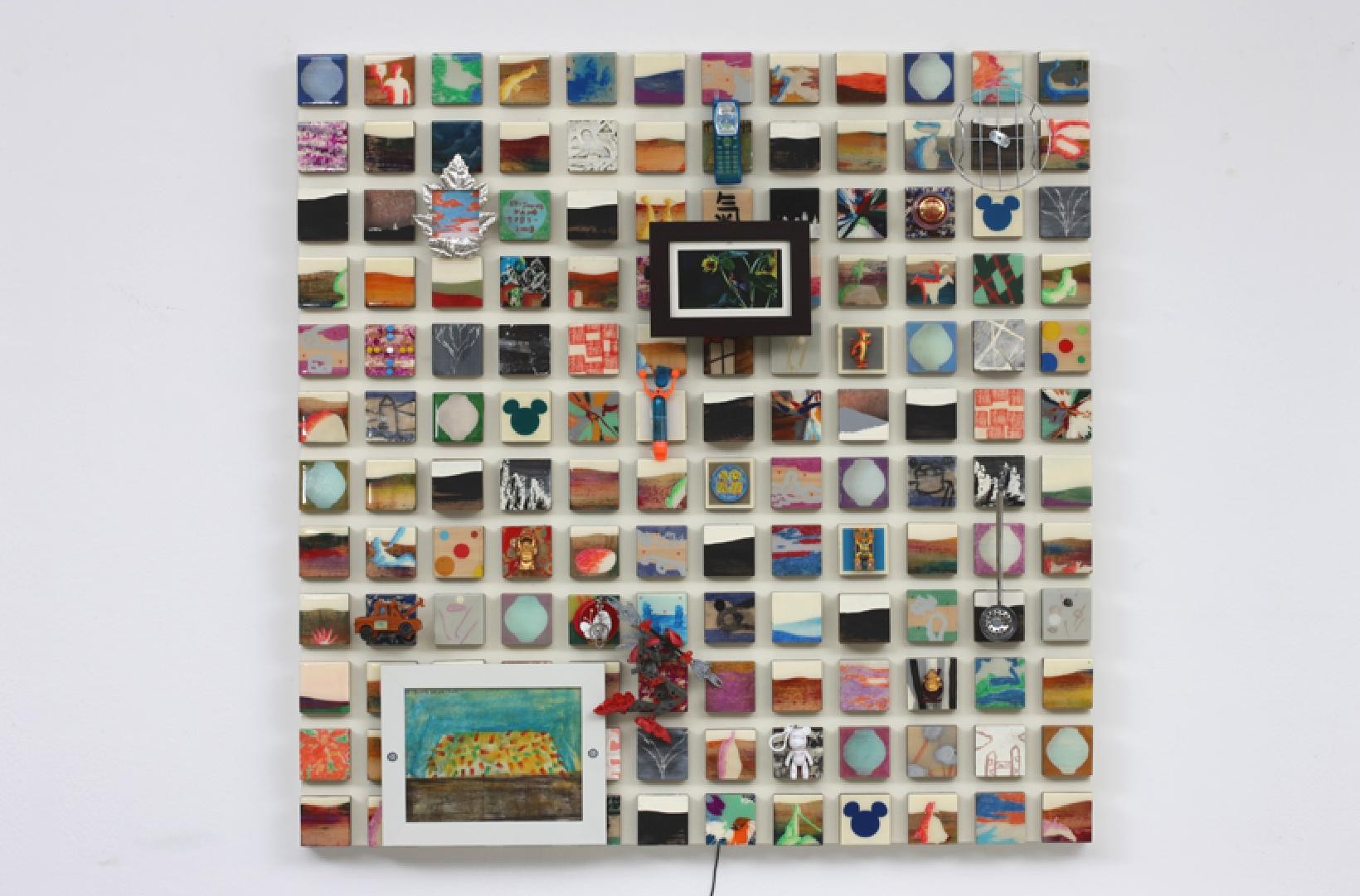
The ‘Mountain’ series places images of mountains into small 48 × 48 cm cubes, creating a striking scenery through scorched color tones. Faithful to rules devised by the artist, these works demonstrate a high degree of compatibility, ranging from palm-sized objects to environmental-scale installations.

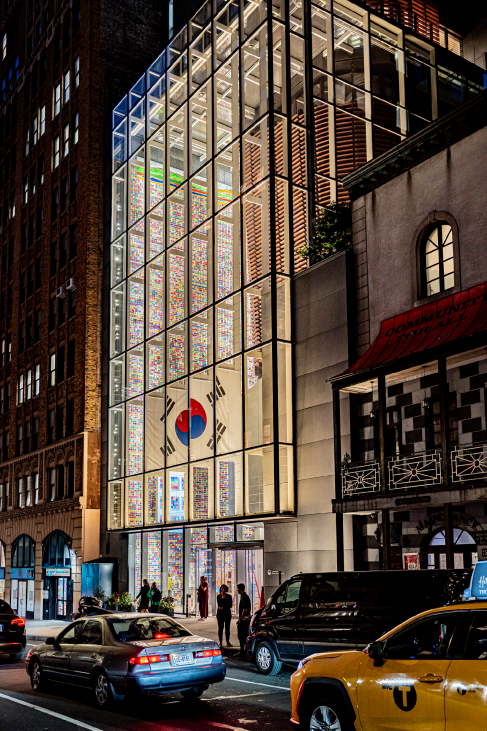
For example, Gwanghwamun Arirang (2020), installed in Gwanghwamun, appears as if a massive cube is rotating. The driving force behind the rotation of the cube is harmony. For an artist who once existed as an outsider at the center of multicultural environments, coexistence must have been not merely a value but a matter of survival.

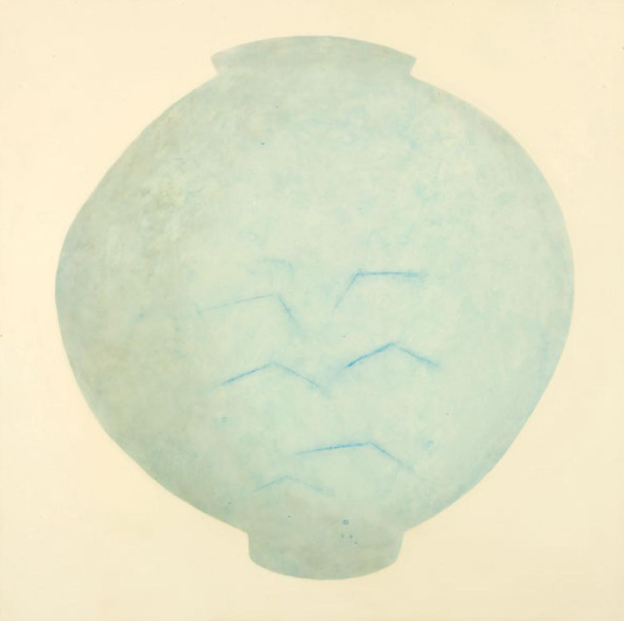
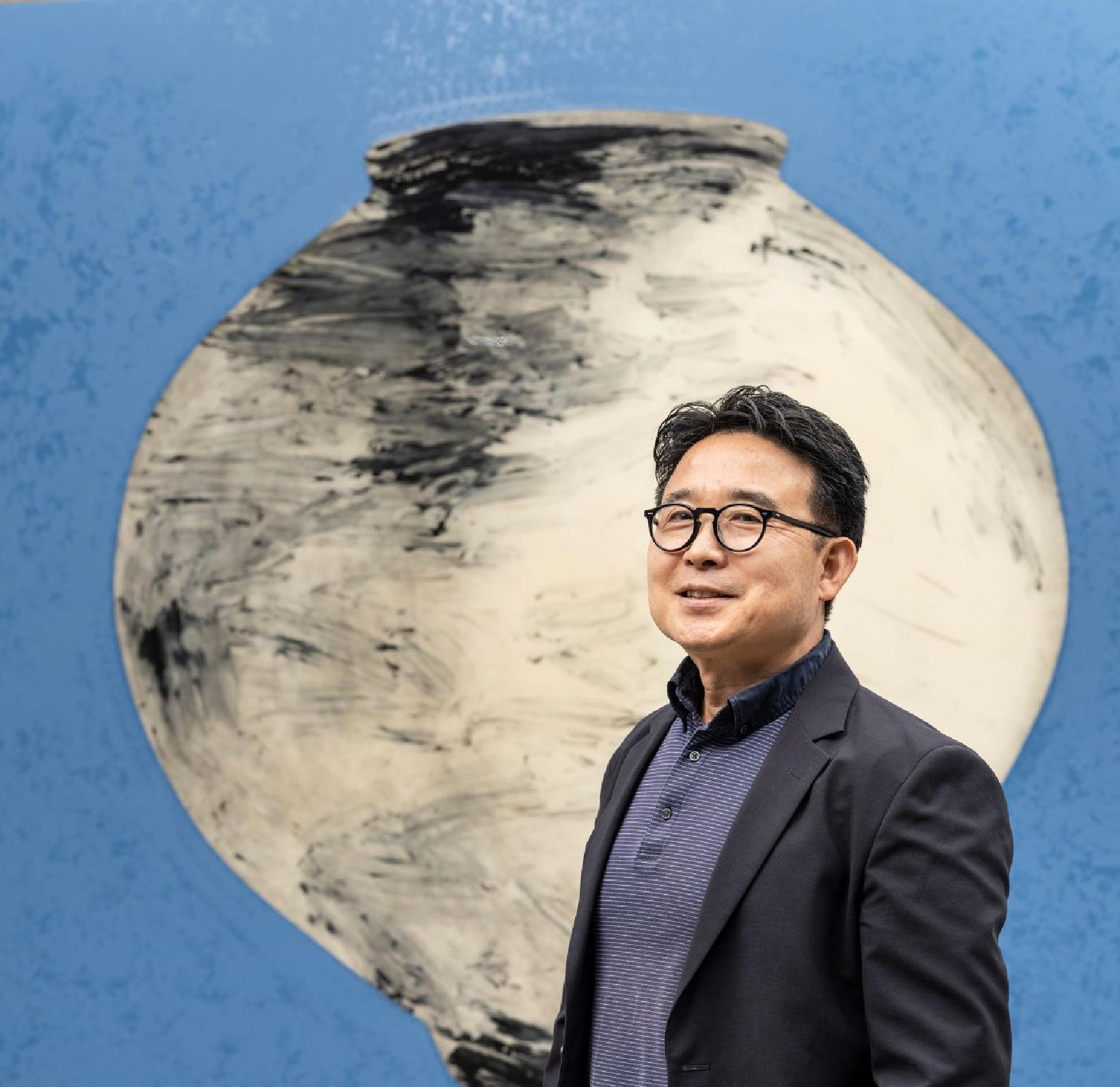
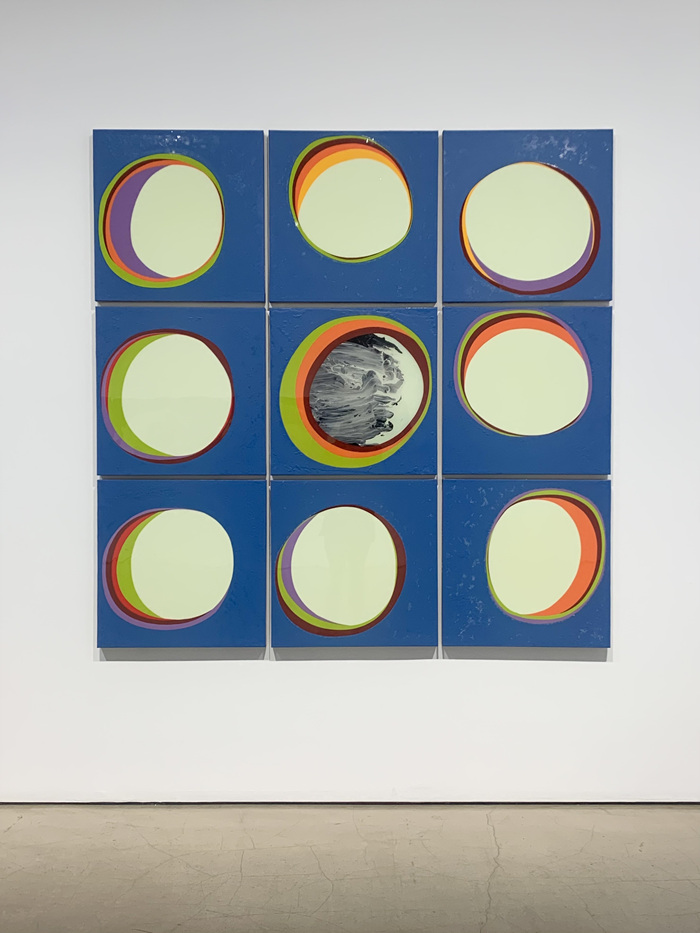
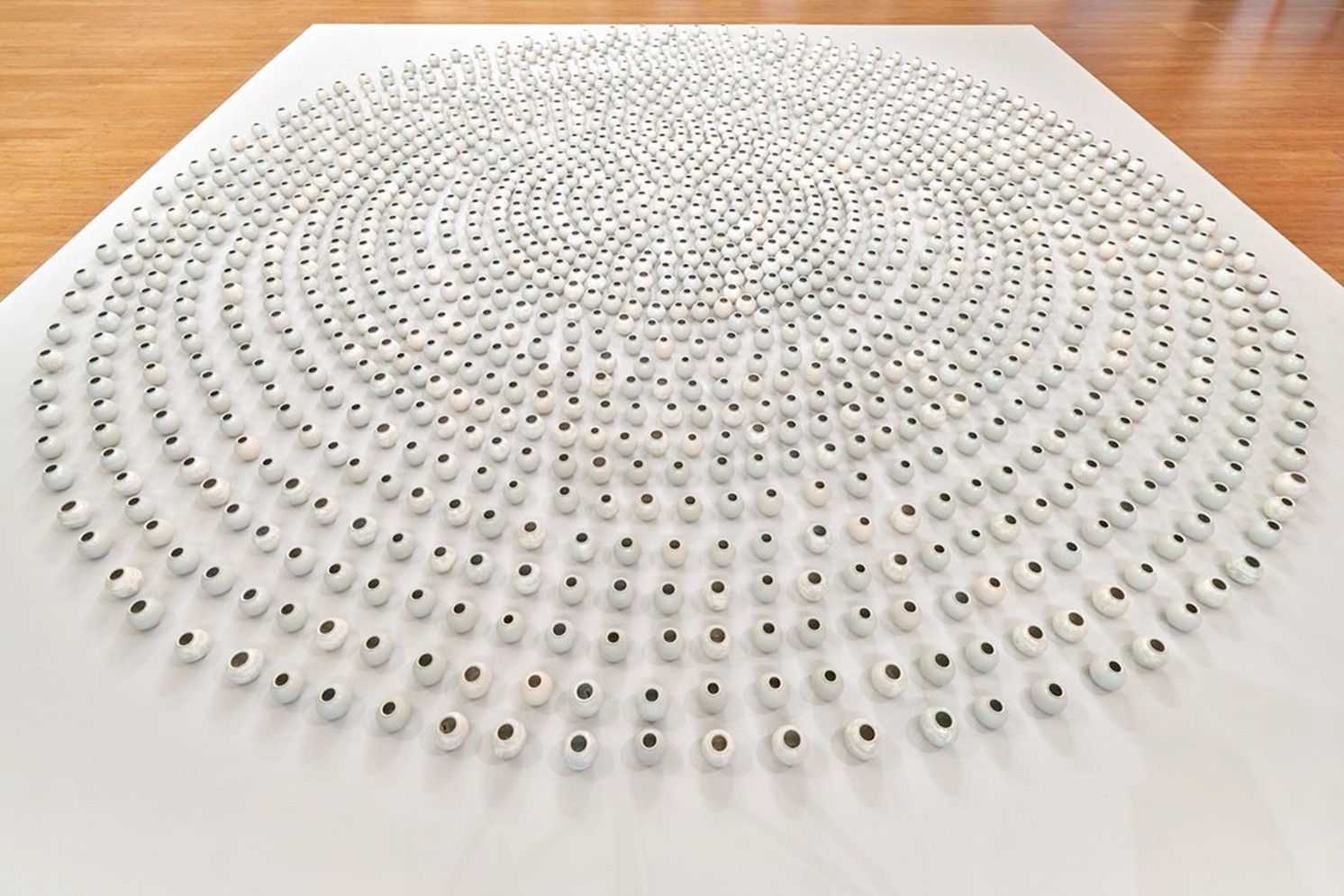
Unlike the cube, the moon is an ancient natural presence that predates cities. Its fundamental shape is round. A circle has no beginning or end; it symbolizes connection even more strongly than a square. Squares and circles, like mandalas, stabilize the center of the mind. As seen in the ‘The Moon Is Rising’ series, which dynamically depicts the moon’s shifting phases, the moon jar—never perfectly symmetrical—returns while subtly shifting its center. Sensitivity to small fragments is projected onto the moon.

Compared to the sun, the moon is incomparably small. While the sun remains constant, the moon changes. They contrast a fixed center with a mutable periphery. In the history of science, supporting heliocentrism rather than geocentrism once rendered one a heretical scientist. Humans harbor a deep-seated preference for a single center.

When secular power seeks to appropriate that sanctified center, philosophies of dispersed centers become blasphemous. The process of organizing the polycentric into a single center and imposing hierarchical order contains deep divisions beneath its apparent unity. Connection and coexistence paradoxically begin with division.

In Kang’s works, small units bearing individual letters gather to form sentences, joined by the iconography of the moon. Here, the moon functions visually as a pause. The artist also emphasizes the moon as a gravitational center influencing water’s dynamic movement.

The moon was the celestial body Newton considered when formulating the law of universal gravitation. In his biography “Isaac Newton”, James Gleick notes that Newton emphasized the meaning of “to gravitate” (to be drawn toward) rather than Aristotle’s notion of heaviness.

Gravity is the moon’s pull toward the Earth. All celestial bodies possess their own weight, drawing one another through it. Newton demonstrated gravity as a universal law of the cosmos, through which harmony among differences becomes possible.

The prerequisite for connection and coexistence in Kang’s work is the recognition of each world in its own right. At this point, the artist diverges from political economy. Artists have long been regarded as idealists. Kang’s poetic phrase “If you look at the moon, it will come true” reflects the hope embedded in his practice of linking.


Ik-Joong Kang 《The Moon is Rising》, Gallery Hyundai, 2022 © Gallery Hyundai

If You Look at the Moon, It Will Come True

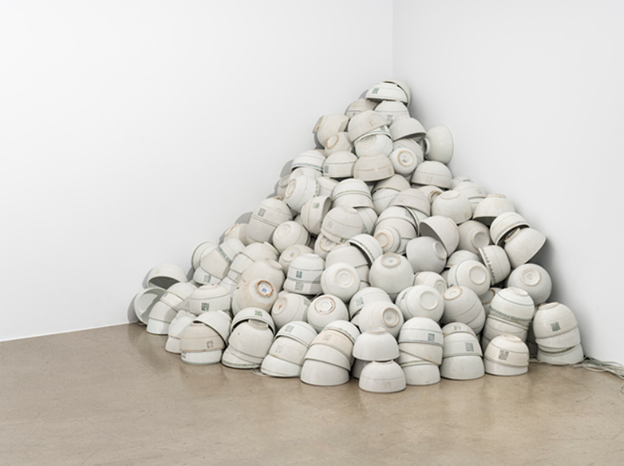
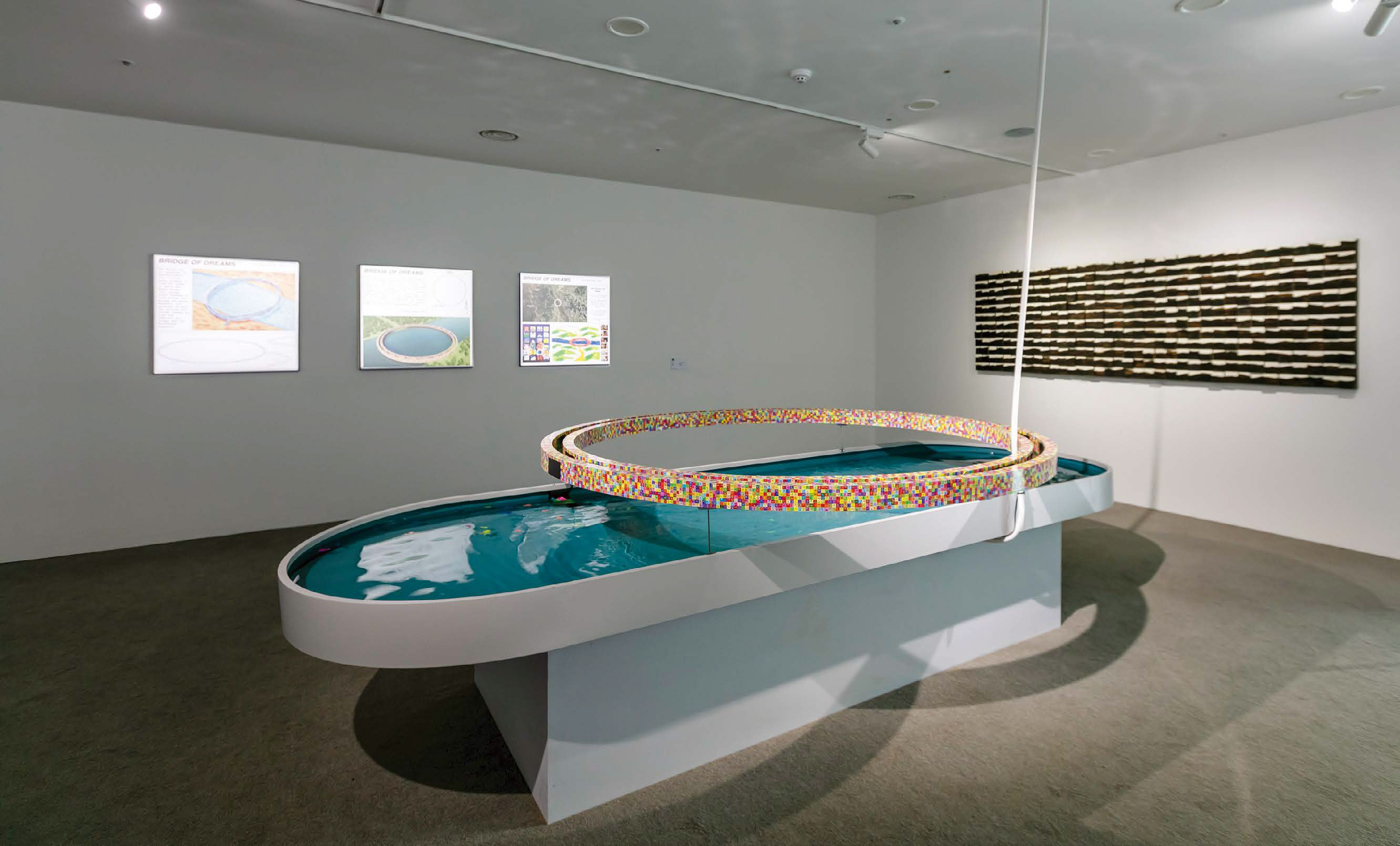
The installation We Are One Family, featuring five hundred stacked rice bowls in one corner of the gallery, connects the artist’s ideal of coexistence to the issue of division. Accompanied by recordings of birdsong captured in the DMZ, the work conveys hope from the world’s only divided nation. Kang’s frequent use of equal-sized units leans closer to equality than freedom—yet freedom, too, must be grounded in equality.

Unlike the day ruled by the sun, night weakens a distorted rationalism that forces a partial reality to stand for the whole. Under moonlight, people become romantic—more integrated. Nam June Paik, who collaborated with Kang, foresaw the future-oriented value of the ancient moon early on.

In works where alphabets form sentences in this exhibition, Paik’s words also appear. Archival materials from 《Multiple/Dialogue: Nam June Paik and Ik-Joong Kang》 (Whitney Museum of American Art, 1994) show Paik’s television monitors alongside Kang’s tile-like wall works, conveying messages of coexistence and dialogue through diversity.

“More is better” (dada ikseon) aligns their work with philosophies of the monad and the multitude. In Kang’s work, individual fragments are not organic parts subordinated to a totality. Dictators favor mass spectacles like card-section performances, where the conductor reproduces centralized power. Kang does not assemble unit structures to produce a dominating whole image. In his poem titled Things I Know, he even writes, “Very little is truly necessary,” rejecting the dogma of organic functionalism that breeds totalitarianism.

From the observer’s standpoint on Earth, the moon’s status is not inferior. Visible from anywhere, it evokes thoughts of home. The swirling, liquid brushstrokes inside and outside the moon jars further suggest the moon’s control over Earth’s waters. Like the sun, the moon profoundly shapes human life.

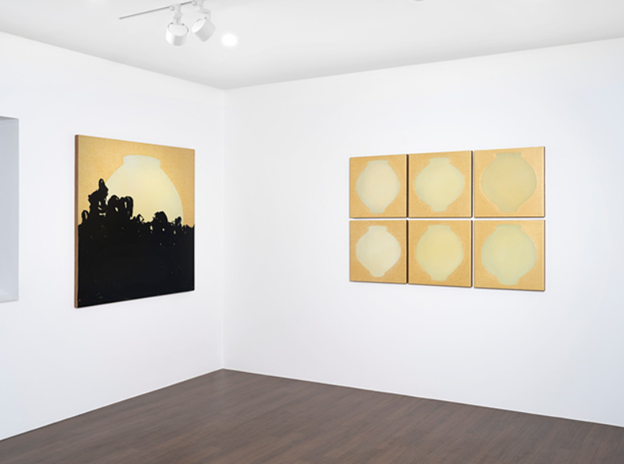
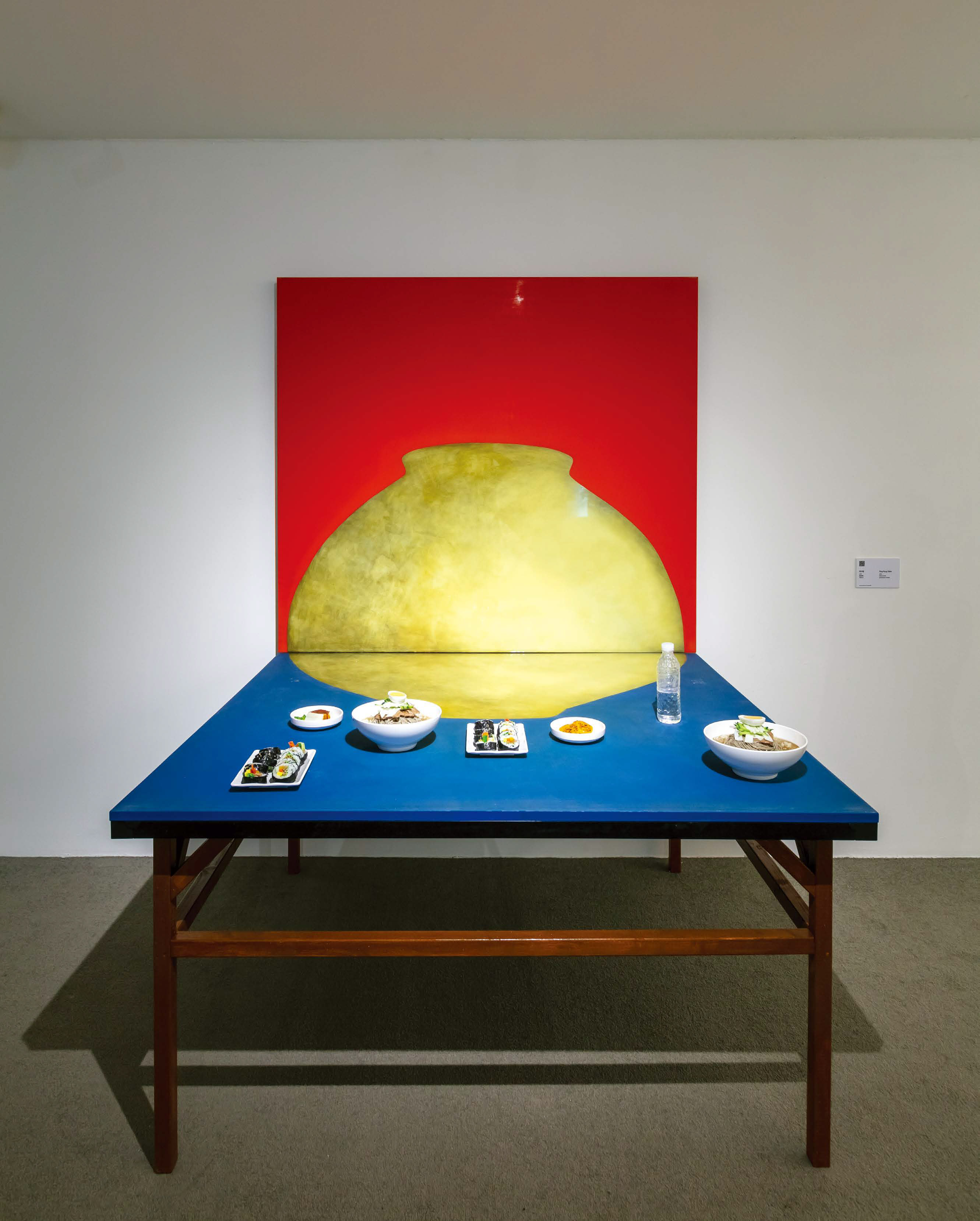
《The Moon Is Rising》 is not merely a depiction of a natural phenomenon but speaks to a paradigm shift symbolized by the moon. While art may be a powerful language for approaching nature, it is not nature itself. The moon jar Kang chooses is an artifact that seems to cradle the moon. He does not throw moon jars nor depict them traditionally; instead, he renders them pictorially, with surfaces gleaming like ceramic. For Kang, the vessel capable of containing everything remains painting.

The moon enters the flat plane through multiple stages, coexisting with letters. Moon jars appear among alphabetic characters, occupying spaces akin to spacing between words. They become pauses or punctuation marks—moments of rest or shifts in rhythm. In an atomic universe composed of particles, they function as invisible yet essential voids. Without spacing, sentences are unreadable. Yet contemporary society’s densely packed unit structures increase risk while lacking the spaces truly necessary for meaning to circulate.


Ik-Joong Kang 《The Moon is Rising》, Gallery Hyundai, 2022 © Gallery Hyundai

The Necessity of the Void

Void is a form of margin and a safety device. It is a site of communication and new generation. Using the same words, some sentences merely designate, while others become poetry. Everyday language communicates; poetic language exists while communicating. When letters are treated sculpturally, readability decreases while the material presence of language intensifies.

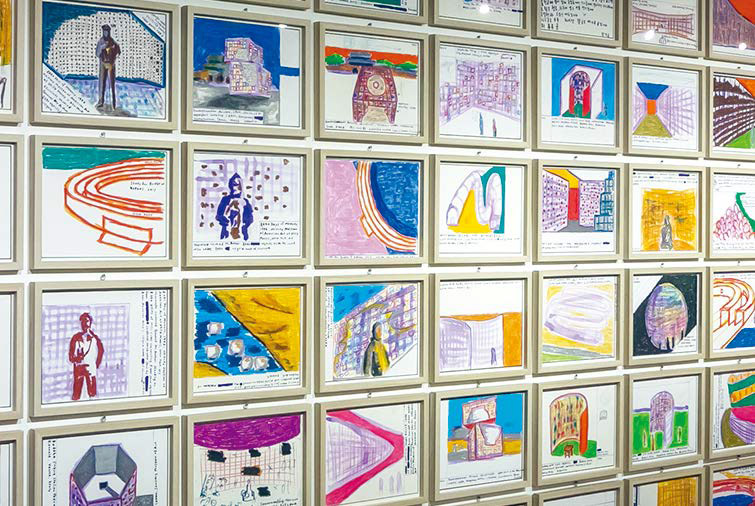
Small handwritten works displayed in the basement gallery resemble diaries or notebooks—precious, personal records made with drawings and colored pencils. Kang remarks, “The best smell is the scent of a book cover just bought at the stationery shop in front of a school.” The ‘The Moon Is Rising’ series borrows the format of landscape painting, freely coloring mountains, fields, moons, water, birds, dogs, people, and houses in oil pastels of various hues, evoking children’s innocent expressions. Within the playground of rules he sets himself, he is completely free.

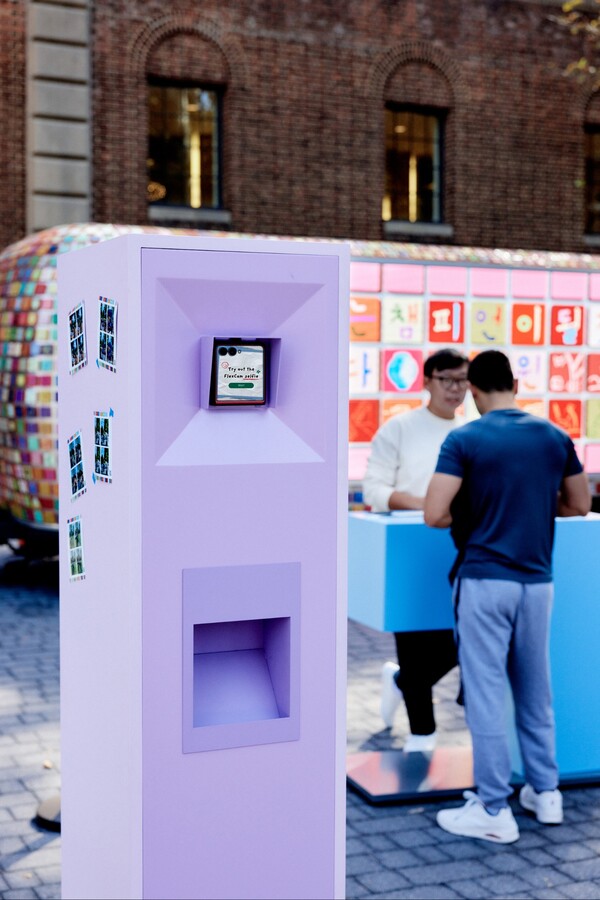
These awkwardly expressed works suggest that such freedom is not the artist’s exclusive privilege. Kang’s public art frequently encourages participation. Archives presented alongside the exhibition reveal preliminary sketches for public projects staged worldwide since the 1990s. These unpublished materials were also conceived on notebook-like paper. His work is deeply rooted in analog sensibility. An essential element of the coexistence and harmony he seeks is the relationship between analog and digital cultures.

Kang’s method of assembling large works from small units emerged from the constrained circumstances of his student life in 1980s New York, when study and part-time jobs left him only fragments of time. He carried small canvases in his pocket, working whenever possible. He still cherishes the significance of these small works, which continue to be reread in new contexts.

That both the alphabet and Hangeul are scientifically structured, easily combinable languages enabled his wordplay to achieve both communication and form simultaneously. Had they been ideographic systems, such freedom of combination would have been difficult. Though moon jars might seem suited to pictographic scripts written in a single stroke, Kang nevertheless combines them with mosaic-like unit structures.

In the separate exhibition space at Dugaheon, moon jar paintings place the moon jar at the forefront while pixel forms recede, transforming it into a hollow void at the center—like a vast park within a dense city. In Kang’s paintings, the moon jar becomes a stage for free-floating icons of houses and people. Traditionally, ceramics bear skies and landscapes; the unpainted moon jar instead becomes a playground where humans and nature freely coexist.

References